@fuchsi @[email protected]
> Nope, you ignored that I answered it
If I misplaced a comment of yours in this long (and hard to read, due to blocking - happy to reverse that at any point) thread, I do apologise. It's not intentional, and you can swiftly rectify the situation by linking to the comment I missed.
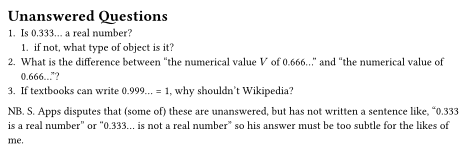
I asked the question here: https://ioc.exchange/@FishFace/116317586606785481 and as far as I'm aware you haven't replied. Please do tell us whether recurring decimals like 0.999... are real numbers - feel free to link to somewhere you said this if you already did. But to be clear, it's a yes-or-no question: a mathematical object either is or is not a real number. Whatever your answer is should be obviously an answer, when we read it.
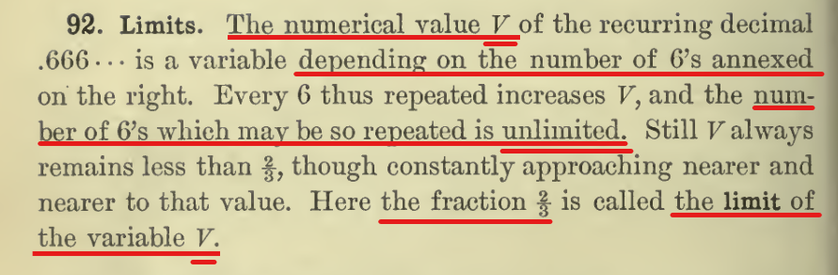
And of course we still await your explanation (always sad to be proven correct) of the difference between the sentences "the numerical value V of 0.666..." and "the numerical value of 0.666...". If there is no such explanation, you might wish to consider retracting your outrage at my omission :)
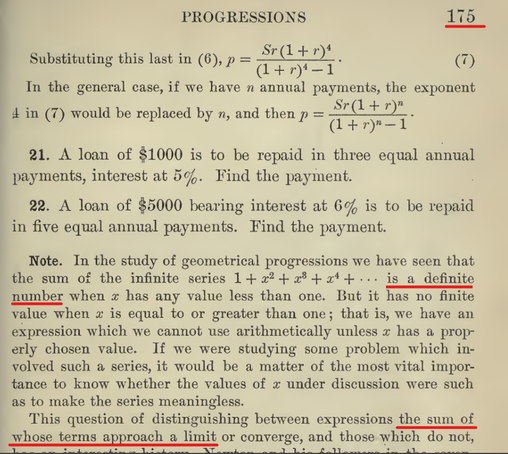
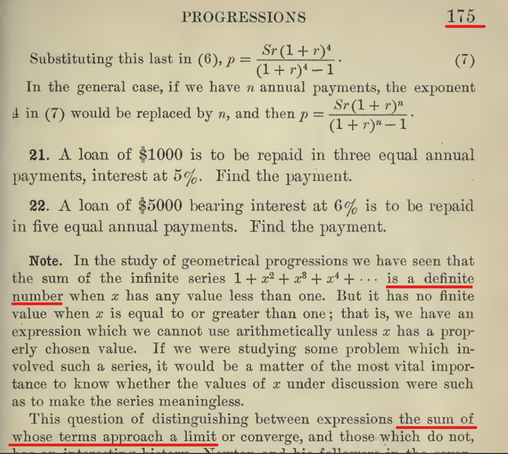
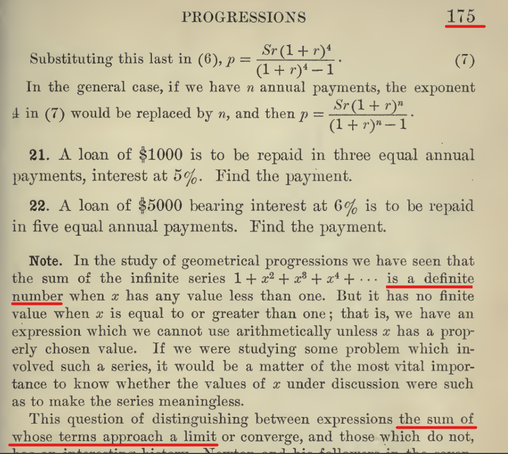
> "And so does Wikipedia" and so does the textbook
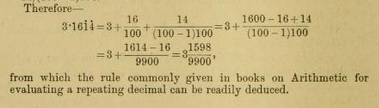
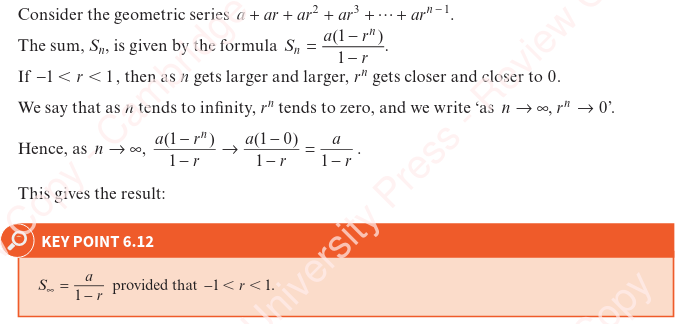
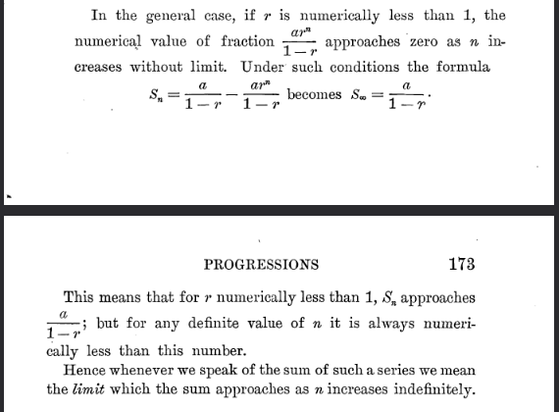
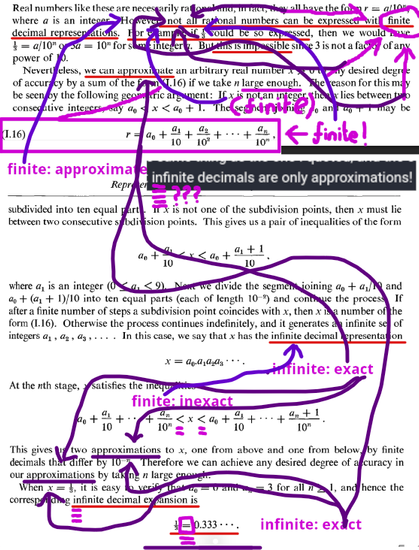
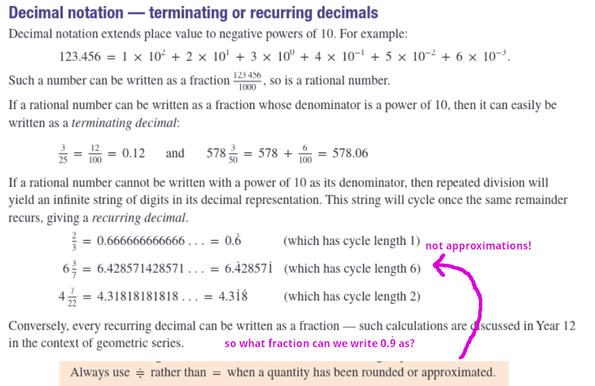
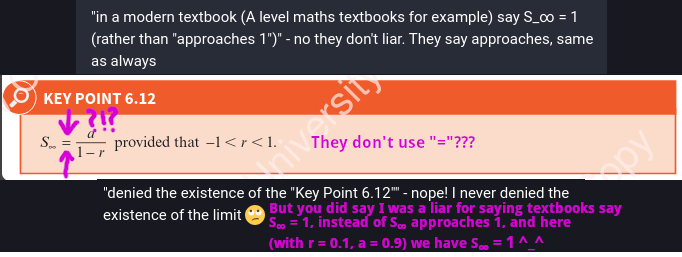
So you're happy that Wikipedia and the textbook both use the notation 0.999... = 1 viz. 0.333... = ⅓. Can you now explain why the Wikipedia article is wrong to write such an equation, but the textbooks are not?
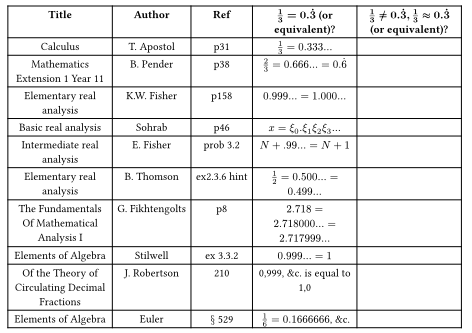
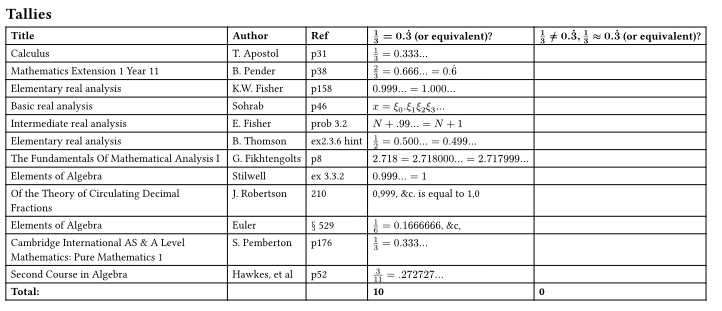
The screenshot you couldn't find is the first one of my comment https://ioc.exchange/@FishFace/116335108529026456, which is from p38 of Mathematics Extension 1 Year 11, and which you referred to here: https://dotnet.social/@SmartmanApps/116323534108291577
It's not especially important; it's in the table already.
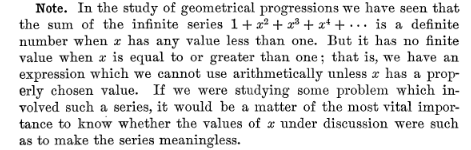
> "Now's a good time to make a table of sources in support of writing 0.999... = 1" - in which you lied, as usual
The full titles, authors and page/other references are all there for you to dispute any cases where I've misquoted them - or indeed to find a reference for where it says something like ⅓ ≠ 0.333...
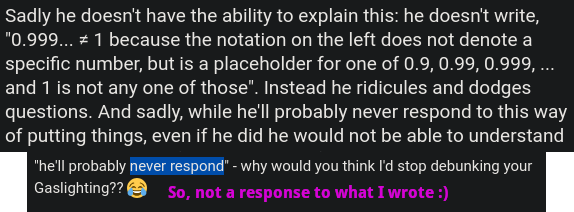
> "not a response to what I wrote" - that was in the other 6 posts, you know, the ones you ignored
Then I'll have to request that you organise your thoughts better, so that I can see what is supposed to be a response to what. Thanks in advance.
I've added some missing texts to the tally, and created an unanswered questions log to help us keep track.
Whenever you're ready to add some sources that actually explicitly say 0.999... ≠ 1 (other recurring decimals are available) please do link them.
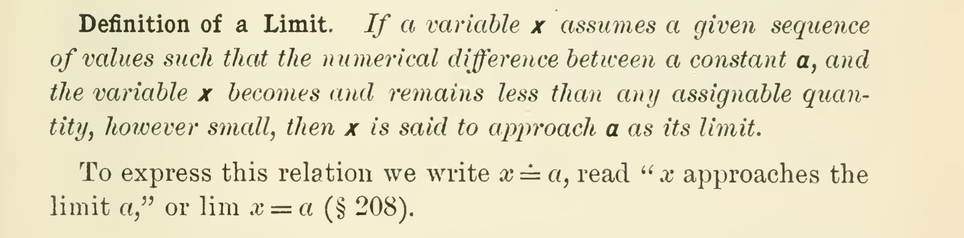
> (which is a direct rejection of Cantor's "proof", who tried to treat it as a number)
Oh dear, that topic. Cantor treated infinity as a type (actually two different types) of equivalence class of sets. Let's not get distracted though.
> NO MATTER HOW MANY TERMS WE ADD UP, THE ANSWER IS ALWAYS LESS THAN 4
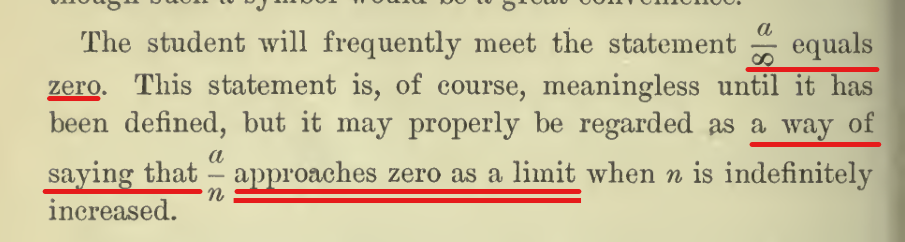
Do you think this is supposed to mean that, "if we add up 'infinitely many' terms, the answer is still less than 4"? Because that would be doing exactly what you just said not to do, and treating infinity as a number. It means "for all natural numbers n, the partial sum of n terms is less than 4". Infinity is not a natural number. It would be incorrect to say "the sum to infinity is less than 4", which is why you have seen many textbooks say "the sum to infinity is ..." and then the limit.
> So yes, the textbook is correct - the infinite sum is always less than the limit, but we use the limit in it's place when doing arithmetic
Sorry, you said "the textbook is correct", and then some words that were not in the textbook. It did not say "the infinite sum is always less than the limit". It said "the sum of the infinite geometric series ... is 4".
Perhaps you would like to try answering Steffi's question again? It was a simple yes-or-no affair, and didn't need the application of your imagination ;)
 💡𝚂𝗆𝖺𝗋𝗍𝗆𝖺𝗇 𝙰𝗉𝗉𝗌📱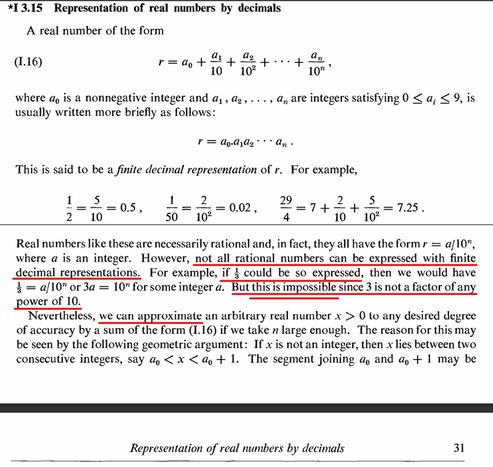
 Steffi the Redhead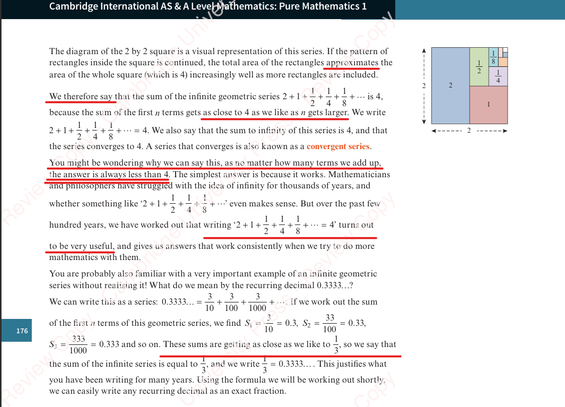
 Fish Face