 Flipboard Tech Desk
Wikipedia has banned its editors from using AI to create articles, @404mediaco reports. @emanuelmaiberg talked to the Wikipedia editor who proposed the guideline about why.
 💡𝚂𝗆𝖺𝗋𝗍𝗆𝖺𝗇 𝙰𝗉𝗉𝗌📱
@TechDesk @404mediaco @emanuelmaiberg
The problem is Wiki already contains a lot of wrong info. I saw an article yesterday which I'm pretty sure was mostly AI slop regurgitaed from a very wrong Wiki page. The problem with it is your next-door-neighbour Joe Blow, who has forgotten the rules of Maths, is totally allowed to admin a page about Maths. Welcome to why I post it here instead. Wikipedia is "like an encyclopedia" in the same way that Madonna is like a virgin
The problem is Wiki already contains a lot of wrong info. I saw an article yesterday which I'm pretty sure was mostly AI slop regurgitaed from a very wrong Wiki page. The problem with it is your next-door-neighbour Joe Blow, who has forgotten the rules of Maths, is totally allowed to admin a page about Maths. Welcome to why I post it here instead. Wikipedia is "like an encyclopedia" in the same way that Madonna is like a virgin
 Furbland's Very Cool Mastodon™
@SmartmanApps @TechDesk @404mediaco @emanuelmaiberg for every troll who edits an article, there’s 5 dedicated editors standing by to correct it. the beauty of wikis is that they’re constantly being fact-checked by tons of experts. @wikipedia even has a dedicated counter-vandalism team!
@SmartmanApps @TechDesk @404mediaco @emanuelmaiberg @wikipedia the problem with traditional encyclopedias is they tend to be biased and can be hard to update. Wikipedia and its many policies bypass all that
@GroupNebula563 @TechDesk @404mediaco @emanuelmaiberg @wikipedia
"for every troll who edits an article" - Professor Rick Norwood isn't a troll https://www.researchgate.net/profile/Rick-Norwood and yet his Maths corrections keep getting backed out by admins. Welcome to why I post my Maths facts on Mastodon, where no-one can back them out https://dotnet.social/@SmartmanApps/110968910722113903
@GroupNebula563 @TechDesk @404mediaco @emanuelmaiberg @wikipedia
"they’re constantly being fact-checked by tons of experts" - and getting backed out again by admins. See previous comment. None of the Maths pages ever cite any Maths textbooks, despite the fact there are many available for free on the Internet Archive
"many policies bypass all that" - including bypassing fact-checking 🙄 so either the policies don't work, or aren't followed. Either way Wikipedia has a facts problem
@SmartmanApps @TechDesk @404mediaco @emanuelmaiberg @wikipedia the policies do work, and are followed. they work quite well, in fact. the articles don't cite textbooks, but they *do* cite papers from credible mathematicians/universities, which IMO tend to be far more authoritative. if this rick norwood is a highly credible mathematician, he himself would likely have a wikipedia article, and unless he died in 1675, he does not. https://en.wikipedia.org/wiki/Richard_Norwood

@SmartmanApps @TechDesk @404mediaco @emanuelmaiberg @wikipedia the only "rick norwood" i can find on wikipedia, unless he goes under another username there, is an avid contributor to the project and seems to quite enjoy it: https://en.wikipedia.org/wiki/User:Rick_Norwood
@SmartmanApps @TechDesk @404mediaco @emanuelmaiberg @wikipedia ...or he was, until he was diagnosed with alzheimer's and begun making disruptive edits to pages, which are probably the ones getting reverted that you're talking about. not to mention, there's zero indication i can find that the wikipedia editor rick and the researchgate rick are the same person
@SmartmanApps @TechDesk @404mediaco @emanuelmaiberg @wikipedia if you have any further concerns about wikipedia or any other wikimedia projects, i highly suggest taking that up with @LucasWerkmeister, the only person i can think of off the top of my head who is more qualified than i to answer this sort of thing
@GroupNebula563 @TechDesk @404mediaco @emanuelmaiberg @wikipedia @LucasWerkmeister
"the policies do work, and are followed" - clearly not, given pages like https://en.wikipedia.org/wiki/0.999... exist
"IMO tend to be far more authoritative" - I see you haven't read any of their blog posts then, where they can't even get order of operations right (spoiler alert: they don't teach it at university, it's taught in high school, which they've long since left - high school textbooks are the references to use)
@SmartmanApps @TechDesk @404mediaco @emanuelmaiberg @wikipedia @LucasWerkmeister ...you can see right here where it cites two textbooks explaining exactly why the article is correct
https://books.google.com/books?id=jWgPAQAAMAAJ
https://archive.org/details/mathematicalanal02edtomm/page/n3/mode/2up
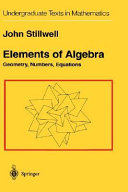
Elements of Algebra
Algebra is abstract mathematics - let us make no bones about it - yet it is also applied mathematics in its best and purest form. It is not abstraction for its own sake, but abstraction for the sake of efficiency, power and insight. Algebra emerged from the struggle to solve concrete, physical problems in geometry, and succeeded after 2000 years of failure by other forms of mathematics. It did this by exposing the mathematical structure of geometry, and by providing the tools to analyse it. This is typical of the way algebra is applied; it is the best and purest form of application because it reveals the simplest and most universal mathematical structures. The present book aims to foster a proper appreciation of algebra by showing abstraction at work on concrete problems, the classical problems of construction by straightedge and compass. These problems originated in the time of Euclid, when geometry and number theory were paramount, and were not solved until th the 19 century, with the advent of abstract algebra. As we now know, alge bra brings about a unification of geometry, number theory and indeed most branches of mathematics. This is not really surprising when one has a historical understanding of the subject, which I also hope to impart.
@GroupNebula563 @TechDesk @404mediaco @emanuelmaiberg @wikipedia @LucasWerkmeister
""you can see right here where it cites two textbooks" - nope. I can see quite clearly they are NOT Maths textbooks, as I said
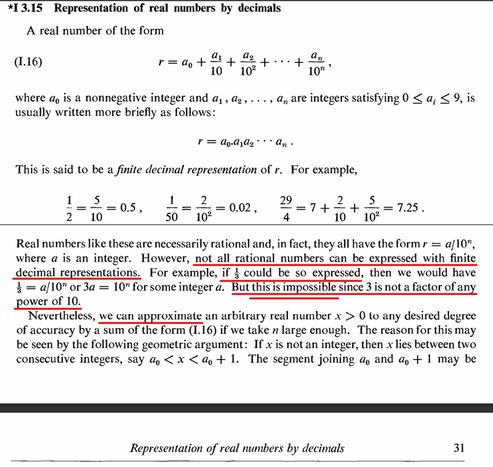
"explaining exactly why the article is correct" - now go read about limits and/or decimal representations in Maths textbooks and you'll discover why it's wrong. Here's a free head-start explaining why 1/3 isn't actually equal to 0.333... and is only an approximation (now multiply by 3)
 Steffi the Redhead
@SmartmanApps @GroupNebula563 @TechDesk @404mediaco @emanuelmaiberg @wikipedia @LucasWerkmeister you have to make the line for "period" over the 3 of 0,3.
@fuchsi @GroupNebula563 @TechDesk @404mediaco @emanuelmaiberg @wikipedia @LucasWerkmeister
"you have to make the line for "period" over the 3 of 0,3" - yes, and is an approximation of 1/3, since it's literally impossible to have an exact decimal representation of 1/3 in base 10, since 3 isn't a factor of 10, as per the textbook
@SmartmanApps @GroupNebula563 @TechDesk @404mediaco @emanuelmaiberg @wikipedia @LucasWerkmeister but it's 3 until infinity. That limes should do that, no?
@fuchsi @GroupNebula563 @TechDesk @404mediaco @emanuelmaiberg @wikipedia @LucasWerkmeister
"but it's 3 until infinity. That limes should do that, no?" - I'm not sure what you mean. Even at 3 to infinity, it's still only an approximation of 1/3, so 0.9 to infinity is only an approximation of 1. ALL non-terminating decimals are only approximations, again as per the textbook. Only terminating decimals are exactly equal to a fraction, such as 0.25 is exactly equal to 1/4, as per the textbook
@fuchsi @GroupNebula563 @TechDesk @404mediaco @emanuelmaiberg @wikipedia @LucasWerkmeister
In other words, no matter how many steps you do your long division to, you're still left with remainder 1 - that remainder 1 literally never disappears, even at preceded by infinite zeroes. It's because 3 isn't a factor of 10, and we're doing it in base ten. In base 3 you can exactly represent 1/3 - it's 0.1 - in base ten you can't. The same thing happens in the other direction converting back.
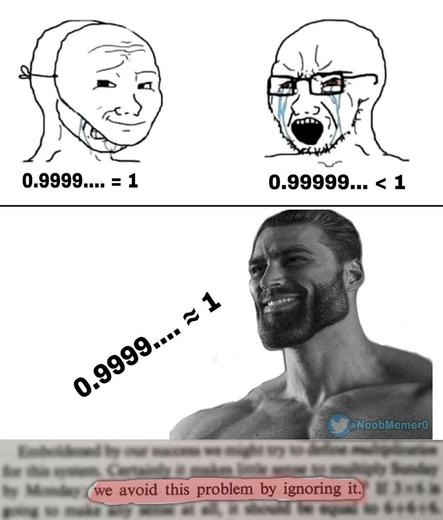
💡𝚂𝗆𝖺𝗋𝗍𝗆𝖺𝗇 𝙰𝗉𝗉𝗌📱 (@[email protected])
Attached: 1 image 1/6 This #MathsMonday I want to cover a new storm I've seen brewing, but first I want to go over again the motivation for these #Maths posts... On one hand it's to provide me (and you!) with things that can be linked to, to save myself (and you) from repeating myself, but peeling back the onion on that really it's about preventing #Math #bullying, for sadly I have seen people who bully others into believing the wrong #Mathematics answer. i.e. not about who's right, but stopping the #bullies!...
@SmartmanApps @GroupNebula563 @TechDesk @404mediaco @emanuelmaiberg @wikipedia @LucasWerkmeister That's not how ifinity works. You don't have the remaining 1. That also gets divided by 3.
@fuchsi @GroupNebula563 @TechDesk @404mediaco @emanuelmaiberg @wikipedia @LucasWerkmeister
"You don't have the remaining 1. That also gets divided by 3" - which then also gives a remainder of 1, divide by 3 again, another remainder of 1, ad infinitum. That's EXACTLY how infinity works - a never-disappearing remainder of 1, infinitely repeating 3's. Again, every non-terminating decimal is only an approximation, only terminating decimals are exactly equal to fractions, as per Maths textbooks
@SmartmanApps @GroupNebula563 @TechDesk @404mediaco @emanuelmaiberg @wikipedia @LucasWerkmeister I am not sure that's how it works.
@fuchsi @GroupNebula563 @TechDesk @404mediaco @emanuelmaiberg @wikipedia @LucasWerkmeister
"I am not sure that's how it works" - That's exactly how it works. Sit down with pen and paper and start doing long (or short) division. 3 doesn't go into 1, add a zero. 3 goes into 10 3 times with 1 remainder, repeat ad infinitum. Again, every non-terminating decimal is only an approximation due to a never-disappearing remainder, due to not being a factor of 10
@SmartmanApps @GroupNebula563 @TechDesk @404mediaco @emanuelmaiberg @wikipedia @LucasWerkmeister ah sorry. It's limit in English.
This is for calculations with infinite numbers. Because you don't have a last digit. Per definition.
@fuchsi @GroupNebula563 @TechDesk @404mediaco @emanuelmaiberg @wikipedia @LucasWerkmeister
"ah sorry. It's limit in English" - yes, the limit is literally the number it can never reach, hence why it's called the LIMIT. The infinite sum is uncalculable, so we use the limit in it's place, since that can be calculated. This is discussed in almost every textbook that covers limits
"Per definition" - get your definitions from Maths textbooks, not Wikipedia - that's my whole point to begin with!
@SmartmanApps @GroupNebula563 @TechDesk @404mediaco @emanuelmaiberg @wikipedia @LucasWerkmeister I learned that stuff 20 years ago in university. And here it's called Grenzwert (threshold or boundary value) or Limes (like that Roman wall).
And yes we used textbooks.
But you can make an analysis to see to which value the limit converges. And there are some interesting things that math does with infinity. And yes, you can calculate with that.
@SmartmanApps @GroupNebula563 @TechDesk @404mediaco @emanuelmaiberg @wikipedia @LucasWerkmeister and doesn't Wikipedia quote textbooks?
@fuchsi @GroupNebula563 @TechDesk @404mediaco @emanuelmaiberg @wikipedia @LucasWerkmeister
"which value the limit converges" - converges but never reaches, the defining feature of an asymptote
"you can calculate with that" - hence why it's used in place of the infinite sum, which can't be calculated, being infinite
"doesn't Wikipedia quote textbooks" - none that I've ever seen. It's certainly not hard to find any which define the limit as being unreachable, thus 0.999... never reaches 1

 Fish Face
@fuchsi @GroupNebula563 @wikipedia @LucasWerkmeister
This person is a crank and will not understand, but I do encourage you to push back on his pollution of mastodon.
As you can see, he just tried to pass off a page about finite decimal expansions as if it were about infinite ones (which are over the page). I actually don't think this is dishonesty; I think he genuinely has such a poor grasp of mathematics beyond the level of high school that he doesn't understand why he's wrong. It's fascinating to observe.
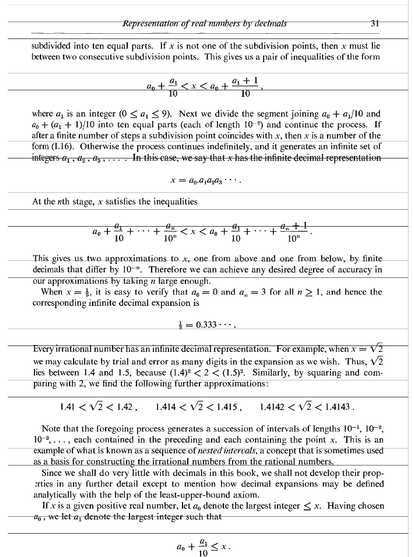
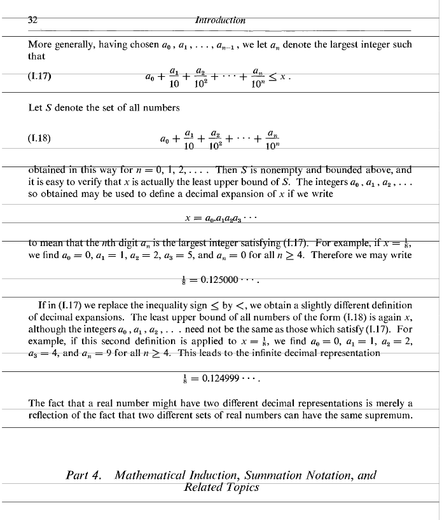
@fuchsi
Keep this in mind - Gaslighter (who is NEVER able to cite any textbooks that agree with him) just told you an outright lie about the page being about finite decimals, not infinite decimals, as seen here... (if he thinks that 0.(3) is a finite decimal, after how many places does it terminate? 😂 )
Keep this in mind - Gaslighter (who is NEVER able to cite any textbooks that agree with him) just told you an outright lie about the page being about finite decimals, not infinite decimals, as seen here... (if he thinks that 0.(3) is a finite decimal, after how many places does it terminate? 😂 )
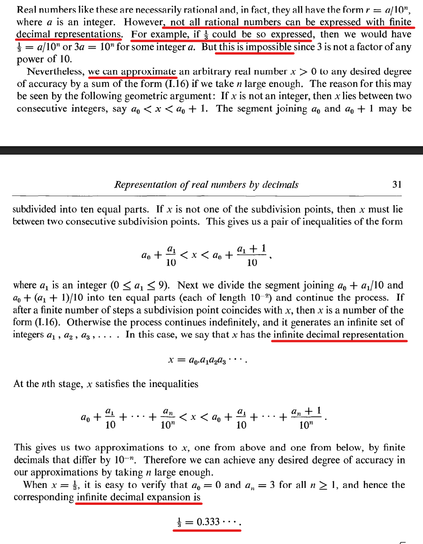
@GroupNebula563 @TechDesk @404mediaco @emanuelmaiberg @wikipedia @LucasWerkmeister
"an avid contributor to the project and seems to quite enjoy it" - yep, that's him. Now go look at the Maths talk pages where his corrections kept getting backed out
"which are probably the ones getting reverted that you're talking about" - nope! Probably more than a decade ago now
"are the same person" - and yet, the corrections were still correct, and were still backed out
@SmartmanApps @TechDesk @404mediaco @emanuelmaiberg @wikipedia @LucasWerkmeister it seems like every time i prove my point in one regard you completely steer the debate in another direction in a futile attempt to remain prevalent. if you really must waste time arguing about this further, please do so with lucas and remove me from any further mentions in this thread. thank you.
@GroupNebula563 @TechDesk @404mediaco @emanuelmaiberg @wikipedia @LucasWerkmeister
"you completely steer the debate in another direction" - my point has always been that corrections by experts get backed out. Go ahead and see all the Rick Norwood corrections that got backed out
"if you really must waste time arguing about this further" - I'm not arguing - I'm stating facts. It's all there in the Talk pages!
...and blocked me. Now guess what happens when Rick Norwood posts a correction! 🙄
 Ben Ford
@SmartmanApps @TechDesk @404mediaco @emanuelmaiberg do you have statistical evidence or is this opinion?
@binford2k @TechDesk @404mediaco @emanuelmaiberg
"do you have statistical evidence or is this opinion?" - neither. Literal facts from Maths textbooks https://dotnet.social/@SmartmanApps/110819316450570395 https://dotnet.social/@SmartmanApps/111203914444416857 - being a Maths teacher - none of which get cited on the Wiki pages, despite many textbooks being available for free on the Internet Archive. Welcome to Wikipedia has a Maths facts problem (and some non-Maths ones too)
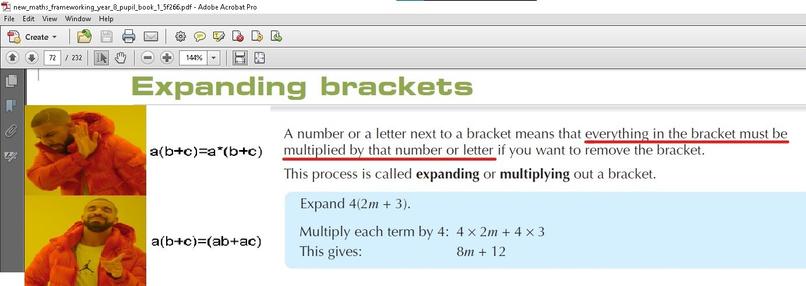
💡𝚂𝗆𝖺𝗋𝗍𝗆𝖺𝗇 𝙰𝗉𝗉𝗌📱 (@[email protected])
Attached: 1 image Reference in top left of screenshot. Note the use of the words "everything" and "must" - certainly no room for ambiguity there! Hence the Distributive Law, because must always be obeyed. AKA expand brackets, AKA expand and simplify. Next, "if you want to remove the bracket" - in other words, you CAN'T remove the brackets UNTIL YOU HAVE DISTRIBUTED AND SIMPLIFIED. Mistake #1 removing the brackets before completing that. Mistake #2 ignoring that the "multiplication" is INSIDE THE BRACKETS...
@SmartmanApps @TechDesk @404mediaco @emanuelmaiberg ok. So you have no evidence of your claim that Wikipedia is false information and are just spouting off on the internet. Go touch grass for a bit. Cheers.
@binford2k @TechDesk @404mediaco @emanuelmaiberg
"ok. So you have no evidence of your claim that Wikipedia is false information and are just spouting off on the internet" - ok, so you claim that MATHS TEXTBOOKS are "no evidence" and are just spouting off on the internet. Got it. 😂 Welcome to why Wikipedia is full of false information 🙄 😡
"ok. So you have no evidence of your claim that Wikipedia is false information and are just spouting off on the internet" - ok, so you claim that MATHS TEXTBOOKS are "no evidence" and are just spouting off on the internet. Got it. 😂 Welcome to why Wikipedia is full of false information 🙄 😡
@SmartmanApps @TechDesk @404mediaco @emanuelmaiberg your claim is “The problem is Wiki already contains a lot of wrong info.”
Your supporting argument is “maths textbooks”
Show the math textbook that says “Wikipedia is full of false information.” You claim to be a math person. Surely you know how to construct a valid proof.
@binford2k @TechDesk @404mediaco @emanuelmaiberg
"Show the math textbook that says “Wikipedia is full of false information” - I'll take that as an admission of being wrong then. You know perfectly well it proves the Wikipedia page on that topic is wrong. 🙄 There are many other such pages, also proven wrong by textbooks
"Surely you know how to construct a valid proof" - textbooks trump your "nuh uh" every time 😂
@SmartmanApps @TechDesk @404mediaco @emanuelmaiberg nobody asked you whether one out of 65,380,334 pages was correct or not, nor is it significant. That’s 0.000001529511917% of Wikipedia. You have a hell of a long way to go before you’ve supported your “full of misinformation” claim.
@binford2k @TechDesk @404mediaco @emanuelmaiberg
"nobody asked you whether one out of 65,380,334 pages was correct or not" - and I never said anything about one page, but MANY pages 🙄
"That’s 0.000001529511917% of Wikipedia" - that's a strawman
"You have a hell of a long way to go before you’ve supported your “full of misinformation” claim" - go ahead and search for #MathsMonday to find a whole bunch more (and that's only for Maths)!
@SmartmanApps @TechDesk @404mediaco @emanuelmaiberg “many” is still not statistically significant, nor is it my responsibility to do the research to back up your claim. https://en.wikipedia.org/wiki/Statistical_significance
For someone who claims to be a “smart man” and a maths expert, you’re not demonstrating qualities of either. I’m going to block you now. I think I’ve given you enough free education.
@binford2k @TechDesk @404mediaco @emanuelmaiberg
"“many” is still not statistically significant," - how does every Maths page I've ever seen grab you as statistically significant? 🙄
"nor is it my responsibility to do the research to back up your claim" - I already backed it up. You haven't backed up your claim
"For someone who claims to be a “smart man” " - not me. I see you don't ever bother doing any research
"I’m going to block you now" - unable to refute anything I said then
@binford2k @TechDesk @404mediaco @emanuelmaiberg
This guy is a crank and there's little point debating him unless you're in for the long haul. The reason he says this is because Wikipedia has articles such as the one on 0.999... which he erroneously believes to simply be false. The other two topics he is consistently wrong about are order of operations and set theory. The only sources he accepts are high school textbooks, but even those he will dismiss if they disagree with him, or torture the language so thoroughly as to render discussion impossible.
Because he's so wrong about basic facts, he will never think Wikipedia is accurate based on statistics because to him it's as if it said the sky were green.
I encourage you all to read at least a little bit of what he says to confirm this, because I think he survives here by people just skipping over his ravings, yet he pollutes the #maths hashtags with relentless self-promotion, each time wasting someone else's time, each time typically getting no push back. He'll never admit he was wrong, but if enough people tell him, he might be wrong more quietly.
Wikipedia's biggest problem is lack of simple context. This is true on mathematical articles but worse elsewhere.
@FishFace @TechDesk @404mediaco @emanuelmaiberg oh, I could tell he was a crank right off. That question was intended more as the end of a conversation rather than the start of one.
 Elizabeth

@SmartmanApps @TechDesk @404mediaco @emanuelmaiberg A lot of it is just human-generated slop too. Wikipedia has actually been trying to aggressively prune articles, because there were just so many stubs that were never going to be expanded, and basically sat there like "this is a topic that exists." This is on top of the misinfo that has plagued the site repeatedly, and some articles sit neglected for years. I've come across pages with years-old vandalism before, or straight-up advertising tagged as such but nobody has acted to remove it. Such content helps no one.
@Elizafox @TechDesk @404mediaco @emanuelmaiberg
Oh! I wasn't talking about an article on Wikipedia - I was talking about an actual article (some science magazine), by a Physics journo (i.e. not Maths), and most of the article sounded like AI slop which was regurgitated from the very wrong Wiki page on the topic (0.999...=1 - in fact it isn't, signed Maths teachers and textbooks)
Oh! I wasn't talking about an article on Wikipedia - I was talking about an actual article (some science magazine), by a Physics journo (i.e. not Maths), and most of the article sounded like AI slop which was regurgitated from the very wrong Wiki page on the topic (0.999...=1 - in fact it isn't, signed Maths teachers and textbooks)