 Apiary
 Fabian Giesen
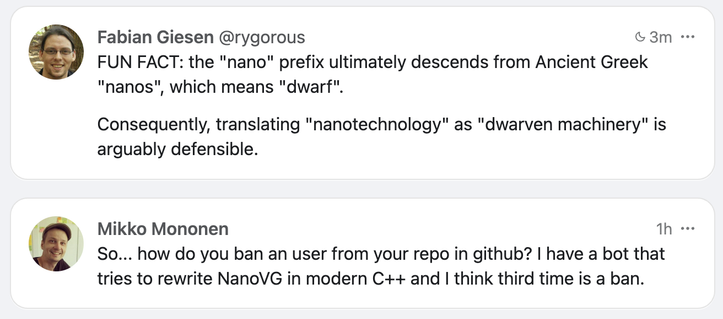
FUN FACT: the "nano" prefix ultimately descends from Ancient Greek "nanos", which means "dwarf".
Consequently, translating "nanotechnology" as "dwarven machinery" is arguably defensible.
FUN FACT: the "nano" prefix ultimately descends from Ancient Greek "nanos", which means "dwarf".
Consequently, translating "nanotechnology" as "dwarven machinery" is arguably defensible.
As an aside, we use impossibly bright, impossibly blue light to inscribe tiny runes on sand, producing constructs that obey our commands (well, sometimes...) and communicate with us through literal liquid crystals.
This is not a fantasy setting. I'm just describing the real world
(well I'm leaving out 1000s of in-between steps, but still)
@kleines_z @gwenthefops @rygorous
Well, that's not casting a spell, that's summoning a demon...
@rygorous And we ride flying machines over the ocean while doing it. And this
https://fediscience.org/@martinvermeer/111782633809967989
It's a magical world...
@rygorous so we’re all developing to a steampunk age… kinda?
Count me in!
/cc @jakehamilton
@rygorous Funfact if you add an "e" at the beginning of "nano", you have "enano*", which is the spanish word for "dwarf"
*probably but not enterily sure to have the same root.
Edit: I just look the word in the dictionary and it is indeed the same root, so apparently there is no joke xD. (From the latin "nanus", and "nanus" from the greek "nanos")
@rygorous you just described Italian.
Nano: same word.
"…the dwarfs found out how to turn lead into gold by doing it the hard way. The difference between that and the easy way is that the hard way works."
- The Truth, Terry Pratchett
This is all I hear when we see crystals being used by engineers in modern technology vs. being used in healing woo.
@rygorous So I did a little digging on where the metric prefixes came from.
https://en.wikipedia.org/wiki/Metric_prefix
kilo = 1000, from Greek χίλιοι; milli = 1/1000, from Latin mille. Each word means one thousand in its respective language.
mega = million, from Greek μέγας, "great"; micro = 1/million, from Greek μικρός, "small."
giga = billion, from Greek γίγας, "giant"; nano = 1/billion, from Greek νᾶνος, "dwarf."
tera = trillion, from Greek τέρας, "monster"; pico = 1/trillion, source unknown.
peta = quadrillion, from the Greek letter "eta" (which in the old Greek system of numeric notation had the value 5) with a p prefix for uniqueness; femto = 1/quadrillion, source unknown.
exa = quintillion, from the Greek ἕξ meaning six; atto = 1/quintillion, source unknown. (In ancient Greek, six was denoted by the letter ϝ digamma, which represented the "w" sound in some dialects. In Byzantine times its position in both the alphabet and in the numeric system was replaced by the letter stigma, which morphed into a sigma-tau ligature. The Latin alphabet borrowed the old digamma's shape and its position in the alphabet for the letter F. See the Wikipedia articles on these below.)
https://en.wikipedia.org/wiki/Digamma
https://en.wikipedia.org/wiki/Stigma_(ligature)
The other greater-than-1 prefixes are taken from the names of Greek letters from the numeric system, with a one-letter prefix so that their abbreviation is unique. The less-than-1 prefixes are derived from the corresponding greater-than-1, but with a different word ending. The former have an uppercase abbreviation, the latter have a lowercase one.
Sorry, this is one of my autism special interests, so of course I needed to infodump!
Therefore, a trillionaire is a monster.
 ARGVMI~1.PIF
 Giacomo Tesio
 das-g
das-g
 Marc
Marc Wolf480pl
 Fiona Ebner
 Gwen the Loitering Fox
 ein kleines z
 Orangenoel
 Claudius
 Martin Vermeer FCD
 Frost, wolf of winter 🐺🎄
 HighlandLawyer
 Moritz Negwer
 HolgerPieta
 Aras Pranckevičius
 dragonfrog
 xenia
xenia 


 Loïc Denuzière
 LR
LR Luigi
Luigi 
 Heals
Heals 
 Erebus
 Ronflaix
 Fissile
 Renato Ramonda
 Bill, organizer of stuff
 Arthfach 🐻
 Gen Denelith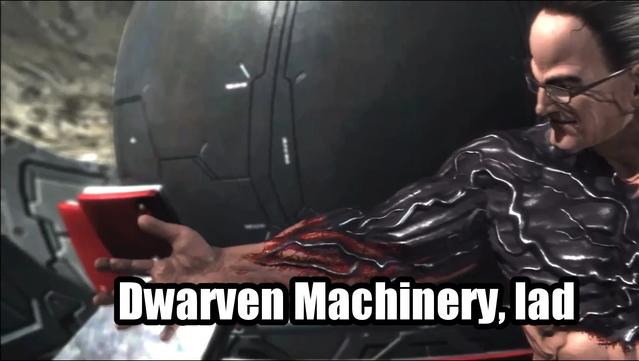
 Daniel Johnson
 Yoïn van Spijk
 Martin Owens
 Andrew (Television Executive)
 Jose Luis Peruyero
 Pēteris Krišjānis
 Zeborah
 D. G. Marshall
 It's Anthony!
 Xenotime, Librarian of Æther
 Benny Powers 🇮🇱🦁