I'm finding the recent Veritasium videos are a bit weird... they mention a recent "thing 1", then do a super-deep historical dive into a somewhat related "thing 2" (presenting it as "the origins of thing 1").

This one [1] is "The Secret Spy Tech Inside Every Credit Card", where they briefly poke at NFC and then wind back to talk about the Soviet's listening device, gifted to the US Ambassador in 1945 [2].

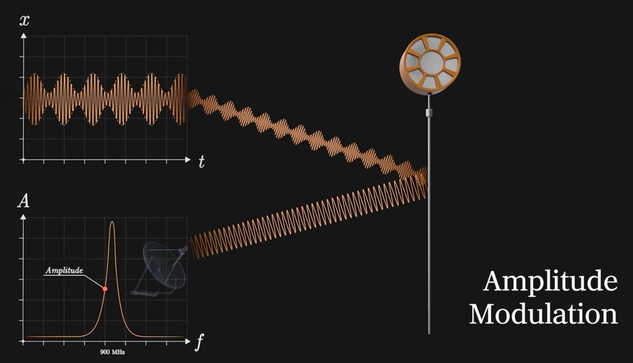
They explain in some detail how the device works, showing it as what many woud recognise as Frequency Modulation, before calling it Amplitude Modulation(?!)

... the Wiki page states "the membrane and the post formed a variable capacitor acting as a condenser microphone and providing amplitude modulation (AM), with parasitic frequency modulation (FM) for the re-radiated signal", which is... I mean... okay, I guess... but isn't any FM broadcast actually AM too by this definition?

1: https://www.youtube.com/watch?v=YSJY3DvnybE

2: https://en.wikipedia.org/wiki/The_Thing_(listening_device)
The last one I watched [1] was "The Internet Was Weeks Away From Disaster and No One Knew", where they drop the scary bomb with no real details, and then run back to "the story begins with a jammed printer" and an interview with fecking Stallman and talk about FSF... (?!)

1: https://www.youtube.com/watch?v=aoag03mSuXQ

The Internet Was Weeks Away From Disaster and No One Knew

YouTube

@attie Yeah, it's diving into the history of the Linux kernel and the free software movement in a very hand-wavy way so as to establish the backdrop through which the xz-utils attack was orchestrated.

It's not the obvious way to tell the story, and it assumes both a) the audience's ignorance on open source and b) a metric fuckton of other computer history details, but, eh.

They also talked a lot about RSA encryption and completely balked at signing and elliptic curves, when Jia Tan's exploit used Ed448.

It could be worse.

@soatok

> They also talked a lot about RSA encryption [...], when Jia Tan's exploit used Ed448.

Ha, I missed that detail... I must confess it was playing while I was doing housework.

> It could be worse.

Oh, completely agree. It's not *bad*, but just felt unexpected / weird.

@attie @soatok it ain't what it used to be, that's for sure

@attie You piqued my interest, so I just watched the video, and I think they (appropriately) described the signal reflecting from The Thing purely as AM. The mechanism for producing AM is that the device's resonant frequency changes with air pressure, but the effect this has on the radio wave is AM.

I believe that the "parasitic frequency modulation" mentioned in Wikipedia is inconsequential. I don't see a citation.

@mossmann

> You piqued my interest
My apologies šŸ˜‚

If I understand things correctly, an exciting signal was aimed at The Thing on a given frequency, causing it to resonate.

The Thing's tuning varied with the air pressure, which meant that as it went in/out of resonance with the exciting signal, the resulting re-radiated signal would have changed in amplitude more signficantly, and probably frequency more subtly.

So yes, the resulting output signal would be largely AM... but my point was more that this isn't what they showed in the bottom-left graph - it wiggles up and down in frequency with consistent amplitude, which suggests FM.

Side note: based on the positioning of that bottom left graph, I feel it would also be reasonable to expect that this is the exciting signal... but it isn't.

Maybe I'm on my "communicate clearly" hobby horse again, but the more recent videos have the feel of "trying to communicate a complex topic without fully understanding it", and "trying to spin a tale into something more substantial than it needs to be".

@attie Apology accepted!

My interpretation of the bottom-left graph is that it is a plot of The Thing's resonant frequency. I agree that it could be clearer.

Yeah, the way they connect the dots from The Thing to contactless credit cards is questionable, but The Thing is certainly the earliest example of an intentional RF retroreflector.

@attie Veritasium's content has been kinda clickbaity for a while. That one a few years back where they looked at an electrical circuit as long as the distance to the moon was a good example of an explanation which was physically correct but presented in a way that attempted to make even educated viewers feel dumb. It caused a lot of controversy in the EE blogosphere, which I suspect got them a lot of hate-views.

@emeb @attie that one was actually very poorly explained, imo, and it led to no end of other well known EE youtubers trying to explain it but with various levels of actual understanding, including some who just authoritatively explained it wrong. the saga was exhausting.

the most annoying part is that it is really quite a simple phenomenon to explain.

@attie isn't the channel owned by some weird conglomerate now?

I suspect it's all somewhat explained by this video (which I've not watched).

https://www.youtube.com/watch?v=piHGnG4LsmQ

The Future of Veritasium

YouTube

@gsuberland @attie it is, and it's "a good thing" according to the video describing it!

tbh Derek deserves a break tho.

@xabean @attie I'm cool with him having a break, I'm less cool with using the channel's reputation as a vehicle to deliver content that cheapens it.
@xabean @attie I may be somewhat of an outlier in terms of how deeply annoyed I am by anything in the category of "education-shaped but not actually that educational" though.
@gsuberland @attie I legit wonder how they had so many technical people *in* the video, and either chose not to spot-check the video with them, or they all gave it a šŸ‘
@gsuberland @attie it'd be like having huygensoptics in a video about the hubble telescope, and then be all "Yeah, the magnetosphere fucked up the mirror because it's made of aluminum, because, ya know, magnets."
@xabean @attie I'm still on the fence about HuygensOptics. his stuff is mostly cool, but some of it feels... a bit fringe? I didn't really notice at first but then he talked about something I knew about and it confused me, and in the process of trying to figure out why it wasn't lining up I ended up stumbling into a conversation between very qualified physics people who were like "this is some crank theory nonsense, what the hell is he even talking about".
@xabean @attie so now I'm wary about the rest of it because once someone demonstrates those sorts of leanings it's hard to not call the rest into question.
@xabean @attie which is deeply frustrating because his stuff is unique, well presented, and right up my alley.

@gsuberland @attie interesting, I had no idea. I was thinking you techies + the RF video was the effect that I can only presume licensed medical doctors experience when watching House MD "this is bullshit" and the entertainment value is lost because there's so much fuckery that they can't see past.

I think that's why I can chill watching House, but things tech adjacent can be grating if it's targeting normies and taking significant artistic liberty with explanations.

@xabean @attie I am a fan of entertainment and I am a fan of education, but I absolutely cannot abide "edutainment" that shucks the responsibility to actually educate or, much worse, teaches misinformation for the sake of an entertaining narrative.

stuff like House is entertainment. it has no responsibility to educate, it can freely take liberties as far as suspended disbelief will carry. it may be jarring to professionals but that's different from pretending to inform and then misinforming.

@gsuberland @xabean @attie yeah after the buyout it have just gone in the shitter. Maybe it's also why he stopped hosting the videos.

@attie That moving frequency is not the signal, but the frequency response of the device.
So in this picture they beam in a constant 900 MHz sine, the peak resonance frequency is moved by the audio input, and that modulates the amplitude of the reflected signal. The signals all have a constant frequency, so no FM here.

I’d say the ā€œparasitic frequency modulationā€ on Wikipedia is wrong, assuming the device actually worked like explained in this video (which I think it did).