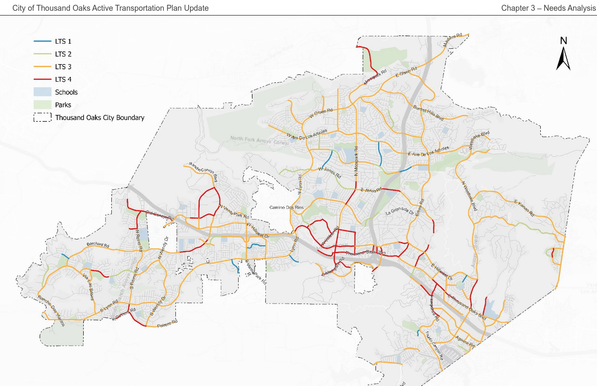
LOL I won't ride any of the LTS 4 and monst of the LTS3 streets here, which is where our city puts their "bike lanes". After seeing the "bike streets" and modal filters in Santa Barbara, California, I think that's the easiest way to make cycling possible in the suburbs here. #BikeTooter
@ai6yr So the thing about putting bike lanes on LTS4 and LTS3 streets is that yes, there IS a better alternative, but that doesn't mean you shouldn't serve the people who are going to cycle on those streets anyway. Invariably, people will cycle on them, so you should do the retrofitting to make them a SAFER space to do it. And last I checked, even shitty bike lanes do increase safety even though they don't ensure it. It should be done, but isn't the ONLY thing that should be done.
@HayiWena @ai6yr if it's an LTS4 after bike lanes are installed, the engineer is bad but also I don't think it's worth installing it for whatever marginal gain you got. You now put a bike lane effectively no one is going to use on what is likely the most significant road, meaning people that don't want real changes can reasonably point to the shitty bike lane and say "why bother".

@DemonHusky @HayiWena @ai6yr

Yeah so frustrating! I've visited so many towns and small cities and neighborhoods in big cities, where the only bike infrastructure was on the main drag. With cars going 45mph and nothing but paint to protect you

We need to bicyclize the small streets first, and the main drag after

In places built during the era of the cul-de-sac, sometimes the main drag is the only route from a to b. That way means we need to create woonerfs, pave the often already existing informal paths that connect one cul-de-sac neighborhood to the next

I think the reason city planners put bike lanes on the main drag is partly that it's visible, so it looks like they're doing something. And partly that it doesn't occur to them that someone might take back streets to get from one place to another

Obviously the solution is to stack the planning committees with bicyclists, and give them a larger budget than the part of the transportation department that deals with car streets

Somehow we need to convince people that the future is micromobility, and any money spent accommodating cars is probably wasted
@NilaJones @HayiWena @ai6yr it's definitely depends on location (and by that I mostly mean political will), but the best case is to do the main streets with the destinations that people are traveling to first, because if you can't get to your destination safely, you aren't biking there.
@NilaJones @HayiWena @ai6yr
But if the options are uncomfortable bike lane on main road and real traffic calming on parallel residential street that is going to build support from non-cyclists for future projects because residents don't like fast cut thru, choose the second option.
@NilaJones @HayiWena @ai6yr Then, you gotta build power as a political group. Get people to consistently show up in front of electeds in all the ways possible. Wear the opposition down and find supporters to uplift. This part is super hard and very much a long game. (I've been lucky to join the Cambridge group after they built up success, but right now the Boston group is needing to recalibrate after our mayor changed her mind on safe streets, the fight doesn't end)
@DemonHusky @NilaJones @ai6yr In my town, you can do the main drag with a resurfacing project (every 10-15y) or a big, grant funded reconfiguration (once in a blue moon), but neighborhood traffic calming there's $X0,000/yr that neighborhoods have to compete for in a resident-nominated, >x% sign in support process. This in a town where the public works director and traffic engineer ride eBikes 8+ mi to work &/walk at lunch. Staff has the will, but need resources.
@HayiWena @NilaJones @ai6yr yeah, my main point is: build what you can that will build momentum. Don't build things that have minimal benefit and are going to weaken support for further improvements. Call that stuff out as being bad faith design, and use that in the future to call out the engineer for being bad at their job when their designs don't work.
@HayiWena @NilaJones @ai6yr
But also, build lots of quick build instead of waiting for major resurfacing projects. Flex post separated lanes on our main roads in Cambridge is why we have the best bike/car commute ratio in the country and still improving. (I'm particularly excited about this summer as we basically finish our plan with the last few major roads)
@DemonHusky @NilaJones @ai6yr It would be a lot easier to get support from engineers to do builds if there were Crash Modification Factors, but it's so hard to aggregate and statistically analyze the safety impacts of different types of infrastructure across jurisdictions. Don't get me wrong; most crash modification factors are developed off of tiny samples and weak sauce stats, but given low bike volumes and short timelines we need a statistical approach to demonstrate the CMF.

@DemonHusky @HayiWena @ai6yr

That's not how bicyclists get places

They don't go along the main drag, unless they are in a neighborhood that doesn't have any quiet through streets

And even then, they probably cobble together a zigzag route, that avoids the main drag as much as possible, cuts through alleys and parking lots and dirt trails, etc. Anything to avoid being where the cars are

After traveling a mile or two on back streets, they go the final block on a busier street, to get to the actual destination

The question is, how do we codify this and make it safer?

@NilaJones @DemonHusky @ai6yr Teens in particular are more likely to take the main drag because the only routes they know are the ones they've been driven on. Low income/under housed/people of color often take the main drag because they don't feel welcome/safe in the white wealthy burbs

@HayiWena @DemonHusky @ai6yr

Really good points! Thank you

I don't go in the white wealthy burbs myself, so I didn't think about that. Are people from outside passing through on bikes?

Maybe part of creating a safe route is letting people know where it is

And as you say, making sure it is safe for everyone!

I'm thinking about, for example, 'the wiggle' in San Francisco, which is a way of getting around the hills, staying relatively level, off the car streets, and also within the poorer neighborhoods

It's shown in a bright color on the bicycle map!

@NilaJones @HayiWena @DemonHusky @ai6yr also a minor issue with what do routing apps recommend? Some of them give dubious advice but some people follow that advice. Algorithms can follow car or strava choices, or wishful GIS annotations by local planners, or just minimize "estimated time".

@dr2chase got routed down some stairs once on a cargo bike pulling a trailer.

@NilaJones @HayiWena @DemonHusky @ai6yr

@dr2chase
lol!

I love getting 'dead-ended' into multiple disability ramp switchbacks with my long-tail cargobike & utility trailer

@NilaJones @HayiWena @DemonHusky @ai6yr

@HayiWena @NilaJones @DemonHusky I just bicycled through a block where they had "NEIGHBORHOOD WATCH, WE CALL 911" signs every three houses on a block.
@ai6yr @NilaJones @DemonHusky I took great delight putting Black Lives Matter stickers on those. One of these days I might take them down. My city doesn't support a neighborhood watch anymore, if they ever did, but hasn't taken the signs down. They had Facebook groups at one point for each police subdivision. Hopefully those got too hard to moderate. 🤣
@NilaJones @HayiWena @ai6yr Cyclists don't travel on the main road because the main road is crap. Most cyclists (and here I'm including all the cyclists that choose not to ride because the destination isn't safe) don't /want/ to zig zag and take parking lots and alleys, they choose to get where they are going safely and efficiently. For some that means zigzag, most that means just not biking. But to my point above, a painted bike lane next to 45mph cars is not a sufficient bike lane.

@NilaJones @HayiWena @ai6yr There is a method to codify what a sufficient bike lane is for the car traffic and it is commonly used by industry (those LTS numbers used above) called Level of Traffic Stress.

https://peterfurth.sites.northeastern.edu/level-of-traffic-stress/

I promise you, if the bike lane is low enough stress, people /will/ bike on the main street, even with little kids in the middle of the winter
https://mas.to/@DemonHusky/114048940987545302

@DemonHusky @HayiWena @ai6yr

Well, this is getting into potato potahto territory

I've used bike lanes like that, with serious separation, and on a fairly busy street

They're not personally to my taste, I still prefer to take the quiet street one block over, where I can cruise along and look at buildings and greenery, and not have to focus on pedestrians constantly stepping out in front of me, lights at every intersection, etc

But I can certainly see how some people might prefer the busy shopping street

@NilaJones @HayiWena @ai6yr I totally choose to take a more scenic route often enough, but if the goal is to make a network that induces new ridership, you need to make the destination streets good. @TheWarOnCars talked about this recently with Portland, where they became a "bike city" by doing neighborhood greenways without making the main streets better, which hasn't been as durable of a change as other cities that have focused on main streets

@DemonHusky @HayiWena @ai6yr @TheWarOnCars

That's really interesting! I thought it was exactly the opposite

The cities I know, where biking to work is a normal thing, year round, have the neighborhood green streets. And the cities I know that have the bike lane along the main drag, nobody bikes there

But I would have counted Portland in the former group! When I've been there, in the winter, there were a lot of people biking

@NilaJones @HayiWena @ai6yr @TheWarOnCars my guess is that those bike lanes are pretty terrible for the level of traffic, so obviously people aren't using them. And I totally support making neighborways to improve connectivity and comfort. I mostly think that neighborways are for people currently biking and a GOOD bike lane on a main road is for people that wish they could bike, and that second group is so much larger than the first group

@DemonHusky @HayiWena @ai6yr @TheWarOnCars

That is a very interesting point

I was thinking in terms of a third group, the people who get on a bike with their kids on a sunny weekend day, but it would never even occur to them to take their bike to work, or grocery shopping. Because biking is a recreational family activity

I was thinking that the boutique street separated bike lane was targeting that group

But you're right that there's a whole other group, the people who don't think about biking unless they see a bike lane at the place that they are headed to in their car, and then they think hey I could do that maybe

@NilaJones @DemonHusky @HayiWena @ai6yr @TheWarOnCars

Related to the one street over: noise levels matter, and contribute to my sense of safety and enjoyment.

You give me a separated super safe bike lane on a busy street and I most likely will still be one street over …unless I have to cross a bridge or something. just another aspect of it, at least for me.

@CJPaloma @NilaJones @HayiWena @ai6yr yeah, I've thought about noise, even had a short conversation with Prof Furth about how it might be missing from LTS. He has worked on an adjustment based on hilliness, so I think a similar thing could be for noise.

There's a great river path in Boston that sometimes is right next to the highway. There is a real highway barrier between the path and the highway so it's not really a safety concern, but the noise still makes that section more stressful.

@DemonHusky @NilaJones @HayiWena How about this grand idea here (now removed) from a few years ago? (speed limit 65, people driving up to 75mph or more).

@ai6yr @DemonHusky @HayiWena

When I was young and stupid I had a route to work that required a short stretch of freeway, maybe half a mile

The shoulder was a lot wider than that

And of course PNW freeways are not like SoCal freeways, in any way. Yours have actual cars on them and stuff

Still, the places where cars are merging are the worst. Those drivers are not looking at the shoulder

(Maybe you will tell me this is not a freeway. But it's what we would call one)

@NilaJones @DemonHusky @HayiWena Yeah, that is a major freeway. I believe they removed the bike lanes after someone on a bicycle was killed. Or someone told them "THAT IS STUPID, YOU CAN"T LET BICYCLES ON A FREEWAY WHERE PEOPLE GO 75MPH"
@ai6yr @NilaJones @DemonHusky Unless there's no alternate route. Sections of I-90 in Idaho and I-82 in Oregon you get a small sign that says bikes on road. Never seen one, I guess most people who bike that way take the Washington side if they are going all the way through.
@HayiWena @ai6yr @NilaJones I've seen someone doing a bike tour on the shoulder of some interstate in Oregon, did not look like somewhere I wanted to be
@DemonHusky @HayiWena @NilaJones Folks tour on the Pacific Coast Highway (PCH) here in California, and I'd never ever ride there. So many pedestrian and cyclist deaths from drunk/inattentive drivers. I get the ocean is there... but.... too much speed, not enough margin of error.

@ai6yr @DemonHusky @HayiWena

It looks like a terrifying place to bike! It would be nice if they would do something about the section through Malibu if they are rebuilding, but I suppose property values are so high it's impossible