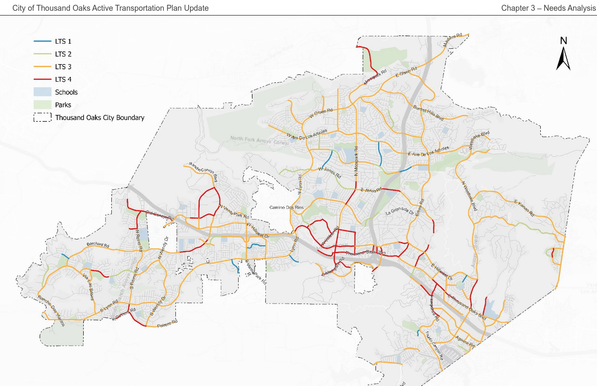
LOL I won't ride any of the LTS 4 and monst of the LTS3 streets here, which is where our city puts their "bike lanes". After seeing the "bike streets" and modal filters in Santa Barbara, California, I think that's the easiest way to make cycling possible in the suburbs here. #BikeTooter
@ai6yr So the thing about putting bike lanes on LTS4 and LTS3 streets is that yes, there IS a better alternative, but that doesn't mean you shouldn't serve the people who are going to cycle on those streets anyway. Invariably, people will cycle on them, so you should do the retrofitting to make them a SAFER space to do it. And last I checked, even shitty bike lanes do increase safety even though they don't ensure it. It should be done, but isn't the ONLY thing that should be done.
@HayiWena @ai6yr if it's an LTS4 after bike lanes are installed, the engineer is bad but also I don't think it's worth installing it for whatever marginal gain you got. You now put a bike lane effectively no one is going to use on what is likely the most significant road, meaning people that don't want real changes can reasonably point to the shitty bike lane and say "why bother".

@DemonHusky @HayiWena @ai6yr

Yeah so frustrating! I've visited so many towns and small cities and neighborhoods in big cities, where the only bike infrastructure was on the main drag. With cars going 45mph and nothing but paint to protect you

We need to bicyclize the small streets first, and the main drag after

In places built during the era of the cul-de-sac, sometimes the main drag is the only route from a to b. That way means we need to create woonerfs, pave the often already existing informal paths that connect one cul-de-sac neighborhood to the next

I think the reason city planners put bike lanes on the main drag is partly that it's visible, so it looks like they're doing something. And partly that it doesn't occur to them that someone might take back streets to get from one place to another

Obviously the solution is to stack the planning committees with bicyclists, and give them a larger budget than the part of the transportation department that deals with car streets

Somehow we need to convince people that the future is micromobility, and any money spent accommodating cars is probably wasted

@NilaJones @HayiWena @ai6yr it's definitely depends on location (and by that I mostly mean political will), but the best case is to do the main streets with the destinations that people are traveling to first, because if you can't get to your destination safely, you aren't biking there.
@NilaJones @HayiWena @ai6yr
But if the options are uncomfortable bike lane on main road and real traffic calming on parallel residential street that is going to build support from non-cyclists for future projects because residents don't like fast cut thru, choose the second option.
@DemonHusky @NilaJones @ai6yr In my town, you can do the main drag with a resurfacing project (every 10-15y) or a big, grant funded reconfiguration (once in a blue moon), but neighborhood traffic calming there's $X0,000/yr that neighborhoods have to compete for in a resident-nominated, >x% sign in support process. This in a town where the public works director and traffic engineer ride eBikes 8+ mi to work &/walk at lunch. Staff has the will, but need resources.
@HayiWena @NilaJones @ai6yr yeah, my main point is: build what you can that will build momentum. Don't build things that have minimal benefit and are going to weaken support for further improvements. Call that stuff out as being bad faith design, and use that in the future to call out the engineer for being bad at their job when their designs don't work.
@HayiWena @NilaJones @ai6yr
But also, build lots of quick build instead of waiting for major resurfacing projects. Flex post separated lanes on our main roads in Cambridge is why we have the best bike/car commute ratio in the country and still improving. (I'm particularly excited about this summer as we basically finish our plan with the last few major roads)
@DemonHusky @NilaJones @ai6yr It would be a lot easier to get support from engineers to do builds if there were Crash Modification Factors, but it's so hard to aggregate and statistically analyze the safety impacts of different types of infrastructure across jurisdictions. Don't get me wrong; most crash modification factors are developed off of tiny samples and weak sauce stats, but given low bike volumes and short timelines we need a statistical approach to demonstrate the CMF.