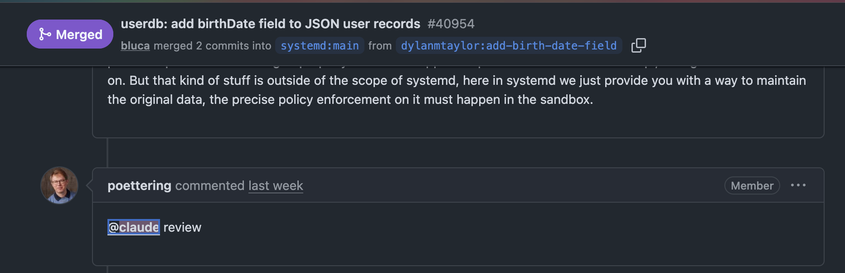

The extent to which core linux projects are laying the groundwork for age verification is very concerning.

I understand why some believe they are compelled to do so, and why others feel that it may be better to implement the most minimal conforming implementation in the hopes of fending off something worse.

But the line must be drawn such that no threat can obligate an OS to collect/store personal information - without that freedom, we face an uphill fight to protect general purpose computing.

IMO the most concerning part of these laws is still the obligations imposed on developers rather than the OS side.

But I didn't anticipate the speed to which system developers would move to implement and accept these awful proposals.

https://mastodon.social/@sarahjamielewis/116212470386958367

@sarahjamielewis

"Do not obey in advance" has fallen on deaf ears, apparently.

@sarahjamielewis ... The nightmarish idea of having to fork linux core.

@sarahjamielewis

I wonder why I'm not surprised that people like Pottering are complacent about this situation.

And it's no surprise that the core distros are complacent either, given how they've been infected by certain schools of thought...

Then there are those who still have the nerve to say that systemd isn't trying to take over all the functions of an OS...

@sarahjamielewis

It's a fairly binary option, comply with the law as written (as best as it can be interpreted anyway) or simply ignore it and see what happens.

If those who are considered to be in violation are prepared to accept the consequences then they should do so.

They would have my support for resisting a stupid and illogical law.

systemd for all of its many faults is making a beginning for those who wish to build a framework. It's not mandatory. I don't see how any version of Linux could force this issue.

For one, I am looking with interest at the Ageless Linux strategy which any version of Linux could adopt as a way to achieve malicious non-compliance.

@simonzerafa @sarahjamielewis

It's a fairly binary option, comply with the law as written (as best as it can be interpreted anyway) or simply ignore it and see what happens.

It's not even complying with the law though... Someone rightfully pointed out, laws are likely to be amended, so rushing to comply in advance will probably not meet later requirements. Other implementations are likely to be contradictory.

systemd for all of its many faults is making a beginning for those who wish to build a framework. It's not mandatory. I don't see how any version of Linux could force this issue.

Putting aside that age-gating is outside of the scope of something that should only be handling init, it's mandatory in that most major distros are built around systemd and use it as a dependency...

@simonzerafa @sarahjamielewis If you want to see something interesting, try removing systemd from your distro. (Don't actually do it. Use dry-run or whatever equivalent you might have.) Just watch how much else gets removed with it...

Some people are actually doing it and it even removes stuff like Pipewire-Pulse. They're back down to Alsa and all the problems it presents...

@nazokiyoubinbou @sarahjamielewis

My bet would be that the Ageless Linux strategy will be the way to go.

Distros will ultimately have to comply with the law (however stupid and illogical) and let users break or sidestep compliance post installation.

The legal folks can point to whomever asks and say that Linux / our distro is compliant and users can break it as they see fit.

I doubt that even the commercial distros will want to pay fines or suffer the other legal consequences even if they can theoretically afford it.

Hopefully the various laws will be eventually be written to be sensible but while we wait for that ...

@simonzerafa @sarahjamielewis As I said in my previous post, rushing to comply in advance will result in them not being able to comply or even breaking other laws (like privacy) in the process. (I would, in fact, argue that they can't comply with these laws due to this and the laws themselves are illegal, so by rushing to comply in advance, they're actually breaking other, more established laws.)

I will agree that the decision should be the user's, but opt-out is NOT letting the user decide. Opt-out is making the decision and then requiring the user to jump through hoops. Ultimately this will also mean your data will be submitted first. That also means opt-out often doesn't really opt-out, it just provides the illusion. Once the data is collected it's frequently already too late.

@simonzerafa @sarahjamielewis As a side note, "just being illegal" isn't the only other option. Fighting back is also an option. Telling them that this can't be legally implemented is an option. Hiring lawyers (fund-raising first if need be, but likely EFF/etc will take it) is an option.

Rushing to comply in advance is intentionally and willfully making a decision to circumnavigate what is best for users because it's what they want (and I might add here that "they" is actually a very small handful of people who are just pushing it through and ignoring/deflecting arguments. Oh, and Claude apparently.)

One thing I'd really like to be clear on is that in complying in advance with that law in one specific area, they're probably breaking a lot of other laws everywhere else.

@nazokiyoubinbou @simonzerafa @sarahjamielewis it is too late. Systemd demonstrated that it was practical to implement. Expect more fucked up verification laws.

@f4grx @simonzerafa @sarahjamielewis You'll have to pardon me if I have to just desperately hope you're wrong. You have a point, but it's not quite too late yet for that to turn around. I hope...

It is a given that if they do capitulate on this it will get worse though, as you say. For one thing, verification through third parties is the only thing that the people who push this stuff through will accept. Eventually the OS will have to demand private details far more complex than birthdates and verify in some sort of way. The OS itself will put a unique identifier on people and even stuff like TOR browser couldn't protect them from being uniquely identified all over the Internet if that sort of thing keeps up.

I will cross my fingers that this will not pan out.

@nazokiyoubinbou

Talking to the legislators who are currently debating the bills and trying to get things changed before they become law, is an option.

https://fosstodon.org/@carlrichell/116261853481052659

The California legislative record reveals that one of the basic problems was that no-one thought beyond smart 'phones and Microsoft Windows, to realize that an "App Store Accountability" law actually encompassed a lot more because of how it defined its terms.

@simonzerafa @sarahjamielewis
#AgeVerification #ColoradoLaw

@simonzerafa @nazokiyoubinbou @sarahjamielewis rush to comply or what...put a disclaimer on Linux that says not valid in California.

If someone installs software not made for CA in CA whose fault is that.

Do they have to actively stop download or installs based on some geo restriction.

@ahasty @simonzerafa @sarahjamielewis Don't forget that by complying with that one law in that one area (which will likely be amended and thus making any compliance in advance rushed out now non-compliant anyway) they're violating laws in California and in other places...

Or they could just not rush to comply in advance and speak to a lawyer. I bet the EFF would be really glad to step in.

BTW, contrary to popular believe among those hitting accept on PRs, Claude is not actually an expert on legal matters (or anything else for that matter...)

@nazokiyoubinbou @simonzerafa @sarahjamielewis

It would be really fun to see a bunch of distros just say no to California. I do hate that these Devs feel like this should be a component of systemd of all things

@ahasty @simonzerafa @sarahjamielewis Agreed.

Systemd has stepped way outside of its scope. Really it has done so in a lot of things, but it's starting to get really extreme as it begins to collect private data about users that they're not even supposed to have direct control over...

IMO it's time to just dump systemd anyway. I suppose it's more of a fallen support beam that broke the camel's back than a straw, but the camel's back is broken and it's time to move on. Systems shouldn't have been built to be so interdependent on systemd which should not be doing all the stuff it's doing...

Really, if they want to comply, since doing so kind of violates laws elsewhere and often enough even the licenses in the distro, they have to make a California-specific distro...

@nazokiyoubinbou @simonzerafa @sarahjamielewis Still on OpenRC to this day. I've never once regretted not having systemd.
@landelare @simonzerafa @sarahjamielewis OpenRC sounds really promising as a really viable alternative. Just the basics with adherence to standards.
@nazokiyoubinbou @simonzerafa @sarahjamielewis OpenRC being called the alternative makes me feel extra old.
@landelare @simonzerafa @sarahjamielewis I mean... It's newer than Unix system five. 😆

@nazokiyoubinbou @landelare @sarahjamielewis

Well I'm older that Unix 5, so I've not really got much to say with regard to all things retro 😂

@simonzerafa @sarahjamielewis I’m really annoyed how this is framed as „law compliance”.

Law doesn’t require an init system to do this shit. Law could be satisfied by a separate service left to rot by everyone else on the planet.

@sarahjamielewis i think what many of "us" (free software likers who are not involved in OS dev its self) have realized in this is how exposed to these demands it actually is.

for a long time i had a fantasy version about how these things are produced, maybe influenced from how open source worked in web development; a lot of light touches building something without much funding. but for linux so much of it is really done through paid development by people working at big companies, and they are quite unempowered to do anything about these decisions other than quit outright.

or maybe better said it's that there is no preexisting whisper network or informal understanding of solidarity on these issues among the people most deeply involved in implementation, so there's not really any muscle to be flexed and push back as a group?

@sarahjamielewis I fear that part of the reason for this is the developer mindset. They see a new problem that they can solve so they start working on it without thinking if they should build this in the first place.
@johan @sarahjamielewis This is why a maintainer's most important job is to say no.
@dalias @sarahjamielewis True but this happens a lot too in non FOSS environments. You have to really hope you have a product owner who thinks about whether the new feature is actually useful
@sarahjamielewis I think the best way to go is to make this a) fully optional and b) as loosely coupled to the system as possible. Next, we need to look into licensing to ensure that if we provide a system meant for the rest of the world w/o age verification, that we can get any legal costs back from users who used it in a country w/ age verification.

@lexLohr @sarahjamielewis

Shifts liability to the user - and away from the OS

@tuban_muzuru @sarahjamielewis Unfortunate, sure, but where else could it be moved? The devs? Then nobody would ever contribute to open source again.
@sarahjamielewis The fact that they’re writing even one line of code for it is concerning already.
@sarahjamielewis given how many Linux machines have no human users for their entire lifecycle that does seem like a solution to a problem that will never exist.
@sarahjamielewis as uncommon as this scenario may be, but I hate that it adds a barier for people who tinker with OSs and publish them online. I hate the feeling that it's assuming that OS development has to be centrilized so that those central entities can be held accountable, I'm affraid that it would set a precedent for adding regulating open source passion driven projects

@sarahjamielewis

there's also a line to be drawn - appliances often have a small rtos in them, I saw a firmware gig for a gaming mouse that used zephyr - so will we need age verification to make popcorn in a microwave? (my microwave already has a mandated child safety door lock which is super annoying)

never mind that all these age verification mechanisms will be circumvented by any determined 12 yr old (or younger)

@sarahjamielewis

From Kagan's dissent in Paxton 2025, she argued that "age verification is never just about age; it is about the end of the anonymous digital life."

@sarahjamielewis for whatever it might be worth, this particular effort looks to have been rolled back.

So far.

https://github.com/systemd/systemd/pull/41179

Edit: as noted later, this doesn't seem to be the case after all -- the request was closed, not merged. 🤬

Revert "userdb: add birthDate field to JSON user records (#40954)" by paramazo · Pull Request #41179 · systemd/systemd

This reverts commit acb6624, reversing changes made to ba1caf0. Revert "userdb: add birthDate field to JSON user records (#40954)" After extensive community discussion, legal review and c...

GitHub
@BrianAllbee @sarahjamielewis That PR looks to have been closed rather than merged, with Poettering seeming to be clear in his opinion that they're overreacting.
@rosaaeterna @sarahjamielewis yah, I missed that. My fault, I won't even blame the UI on my phone. 😉
@BrianAllbee @sarahjamielewis For me the merge of the revert seems closed, so despite it saying that "we agreed" it looks like the revert did not go trough.

@dragonfi @sarahjamielewis well, crap. I missed that.

Good catch.

@sarahjamielewis I don't know if you're familiar with Steam. It requires a sort of age verification to view a video games page. You have to select a birth date to comply with regulations similar to what's happening here. Most folks just scroll down to 1945 or something insane allowing them to view the content and also screwing up any real data. I think this will be the compromise moving forward unless some sort of visual age verification or ID turns out to be a requirement.
@sarahjamielewis
I can't find myself objecting to a ~/YOB file.

@quoidian @sarahjamielewis

I can. That means that all apps need to be able to read from my home directory

@johntimaeus @sarahjamielewis
most apps do read and write, perhaps not execute, in the home directory, don't they?

@quoidian @sarahjamielewis

Most, yes. Typically interacting with sub directories that are easily tightened with selinux.

To be compliant with the CA law, by my understanding *every* application would need to access the birthday data.

Which then raises the next stupid question raised by this stupid legislation:
What is an application?
Does it include vi, less, and curl? All of these can be used to browse the Internet. What about image rendering software?
What if I 'sudo /usr/bin/google/chrome'?
When was root born?

The whole thing is completely dum-dum idiocy, pushed on lawmakers under the "think of the children" banner by techbros who dream of a day when all compute is rented by the minute.

@sarahjamielewis Can't wait until we start seeing encryption locks on motherboards /s
@sarahjamielewis A problem is that opposition is necessary, but no single person or project can be blamed for feeling forced to comply. Backlashes can hit hard.
Developers and distros should agree on a shared, strong response. Such as: "If the law passes, we will stop distributing to the USA and prevent users there from using our illegal software through updates that will brick their devices, including servers". "Malicious" compliance along those lines could raise corporate lobbying for repeal.
@sarahjamielewis
systemd's development has been guided by huge conglomerates, targetting use cases in cloud, large clusters and hyperscalars, for at least a few years already.
They're not "compelled to do so", they're doing what spineless corporations do all the time: offering compliance happily in advance.

@sarahjamielewis Expecting corporations or commercial entities (which includes the Linux Foundation) to resist government regulations is bound to disappoint.

The people to blame are those that passed the laws.

@sarahjamielewis

is this because our vision of core linux being maintained by altruistic independent developers located all around the world is false?

is the reality that many of the core developers and those with power are corporate secondees?

@sarahjamielewis I knew I'd regret systemd at some point. Time to go back to init scripts. (Yes, I know the problem is much bigger and more widespread than systemd, but it's pissing me off in particular because it's not even the OS or a distro, and yet they're rushing to comply)

@sarahjamielewis the only valid action is to #RefuseToComply and ban the #Cyberfascists who push that shite publicly!

  • Make them known for that so noone will ever hire or accept them in their projects!
    • Refuse to work with/for them (in the same company/project) until they have undone harm caused WIT INTEREST!

https://infosec.space/@kkarhan/116270391364999713

Kevin Karhan :verified: (@[email protected])

@[email protected] thus the only valid reaction is to *proactively refuse to comply* and *actively sabotage such cyberfascidt efforts! - I mean, what's next? - #Russia's #Roskomnadnozr demanding *"#KYC"* of #Users for using #WiFi? - *"P.R."* #China's *"Cybersecurity Administration"* demanding system-wide blocking of #VPN & @[email protected] / #Tor? Just like noone should comply with that #cyberfascism, so should noone comply with #US-based cyberfascism either! - Use #Monero and give #ITAR the finger… - Refuse to finance #terrorism by refusing to create taxable revenue for U.S. corporations! I certainly won't comply with cyberfascism in @OS1337 and any *"#AgeVerification"* is #fascist bullshit under false pretense that needs to be outlawed!

Infosec.Space
The Engineer Who Tried to Put Age Verification Into Linux

Dylan, useful idiot with commit access, pushed age verification PRs to systemd, Ubuntu & Arch, got 2 Microslop employees to merge it, called it 'hilariously pointless' in the PR itself, then watched Lennart personally block the revert. Unpaid compliance simp.

Sam Bent