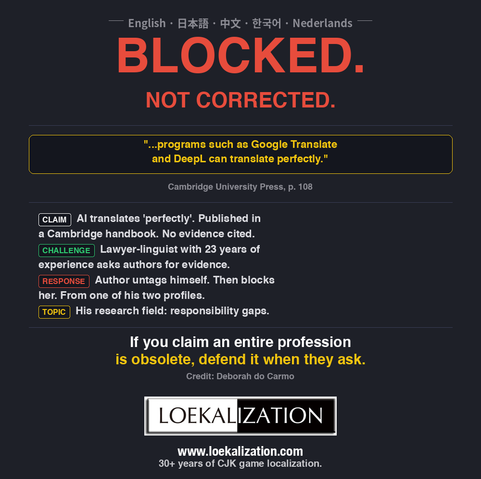
A Cambridge University Press handbook states that Google Translate and DeepL "translate perfectly."
A lawyer-linguist with 23 years of experience asked the authors for evidence. The response? One author untagged himself from the discussion. Then blocked her from one of his two LinkedIn profiles. No correction. No clarification. No engagement with the substance. From a philosopher who writes about responsibility gaps. This is how it works: academics make claims about translation in publications that inform law, policy, and public opinion. They don't consult translators.
They don't cite evidence. And when a domain expert challenges the claim, they disappear. The problem is not one professor. The problem is that "AI translates perfectly" now sits in a peer-reviewed reference work that lawyers, policymakers, and researchers will cite for years. And the people who put it there won't defend it. If you make a claim about an entire profession in a Cambridge publication, you should be willing to stand behind it when that profession asks questions.
Source: Lode Lauwaert & Ann-Katrien Oimann, "Moral Responsibility and Autonomous Technologies", in The Cambridge Handbook of the Law, Ethics and Policy of Artificial Intelligence (Cambridge University Press), p. 108. Credit: Deborah do Carmo for raising this issue and pursuing it with professionalism despite the silence. #GameLocalization #Translation #AI #CambridgeUniversityPress #AcademicIntegrity #Localization