Fossil gas is a feedstock for the Haber-Bosch process used to make fertiliser (but invented for making early 20th Century munitions).

Gas has been plentiful and cheap in the Persian Gulf and so it has made sense to build out decades of infrastructure to make fertiliser at point of source.

Consequently, about one third of the world’s fertiliser demand has been met by moving it through the Gulf and out into the wider world.

And now that’s not happening…

…For the northern hemisphere, fertiliser for next year’s growing season will be needed towards the end of this year.

We can expect food prices to rocket.

And in the UK, we have only a single fertiliser manufacturing plant left

https://overcast.fm/+8dw8WNRF4

Iran, Food & Fertiliser — Macrodose

On this week’s Macrodose, James Meadway looks at the how the US-Israel war on Iran will impact global food prices (3:07), and how data centres are the newest target in modern warfare (9:47).Subscribe to support the show at ⁠⁠⁠⁠⁠patreon.com/Macrodose.⁠⁠⁠⁠⁠ Your pledge is a donation supporting free public education; perks are thank-you gifts for your support.Got a question or comment? Reach out to us at ⁠[email protected]⁠.To learn more about the work we do at Planet B Productions, head to ⁠planetbproductions.co.uk⁠.Apply for Planet B’s Digital Content Lead job opportunity: https://planet-b-productions.homerun.co/digital-content-lead/enListen to Death In Westminster - a new documentary podcast from Planet B Productions & Novara Media: https://novaramedia.com/category/audio/death-in-westminster/#the-station

…If it’s not already obvious, we need to be instituting a Dig For Victory style programme, except it won’t be about ‘victory’, it will be Grow Food To Live Better.

We need national communal regenerative farming started now. Which among other things, means compulsory land orders on wasteful tracts of privately-owned land.

But I guess we’ll wait until hunger ravages because we have one of the stupidest governments of my lifetime in power

…I’m a climate and biosphere collapse-concerned web designer. So aside from shit posting like an old fart, I tend to post about environment and tech.

Being a tech heavy community, Mastodon tends to prick its ears up a bit more when I post about tech. Posts about food systems like the above, not so much.

So by way of a lead in to where this thread is going shortly (and may subsequently continue), here following is a *tech* angle on the Straits of Hormuz being more or less closed…

…The following is taken from a transcript of something I’ll share a link to in a bit.

“The majority of crude oil that passes through the Straits of Hormuz is classified as sour crude with a high sulfur content, and when you refine sour crude, you produce elemental sulfur as a byproduct.

When we pull ~17 million barrels a day of sour crude off the market, we’re not just losing fuel, we also are potentially losing sulfur…

…“And sulfur’s the feedstock for sulfuric acid and sulfuric acid is what we use to leach copper and cobalt out of the ground in places like the DRC and Zambia. The two of those countries together supply over a sixth of global copper and more than 70% of global cobalt.

So the little oil snafu in the Straits of Hormuz could lead to no marginal copper or cobalt.

No transformers, no grid expansion. No grid expansion, no data centers, which means no EV charging infrastructure, no AI build out, etc…

…“So this chain – Hormuz to sulfur, to acid, to copper, to transformers, to compute – really has very little to do with gasoline prices.

But it’s one example of the complexity and risk of our interconnected just in time system.”

- - -

That’s the tech lens. Next up, linking back to food at the top…

…“So here’s another hotter effect: Natural gas.

Qatar sits inside the Persian Gulf. They’re responsible for roughly 20% of all globally traded LNG.

Europe spent two years after Ukraine’s invasion rewiring its entire energy import infrastructure away from Russia’s pipeline gas towards US and Qatari LNG.

So European dependency now runs directly through the closed Straits of Hormuz. And unlike oil, there is no overland alternative for LNG…

…“And the [LNG] price spikes are already hitting European importers and futures markets.

There’s also nitrogen fertilizer. Over 40% of internationally traded nitrogen fertilizers originate from or are navigated through the Persian Gulf.

Nitrogen fertilizer starts with natural gas, which is then the feedstock for ammonia, which becomes urea, which goes on the fields around the world, and a disrupted planting cycle could translate into food price inflation very quickly, within months…

…“And food inflation in import-dependent nations that have very thin fiscal reserves like Egypt or Pakistan or Turkey, becomes political quite quickly. A recent guest on TGS, Craig Tindale, labeled this situation as a potential globalized Arab Spring…
…“Beyond energy, fuel, and inflation, there’s also the supply chain precursors for something like 6,000 distinct products that move through the Straits of Hormuz. Thousands of products, from polyester to medical plastics to semiconductors. They all use petroleum as precursors to their physical products or in the process that makes them…

…“The wide boundary point here is this.

We’re not watching an oil price shock.

We’re watching the exposure of a civilization that organized itself around maximum efficiency and zero redundancy, and built a single point of geopolitical failure into the center of a global physical economy, the Straits of Hormuz and the situation there is the most consequential single location on the planet for the foreseeable future.”

…At this point, I’ll share where the transcript across the preceding 8 posts is from.

It’s a half hour podcast episode:

‘Wide Boundary News: The Iranian War, Rising Gas Prices, and the Single Point Failure’

Audio: https://overcast.fm/+BTumXe5m9g
Text [pdf]: https://www.thegreatsimplification.com/wp-content/uploads/2026/03/Frankly-130-Transcript-WBN-10-March-2026.docx.pdf

I’ll go on to share a bit more but I recommend listening to the whole thing.

Wide Boundary News: The Iranian War, Rising Gas Prices, and the Single Point Failure | Frankly 130 — The Great Simplification with Nate Hagens

This week’s Frankly is another edition of Nate’s Wide Boundary News series, where he invites listeners to view the constant churn of headlines through a wider-boundary lens. In this installment, Nate addresses the U.S. and Israeli military offensive against Iran and traces the reverberating effects that extend far beyond the conflict itself, starting with what the closure of the Strait of Hormuz means for a civilization that routes a massive share of its physical economy through a single maritime corridor. Nate begins with the core misperception that oil registers as roughly 3% of GDP by cost, when in reality it underpins 100% of economic activity. Building off of that, he outlines a series of second- and third-order effects that rarely appear in headline coverage, including hidden dependencies on sulfur, liquefied natural gas, and nitrogen fertilizer that connect the Strait of Hormuz to mining operations, European energy security, and global food systems. He also explains the stock-and-flow imbalance…

…The next bit gets into military asymmetry and dependencies.

“In ecology and economics, stocks are what’s accumulated and flows are what moves through them.

The problem is that flows feel infinite right up until the stock runs out. And I refer to this as the slurping sound with respect to oil extraction.

Stocks and flows apply to military capacity as well…

…“The US has historically had the most impressive offensive flow, capacity: shock and awe, precision strikes, the ability to put bombs on target anywhere on earth, within hours.

But the stocks, particularly the stocks of things like interceptor missiles maybe getting dangerously low.

I’m told by people who follow this closely that the US and Israel have been firing 5 to 7 interceptors for every incoming Iranian missile…

…“And by the way, each of those interceptors cost millions of dollars and takes months to manufacture.

A PAC-3 interceptor costs like $4 million. In contrast, a Shahed drone made in Iran costs around $50K. That’s a cost-exchange ratio of about nearly 100:1 in Iran’s favor. So Iran doesn't need to win the Air War outright. They probably just need to keep up intermittent launches long enough to limit what the US can shoot back with…

…“And Secretary of State Rubio said publicly that Iran is producing offensive weapons faster than the US and its allies can manufacture interceptors to stop them. And the Secretary of War suggested this war may go on for months.

The US is historically structured for periodic high intensity bursts, not
sustained engagement. The assumption has always been overwhelming force, short duration, then restock. But that model does not hold if a conflict drags on. Especially a large conflict.”

…If there’s a single sentence to take away from the above, it’s:

“Flows feel infinite right up until the stock runs out”.

- - -

But that’s enough for now. If it’s too much for you, then sorry, mute or block me.

I’m not going to be not interested in this stuff.

…People who have read the entire thread (most of it are not my words) may have noticed:

“about one third of the world’s fertiliser demand” is me voicing James Meadway on the podcast linked at he top.

“Over 40% of internationally traded nitrogen fertilizers” is me quoting Nate Hagens.

Obviously, whatever the actual numbers are matter and are consequential. But for the purposes of this thread, please treat them as a heuristic, a window into astonishing complexity and fragility focused into…

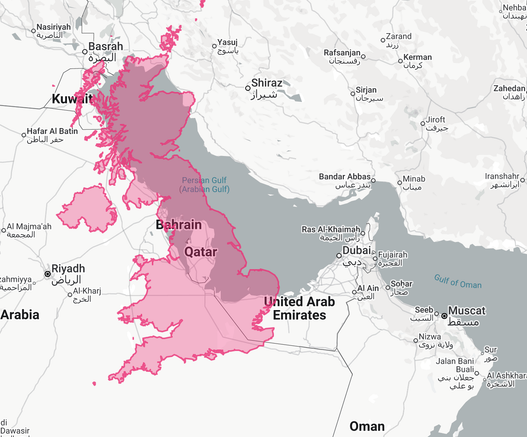
…the Persian Gulf and the Gulf of Oman, bodies of water 200 miles wide at their widest and about 750 miles from Basra in the north to Muscat in the south.

Which makes it roughly the area of the UK.

Map courtesy of https://thetruesize.com

…I keep adding to this thread 😬

The reason I said https://mastodon.social/@urlyman/116232633085736906 in this thread’s post #3 is because I understand that fertilisers are a sort of Faustian pact:

Yes, they massively ramp up yields, but that has an *enormous cost*:

A. Modern industrialised agriculture accounts for about 1/3rd of greenhouse gas emissions
B. It is denuding soils, polluting water: https://mastodon.social/@urlyman/116238945720345864
C. A+B combined are loading further precarity into our food systems: https://mastodon.social/@urlyman/111555969227295370

…Further up this thread you’ll find a segment about ‘sulfur’ (American spelling). But don’t just take Nate Hagens’s word for it, West Point are waking up to the Netanyahu/Trump/Hegseth/Rubio fustercluck too.

(ht @PaulWermer )

https://www.theguardian.com/world/2026/mar/19/west-point-analysis-iran-war-costs

West Point analysis warns that strait of Hormuz blockade will strangle US defense industry

Report shows how minerals critical to defense readiness have seen a ‘near total’ disruption in seaborne trade

The Guardian
@urlyman Know much about #composttoilets ? Food and water issues seem to meet up round the back...

@SusiArnott my knowledge of composting toilets is not flush.

Cistern change, not climate change, or something

@urlyman want to find out more for upcoming handbook on Food and Water but seems like nitrogen and phosphorus could be returned to soil at the same time as water use (and pollution) are reduced... Pre-water closets, is that what happened anyway? Obvious need to avoid disease transmission (yuck factor will be related:)
#foodsecurity #sustainability

@SusiArnott @urlyman Here are three small companies from Germany that offer compost toilets and/or have processing plants to turn the contents into humus.

Apparently you can compost also yourself in the garden in a closed composter, but that needs two years time until you can harvest your first humus.

https://goldeimer.de/
https://trobolo.com/
https://finizio.de/

Alle für Klos! Klos für alle! | Goldeimer

Soziales Klopapier, Trockenklos auf Festivals und im Garten, Part of the Viva con Agua Family. Unterstütze unsere Vision mit einem Kauf oder einer Spende!

Goldeimer
@urlyman And damage to the soil biome and water bodies due to nitrate concentration.
@urlyman Modern industrialised #agriculture is not only contributing to #climatechange & reducing #soil #fertility & #biodiversity, but is also killing off #insect #pollinators. The result (if we aren't very careful) will be a drastic reduction in #Food #production just as the global #human #population reaches 9 billion in 2050. We don't want Thomas Malthus being proved right!
@urlyman do not mute or block him. if learning facts is difficult, pace yourself. a job for chocolate and television.
@urlyman and with the US stock of weapons quickly depleting, what will happen in other regions? North Korea against South Korea? China and Taiwan? Russia in Europe? Who will use this opportunity to use force?

@urlyman

They are producing defensive weapons. The USA is firing on their homes.
Typical of a US pol to use language to spin the narrative.
They are , amazingly enough, permitted to produce weapons to defend themselves, and to strike at the people who struck at them first, including if those persons are based in someone else's country, because their own country is too far away, which in turn begs the question, WHY DID THE US START DROPPING BOMBS?
The rant took over: I decided to let it run

@urlyman One should obviously compare with the cost of the damage the incoming drone or missile is likely to do, not with the cost of it.

@tml Sure.

My point of the above thread is not to cast false certainties or wash away complexity. It’s to try and bring to the fore the fragile interconnectedness that the Secretary of War and his dick-swinging colleagues are blowing up

@urlyman @tml But the relative depletion dynamic is about the cost/effort of manufacture, and that only.

@martinvermeer the Straits of Hormuz are the epicentre of the mother of all flows. Nothing in that context is about one thing only. Everything has nth-order effects.

@tml

@urlyman excellent thread. What is most mind breaking is not recognising that most commercially lucrative and effective does mean not best in critical times.
Fact that so many industries are caught back footed is telling very unpleasant truths how world economy runs.

@urlyman I'm afraid that there are more than one such points, it's just that this is the currently smothered one.

An attack by China on Taiwan, for example.

Day 8: Corona, Brittleness and Efficiency

The last years have been focused on making the economy more efficient. But the corona crisis now shows us the downside of our efficiency. The economic systems in turn have become more brittle.

Literarily Starved

@urlyman
I'd call the Panama Canal the 2nd consequential location on the planet, beside the Suez Canal.

After all we are not much further in developing trade independent from geography than in the middle ages.🙄

@grootinside there are indeed lots of choke points. We sure do love a shortcut.

Shorting the deep time reservoirs of oxygen in the air and carbon in the ground looks to be our undoing

@urlyman this is not a built problem. Its a natural result of geography and resource distribution.

@mikebabcock I agree that geography and resources are culturally deterministic. But those dynamics could have met a different mix of ideas about how to be in the world. And that would have had a different quality about it.

Anyway, it didn’t, and here we are

@urlyman you said "built a single point of geopolitical failure into the center of a global physical economy" and that's what's false. Nobody built that point of failure in, its a facet of continental drift and resource locations. If the world's major oil supplies were in India instead, Hormus wouldn't matter.
The USA *does* have better oil suppliers, like Canada (52% in fact).

@mikebabcock I’m relaying the words of Nate Hagens, hence the quotation marks and the references to him as the source elsewhere in the thread.

I think he has interesting things to say about our cultural predicament.

I know how plate tectonics work over deep time and so does he but that’s not the point he is trying to draw attention to

@urlyman Any current shortages are just profiteering.

But if the current stupidity goes on for some months, then yes, there will be a simultaneous uptick in energy prices and fertiliser prices. Anywhere dictatorial that relies on rural voters to outweigh urban voters (hello, Turkey, Pakistan) will be in trouble.

Don’t forget the recursive effect of oil price increases on shipping which affects costs of everything being shipped. Hello, inflation.

@BashStKid Bash, I’m exhausted, so my post might not explain this well. It’s not “profiteering to raise prices on goods you do not think you can replace.

If I have gas ¡in the tanks at my service station purchased at price x to sell at price y, the moment my ability to procure more is threatened, the more valuable that gasoline becomes. It now has to pay my immediate AND my future bills. This happens immediately, when supply is threatened, not a few months down the road.

@MiriShuli That is literally the definition in most European law, strengthened by any evidence of anticompetitive collusion with other vendors.
The practical point is that regulators rarely target the end of the supply chain, but higher up, in this case the regional oil suppliers, linked to ports and the primary or secondary oil storage for distribution. They’re usually doing the major price fixing, and collusion with other majors.
@urlyman "towards US and Qatari LNG" - and thats the key part here. USA's actions mean that the Qatari LNG is unobtainable currently which suits the USA just fine . Trump did say 'we're going to get very rich' .
@alanbuxey what are the chances that the Trump admin thinks the US is well insulated but isn’t?
@urlyman and our christian-democratic party and their ministry for energy is run by gas-lobbyists. Great combi for real trouble.