 🐈⬛David Sommerseth
This is sad 😢
UPDATE (2026-03-02): This toot has gotten a lot more attention than what I would ever anticipate. Some clarifications are needed. A follow up is here: https://infosec.exchange/@dazo/116158898983233133
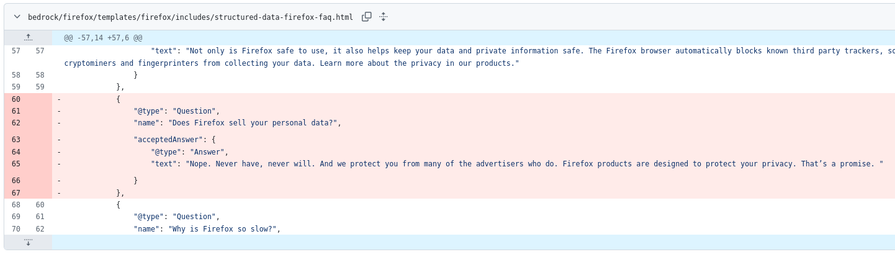
This is sad 😢
UPDATE (2026-03-02): This toot has gotten a lot more attention than what I would ever anticipate. Some clarifications are needed. A follow up is here: https://infosec.exchange/@dazo/116158898983233133
#Mozilla has lost their ground and is now in a free fall into a sinkhole. I doubt they'll ever get out if this again unless they do a 180-turn within the coming days. Mozilla has lost a lot of trust and credibility over the last couple of years. This accelerates that distrust even more.
https://blog.mozilla.org/en/firefox/update-on-terms-of-use/
It looks promising, until you hit the last paragraph (my highlight)
In order to make Firefox commercially viable, there are a number of places where we collect and share some data with our partners, including our optional ads on New Tab and providing sponsored suggestions in the search bar. We set all of this out in our privacy notice. Whenever we share data with our partners, we put a lot of work into making sure that the data that we share is stripped of potentially identifying information, or shared only in the aggregate, or is put through our privacy preserving technologies (like OHTTP).
In my book, that's indirectly selling data.
Goodbye, #Firefox.
Update (2026-02-26): So this change happened exactly 1 year ago. I saw the date and missed the year. And since Mozilla is still doing the privacy whitewashing, there is no reason to trust Mozilla more today than a year ago. Leaving Firefox is unavoidable. The current Mozilla leadership does not deserver much trust from the community.
@graves501 @theorangetheme @dazo
I went all-in on @zenbrowser and am really loving it. Waterfox on my phone for now.
Anything using Chromium is a non-option to me. Sure, let's just further cement Google's control of web standards. :-P
@EdCates @graves501 @theorangetheme
Agreed! We don't need to repeat the Internet Explorer fiasco.
@dazo @graves501 @theorangetheme
Exactly! It's why Vivaldi fans give me a headache.
@mxk @EdCates @graves501 @theorangetheme
What "gives me headaches" when a browser render engine gets a monopoly, we easily end up with the complete chaos we had with Internet Explorer roughly 20 years ago. Web sites had to account for IE3, IE4-5 and IE 6 version plus the "minority others". A web page would end up behaving completely different across all these aspects. The Opera browser was at that time one of the engines which was close to most compliant to the web standards.
Microsoft extended IE without caring about standards and since it was the dominating browser at that time, they didn't care much about the standards. They had their own standards. But they also didn't care about compliance between their own versions even.
Web developers at that time focused on getting the IE experience as best as they could and then came the minority browsers.
This can easily happen again if Chromium ends up without real competition. Then Google can do whatever they want with Chrome, drop caring about standards since it "owns" the browser scope. And by doing that, websites starts to adopt to make sure web sites renders best on Chrome, resulting in people being locked in with Chrome. And somewhere along this path, Google can ditch the open source Chromium - just as they try to squeeze out the third-party Android apps these days.
By not having a real competition in any market space, we users/consumers ends up as the losing part sooner than later.
@mxk Well, what to say ... Ignorance is bliss, perhaps?
The same arguments can be used about any type of politics. If you don't care about the details of the politics, you have not much to complain about when reality hits you.
Your arguments are common. And most users just want "something that works". Everyone gets that. Everyone, even I, want that. But if nobody fights for freedom, the freedom will eventually be taken away from everyone - also those who didn't care to join the fight. That's the reality.
But there must be room for some pragmatism. Sometimes you need to use what works while fighting the good cause. But that is not the same as ignoring there is something to fight for.
@mxk It's naive when you stand alone. Just as it is naive to call a single waterdrop a sea.
When individuals unite, it becomes a movement which can cause a change.
How else do you think Linux became the dominant server OS on the Internet? It all started with with a single individual saying:
I'm doing a (free) operating system (just a hobby, won't be big and professional like gnu) for 386(486) AT clones.
Now it is available for lots of platforms and used "everywhere". There are tons of such examples.
People must unite. And even "going with the flow" of what "everyone else uses" is exactly the same thing. You've just joined a different movement.
If nobody does nothing, nothing will ever change.
@dazo Linux got adoption due to its features, not because of politics.
Some people might work on it out of idealism, but wide adoption and financing come from Linux actually being a useful project.
Linux got adoption due to its features, not because of politics.
Not quite so simple. You skip why Linux was created in the beginning. It was because there was no affordable Unix alternatives available to students.
All the features we take for granted in Linux today was lacking in the beginning. It was a pretty limited OS in the beginning, only supporting a very limited set of hardware.
But Linux got adoption because it was a community wanting to builds something better, which happened to happen in the open. And it gained features through open collaboration. It was not a commercial drive itself which gave Linux the adoption.
What gave adoption was the freedom it delivered. You can call freedom a feature in this context. And others have tried to stop Linux from gaining success over the years; from Microsoft calling it a cancer, to SCO suing it for copyright issues.
The reason more and more companies decided to bet on Linux, support it in various ways, the reason some companies tried to fight Linux ... they are all based in (corporate/business) politics.
What Mozilla is doing is contrary to this. And Firefox is the immediate collateral damage, which makes the whole browser scope more difficult unless a sustainable alternative surfaces. The Chrome/Chromium dominance today is therefore a considerable threat for an open, free and sustainable browser experience.
We have already been down this path before, with Internet Explorer. We don't need to repeat these mistakes. In that sense, the Chrome browser "saved us" back then. Now Chrome/Chromium has become the new threat.
@dazo even if I would buy into your position:
Which browser would be the freedom haven that people form a community around and enjoy the freedom.
Firefox isn't a community project in any serious fashion, nor is chrome.
If you look for that type of dynamic, servo is the best bet we currently have. And it's just not there yet, to be usable as your daily driver.
@ohir Sorry for the late response. I've only heard briefly about it.
From a few simple tests ... NetSurf might have a future, but it would need to improve the page rendering by a lot. It can't even display a fairly simple site like lwn.net with the right colours.
I've added a comparison from another "lightweight" browser, Epiphany from GNOME.


@dazo
> NetSurf might have a future, but it would need to improve the page rendering by a lot.
And here we, I mean we FLOSS creators and users, have the biggest problem: we are used to say "they would need to improve". "They" are supposed to have resources to improve. Or "they" are supposed to find a backing corpo funds and then do something for "us". Uh, then we'd balk at "them" for being not enough pure having a corpo sponsor.
Time to start thinking about reversing this trend. What about scaling down the features to the bare bones that are needed for _useable_enough_ environment in which a small teams of passionate hobbyists can maintain useful tools? I can't browse youtube nor github with NetSurf. Yet it is good enough to browse Wikipedia.
I would like to see the webs being accessible from the NetSurf and similar engines. Or at least that 0.1% of web content that matters.
@ohir I agree that a browser doesn't need all the fancy bells and whistles. But when it struggles to render a very basic and, by design, very simple HTML page - then the bar for a MVP is set too low.
LWN is appreciated by lots of readers for being lightweight and avoid all the fancy web features so it renders well on most devices. And that's the level Jon Corbet is aiming for on that site. So it is a pretty good check to see how well a minimalistic browser engine works.
And that's why I say NetSurf is not ready for primetime yet. But it may get there. And I hope it will improve with time.

 The Orange Theme
 Andrew Graves
 Ed
Ed mxk
mxk ohir
ohir mystixa 🎶🎧