 Kevin Tavukciyan
 ✧✦Catherine✦✧
please enjoy: my Wasm-hosted, Wasm-targeting build of Clang/Clang++/LLD: a self-contained, 25 MiB (gzipped) pure function
https://www.npmjs.com/package/@yowasp/clang
https://www.npmjs.com/package/@yowasp/clang

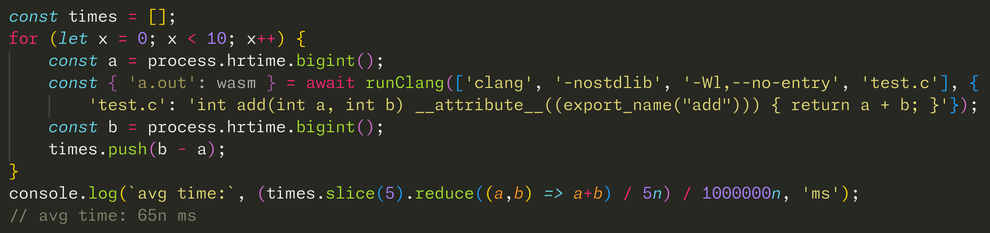
this C compiler is really fast! it can compile and link a simple C program in ~65 ms on my machine. (this involves spawning three Wasm "processes")
on the same machine, running the same command with a very similar Clang build natively takes ~80 ms.
this is fast enough for update-as-you-type live coding!
@snowfox @whitequark @s0 I don't think any of those support multiple pipelined transactions so it would be super slow.
Would be interesting to imagine what a pipelined variant would look like though
@s0 not bad, actually. Build once, optimise closer to the end user CPU
@whitequark this is great
import { runClang } from "npm:@yowasp/clang";
async function c(statics, ...rest) {
  const { "a.out": wasm } = await runClang([
    "clang",
    "-nostartfiles",
    "-Wl,--no-entry",
    "-Wl,--export=malloc",
    "-Wl,--export=free",
    "input.c",
  ], {
    "input.c": String.raw({ raw: statics }, ...rest) + "\n" +
      'char* __Run(char* input) __attribute__((export_name("__Run"))) { return run(input); }\n',
  });
  const module = await WebAssembly.compile(wasm);
  const enosys = () => {
    return 52;
  };
  const instance = await WebAssembly.instantiate(module, {
    wasi_snapshot_preview1: new Proxy({}, {
      get(o, k) {
        return enosys;
      },
    }),
  });
  return (...args) => {
    const encoded = new TextEncoder().encode(JSON.stringify(args));
    const inp = instance.exports.malloc(encoded.length);
    new Uint8Array(instance.exports.memory.buffer, inp).set(encoded);
    const ptr = instance.exports.__Run(inp);
    instance.exports.free(inp);
    if (ptr) {
      const u8 = new Uint8Array(instance.exports.memory.buffer, ptr);
      const str = new TextDecoder().decode(u8.subarray(0, u8.indexOf(0)));
      instance.exports.free(ptr);
      return JSON.parse(str);
    }
    return null;
  };
}
const run = await c`
#include <string.h>
#include <stdio.h>
char* run(char* input){
  char* out = 0;
  input[strlen(input)-1] = 0;
  asprintf(&out, "\\"hello, %s", input + 2);
  return out;
}
`;
console.log(run("world")); Alex Rock
 Toni Aittoniemi
 s0 Is Not A Sysadmin
 Andrew Zonenberg
 SnowFox
 abrasive
 Мя ��
Мя �� Ted Mielczarek
 Joe Groff (1M Context)
 mal3aby
 Koutsie
 em♡
em♡