 Peter Krefting
If a #Commodore64 starts up with an Out Of Memory error, that's probably not a good sign.

Still the most beautiful home computer ever made, IMHO.

Hmm, neither the #CommodorePlus4 nor the #Commodore16 can see the SD2IEC over serial. The Plus/4 doesn't see anything on cassette, and when I connect either Datasette (I have two) to the C16, the screen goes all weird.
I don't think either of these are quite healthy.
The #Commodore16 does work with my SD2IEC when I power it from its tape port (via adapter).
For the #CommodorePlus4 I was told that cassette not working was due to a bad CPU, so I got me a replacement and now that works.
https://www.freepascal.org/~daniel/8501/
Now to get a proper PSU. Or just an adapter cable for the aftermarket C64 PSU I got.

This one doesn't give any signs of life. No power LED, no serial bus reset, nothing.
I'm not sure I tested it when I got it, or if I only tested the other unit.

Oh, this is nasty! Look at that thing where the fuse is supposed to be...

Apparently it's just the power switch that's bad. (And the fuse needs to be replaced of course).
It's nice to have colleagues who know their way around hardware.


@nafmo polyplay sells them:
https://www.polyplay.xyz/Netzschalter-fuer-C64-C128D-DCR-VC20-1541-II-1581
#PCBWay delivers.
But I need something to pull the TED out without destroying it. It's not as simple as it looks in all those videos the repair guys keep publishing :-) So far all I've manged to do is to make scratch marks...
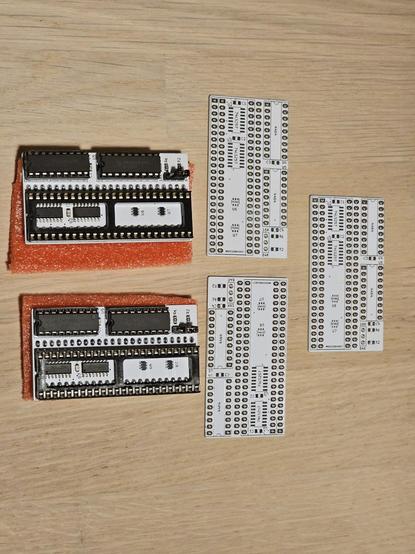
So, does this make it a Commodore 64? Or maybe a Commodore Minus 4?


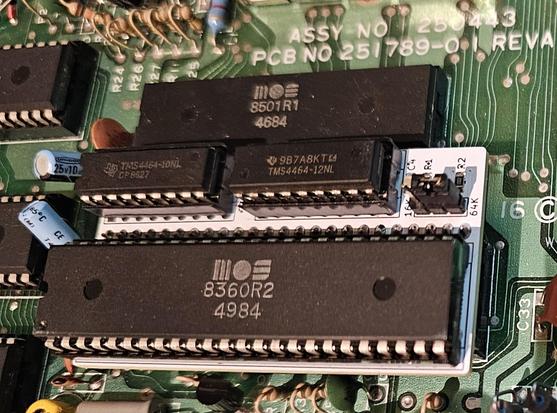
Uh oh, that is not good. The second unit gives me a black screen with the expansion installed. I pushed in the RAM chips and got some junk on the screen instead.
Moving the jumper to 16K makes it boot up again, so at least I didn't kill the TED chip (I *did* bend its legs slightly on extraction, so I was worried).
So, are the RAM chips on the Fixteen bad, or the assembly? I have no clue. I'll lend it in, but turned off. At least the other one works fine.

Sometimes it shows garbage on start, sometimes just a black screen. I'll leave it in, disabled.


I found a seller of 4464s on eBay in a France and ordered two. I popped one of the ones that came from China and put one in, and now the #Fixteen works! So now I have two "Minus 4"s!
That means I have a spare 4464 in case one of the others break down later.
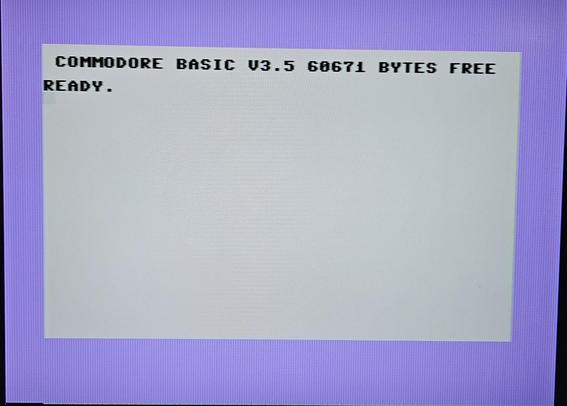
*That* looks weird. I connected a USB gamepad through a mouSTer *and* a C64-joyport adapter I got with the machines, and all gamepad directions also trigger a set of keypresses that I don't see with a regular joystick..
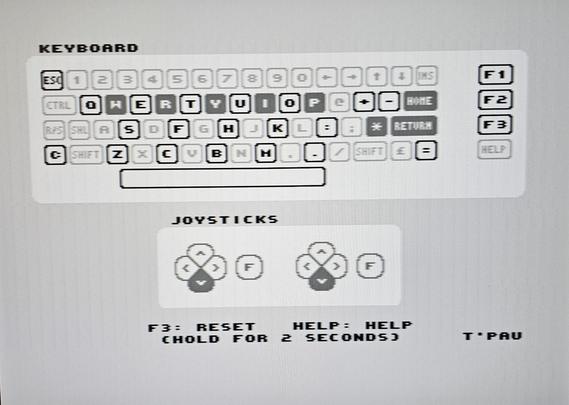
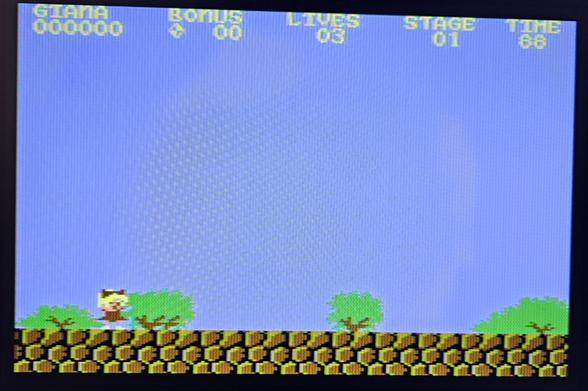
@root42 No to both questions. Since I have one working, I didn't want to risk breaking that. PCBWay did mention something about assembly issues with one of the devices, so that might be it. I also do not have any chips of this type.
But I'm happy with one working. I did order two to be assembled in the hope of getting one working unit.
Now what to do with the three remaining naked PCBs I got (minimum print order was five).
@root42 With a keyboard layout putting the equal sign at the bottom right, past the right shift key? I don't think so.
But the colour scheme is not bad.
@root42 I need to read up on chips to see which one is which.
I don't know the history of this unit, I think my father received it as broken from someone.
@root42 Can any of the diagnostics cartridges be flashed onto a Retro Replay?
It can boot into the Retro Replay cart. With that I can get it to boot into BASIC with "38911 bytes free", but FRE(.) now reports -26627.
@root42 It was a wild chance, I got a Retro Replay when those were new and hot (this stuff has been sitting in storage since 2006…), so that's what I have to work with.
Maybe I should just keep it as a donor for a SID to a future 64 Ultimate?
@root42 *If* I can find a diagnostics cartridge that I can flash to the RR, I'll have a go at that.
I'm a software engineer, not a hardware one. I'm horrible at fixing hardware. 🙂
@root42 For reference: I used FMGPUCCRBRR from https://csdb.dk/release/?id=39383 to create a cartridge image that I flashed on the RR.
The boot menu doesn't display on the broken C64, but the programs do start.
@root42 I don't think so.
https://gitlab.icomp.de/c64-dev/replay/-/tree/main/flashutility?ref_type=heads is the closest I have to documentation.
Looking at the old files I have, I bought this in 2000 or 2001 :-)
(EDIT: It was released late 2001)
@root42 It can run anything that runs on Action Replay hardware, since that is what it was set out to emulate.
(I grew up with a TFC3, so I never quite did get along with it)
@root42 There was also some stuff that had come loose, but soldering that back up didn't help.
We'll try switching the bad chip (at some later point in time) and see if that helps.
I'd really love to have a proper localized C64. They had stopped selling them by the time I bought mine.
@root42 I've ordered a set of 4164 chips now. Maybe I'll get lucky.
The board shows signs of having been tampered with before, perhaps a previous attempted repair that didn't work?
@root42 This seems to indicate a single bit failure, which, according to the schematics, matches the one chip that was not the same as the others...
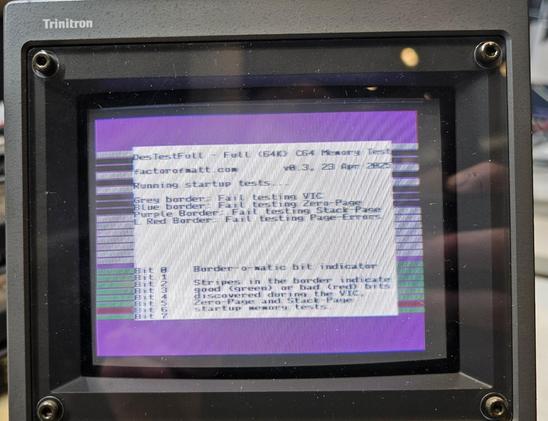
@root42 Yes, it's not that easy to see on the small screen I have available at the office.
The old Commodore diagnostic tool didn't like them, though, being the Swedish localisations..
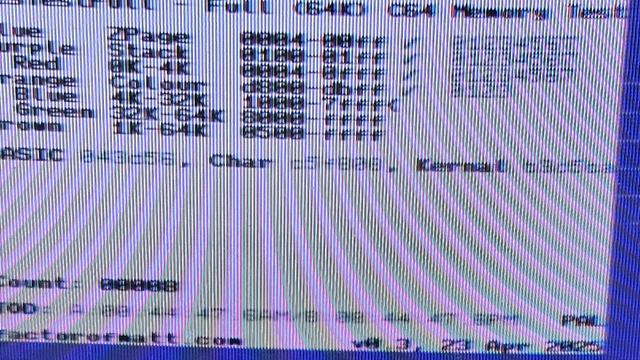
So, it looks like that Swedish KERNAL EPROM is socketed... Does anyone know if there is a Swedish localized #Commodore64 #JiffyDOS around that one can get from somewhere?
14 iterations without reporting any errors!
The old PSU started smelling a bit funny, so I think it is best avoided. I bought one from https://www.c64psu.com/ that works like a charm, though.

That's exactly the same chip that the diagnostic I ran a month ago blamed, BTW.
https://social.vivaldi.net/@nafmo/115288762186806724
But now I have a KFF2 cartridge to play with (I wanted an S-Video cable, and since I had to pay import duties anyway I'd added some more stuff to the order...)

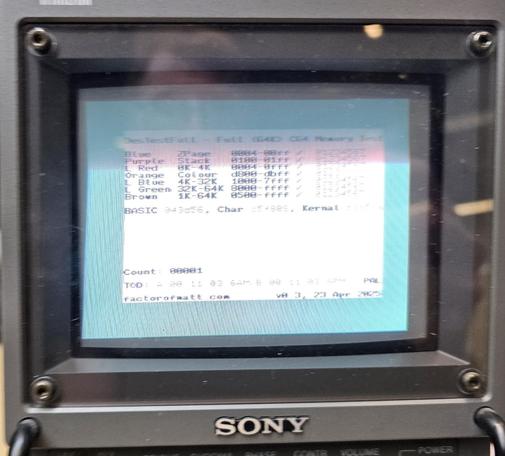
Attached: 1 image @[email protected] This is as far as the diagnostics I found on CSDb got before crashing.


 root42
 Anders Carlsson