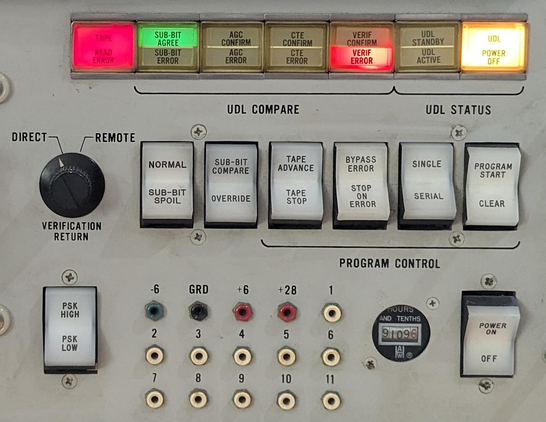

We obtained a mysterious box of 1960s electronics. I reverse-engineered it and with much effort, we got it running. It turns out to be a test unit for testing NASA's Up-Data Link, a system from the Apollo moon landing to control the spacecraft from the ground. Let's take a look inside... 1/n
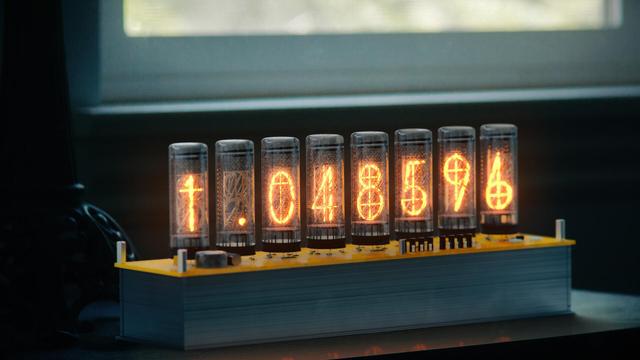
This box has thirteen orange digits at the top, which look like Nixie tubes. But they are a different technology called edge-lit lightguide display. Each digit has ten plastic sheets and ten lightbulbs. Each sheet has dots etched in the shape of a number. Lighting a sheet lights up that number.
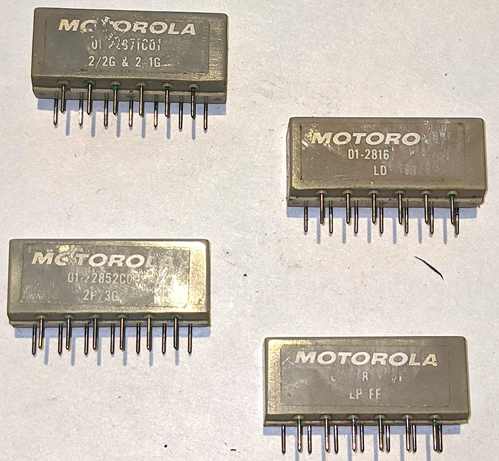
The box uses an old style of electronics that predates integrated circuits. Each thumb-sized encapsulated module implements a few logic gates or other simple circuit. A cryptic label such as "2/2G&2/1G" hints at the function. 3/n
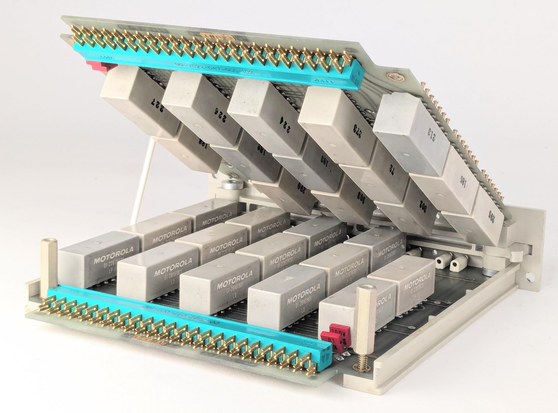
The modules were mounted on circuit boards in rows with a module-sized gap in between. Two boards could be fitted together with modules sliding into gaps to form a tight sandwich. These dense sandwiches slid into the top of the box to create its circuits. 4/n
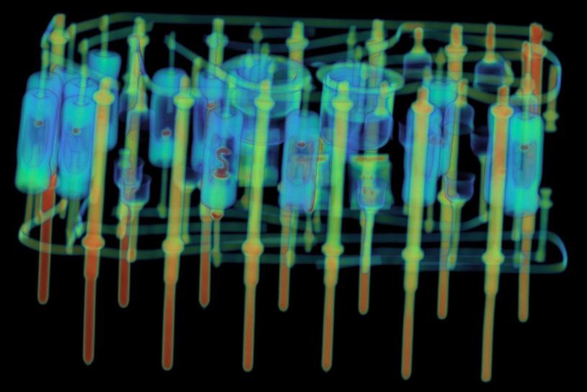
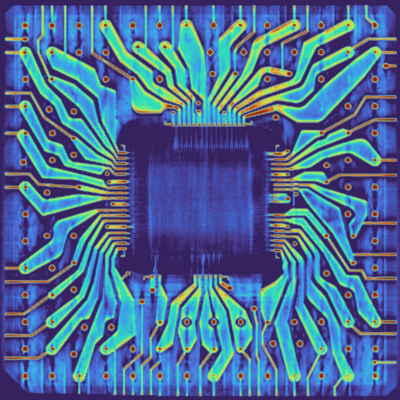
How could I find out what's inside these sealed modules and what they do? I tested various signals to learn their functions. Then Lumafield did a 3D CT scan to reveal the components (transistors, diodes, resistors, and capacitors) stacked inside.
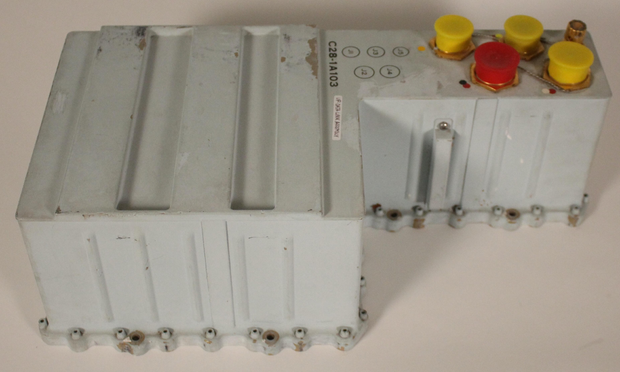
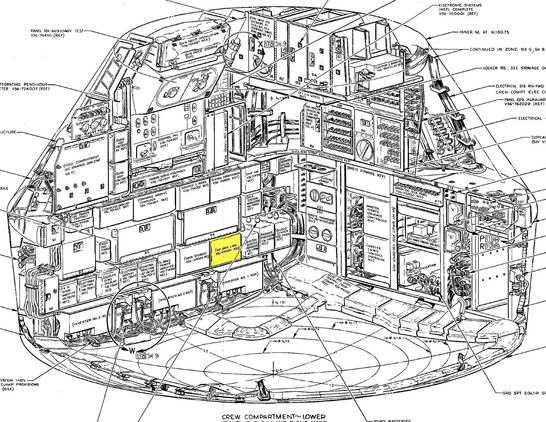
This test box sent test messages to the Up-Data Link box (below). The UDL (below) on the Apollo spacecraft received encoded digital message and controlled the Apollo Guidance Computer, clock, and other circuits. The UDL (yellow) was one of many electronics boxes inside the spacecraft. 6/n
The test box displayed success or errors on its lights, showing status for the Apollo Guidance Computer (AGC), clock (Central Timing Equipment, CTE), and other Apollo systems.

For more information on Apollo's Up-Data Link and this test box, see my blog post: https://www.righto.com/2025/07/reverse-engineering-mysterious-up-data.html

I worked on this with @CuriousMarc, @tubetime, Mike Stewart, and others. Thanks to Marcel for supplying the box.

Reverse engineering the mysterious Up-Data Link Test Set from Apollo

Back in 2021, a collector friend of ours was visiting a dusty warehouse in search of Apollo-era communications equipment. A box with NASA-st...

And if you prefer videos, check out CuriousMarc's extensive series on this box and other Apollo hardware:
https://www.youtube.com/watch?v=2Jt0PsxLM7k&list=PL-_93BVApb58SXL-BCv4rVHL-8GuC2WGb&index=36
Apollo Comms Part 34: Trying every function of the Apollo command system

YouTube

@kenshirriff

It has to be mentioned that the AGC restoration series is fairly epic 🙂🖖

@kenshirriff One video I'd like to see one day, even if I understand it's more "elevator music material" that a video on its own .. would be ( I suppose cause Doppler effects and such ? ) .. "Why did they use that particular type of modulation" ? IIRC it was "mostly" phase modulation of carriers ?
@kenshirriff absolutely fascinating, thank you!
@kenshirriff I love seeing stuff like this!

@kenshirriff

I am properly interested here.

I can't find it now but during lockdown there was a YouTube video series from people who got hold of one of the old actual Apollo landing computers and (tl;dr) got the fecker working I think hitched up to a simulator.

This would be a perfect hook-up 😀

@CuriousMarc @tubetime

@bytebro This is the video series on the Apollo Guidance Computer: https://www.youtube.com/playlist?list=PL-_93BVApb59FWrLZfdlisi_x7-Ut_-w7
@kenshirriff @bytebro and the up data link test box is already up and running and driving a full apollo telemetry and telecommand link in Marc's basement!
@kenshirriff Very interesting, thank you 😀
@kenshirriff @CuriousMarc @tubetime
That was a fascinating read. Thank you! It's amazing how much was achieved given the level of technology at the time.

@kenshirriff @CuriousMarc @tubetime

That was fascinating reading. Thanks to all of you for making this happen — and then writing about it, and then sharing it. 👍

@kenshirriff Trying this picture out as my desktop background
@kenshirriff
These line drawings are always gorgeous and this one isn't an exception
@magnetic_tape @kenshirriff I am looking with my mouth open at those two gyro assemblies by the side of a food storage compartment, and an integrated pendulous accelerometer right above it, an instrument with a pedigree all the way back to the V-2...
@kenshirriff Looks like a cordwood module (components sandwiched between two PCBs).
Haven't seen one of those in decades. Last one was a used pacemaker that was embedded in a clear resin. You could see where one of the parts wasn't soldered and was barely making contact with the board trace. First time I'd seen a case where heart failure could occur *after* the pacemaker was removed.
@kenshirriff So sort of like flipchips but more compact?

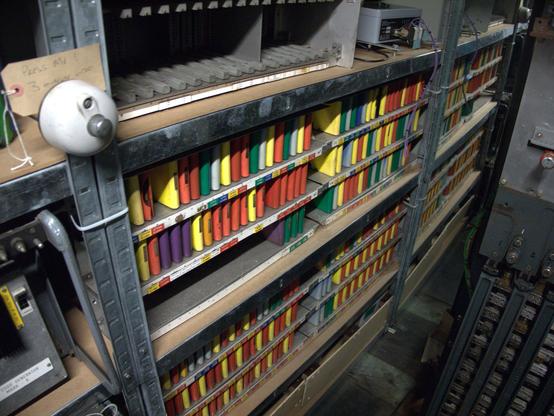
@kenshirriff so a slightly (but only slightly) more advanced version of these, which made up the automatic train control and signalling system of the #VictoriaLine on the #LondonUnderground when it originally opened. Each block contains one gate with eg red for AND and yellow for OR.

(photo swiped from @RogerBW - for more see https://blog.firedrake.org/archive/2017/10/Electric_Railway_Museum_final_open_day.html)

@kenshirriff @RogerBW oh, and after wondering for several years what became of this when the Electric Railway Museum closed, it's now at the #ColneValleyRailway and can be visited by arrangement - see https://www.facebook.com/viclineato.
Log into Facebook

Log into Facebook to start sharing and connecting with your friends, family, and people you know.

Facebook
@kenshirriff
Those gates remind me of some pneumatic gates I've worked with.
The plemum mounted ones even had the ports arranged like those pins.
https://www.aegroup.uk.com/wp-content/uploads/2019/07/Logic-Valves-AFP-2L_EDIT.png
@kenshirriff Oh, nice! I didn't even know that this technique was used in the past. I always thought it was a modern/cheap way to imitate the look of Nixie tubes.
@flxtr @kenshirriff I don't know the vintage of the controls, but when I took a nuclear engineering class back in the '80s at WPI, the reactor control panel used this type of stacked display to indicate the control rod depth. Was amusing to see digits go deeper into the panel as the numbers changed.
@kenshirriff hah! And to think we thought we'd invented this edge-lit technology with makerspace laser cutters, acrylic sheets and LEDs underneath ...
@kenshirriff those are so beautiful! Very nice, thanks for sharing!
@kenshirriff Nixie tube—it's a thing of beauty and elegance.😍
@kenshirriff I definitely thought those were nixies from the look and age. Are the bulbs neon, or is it just very warm incandescent?

@wikkit @kenshirriff

Incandescent. Fran Blanche did a proper deep dive on one of these a few years back. https://youtu.be/J2xAetY9O1E?feature=shared

Super Rare KGM Edgelit Displays!!! Just Beautiful!

YouTube
@helvick @kenshirriff Interesting thanks. The infinity mirror effect increasing as the numbers get larger definitely differentiates the look from the Nixie.
@kenshirriff Now I kinda want @TechConnectify to make a video about these displays 🤔
Honestly dissecting such old computers is 100% something I would love to watch him do ❤️
@K4mpfie @kenshirriff @TechConnectify I scrolled down to find this comment after searching his channel, because I was going to tag him if nobody else had already. I’d enjoy watching him discuss those displays.
@kenshirriff wow, they got it so even...
@armyofevilrobots every tried your lasercutter on thin clear sheet to get something like this?

@kenshirriff Similar tech was once used in laptop keyboard backlights. Thin edge-lit plastic sheet, with dots under each key to scatter the light upwards.

https://johannesluderschmidt.de/mbp-keyboard-assembly-backlight-illumination-with-ftir/271/

MBP Keyboard Assembly: Backlight illumination with FTIR – Johannes Luderschmidt

@kenshirriff 130 little light bulbs, makes me wonder what the failure rate was.

@kenshirriff Loving the Nixie tubes!

Did you have to replace any?

@thomasadam @RolfBly Although the digits look like Nixie tubes, they are a different technology: edge-lit lightguides, driven by ten incandescent bulbs for each digit. We had to replace a few bulbs.
https://oldbytes.space/@kenshirriff/114892205352274039
Ken Shirriff (@[email protected])

Attached: 1 image This box has thirteen orange digits at the top, which look like Nixie tubes. But they are a different technology called edge-lit lightguide display. Each digit has ten plastic sheets and ten lightbulbs. Each sheet has dots etched in the shape of a number. Lighting a sheet lights up that number.

OldBytes Space - Mastodon

@kenshirriff

Thank you for yet another presentation of one of your incredible finds.

Your account is making my day, whenever you post something about another mysterious box you've gotten your hands on.

The most curious part to me is that the only security measure this whole system had was the need of a powerful transmitter hooked up to a large antenna pointed at the spacecraft, presumably something only a nation state could have, especially at the time.

The sub-bit encoding reminds me of how data is encoded on CDs, iirc there are 10 physical bits for each data byte. Both for error detection and so that there are no long runs of repeating bit values that could throw off the tracking of the laser or the timing of the bits.

@kenshirriff how has nobody made a "what's updata / not muchdata" joke yet :D
@gsuberland @kenshirriff Data: “as we are located in deep space, you will have to be more specific about your directions”

@kenshirriff Soooo cool!! 🤯 Also, I bet HAINBACH could make music with that thing 😂

https://www.youtube.com/watch?v=yxBC6XzuMPs

We Used the Moon as an Echo (And Made It Into a Free Plugin)

YouTube
@kenshirriff This is so cool! My dad (an electronics engineer) work for a sub-sub-subcontractor for some NASA telemetry stuff during Gemini. He always had interesting old hardware lying around.
@kenshirriff thank you for sharing. a gem of a post.

@kenshirriff

This is fascinating, thanks for posting it!