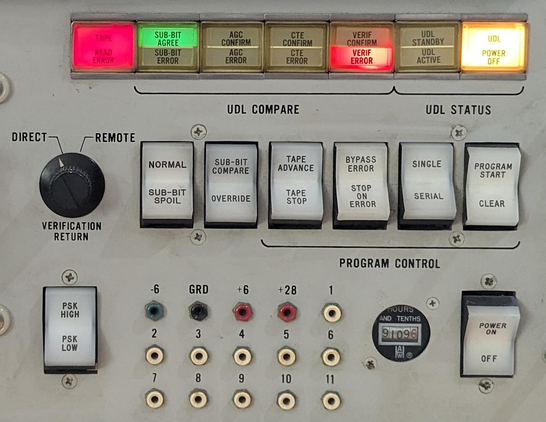
We obtained a mysterious box of 1960s electronics. I reverse-engineered it and with much effort, we got it running. It turns out to be a test unit for testing NASA's Up-Data Link, a system from the Apollo moon landing to control the spacecraft from the ground. Let's take a look inside... 1/n
This box has thirteen orange digits at the top, which look like Nixie tubes. But they are a different technology called edge-lit lightguide display. Each digit has ten plastic sheets and ten lightbulbs. Each sheet has dots etched in the shape of a number. Lighting a sheet lights up that number.
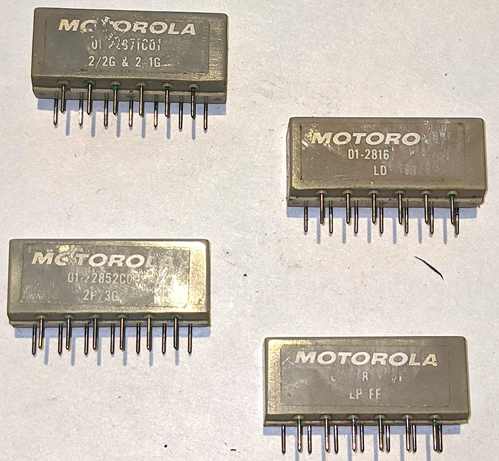
The box uses an old style of electronics that predates integrated circuits. Each thumb-sized encapsulated module implements a few logic gates or other simple circuit. A cryptic label such as "2/2G&2/1G" hints at the function. 3/n
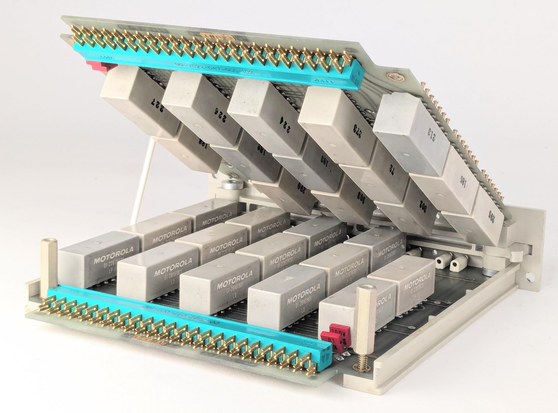
The modules were mounted on circuit boards in rows with a module-sized gap in between. Two boards could be fitted together with modules sliding into gaps to form a tight sandwich. These dense sandwiches slid into the top of the box to create its circuits. 4/n
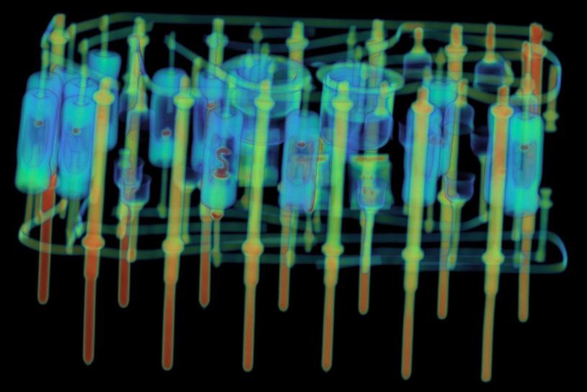
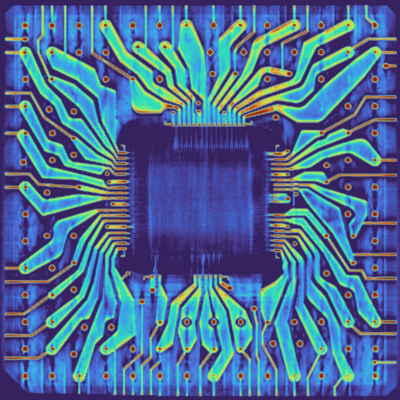
How could I find out what's inside these sealed modules and what they do? I tested various signals to learn their functions. Then Lumafield did a 3D CT scan to reveal the components (transistors, diodes, resistors, and capacitors) stacked inside.
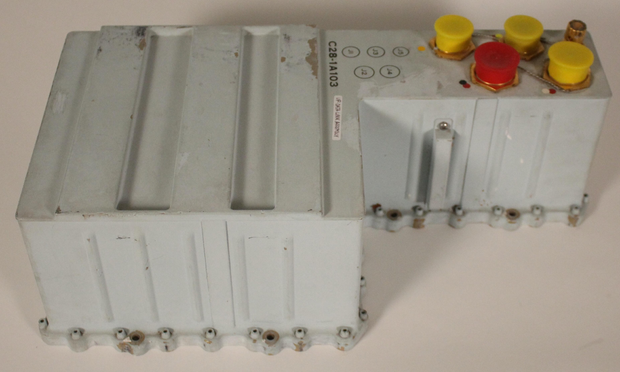
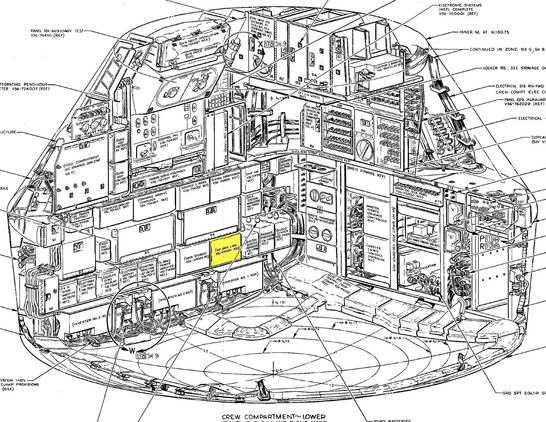
This test box sent test messages to the Up-Data Link box (below). The UDL (below) on the Apollo spacecraft received encoded digital message and controlled the Apollo Guidance Computer, clock, and other circuits. The UDL (yellow) was one of many electronics boxes inside the spacecraft. 6/n
The test box displayed success or errors on its lights, showing status for the Apollo Guidance Computer (AGC), clock (Central Timing Equipment, CTE), and other Apollo systems.

For more information on Apollo's Up-Data Link and this test box, see my blog post: https://www.righto.com/2025/07/reverse-engineering-mysterious-up-data.html

I worked on this with @CuriousMarc, @tubetime, Mike Stewart, and others. Thanks to Marcel for supplying the box.

Reverse engineering the mysterious Up-Data Link Test Set from Apollo

Back in 2021, a collector friend of ours was visiting a dusty warehouse in search of Apollo-era communications equipment. A box with NASA-st...

And if you prefer videos, check out CuriousMarc's extensive series on this box and other Apollo hardware:
https://www.youtube.com/watch?v=2Jt0PsxLM7k&list=PL-_93BVApb58SXL-BCv4rVHL-8GuC2WGb&index=36
Apollo Comms Part 34: Trying every function of the Apollo command system

YouTube

@kenshirriff

It has to be mentioned that the AGC restoration series is fairly epic ๐Ÿ™‚๐Ÿ––

@kenshirriff One video I'd like to see one day, even if I understand it's more "elevator music material" that a video on its own .. would be ( I suppose cause Doppler effects and such ? ) .. "Why did they use that particular type of modulation" ? IIRC it was "mostly" phase modulation of carriers ?
@kenshirriff I love seeing stuff like this!

@kenshirriff

I am properly interested here.

I can't find it now but during lockdown there was a YouTube video series from people who got hold of one of the old actual Apollo landing computers and (tl;dr) got the fecker working I think hitched up to a simulator.

This would be a perfect hook-up ๐Ÿ˜€

@CuriousMarc @tubetime

@bytebro This is the video series on the Apollo Guidance Computer: https://www.youtube.com/playlist?list=PL-_93BVApb59FWrLZfdlisi_x7-Ut_-w7
@kenshirriff @bytebro and the up data link test box is already up and running and driving a full apollo telemetry and telecommand link in Marc's basement!
@kenshirriff Very interesting, thank you ๐Ÿ˜€
@kenshirriff @CuriousMarc @tubetime
That was a fascinating read. Thank you! It's amazing how much was achieved given the level of technology at the time.

@kenshirriff @CuriousMarc @tubetime

That was fascinating reading. Thanks to all of you for making this happen โ€” and then writing about it, and then sharing it. ๐Ÿ‘

@kenshirriff Trying this picture out as my desktop background
@kenshirriff
These line drawings are always gorgeous and this one isn't an exception
@magnetic_tape @kenshirriff I am looking with my mouth open at those two gyro assemblies by the side of a food storage compartment, and an integrated pendulous accelerometer right above it, an instrument with a pedigree all the way back to the V-2...
@kenshirriff Looks like a cordwood module (components sandwiched between two PCBs).
Haven't seen one of those in decades. Last one was a used pacemaker that was embedded in a clear resin. You could see where one of the parts wasn't soldered and was barely making contact with the board trace. First time I'd seen a case where heart failure could occur *after* the pacemaker was removed.