We obtained a mysterious box of 1960s electronics. I reverse-engineered it and with much effort, we got it running. It turns out to be a test unit for testing NASA's Up-Data Link, a system from the Apollo moon landing to control the spacecraft from the ground. Let's take a look inside... 1/n
This box has thirteen orange digits at the top, which look like Nixie tubes. But they are a different technology called edge-lit lightguide display. Each digit has ten plastic sheets and ten lightbulbs. Each sheet has dots etched in the shape of a number. Lighting a sheet lights up that number.
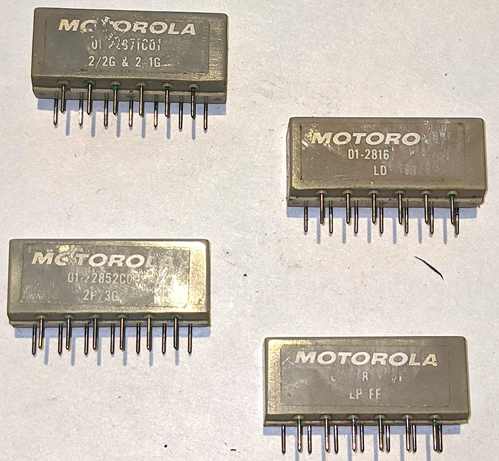
The box uses an old style of electronics that predates integrated circuits. Each thumb-sized encapsulated module implements a few logic gates or other simple circuit. A cryptic label such as "2/2G&2/1G" hints at the function. 3/n
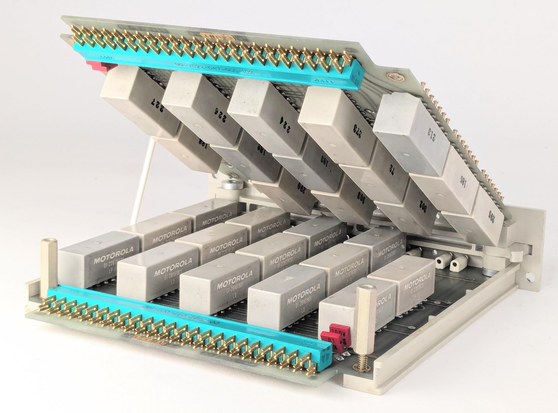
The modules were mounted on circuit boards in rows with a module-sized gap in between. Two boards could be fitted together with modules sliding into gaps to form a tight sandwich. These dense sandwiches slid into the top of the box to create its circuits. 4/n
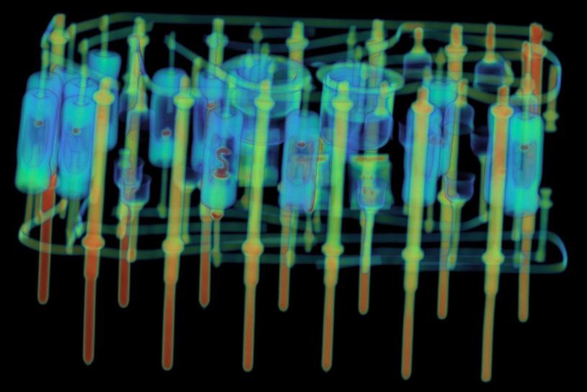
How could I find out what's inside these sealed modules and what they do? I tested various signals to learn their functions. Then Lumafield did a 3D CT scan to reveal the components (transistors, diodes, resistors, and capacitors) stacked inside.
@kenshirriff Looks like a cordwood module (components sandwiched between two PCBs).
Haven't seen one of those in decades. Last one was a used pacemaker that was embedded in a clear resin. You could see where one of the parts wasn't soldered and was barely making contact with the board trace. First time I'd seen a case where heart failure could occur *after* the pacemaker was removed.