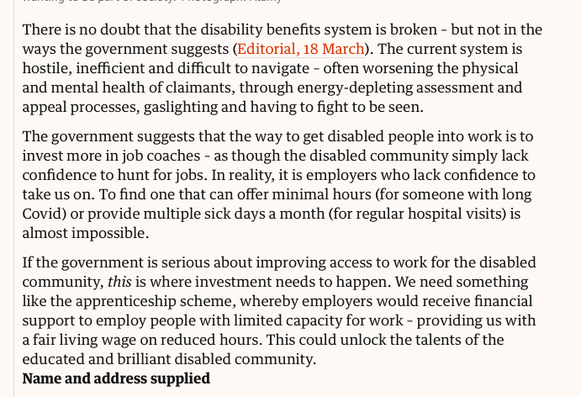
Great letter in the Guardian this morning pointing out, that its not disabled people not wanting to work that is the major problem, its employers being unwilling to employ them that is a more serious impediment for those with health issues who wish to get back into work....

But of course, as always a political class that would rather work with economic models of individuals than look at what's really happening in the world, often misses this simple point!

#disability #work

@ChrisMayLA6 I would also add wfh v office work to that. It never gets mentioned that remote and hybrid working massively increases accessibility. Whether that's enabling people to work on days when commuting is impossible, or removing physical accessibility obstacles, or allowing neurodivergent people to work in a comfortable environment, or a million other things - being able to work remotely allows a huge number of disabled people to do as much work as they want/need.

Forcing workers into the office (in jobs where there's no practical need for that) removes opportunities and takes highly skilled and committed workers out of the workforce.

@RolloTreadway @ChrisMayLA6 very well said!

One of the ways in which I'm limited is that half an hour driving through rush hour, with a start time hanging over me, leaves me unable to be effective for the first hour.

WFH, non-standard start time (so traffic is quieter), non-fixed hours (so I start whenever I get there and can't be "late") would all help. But they all have to come from the employer.

@ChrisMayLA6 I think that discussion of work and disability and benefits is a red herring. The issue is not the number of people on some form of income support because of disability. The issue is the cost of rent. The benefits bill, including disability benefits, is so high because rent is so high and housing costs are including in the numbers being bandied around. Benefits are a massive subsidy to landlords.

If this government was serious about reducing the benefit bill it would bring in measures to prevent rent seeking. The obvious would be the end of assured short term tenancies. More subtle would be enhancing renters rights and beefing up enforcement, both with more inspectors and massive penalties for infringements. Even just paying for the enforcement of existing regulation would be a better use of money than job coaches. None of this will happen, as Reeves' only vision for 'growth' is further inflating the property bubble

@RobertoArchimboldi @ChrisMayLA6 The Renters' Rights Bill, which includes the abolition of fixed term assured tenancies and assured shorthold tenancies amongst various other protections for tenants, has already passed the Commons and is currently making its way through the Lords.
@RobertoArchimboldi @ChrisMayLA6 I mean, sure, there are a lot of very real things to criticise the Government for. But I really don't understand these constant accusations that they'd never do things that they are literally doing. It's not as if legislation is a secret.
@RolloTreadway @ChrisMayLA6 thank you for the correction. I knew that they had been proposing the bill. I had missed the fact that it was actually making its way through Parliament. I confess that, as a consequence, I had been confidentially assuming that, like the previous Tory version, it would never receive royal assent. It is good to know that my confidence was based on an error. Still, if I wanted to trumpet my commitment to reducing the benefit bill, I would trumpet my commitment to reducing rent
@RobertoArchimboldi @ChrisMayLA6 Now that is interesting. So cut rents, cut housing benefit, and you can increase other benefits?

@nusher @ChrisMayLA6 absolutely, take me. I'm on the absolute maximum disability allowances having what I like to call a daily mail friendly disability, a high level, complete spinal cord injury. I receive £20,000 in benefits about half of which is my housing costs. I, unusually, own my own flat. The benefits cover my maintenance charge. I would be entitled to the two room rate, or about £14,000/year where I live. If I was in specialist supported accommodation, I would be on housing benefit, not Universal Credit. The landlord could charge a 'fair rent' above even that and still be paid out of housing benefit.

If you are not disabled you face a benefit cap, but the vast majority of your UC is your housing component. The one room rate where I am is £1100/month. The job seeker's component just shy of £400, for over 25s. So about two thirds of your benefits is being paid to landlords

@RobertoArchimboldi @ChrisMayLA6

Those are penetrating thoughts.

@linuxgnome @ChrisMayLA6 thank you. I highly recommend Nick Bano's 'Against Landlords', if you are interested in taking things further:
https://gardencourtchambers.co.uk/nick-banos-new-book-against-landlords-how-to-solve-the-housing-crisis-out-today/
Nick Bano's new book 'Against Landlords: How to Solve the Housing Crisis' out today | Garden Court Chambers

Nick Bano of the Garden Court Housing Law Team has authored 'Against Landlords: How to Solve the Housing Crisis', published by Verso Books.

Garden Court Chambers

@ChrisMayLA6

This aligns with the #DEI discussion. If you live long enough, you will become disabled.

Most #disabled people can work. As a #country, the #US (being a hotbed of #capitalism), believes that it's better for disabled folks to be #taxpayers than #tax burdens. This goes along with the idea that you "earn" a living by being employed. There are many programs available to upskill disabled folks, and not all are #government-funded.

That said, many employers are under the misguided impression that disabled people want jobs they are not qualified for. And that hiring a disabled person is an act of charity.

I'm a #blind man. I graduated with honors from a community college. My degree is in #computer #programming. I am also a licensed #insurance agent in my state. And, I spent over six years working as an administrative professional. In previous live, I was a #tax professional, working at a kiosk in a Walmart. I've also done web development, and supervised a technical support team for a dial-up ISP.

I'm currently unemployed. I ran out my state's benefits a few months ago. I've been applying for jobs, and going to job fairs. I've even had a few interviews.

@vor

Thanks for this; over here on this side of the Atlantic we're not so clear on how the US benefits system works for the disabled... thanks for this context (boosted)

@ChrisMayLA6

As a deaf mum of twins it took me years to get back into the workplace…it was a local council with a policy that offered anyone with a disability who met the essential criteria an interview, that eventually got me back into a regular PAYE job. Until then, I picked up crumbs of work on a self employed basis. Many of us who are disabled resort to working for ourselves, because employers won’t give us a chance…but it’s a very precarious existence.

@JugglingWithEggs

thanks for sharing your experience - very helpful context

@ChrisMayLA6

I think employers may countenance the fact you are a mother, a few will see being disability aware as a positive thing they can put on their public facing websites, but do many want to employ you within school hours if you also have a disability?

Falling into both boxes is not often talked about. Disabled women can have children and also need to work.