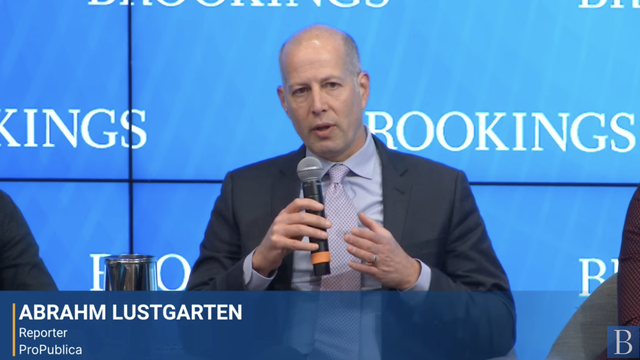
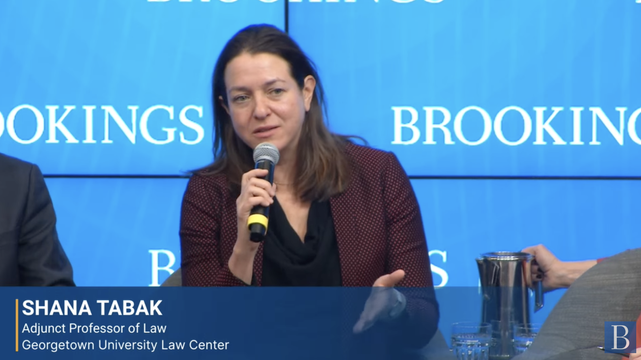
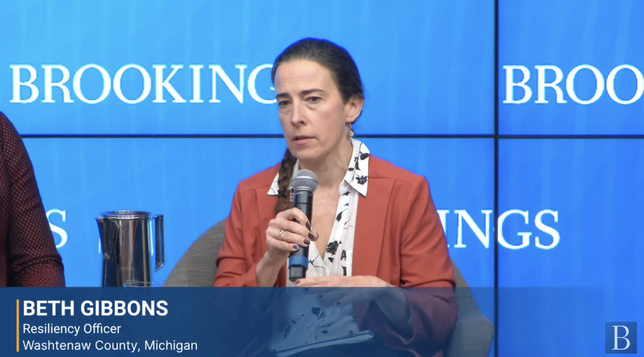
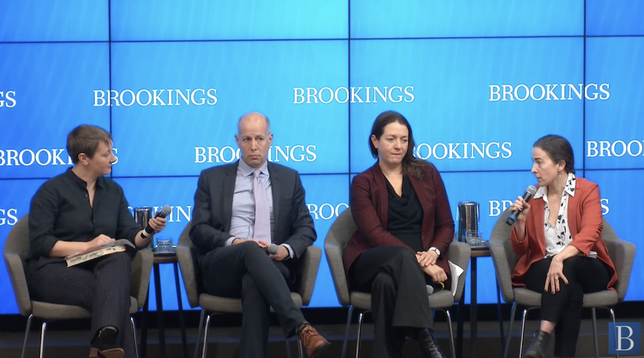
Starting at 10 am: The Brookings Institution holds a discussion on domestic climate migration, driven by disasters like Katrina, Helene, Milton, the Los Angeles fires, drought, flood, insurance withdrawals, etc. with Abrahm Lustgarten, Shana Tabak, and Beth Gibbons, moderated by Vanessa Williamson.
#USClimateMigration #climate #uspol #immigration
https://www.youtube.com/watch?v=ZDRX2dnDAE0
How to prepare for climate migration in the US

YouTube
Abrahm Lustgarten: "The science suggests there's a shift in the global niche humans have lived in for the last 6,000 years. By the end of the century, about 6 billion people will be living outside of an ideal human habitat. In the US, that means moving towards the northern borders."
"The country is being squeezed from the West Coast and the South, and to a lesser degree on the East Coast, towards the center. Fires in the West and the Southeast, extreme humidity up the Mississippi Basin, extreme storms in the South."
Shana Tabak, Georgetown Law: "We've already sort of passed the 1.5C limit we set in international agreements. Climate change is going to affect us all. We've gone through a transition in the federal government. What opportunities do we still have at the transnational or subnational level?"
Beth Gibbons, the resiliency officer in Washtenaw County, Michigan, Ann Arbor, bordering Detroit but 65% agricultural. "The county is gaining population. When we look at climate migration models, this county and city is expected to grow."
Beth Gibbons: "We're living in a changed climate. The best way to talk with people is about the change that is already with us. One of the most forward-looking adaptation communities is Broward County, Florida. You can have great adaptation plans, with threshold analyses. Santa Cruz, Calif. has that. Plan for when a cliff erodes, time to close a road. But when they experience the impact, for example, they have trouble executing the plan."
Abrahm Lustgarten: "Housing is a key issue. We don't expect Arizona to become an unpopulated wasteland, but we expect urbanization. Cities like Phoenix, Atlanta will continue to grow."
Shana Tabak: "In Katrina, massive numbers of people were displaced. There were major disparities in who got insurance payouts, who lived on high ground. People may all think they're temporarily displaced, but only those with resources were able to return and rebuild."
Beth Gibbons: "We have to be able to talk about housing. We have a housing crisis, it's everywhere. In Ann Arbor, they're trying to build 40,000 units in 10 years. 18 of 20 new housing developments are full electrification. There are 28 developments across the county, we want them all to be electrified. We're really thinking about the coupled approach to housing."
Abrahm Lustgarten: "We have an extraordinary backlog of justice issues. I don't know how we dig out of that hole. Redlined communities in Los Angeles are 10 degrees hotter. Flood control infrastructure, water treatment infrastructure. The availability of funds to address those problems is so dependent on local property tax systems. Poorer neighborhoods just don't have the tax base to make the changes."
Abrahm Lustgarten: "What's needed is an extraordinary infusion from the state and federal level, which I am not optimistic that we'll see."
Vanessa Williamson: "Climate disasters operate as a rachet effect on existing inequalities in the tax code."

Beth Gibbons: "Climate work is hard. Good social work is hard. It was a relief to feel support from the federal level for the last couple of years. Not having federal support is the reality we're going to be in. We'll make it work.

Your budget is a reflection of your values. You can't make it a conversation of climate versus housing. You find ways to do integrated work. That's what's necessary. In Michigan, we've had strong state leadership."

Abrahm Lustgarten: "Most people who move don't think about climate change directly. Surveys from real estate firms at a very local level find people are thinking about the flood or wildfire risk. And there are climate activists like Collette Pichon Battle who see it. She moved back to her community to save it, but she has learned about the undeniable fate of the Louisiana coastline. There are going to be places that will simply disappear or become uninhabitable."

Vanessa Williamson: "Is it important for people to understand climate change is driving these changes?"

Lustgarten: "It's critically important. If we don't have agreement what the problem is, we can't make a collective decision on how to address it."

Abrahm Lustgarten: "In [conservative] communities, there's no shortage of grievance about how their agricultural opportunities used to be different. There was more water, less heat. There were more animals when they hunted. It's less denialism than what you think the solutions are to the problems you see."

Beth Gibbons: "I'm frustrated by the language of 'climate refugees'. It's not a real term. When climate and migration are combined, it creates a greater fear of migration. We need to not encourage a reaction of fear and othering. Our futures are linked."

Shana Tabak: "I also dislike the 'climate refugees' framing. Legally, there's no such thing. I would like this question of climate and habitability to take place within the context that none us are able to escape the climate."

Abrahm Lustgarten: "Communicating on climate is really hard. The media has done an awful job historically, is improving, but has a long way to go. The journalism business is under threat. And the issue is generally overwhelming, even to journalists."
Abrahm Lustgarten: "I find myself wavering from disaster porn like Uninhabitable Earth, it's the impending apocalypse, to an emphasis on solutions. There are different audiences for different approaches. Some people will see the Los Angeles fires and start paying attention. Some won't."

Audience question: "How can places with a high cost of living be prepared for displaced individuals without exacerbating the cost of living?"

Beth Gibbons: "Building more housing."
#YIMBY #climate

@climatebrad

It feels to me like "build more housing" can't be the answer. You almost might as well say "make more land". It's not a durable solution. And it doesn't address the many other aspects of society that need to be addressed. Jobs food commerce in general, schools, the nature and flow of community itself.

A favorite quote comes to mind.

"Better implies different."
--Amar Bose, at an MIT Enterprise Forum event

(He was trying to explain to sales people at stores that would sell Bose speakers why they had to make changes in how they set them up. "Couldn't they just do what they'd always done?" The people would ask. They were used to that and did not want to change. He was trying to explain succinctly why you can't just radically improve something and leave it the same at the same time. So he, explained, that slogan had emerged.)

Surely higher population density at some point means using existing resources differently. I'm not pushing an agenda here, but I am observing that higher density feels less compatible within every person for themselves and traditional-ownership / rent-taking-for-profit model. Surely that brings a 2-tiered citizenship and breeds discontent/danger as inequality simmers.

In computer science, we talk about building systems that scale, planning for higher traffic. This could really be done in a system that did not plan for scale without the architecting the system entirely, and I've even seen some of pine that every factor of 10 in scale requires a redesign.

Sometimes the architectural plan is indeed to just add servers, but that has to be planned in, and there has to be a source of servers, and the system architecture has to be structured such that in the new model, all the necessary flows will happen correctly and resources won't be cut off from each other or too hard to access or too expensive.

"Build more housing." does not sound like the kind of answer I could give in a job interview and expect to be hired, with the hiring manager saying "this person has clearly demonstrated their understanding of operating at scale". The answer is not of a shape that seems right to me, nor does it offer sufficient detail.

A lot of capitalism seems to operate on a theory that you just twist some knobs and everything will just happen right without coordination. I think this is less and less true as either populations grow larger or resources grow smaller or resources become more stressed.

I did not write the accompanying article specifically to address this issue, and yet I feel like it says some important additional things I might say here if I were to ramble on. It is not a complete discussion of scale, but more discussion of why I don't think the traditional ways of thinking about just turning a few knobs is likely to keep working.

Losing Ground in the Environment
https://netsettlement.blogspot.com/2019/09/losing-ground-in-environment.html

It also just not addressed the issue of urgency, and the way in which urgency materially changes the set of usable solutions. I did try to address that issue here:

The Politics of Delay
https://netsettlement.blogspot.com/2024/10/the-politics-of-delay.html

#climate #ClimateMigration #SystemsThinking #scaling #ScalingSoftware #Community #Housing #LateStageCapitalism #capitalism #population #collapse #inequality #sustainability #SocialPolicy #SafetyNets
Losing Ground in the Environment

Essay on how we can't still see the world as an infinite resource. Things are interconnected and finite, so we need a fresh mindset when planning.

@kentpitman @climatebrad I don't think it's the whole of the solution, or even the right place to start, but I do think it's still an important part.

My advice would be 'Build the capacity to build stuff, including housing.'

#permaculture

@Angle @climatebrad

I'm not opposed to the idea of assuring adequate infrastructure, but if there's not any repurposing, then the community into which this is injected is not participating in the solution, just being extended, and that's a form of climate denial.

I'm already worried. In a sense, when I hear "build", I hear "consume", and any real solution to climate is as sustainable and consumption-free as possible.

So, to borrow another analogy, it's like telling the people of New Orleans that the solution is bigger levies. It may help for a while, but it just doesn't feel solution-like.

@kentpitman @climatebrad What infrastructure do you want to repurpose? Edenicity wants to majorly cut down on roads, which I sympathize with. And I think a lot of office space is unnecessary. On the whole though, I think we need to build a lot more in order to have space for everyone.

See Edenicity on city design: https://www.youtube.com/@edenicity/videos

Before you continue to YouTube