
Rather a niche discovery, but in poking around among the #klezmer copyright scores I got from the US Library of Congress over the last year, I noticed that one of Max Leibowitz's 1919 submissions is a well known piece from the klez #violin repertoire commonly called Romanian Fantasy No. 3. Leibowitz was a Romanian violinist living in New York who I believe started the trend of klezmer musicians copyrighting folk melodies.

#MusicHistory #MusicManuscript #SheetMusic #FolkMusic #JewishMusic
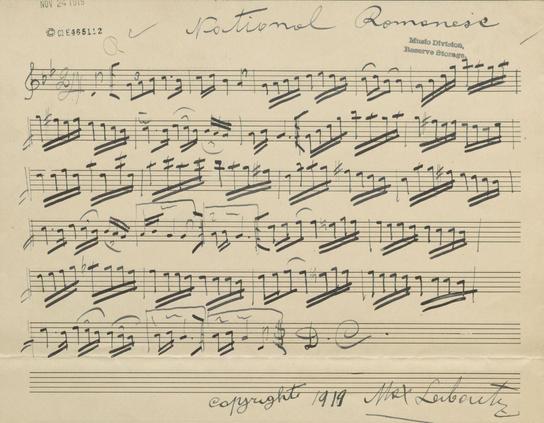
For comparison, here's the well known recording by Josef Solinski, made in #Warsaw in 1911. Solinski is generally thought to have been a pseudonym for Oscar Zehngut, a #violinist and arranger active in #Lviv. Leibowitz's score is pretty close to the recording, so I could believe that he just wrote it down with a slightly different articulation and copyrighted it, but it's also possible it was a well-known piece known to both violinists.

https://search.library.wisc.edu/digital/AOWACQFROHJM2M8N/AMEOICIM5NS3J48R

#78rpm #MusicHistory #klezmer

‎Rumänische fantasien, 3 teil (2 of 2) - UWDC - UW-Madison Libraries

I love pieces like this because they contain cultural layers like an onion: modern Klezmer revival, interwar New York, pre-WWI Warsaw, Austro-Hungarian Galicia, Kingdom of Romania, Ottoman Empire.

For cultural context in understanding pieces like this beyond "old klezmer music" to realising it is also a performance of old #Romanian music which was dear to Jewish listeners, I like to link this old Alexandru Cercel album:
https://youtu.be/-QVmVSfxuNE?si=fDE0-I-WIn1MrzeF

#MusicHistory #violin #FolkMusic

Alexandru Cercel - Fi-ar ceasu afurisit

YouTube

Cercel recorded decades later, but in an extremely old fashioned manner. so we can get an idea of what kind of performance Solinski/Zehngut was referencing in his 1911 recording, which is done in a Jewish style but also very much this kind of old Romanian music.

#FolkMusic #MusicHistory #violin #fiddle #Romania

If you want to hear a more distant Turkish/Ottoman cousin to this piece, listen to the ubiquitous piece Nihavend Longa, which iirc dates to the 19th century and itself is composed in a genre that references Balkan music.
https://youtu.be/WWW8elIBwZI?si=WRmNhIol2Xqz2THO

#FolkMusic #MusicHistory #TurkishMusic #clarinet #kanun #violin

Keman Cünbüş Kanun Klarnet - Nihavent Longa - Taş Plak Türkiye 1930 78rpm

YouTube
@carkner Oh, thanks a lot. Did not know this one, knew only this one:
https://www.youtube.com/watch?v=Xfhy2h9zu68
Chira Chiralina / Old epic ballad

YouTube
@mavori this album had a bit of a strange trajectory, I don't fully understand its original context but it was re-released by a Romanian newspaper in the 2010s for some reason and was available on their website for some time. Bob Cohen of Di Naye Kapelye was the one drawing everyone's attention to it. Eventually it stopped being available online till someone uploaded it to youtube.
@carkner There were a lot of recordings during the Ceausescu period, as he promoted folk music – and folk music is seen still for many people as part of this dark time. But there are still some folk music festivals. Interestingly, there is often no mention of jewish music which is not so surprising, as jews in Romania lived a long lasting history of antisemitism
@mavori yeah, I've heard there were a few token Jewish artists who were permitted to record and perform Yiddish music with Electrecord in that era, and Roma musicians while much more prominent, were also mostly not allowed to record many of their "own" genres (more Turkish-style rhythms etc). When I was in Romania a decade ago I did not encounter much Jewish music being performed in festivals, but I follow friends like Zoe Aqua and Jake Shulman-Ment who tour and perform there.

@carkner @carkner

I was following up on some US folk/blues, discovering somewhat the same - pieces written down and copyrighted. An explanation I only half-recall was that initial expression in a different media garnered a copyright. Ditto for substantial change, such as arrangement for orchestration.

Nearly everything I was looking for had never had the copyright renewed.

@Amgine
Yeah, in the New York Jewish music context (which has been one of my research slow burns for the last year or two) they were copyrighting apparently because they thought it would make a case more solid for them alone to record a particular melody. almost never renewed either, maybe in a handful of melodies that were being re-recorded post WWII. the opening post of my blog last year deals with it but it may be TMI for someone not already interested in old klezmer
https://alte.klezmor.im/2023/08/03/golden-age-american-klezmer-copyright-scores-in-the-library-of-congress-1917-28/
Golden age American klezmer copyright scores in the Library of Congress (1917-28) – Old Klezmers – Alte Klezmorim

@carkner

Only as wonderful music, not so much as a topic of study or politics!