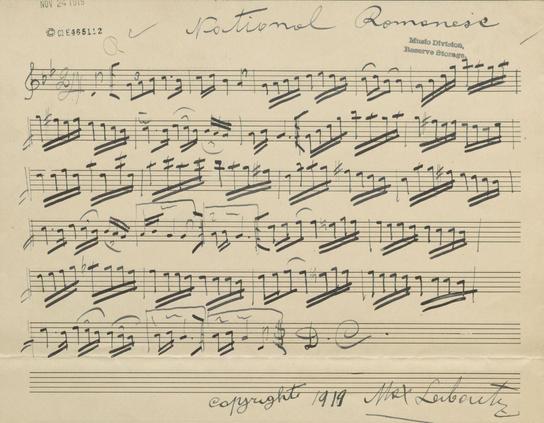
Rather a niche discovery, but in poking around among the #klezmer copyright scores I got from the US Library of Congress over the last year, I noticed that one of Max Leibowitz's 1919 submissions is a well known piece from the klez #violin repertoire commonly called Romanian Fantasy No. 3. Leibowitz was a Romanian violinist living in New York who I believe started the trend of klezmer musicians copyrighting folk melodies.

#MusicHistory #MusicManuscript #SheetMusic #FolkMusic #JewishMusic
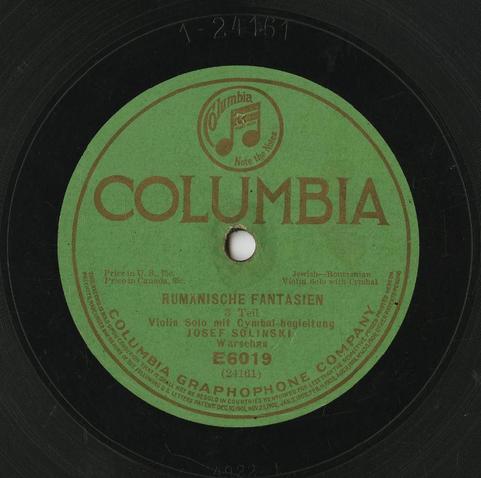
For comparison, here's the well known recording by Josef Solinski, made in #Warsaw in 1911. Solinski is generally thought to have been a pseudonym for Oscar Zehngut, a #violinist and arranger active in #Lviv. Leibowitz's score is pretty close to the recording, so I could believe that he just wrote it down with a slightly different articulation and copyrighted it, but it's also possible it was a well-known piece known to both violinists.

https://search.library.wisc.edu/digital/AOWACQFROHJM2M8N/AMEOICIM5NS3J48R

#78rpm #MusicHistory #klezmer

‎Rumänische fantasien, 3 teil (2 of 2) - UWDC - UW-Madison Libraries

I love pieces like this because they contain cultural layers like an onion: modern Klezmer revival, interwar New York, pre-WWI Warsaw, Austro-Hungarian Galicia, Kingdom of Romania, Ottoman Empire.

For cultural context in understanding pieces like this beyond "old klezmer music" to realising it is also a performance of old #Romanian music which was dear to Jewish listeners, I like to link this old Alexandru Cercel album:
https://youtu.be/-QVmVSfxuNE?si=fDE0-I-WIn1MrzeF

#MusicHistory #violin #FolkMusic

Alexandru Cercel - Fi-ar ceasu afurisit

YouTube

Cercel recorded decades later, but in an extremely old fashioned manner. so we can get an idea of what kind of performance Solinski/Zehngut was referencing in his 1911 recording, which is done in a Jewish style but also very much this kind of old Romanian music.

#FolkMusic #MusicHistory #violin #fiddle #Romania

If you want to hear a more distant Turkish/Ottoman cousin to this piece, listen to the ubiquitous piece Nihavend Longa, which iirc dates to the 19th century and itself is composed in a genre that references Balkan music.
https://youtu.be/WWW8elIBwZI?si=WRmNhIol2Xqz2THO

#FolkMusic #MusicHistory #TurkishMusic #clarinet #kanun #violin

Keman Cünbüş Kanun Klarnet - Nihavent Longa - Taş Plak Türkiye 1930 78rpm

YouTube