 Alex Darby // darbotron🛹
 lcamtuf
Ah yes, I remember buying that textbook
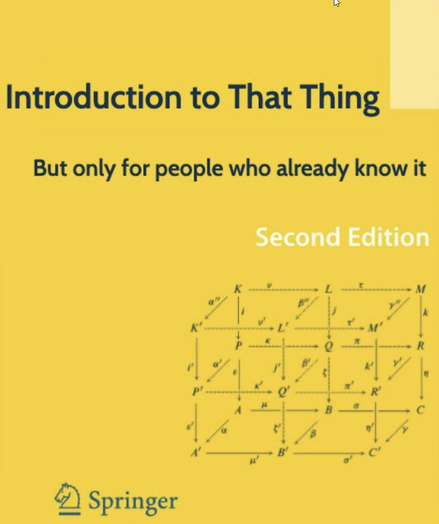
@lcamtuf, Chapter 1 defines numbers, some common mathematical notation, and a few other things that give you hope that you can read this book.
You might get through Chapter two.
By Chapter 3, you,put it on the shelve with all your other Springer textbooks.
@jpgoldberg @lcamtuf Springer books are like the math entries on Wikipedia. They’re both places where people are in a competition to make themselves as baroque and not just esoteric, but practically occult as possible.
Now excuse me, I have to finish replacing the word “one”with“unity”
@johncarlosbaez @jonathankoren I thought the reason for that was that "sums to one" invites the question "sums to one what?"
In some contexts it could be really misleading. "a series of dyadic fractions that sums to one" could mean "a series of dyadic fractions that sums to unity" or "a series of dyadic fractions that sums to a dyadic fraction".
@mjd @johncarlosbaez @jonathankoren
I thought that this goes back to (at least) the Pythagoreans. For them unity was not a number. And it’s only since Frege’s definition of the integers that one is clearly a number.
@jpgoldberg @johncarlosbaez @jonathankoren The Treviso Arithmetic of 1478 says explicitly that 1 is not a number.
But I find your suggestion of Frege hard to understand. Are you reallly saying that Gauss wouldn't certainly have considered 1 a number? Cauchy? Legendre?
@mjd @johncarlosbaez @jonathankoren
I never meant to say that Gauss et al wouldn’t consider 1 a number. I wasn’t trying to suggest that Frege is responsible for 1 being considered a number, but I do see how that could follow from what I wrote.
I am ignorant of when 1 became fully accepted as a number, and so I shouldn’t have written something that carries the implicature that it is “only since Frege.”
@lcamtuf fuckin lol
so many times
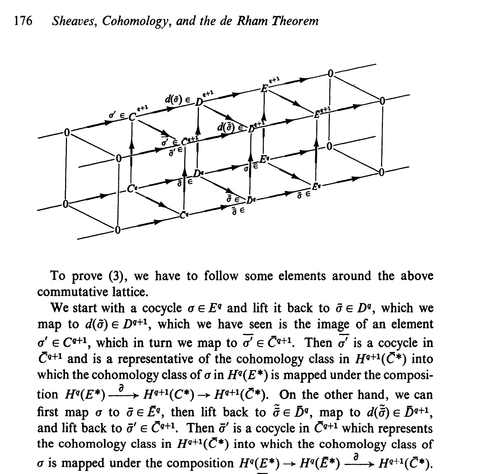

Hey, sorry to interrupt, but as a non-professional mathematician, I can confidently tell you that you're overcomplicating things.
What you're actually looking at is just a trivial crystallographic Simple Cubic system of Argon, Boron, Carbon, Potassium, Lithium, Magnesium, Phosphorus, Quarks (obviously!), and Radon under elastic constraint. Naturally!
Unless it's a plastic deformation...
Or? wait, what's that? there two types of forces?
Let me kindly ask my colleague Dunning-Krugger: He knows everything on the subject.
I was a bit ashamed for the "Quarks" part, and the totally inert Argon and Radon...
But maybe given super extreme high-pressure Argon and Radon could organise themselves anyway ? I have no idea
@lcamtuf I always felt like Weil's Basic Number Theory was the quintessential example of that book. The thing is, it was also great to read!
I just wouldn't want to be the person who just got excited about quadratic reciprocity and picked it up in the library because the title sounded friendly. Cheeky french number theorists!
Sure you claim to know the thing. But do you really?!
@lcamtuf in college I bought the previous edition; it was a lot cheaper than the current edition, and how much really changes in that thing from year to year?
I spent the $26 I saved on beer.
@PizzaDemon @lcamtuf
Advanced … - elementary school level
Intermediate … - high school level
Basic … - college undergrad level
Fundamentals of … - graduate level
An Introduction to … - postgrad level
One of the classes I took in college was titled “An Introduction to Counting”. It was *deep* number theory from a professor familiar with the joke.
Oh, yeah. Got several of those, for various values of "that thing".
@lcamtuf I feel this hard.
Gave myself a crash course in the matrix algebra used in mechatronics to understand the source code of a library some students wanted to use for FIRST Robotics. It's a library to predict how a 2-wheel robot will drive. Naively, I'd have just suggested to them "your forward speed should be the average of your wheel speeds and your turn speed should be the difference of your wheel speeds," but they wanted to use the library.
So after reading about forty pages of explanatory material and a half-dozen Java classes, I discovered the core of the library was a matrix algebra encoding of... "Your forward speed is the average of your wheel speeds and your turn speed is the difference of your wheel speeds."
 Jeffrey Goldberg
 jonathankoren™
 John Carlos Baez
 Mark Dominus
 Chris Fox
 Universal Basic Friend
 Graham Sutherland / Polynomial
 Ruud van Asseldonk
 Chon Torres
 notsoloud
 Pau Amma
 Kaelef

 shimst3r is now on famichiki
 Philip Kaludercic
 Shane Celis
 HoldMyType
 jnpn
jnpn 💡𝚂𝗆𝖺𝗋𝗍𝗆𝖺𝗇 𝙰𝗉𝗉𝗌📱
 accela
 🅮
🅮 pseyfert
 kirjoittaessani
 Christian Lawson-Perfect
 chris martens
 tj usiyan
 🐦⬛
🐦⬛ Anders Lindqvist
 Steph. Luis Rolland-Brabant ⁂
 Dr Daniel, Photon Shepherd🇸🇪🇦🇺
 Mickaël Montessinos
 ראַף
ראַף 
 The Turtle
 Flaming Cheeto
 Zimmie
 grundy
 Leen Kievit
 robcornelius
 Max Leibman
 Weekend Editor
 Mark T. Tomczak
 Dr David Mills
 Reid
Reid 
 λzyd
λzyd Hackhörnchen
 Willow
  飛柳
飛柳 crispy branzino ☭ (sold out forever)
 multiplex