 lcamtuf
Ah yes, I remember buying that textbook
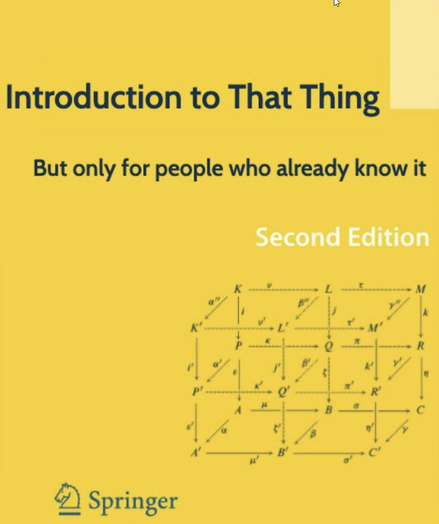
@lcamtuf, Chapter 1 defines numbers, some common mathematical notation, and a few other things that give you hope that you can read this book.
You might get through Chapter two.
By Chapter 3, you,put it on the shelve with all your other Springer textbooks.
@jpgoldberg @lcamtuf Springer books are like the math entries on Wikipedia. They’re both places where people are in a competition to make themselves as baroque and not just esoteric, but practically occult as possible.
Now excuse me, I have to finish replacing the word “one”with“unity”
@johncarlosbaez @jonathankoren I thought the reason for that was that "sums to one" invites the question "sums to one what?"
In some contexts it could be really misleading. "a series of dyadic fractions that sums to one" could mean "a series of dyadic fractions that sums to unity" or "a series of dyadic fractions that sums to a dyadic fraction".
@mjd @johncarlosbaez @jonathankoren
I thought that this goes back to (at least) the Pythagoreans. For them unity was not a number. And it’s only since Frege’s definition of the integers that one is clearly a number.
@jpgoldberg @johncarlosbaez @jonathankoren The Treviso Arithmetic of 1478 says explicitly that 1 is not a number.
But I find your suggestion of Frege hard to understand. Are you reallly saying that Gauss wouldn't certainly have considered 1 a number? Cauchy? Legendre?
@mjd @johncarlosbaez @jonathankoren
I never meant to say that Gauss et al wouldn’t consider 1 a number. I wasn’t trying to suggest that Frege is responsible for 1 being considered a number, but I do see how that could follow from what I wrote.
I am ignorant of when 1 became fully accepted as a number, and so I shouldn’t have written something that carries the implicature that it is “only since Frege.”
 Jeffrey Goldberg
 jonathankoren™
 John Carlos Baez
 Mark Dominus
 Chris Fox