h/t to @PaulHammond51 & Mars Guy for referring to the recent "10th International Conference on Mars" in the Cheyava Falls video. Only news or pointer I've seen to it.

The summary papers & posters are a treasure trove of upcoming research or incremental studies since LPSC

🧵 1/N

https://www.hou.usra.edu/meetings/tenthmars2024/technical_program/

Tenth International Conference on Mars - July 22–25, 2024

The Tenth International Conference on Mars is a large, 500–600-person gathering of Mars scientists from a range of disciplines, institutions, and countries.
The Tenth International Conference on Mars is a large, 500–600-person gathering of Mars scientists from a range of disciplines, institutions, and countries.
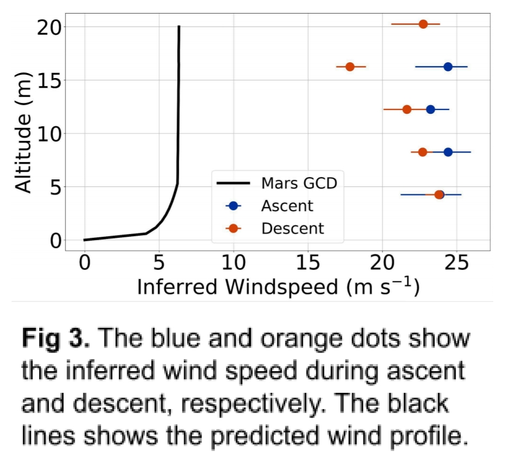
Using #MarsIngenuityHelicopter as a weather vane 😀 Preliminary analysis of telemetry to estimate wind speed & direction. Surprisingly strong winds detected!

Jackson & Brown: Estimating Near-Surface Martian Winds Using the Ingenuity Helicopter's Attitude
https://www.hou.usra.edu/meetings/tenthmars2024/pdf/3346.pdf

"Tilting in the breeze Ginny groks the martian winds Surprisingly strong."

🧵 2/N

Iteration/compilation of conclusions from earlier papers from this team.

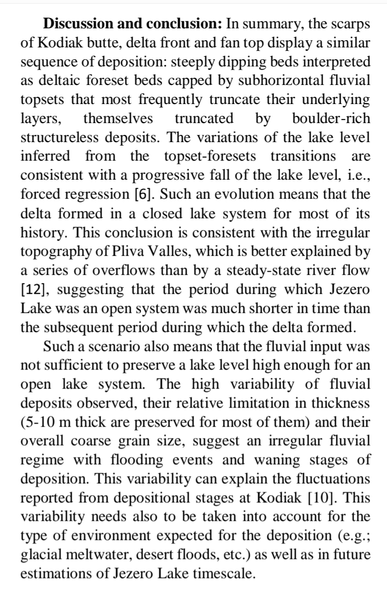
Mangold et al: "Constraints on Jezero Paleolake History from Its Fluvial Input"
https://www.hou.usra.edu/meetings/tenthmars2024/pdf/3079.pdf
"A high variability in fluvial deposits is observed on Jezero delta front and top, which reflect variable fluvial regimes associated to Jezero lake level fluctuations in a closed basin."

#JezeroDeltaScience 🧵 3/N

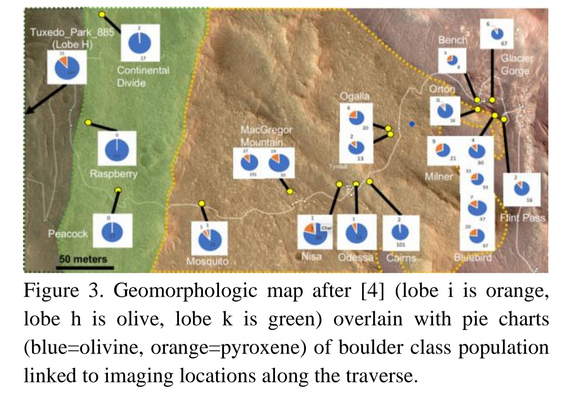
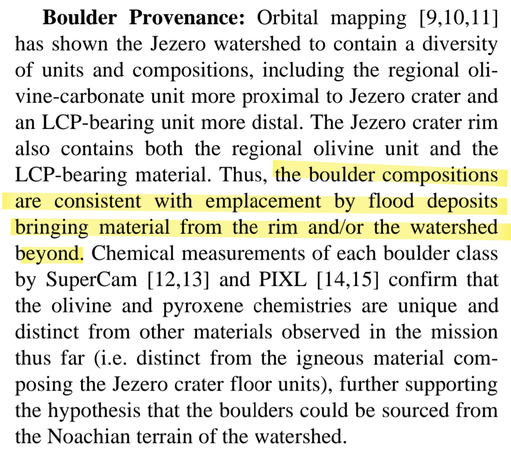
A new iteration of analysis of Margin Unit boulders, this time with MastCam (compare to this earlier one with SuperCam https://mastodon.social/@sharponlooker/111870338355722359 ). Boulders "confirmed" to be coming from floods and differ from Séítah.

Vaughan et al : "Investigating the Blocky Unit Boulders of the Western Jezero Fan Top Using Mastcam-Z"
https://www.hou.usra.edu/meetings/tenthmars2024/pdf/3328.pdf

🧵 4/N #JezeroDeltaScience

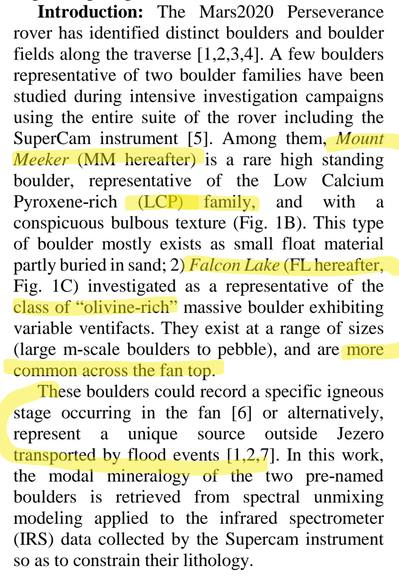
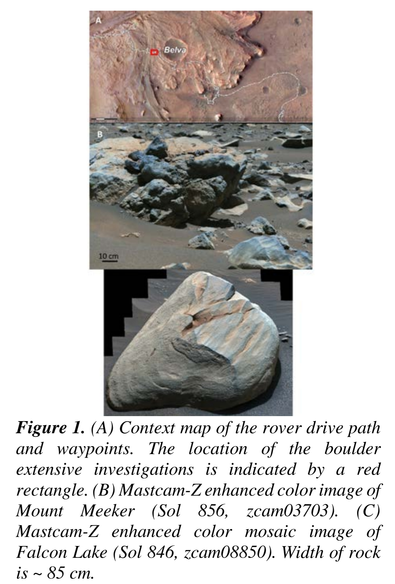
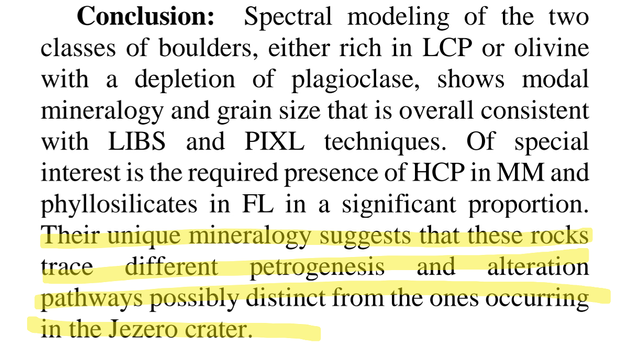
More boulder-family work on 2 representative targets.

Poulet et al : "Investigating the Modal Mineralogy of Olivine- and LCP-Rich Boulders Identified in Jezero Crater"
https://www.hou.usra.edu/meetings/tenthmars2024/pdf/3107.pdf

🧵 5/N

#JezeroDeltaScience

Paul Hammond (@[email protected])

Video of Ken Farley's talk at the 10th International Mars Conference discussing Mars sample return and the samples collected to date, including “Cheyava Falls”. Ken is the project scientist for NASA’s Perseverance Mars rover mission. https://www.youtube.com/watch?v=61phIWESjis #Solarocks #Space #Mars #Rover #Perserverance #MarsSampleReturn #Science

Fosstodon

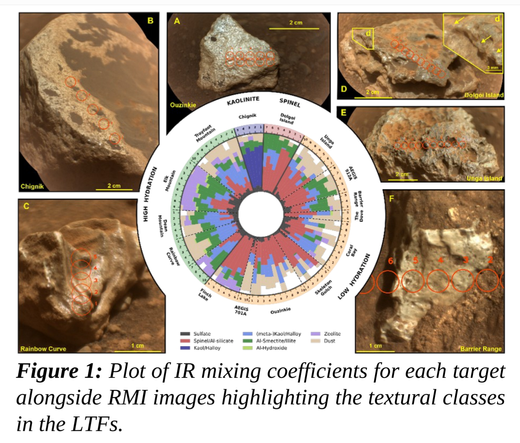
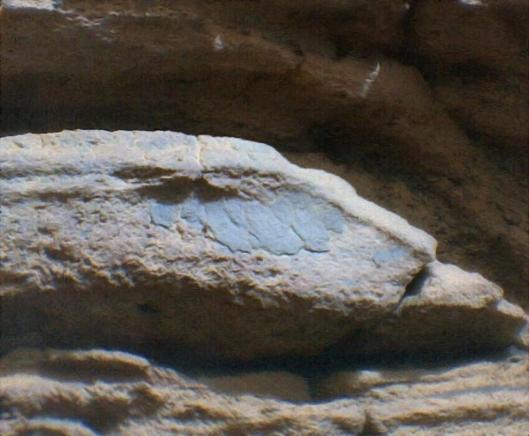
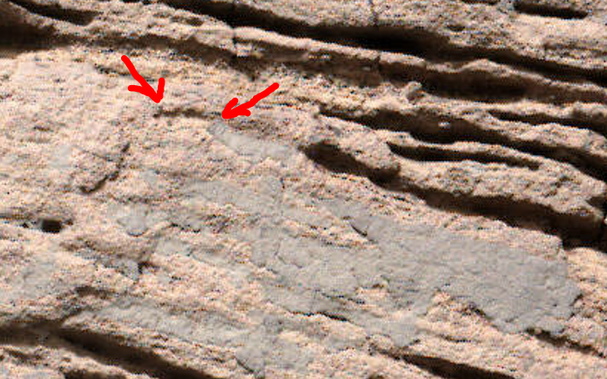
Revisiting my backlog of this conference: a paper on bright floating rocks that don't look too dissimilar to what the rover is currently finding on the rim

Royer et al : "Heavily Altered Aluminum-Rich Light-Toned Float Rocks in Jezero Crater"
https://www.hou.usra.edu/meetings/tenthmars2024/pdf/3258.pdf

🧵 7/N

#JezeroDeltaScience #JezeroBrightRocks

[EDIT]: final paper at https://www.nature.com/articles/s43247-024-01837-2

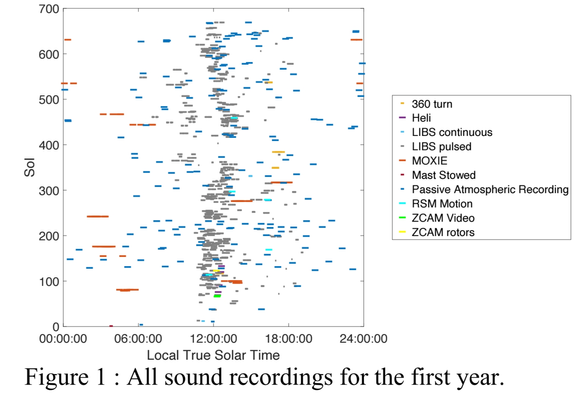
Sounds from Mars, Supercam mic recordings available at
https://pds-geosciences.wustl.edu/missions/mars2020/supercam.htm

Mimoun et al : "A preliminary catalogue of Martian sounds"
https://www.hou.usra.edu/meetings/tenthmars2024/pdf/3071.pdf

🧵 8/N

Mars 2020 SuperCam Archive

This site provides planetary science data, tools, and documentation from the PDS Geosciences Node.

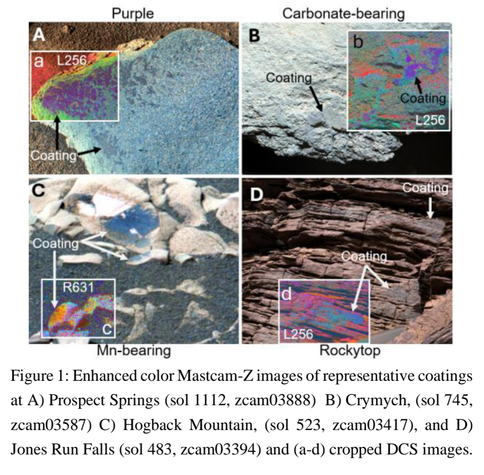
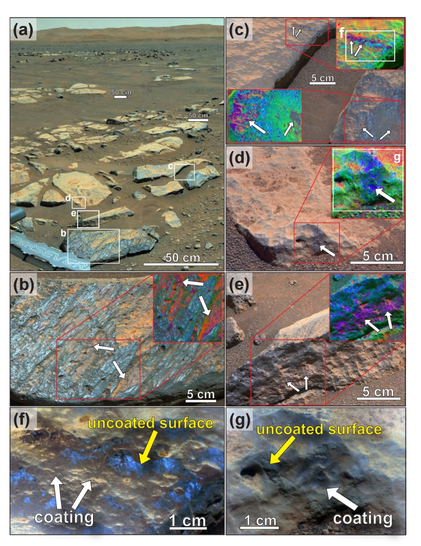
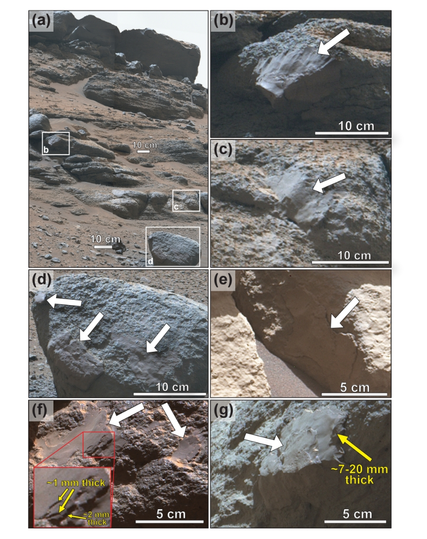
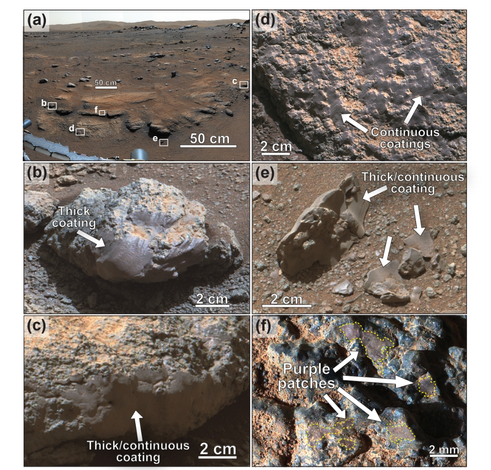
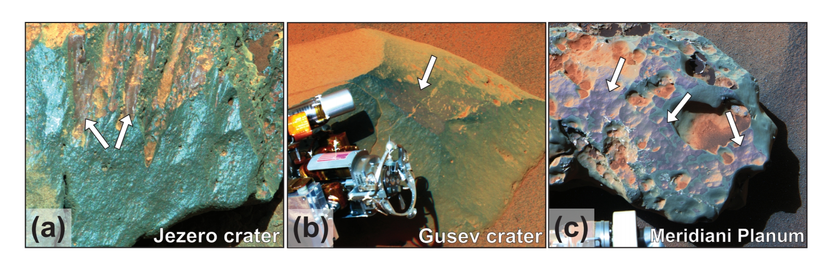
Coating talk at last! "Plaster" gets its own category (Rockytop) and along with the Mn-bearing, is interpreted more as an infill, instead of airfall dust (purple aka "varnish")

Theuer et al : "Characterization of Rock Coatings in the Fan Front, Upper Fan, and Margin Units Using Mastcam-Z Data"
https://www.hou.usra.edu/meetings/tenthmars2024/pdf/3481.pdf

🧵 9/N

#JezeroDeltaScience #JezeroPlaster

The paper above refs (2) a submitted one. Turns out it's still a preprint, waiting for peer review since 2023. I found the manuscript by chance while reading others, it's a whopping 500MB in that format!

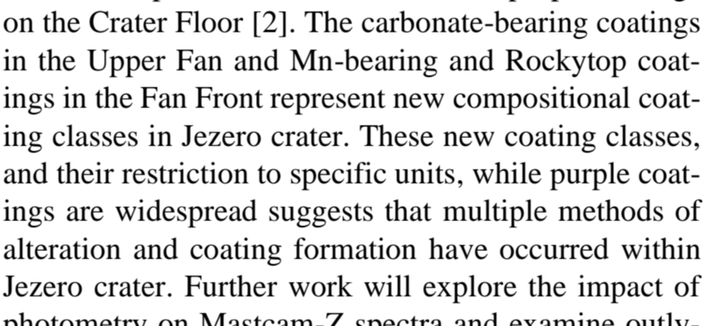
Covers 3 categories of identified coatings on Máaz & Séítah, discusses potential origins & compares to previous coatings seen by other rovers.

Garczynski et al: "Rock Coatings as Evidence for Late Surface Alteration on the Floor of Jezero Crater"
https://essopenarchive.org/users/578302/articles/651742-rock-coatings-as-evidence-for-late-surface-alteration-on-the-floor-of-jezero-crater-mars

#JezeroPlaster

For completeness: a predecessor LPSC summary paper from 2022 with mostly the same authors

"Perseverance and the purple coating: a Mastcam-Z multispectral story"
https://www.hou.usra.edu/meetings/lpsc2022/pdf/2346.pdf

@sharponlooker
Yay! 👍 👍 !!

@65dBnoise now I understand why you said you had seen lots of "varnish", I didn't pay enough attention to the crater floor campaign and there's a lot there 😉

The paper's language is (as usual) a bit meandering when it comes to explanations, there's a lot to unpack, but really useful.

@65dBnoise look at fig 9e in the 2nd photo. Reminds me of recent cases from the rim climb

@sharponlooker
At last, something substantial (judging by the megabytes) about our plastered rocks! I was about to lose faith 😃

I see Christian Tate in the authors.

@65dBnoise still wondering what's taking it so long to be published in JGR Planets, no wonder we had not found any discussions. Hope it doesn't take that long for the ones about the delta and rim coatings
@sharponlooker
Working in geological time, I guess?

@sharponlooker
The processes that create those coatings are mysterious, ghostly I should say, involving aeolic action, dust, water, etc, even for the ones observed and analyzed here on Earth, AFAICT, so a meandering language seems to be appropriate for their nature, haha.

Ah, there is a suggestion that the rover should take a sample so that the MSR mission (well, yeah) can bring it back for better examination.

@65dBnoise I think the paper said there was already a "coated" sample, but I didn't read that part so carefully.
@sharponlooker
"The Perseverance
rover likely sampled these rock coatings on the crater floor", end of abstract.
@65dBnoise I find it funny that there's mention of the possibility of some terrestrial coatings having biological origins, but that's tabú for the martian ones 😉

Samantha Theuer's master thesis: "Spectrophotometric Characterization of Hawaiian Coated Basalt and Implications for Mars"
https://cedar.wwu.edu/wwuet/1347/

#JezeroPlaster

Spectrophotometric Characterization of Hawaiian Coated Basalt and Implications for Mars

Visible to near-infrared (VNIR) reflectance spectroscopy is a commonly employed technique used to study the surface of Mars and other bodies, but spectra are sensitive to viewing geometry, non-linear spectral mixing, surface texture, and environmental factors. Furthermore, alteration products like coatings may considerably impact spectra, which is of particular importance for investigating Mars, where orbital spacecraft and rovers have documented extensive surface coatings. Studying how coatings affect the spectra of naturally weathered analog rocks, therefore, is critical to our ability to identify coatings on Mars, determine their compositions, and interpret their formation environments. Previous work using synthetic coatings and limited natural weathered materials has shown that coatings influence spectral slope, can impart unique photometric behavior, mask underlying lithologies, and may alter other absorption features, but further work is needed to characterize the spectral behavior of natural coatings. Coated basalt samples from Hawaii are reasonable natural analogs for coatings on Mars, and previous work has described silica-rich and Fe/Ti-enriched coatings with proposed formation mechanisms. However, no previous studies have quantified their full VNIR spectral and photometric behaviors. Here, we characterize coated Hawaiian basalt samples and constrain the effects of viewing geometry on their VNIR spectra for the first time. We collected samples from the 1920 Kilauea flow along the Kau Desert Trail and the 1970 Kilauea flow along the Puna Coast Trail in Hawaii Volcanoes National Park. Coating composition and morphology were characterized using reflected light microscopy and Scanning Electron Microscope (SEM) with energy dispersive spectroscopy (EDS) elemental maps and backscattered electron (BSE) imaging. Spectral and photometric behavior was characterized via Western Washington University’s TANAGER spectrogoniometer at geometries covering the full scattering hemisphere. VNIR spectra were convolved to bandpasses of the Mars-2020 Perseverance Rover’s Mastcam-Z instrument to be directly compared to Mastcam-Z spectra from Jezero crater, Mars. Mastcam-Z multispectral data from Perseverance’s recent exploration campaigns (sols 415-1198) were assessed for evidence of coatings. We identified three unique coating types with distinct stratigraphic relationships on the Hawaiian samples: (1) “porous” fragment-bearing SiO2 coatings; (2) “Fe/Ti-bearing” coatings; and (3) “layered” SiO2 coating with visible striations and fractures. The coatings significantly mask the VNIR spectral character of the underlying basalt and cause distinct wavelength-dependent photometric behaviors, particularly in the NIR; these may significantly impact interpretations of Mastcam-Z data of coatings of Mars. Our SEM analyses of coating relationships challenge the previously published formation model; further work is needed to determine the coatings’ formation mechanism.

Western CEDAR

@sharponlooker
I tried hard to read the paper on this tiny phone screen, an almost impossible task (no wonder why young people don't read long texts). But I somehow managed, kind of.

So, ok, we now have a rough idea about the composition of those coatings, but to my IANAG understanding there's still the same uncertainty about the process that create(s|d) them. "Infill" describes the observable, but not so much the process. No?

@65dBnoise kudos to reading on a small screen. The figures required quite a lot of zoom

Uncertainty or not, & with some reservation to what is meant by infill, I feel that there's validation to this gut-feeling of "varnish" vs "plaster". One of the important things said here about Rockytop is that both the host rock & the infill are similar material, so it's not hard to see this as episodes of (probably) water seeping through cracks at late times, moving laterally & altering the host rock

@sharponlooker
But validation of what? You mean of it not being varnish? Then some geologists should rescind their calling it publicly, with almost certainty, desert varnish.

What follows your "it's not hard..." is the explanation I was looking for, but it is not given in the paper; we're still in the realm of speculation. Such uncertainty should rather be expected, considering it took centuries to understand how Terran desert varnish was created.

@65dBnoise validation that there was a qualitative difference, that the "plaster" was not the same type. Note that the paper does not mention desert varnish, it's purple coating and assumed origin is airfall. And yeah, we better wait for more papers, this one is still ongoing work and focused on Mastcam observations

@sharponlooker
There are definitely at least two types of coatings visible in the normal color MastcamZ images, those thin purple ones, almost always on top of rock surfaces, and the thick gray ones, mostly seen on vertical surfaces.

IIRC, thickness did not concern the paper,.but it's the thick coatings we called plaster which is what they hypothesize is infill.

@sharponlooker
Lots of activity around noon, and it appears to be LIBS pulsed. That could mean that the laser is quite noisy, but of course it is to be expected since mic and laser are located very close to each other.

@65dBnoise and it's "intentional". From the mic operations section, right above the graph:

"IC+LIBS (Microphone plus SuperCam LIBS) continuous mode, the microphone is turned on to record the LIBS-induced laser burst at 100 kHz. Given that the laser is shot at a frequency 3 Hz, a maximum of 120 shots occur during the recording."

@sharponlooker
One could say that there is a war going on between alien invaders and natives, involving supreme alien weaponry spewing invisible death rays etc but also strong resistance by huge number of natives. In the end, we know that the natives will prevail.

The above description is absolutely true, depending on the perceived meaning of a few words. Robert Graves, in his novel "Hercules, My Cotraveler" says that this gift of deceiving with words was given by Hermes to his priests. 🙃

@sharponlooker
Not a single mention of Belva in the paper? 🤔
My naive expectation would be for a few words, even in passing, about the crater next to those targets, and the (im?)possibility for those rocks to be ejecta.
But then again, IANAG.

@65dBnoise I haven't seen any references to Belva at all yet in all these papers. I can only guess there's a comprehensive study ongoing that will result in one of those longer papers for JGR Planets or Science.

Putative Belva ejecta I'd expect to show as outliers in the kind of general classification studies like in post nr4, or in more comprehensive analyses like this one for bright float rocks (2 categories with only 1 target each 😉) https://www.hou.usra.edu/meetings/tenthmars2024/pdf/3258.pdf

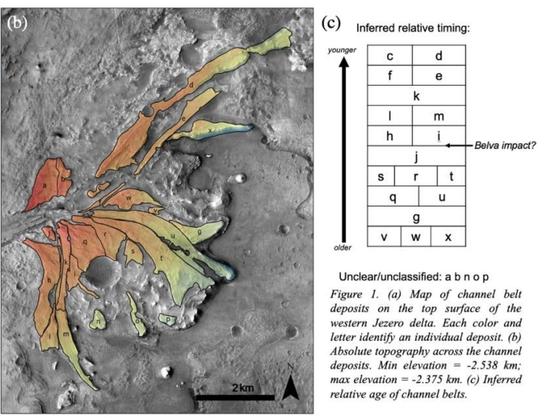
@65dBnoise then again, looking at the proposed chronology for the alphabet-labeled flows of the delta, Belva happened midway, so one would expect most ejecta having been buried by newer flows
@sharponlooker
Isn't the Neretva Vallis riverbed somewhat midway?
@65dBnoise from my pinned post, paper from last year, includes the only chronology I've seen so far https://www.hou.usra.edu/meetings/lpsc2023/pdf/2067.pdf

@sharponlooker
The riverbed is not included in that chronology.

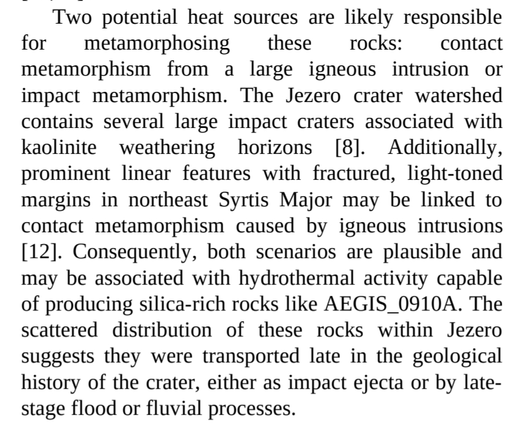
There is this mention of crater impact in the "Discussion" section of that paper, also mentioning "several large impact craters" in general, but Belva is not mentioned:

"Two potential heat sources are likely responsible for metamorphosing these rocks: contact metamorphism from a large igneous intrusion or impact metamorphism."

@65dBnoise the riverbed must have been there throughout all epochs, I don't think there's much that can be said about its chronology from orbital data, we'll see when the in-situ data has been studied.

When they talk about impacts or igneous intrusions as sources of metamorphism, I always interpret it as "regional"/ larger scale events than Belva, you need high temps for that. But yeah, Belva is no small crater anyway

@sharponlooker
Surely it has been there for as long as Jezero exists and water was flowing into the crater, but its current surface was formed at some narrower period, probably when water flow was waning, before it stopped. It might be when it eroded the layers above Bright Angel and made it appear at the surface. So I'd expect it to have a better defined age.
@sharponlooker
6 named targets but not one reference to location, or even Sol. 😐 And IIRC, there is no reverse index, name-to-location, in the PDS.
@65dBnoise preliminary paper, they don't have to bee so exhaustive. But we the people demand a feature-searchable map asap! 🙃
@sharponlooker
It would require just 6 Sol entries in the caption, not a big deal.

@sharponlooker
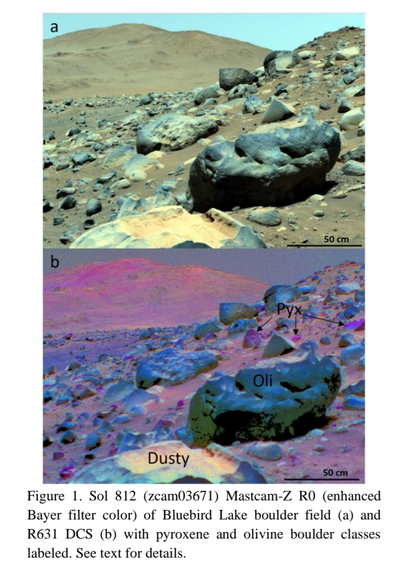
Here are #crackedRocks Oli and Dusty a few meters west of #Perseverance and all of them just west of Belva Crater.

On the map, the green area is the field-of-view of MCZ at 34mm.

Processed, leveled MCZ_LEFT, FL: 34mm
looking W (267°) from RMC 39.1170
Sol 812, LMST: 10:19:24
Original: https://mars.nasa.gov/mars2020-raw-images/pub/ods/surface/sol/00812/ids/edr/browse/zcam/ZL0_0812_0739017260_428EBY_N0391170ZCAM03671_0340LMJ01.png

Credit: #NASA/JPL-Caltech/ASU/65dBnoise

#Mars2020 #Solarocks #Space #QGIS

@65dBnoise we have to find a Stan for that Oli 😀

Will be interesting to see this method applied to the Mount Washburn boulders and compare.

@sharponlooker
Would it apply to at least some of the other #crackedRocks we've seen around?

(didn't read the paper)

@65dBnoise it's a coarse categorization method but "simple to apply" (reminds of Tau's principal component analysis processing at UNMSF), more helpful with boulder field views. Nice with an in-situ additional datapoint to confirm those letter-labeled flows identified from orbit.

I suspect Mount Washburn and other such boulder-rich areas in Neretva will show more diversity. The #JezeroBrightRocks will require more sophisticated methods to identify their provenance.

@65dBnoise let's add a #PDSAnalystNotebook to it 😉
@sharponlooker
I added it.
@sharponlooker
I saw your exchange with @PaulHammond51 but had no time and brain bandwidth to read it and the paper carefully. Still short on both.
@65dBnoise the good thing with these conference papers is they're brief & concise 😉
@sharponlooker
Ha, ha! Exactly not what I wanted. I'd like to see raw data and grok for once what kinds of data were collected, at what rate. We still have no idea what those were (are?); all we can do is infer those from brief papers and from scant words from conferences and interviews.
@65dBnoise I'm surprised the full telemetry hasn't yet been released even for the earliest flights? That's quite the proprietary period...
@sharponlooker
I just read through the paper. Interesting, especially the flights to higher altitude; alas, there was no MEDA data for those. Apparently telemetry includes IMU/inclinometer data, but we still don't know the details.