h/t to @PaulHammond51 & Mars Guy for referring to the recent "10th International Conference on Mars" in the Cheyava Falls video. Only news or pointer I've seen to it.

The summary papers & posters are a treasure trove of upcoming research or incremental studies since LPSC

🧵 1/N

https://www.hou.usra.edu/meetings/tenthmars2024/technical_program/

Tenth International Conference on Mars - July 22–25, 2024

The Tenth International Conference on Mars is a large, 500–600-person gathering of Mars scientists from a range of disciplines, institutions, and countries.
The Tenth International Conference on Mars is a large, 500–600-person gathering of Mars scientists from a range of disciplines, institutions, and countries.
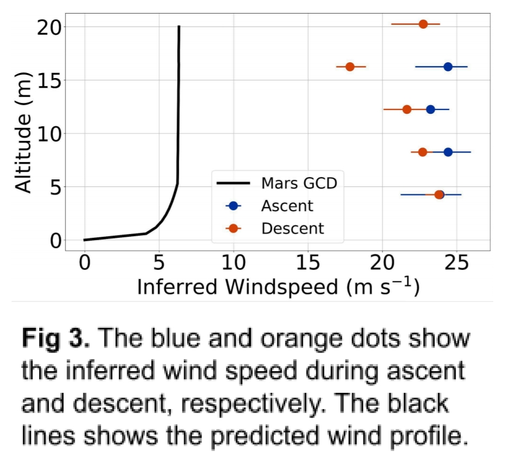
Using #MarsIngenuityHelicopter as a weather vane 😀 Preliminary analysis of telemetry to estimate wind speed & direction. Surprisingly strong winds detected!

Jackson & Brown: Estimating Near-Surface Martian Winds Using the Ingenuity Helicopter's Attitude
https://www.hou.usra.edu/meetings/tenthmars2024/pdf/3346.pdf

"Tilting in the breeze Ginny groks the martian winds Surprisingly strong."

🧵 2/N

Iteration/compilation of conclusions from earlier papers from this team.

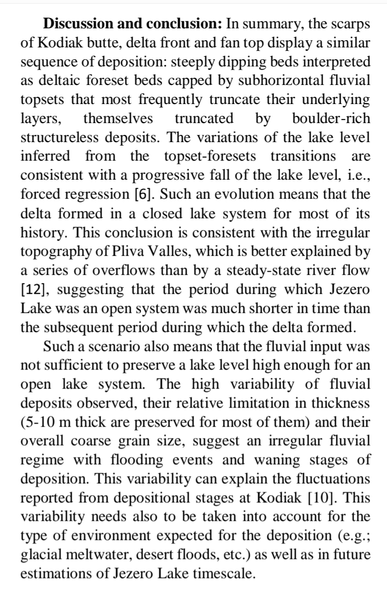
Mangold et al: "Constraints on Jezero Paleolake History from Its Fluvial Input"
https://www.hou.usra.edu/meetings/tenthmars2024/pdf/3079.pdf
"A high variability in fluvial deposits is observed on Jezero delta front and top, which reflect variable fluvial regimes associated to Jezero lake level fluctuations in a closed basin."

#JezeroDeltaScience 🧵 3/N

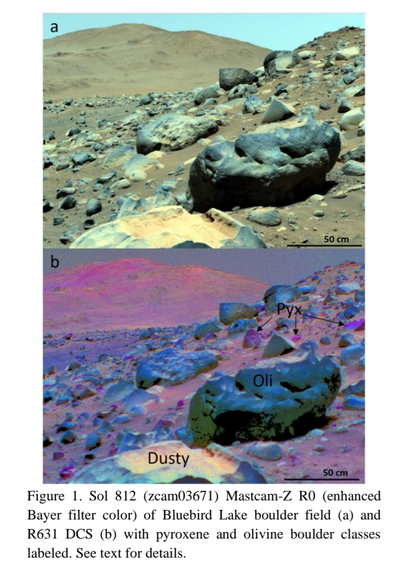
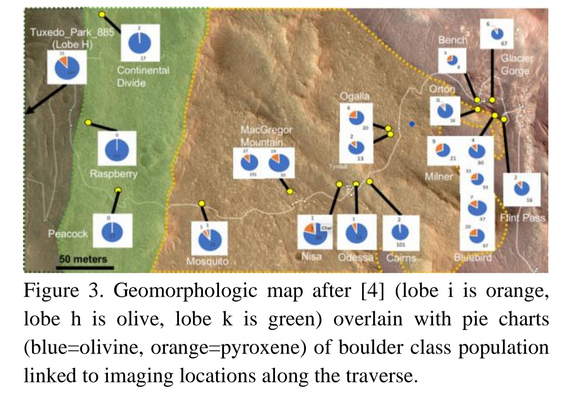
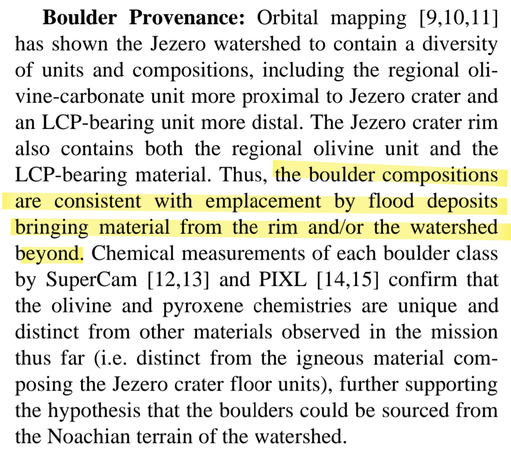
A new iteration of analysis of Margin Unit boulders, this time with MastCam (compare to this earlier one with SuperCam https://mastodon.social/@sharponlooker/111870338355722359 ). Boulders "confirmed" to be coming from floods and differ from Séítah.

Vaughan et al : "Investigating the Blocky Unit Boulders of the Western Jezero Fan Top Using Mastcam-Z"
https://www.hou.usra.edu/meetings/tenthmars2024/pdf/3328.pdf

🧵 4/N #JezeroDeltaScience

@sharponlooker
Here are #crackedRocks Oli and Dusty a few meters west of #Perseverance and all of them just west of Belva Crater.

On the map, the green area is the field-of-view of MCZ at 34mm.

Processed, leveled MCZ_LEFT, FL: 34mm
looking W (267°) from RMC 39.1170
Sol 812, LMST: 10:19:24
Original: https://mars.nasa.gov/mars2020-raw-images/pub/ods/surface/sol/00812/ids/edr/browse/zcam/ZL0_0812_0739017260_428EBY_N0391170ZCAM03671_0340LMJ01.png

Credit: #NASA/JPL-Caltech/ASU/65dBnoise

#Mars2020 #Solarocks #Space #QGIS

@65dBnoise we have to find a Stan for that Oli 😀

Will be interesting to see this method applied to the Mount Washburn boulders and compare.

@sharponlooker
Would it apply to at least some of the other #crackedRocks we've seen around?

(didn't read the paper)

@65dBnoise it's a coarse categorization method but "simple to apply" (reminds of Tau's principal component analysis processing at UNMSF), more helpful with boulder field views. Nice with an in-situ additional datapoint to confirm those letter-labeled flows identified from orbit.

I suspect Mount Washburn and other such boulder-rich areas in Neretva will show more diversity. The #JezeroBrightRocks will require more sophisticated methods to identify their provenance.

@65dBnoise let's add a #PDSAnalystNotebook to it 😉
@sharponlooker
I added it.
@sharponlooker
I saw your exchange with @PaulHammond51 but had no time and brain bandwidth to read it and the paper carefully. Still short on both.
@65dBnoise the good thing with these conference papers is they're brief & concise 😉
@sharponlooker
Ha, ha! Exactly not what I wanted. I'd like to see raw data and grok for once what kinds of data were collected, at what rate. We still have no idea what those were (are?); all we can do is infer those from brief papers and from scant words from conferences and interviews.
@65dBnoise I'm surprised the full telemetry hasn't yet been released even for the earliest flights? That's quite the proprietary period...
@sharponlooker
I just read through the paper. Interesting, especially the flights to higher altitude; alas, there was no MEDA data for those. Apparently telemetry includes IMU/inclinometer data, but we still don't know the details.