h/t to @PaulHammond51 & Mars Guy for referring to the recent "10th International Conference on Mars" in the Cheyava Falls video. Only news or pointer I've seen to it.

The summary papers & posters are a treasure trove of upcoming research or incremental studies since LPSC

🧵 1/N

https://www.hou.usra.edu/meetings/tenthmars2024/technical_program/

Tenth International Conference on Mars - July 22–25, 2024

The Tenth International Conference on Mars is a large, 500–600-person gathering of Mars scientists from a range of disciplines, institutions, and countries.
The Tenth International Conference on Mars is a large, 500–600-person gathering of Mars scientists from a range of disciplines, institutions, and countries.
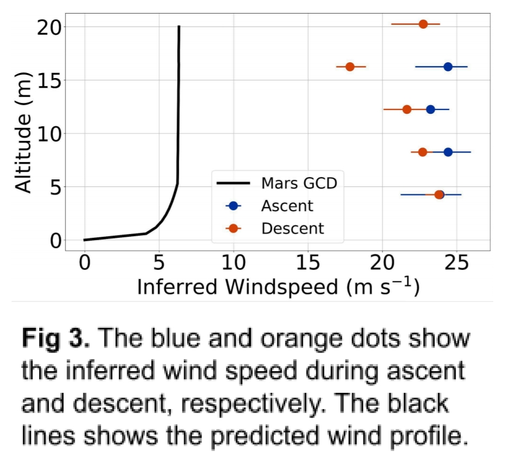
Using #MarsIngenuityHelicopter as a weather vane 😀 Preliminary analysis of telemetry to estimate wind speed & direction. Surprisingly strong winds detected!

Jackson & Brown: Estimating Near-Surface Martian Winds Using the Ingenuity Helicopter's Attitude
https://www.hou.usra.edu/meetings/tenthmars2024/pdf/3346.pdf

"Tilting in the breeze Ginny groks the martian winds Surprisingly strong."

🧵 2/N

Iteration/compilation of conclusions from earlier papers from this team.

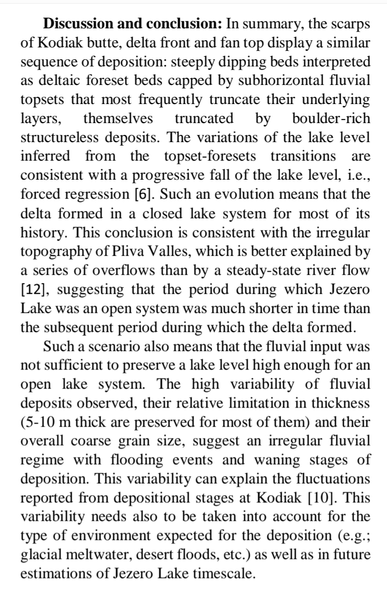
Mangold et al: "Constraints on Jezero Paleolake History from Its Fluvial Input"
https://www.hou.usra.edu/meetings/tenthmars2024/pdf/3079.pdf
"A high variability in fluvial deposits is observed on Jezero delta front and top, which reflect variable fluvial regimes associated to Jezero lake level fluctuations in a closed basin."

#JezeroDeltaScience 🧵 3/N

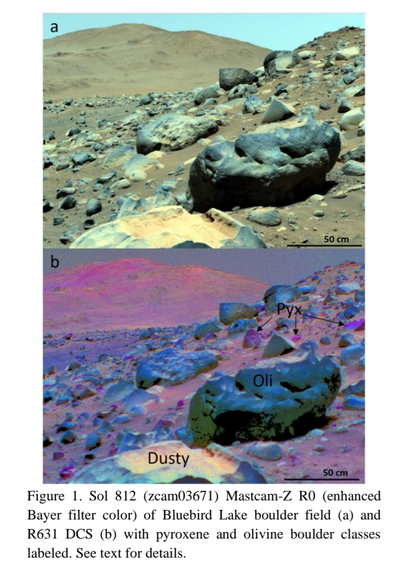
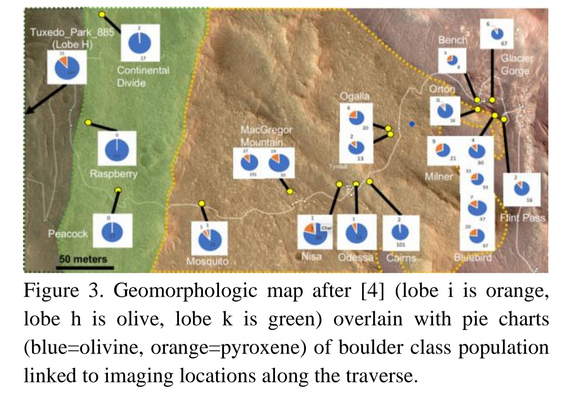
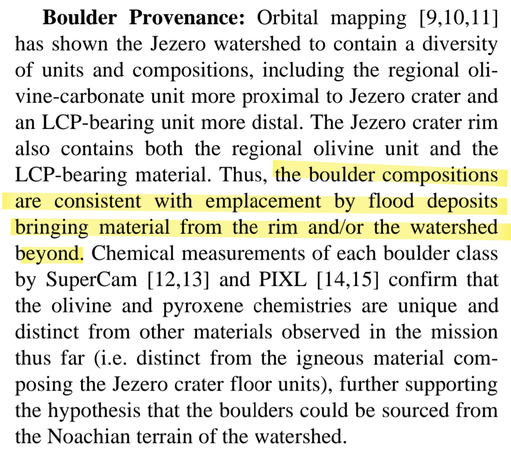
A new iteration of analysis of Margin Unit boulders, this time with MastCam (compare to this earlier one with SuperCam https://mastodon.social/@sharponlooker/111870338355722359 ). Boulders "confirmed" to be coming from floods and differ from Séítah.

Vaughan et al : "Investigating the Blocky Unit Boulders of the Western Jezero Fan Top Using Mastcam-Z"
https://www.hou.usra.edu/meetings/tenthmars2024/pdf/3328.pdf

🧵 4/N #JezeroDeltaScience

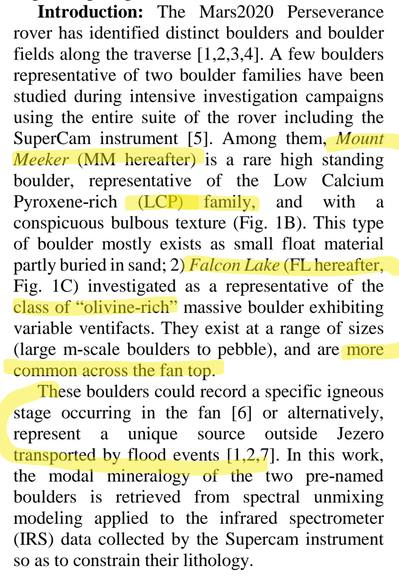
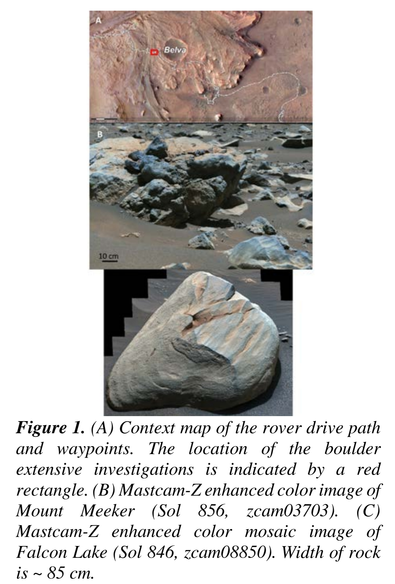
More boulder-family work on 2 representative targets.

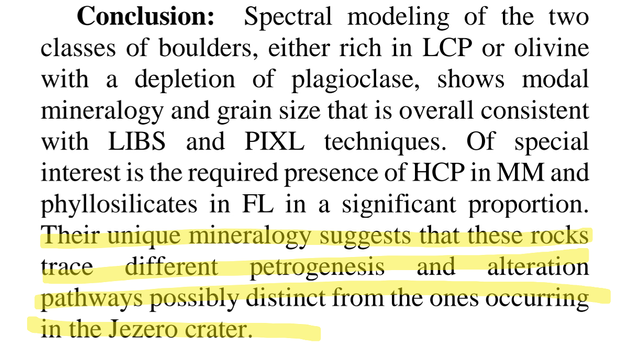
Poulet et al : "Investigating the Modal Mineralogy of Olivine- and LCP-Rich Boulders Identified in Jezero Crater"
https://www.hou.usra.edu/meetings/tenthmars2024/pdf/3107.pdf

🧵 5/N

#JezeroDeltaScience

@sharponlooker
Not a single mention of Belva in the paper? 🤔
My naive expectation would be for a few words, even in passing, about the crater next to those targets, and the (im?)possibility for those rocks to be ejecta.
But then again, IANAG.

@65dBnoise I haven't seen any references to Belva at all yet in all these papers. I can only guess there's a comprehensive study ongoing that will result in one of those longer papers for JGR Planets or Science.

Putative Belva ejecta I'd expect to show as outliers in the kind of general classification studies like in post nr4, or in more comprehensive analyses like this one for bright float rocks (2 categories with only 1 target each 😉) https://www.hou.usra.edu/meetings/tenthmars2024/pdf/3258.pdf

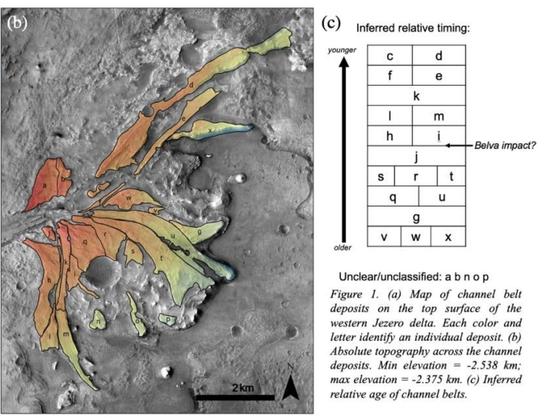
@65dBnoise then again, looking at the proposed chronology for the alphabet-labeled flows of the delta, Belva happened midway, so one would expect most ejecta having been buried by newer flows
@sharponlooker
Isn't the Neretva Vallis riverbed somewhat midway?
@65dBnoise from my pinned post, paper from last year, includes the only chronology I've seen so far https://www.hou.usra.edu/meetings/lpsc2023/pdf/2067.pdf

@sharponlooker
The riverbed is not included in that chronology.

There is this mention of crater impact in the "Discussion" section of that paper, also mentioning "several large impact craters" in general, but Belva is not mentioned:

"Two potential heat sources are likely responsible for metamorphosing these rocks: contact metamorphism from a large igneous intrusion or impact metamorphism."

@65dBnoise the riverbed must have been there throughout all epochs, I don't think there's much that can be said about its chronology from orbital data, we'll see when the in-situ data has been studied.

When they talk about impacts or igneous intrusions as sources of metamorphism, I always interpret it as "regional"/ larger scale events than Belva, you need high temps for that. But yeah, Belva is no small crater anyway

@sharponlooker
Surely it has been there for as long as Jezero exists and water was flowing into the crater, but its current surface was formed at some narrower period, probably when water flow was waning, before it stopped. It might be when it eroded the layers above Bright Angel and made it appear at the surface. So I'd expect it to have a better defined age.