@bontchev
ALT
A toodle-like drawing with title "GOOGLING STUFF..." showing a table
with two columns, left "..THEN" and right "...NOW". The titles are
underlined. The left column is almost empty, it shows SEARCH RESULTS:
and below that a yellow post-it like box: "THE THING YOU WANT". The
right column is fully cluttered. At the top a red box: "CRAZY AI
MISINFORMATION THAT WILL GET PEOPLE KILLED". Below that simple black
framed boxes: "SPONSORED RESULT", "SPONSORED RESULT", "SPONSORED
RESULT", "SPONSORED RESULT", a box "PEOPLE ALSO ASK" with two bullet
lists: "* __________". Below that another box: "VIEW PRODUCTS" with a
row of four square boxes. At the very bottom the top of a yellow
post-it like box.
Login • Instagram

Welcome back to Instagram. Sign in to check out what your friends, family & interests have been capturing & sharing around the world.

@bontchev C'est la modernité et le progrès selon le capitalisme
@bontchev Google is an example of enshitification
@PictoPulse356 @bontchev it's pretty hard to deny that (cost)free internet services inevitably leads to enshitification. If we want something that's both good and that respects our privacy, subscription is the only way.
GitHub - benbusby/whoogle-search: A self-hosted, ad-free, privacy-respecting metasearch engine

A self-hosted, ad-free, privacy-respecting metasearch engine - benbusby/whoogle-search

GitHub

@bontchev

I just checked if the "I fell I'm lucky" button was still there on Google...

Yes, and it still works as expected !

That's not a good enough reason to use Google search engine (not been using it for years now, that's why I checked).

@bontchev Google “St. Bernard of Clairvaux” and you get “10 Best St. Bernards of Clairvaux Near You!”

@jinglepostman @bontchev

Interestingly, only yesterday Mastodon taught me all about St. Bernard and the accuracy of lactation:

https://masto.ai/@vagina_museum/112563404762605114

Vagina Museum (@[email protected])

Attached: 1 image It's been a while since we've shown you a weird fad in medieval Christian art, so here's one you might enjoy - Lactatio Bernardi: The Lactation of St Bernard. Date unknown, courtesy of Bodleian Library.

Mastodon

@bontchev Not sure that is true

it used to be
"Something really interesting you never knew about related thing", oops an hour later try the next link
"Thing you want"

@etchedpixels @bontchev That's closer, yeah. I used to see a lot of results that weren't really what I was after (and sometimes were wrong or completely unrelated).

The image did get right that the same basic thing is pretty much just pushed under AI, ads, etc.

@bontchev view products aren't at the bottom, they're at the top if your search term is anything that could be bought
@bontchev
I got rid of Overview & sponsored links, & still get 20 right-wing misinformation links before any reality-based answers.
@bontchev The cartoon forgot to make the Now side 50% smaller in size so Google can stuff 50 lbs more crap into the same size frame.
@bontchev the rot economy claims another victim
Volker Weber (@[email protected])

Old School Google Die Älteren werden sich erinnern, dass man früher von Google einfach eine Liste von Treffern bekam. Dann wurde die Ergebnisseite immer weiter möbliert und mit Werbung garniert. Was wäre, wenn ich Euch erzähle, dass es das immer noch gibt? Könnt Ihr selbst probieren. Geht einfach in die URL einer Ergebnisseite und hängt dort einen weiteren Parameter an: udm=14 Links seht Ihr Google 2014, rechts Google 2024: https://vowe.net/2024/05/20/old-school-google/ #google

Heise Medien on Mastodon
@bontchev @kb9ens on the left: "results that actually directly match the search terms you entered" … on the right: "results that match search terms you didn't enter but happen to be spelled somewhat similarly. none match what you actually submitted."
@bontchev You're too optimistic. You show the right result showing up beneath the garbage. A lot of times now search shows *nothing* but garbage.
@bontchev Lol, the internet was never like on the left. Early search was *awful*.
@nafnlaus @bontchev
How early? AltaVista was, for a while, brilliant. Perhaps the job was easier then, prior to the 'dot com' boom, because the web was full of pretty much only real content.

@hitsuyonai @bontchev AltaVista was garbage, which is why everyone jumped ship to Google. Pre-pagerank search was just awful.

And no, the internet was never devoid of SEO. In fact, SEO used to be FAR easier before Pagerank. Even in the early days of pagerank, people immediately started gaming the system by loading each other's pages up with mutual links to climb the graph.

People need to stop looking at the past through rose-coloured glasses. The early internet was terrible.

@hitsuyonai @bontchev Some history on SEO.

The internet was awash in it. Pagerank did an awful lot to push it down, though it's required continual refinements.

The very reason we have Google today as a giant megacorp was because they introduced the first relatively effective anti-SEO technique, onto a web flooded in SEO.

@nafnlaus @bontchev
I'm talking about the web, not the internet (the first browser I used was in corridor between restaurant 1 and the X bus stop at CERN, with a note saying something like 'have a play on this').
Early days one could follow links; then people started to create indexes/ directories and the like.
AltaVista added a search capability - and it had a 'near' keyword - which made finding what one wanted way easier, and also eliminated the little dross that existed at the time.

@hitsuyonai @bontchev Those links were usually dead. Search was so terrible that people created "webrings", which were themselves awful. There was not "little dross" - the internet was primarily dross. Useless corporate "We're On The Internet" PR sites, tons of hideous hand-edited HTML sites written by amateurs, and an endless sea of porn sites trying to bait in everyone from everywhere with SEO, deceptive links, banner ads, etc.

This is what the internet was like:

http://www.ultimatecitrus.com/index.html

UltimateCitrus.com - The Ultimate Citrus Page

Citrus - Ultimatecitrus.com, your source for citrus information

@hitsuyonai @bontchev Don't get me wrong, I have fond memories from the era. It was a new frontier. New things you can accomplish. A whole new world at your fingertips.

But by modern standards, it was unambiguously awful. People then would have gone *crazy* over access to something like our modern internet.

@nafnlaus @bontchev
have a look at this list, and tell me which ones you don't like:

https://en.wikipedia.org/wiki/List_of_websites_founded_before_1995

AltaVista started in 1995. They might have played an inadvertent role in aiding the enshitification of the web, but pagerank was more eaily gamed than AltaVista's 'near' keyword.

The beancounters of UK academia went for remarkably similar idiocy to pagerank.

Google won because the management of DEC, the second biggest computer hardware manufacture on earth at the time, were muppets.

List of websites founded before 1995 - Wikipedia

@hitsuyonai @bontchev This has to be a joke. A list of websites from before 1995 as some sort of proof? There were an estimated 23,5k websites in 1995. How many of them are on your list? Almost none. Because they were rubbish.

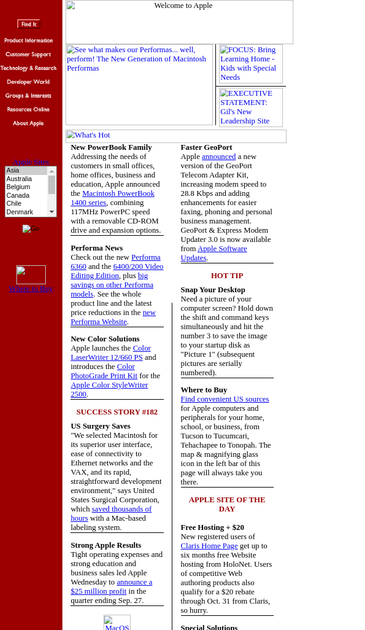
And the ones that were there? Let's just pick a random one. Apple is seen as a paragon of style and user-friendly convenience, so let's bias the comparison and look up what their website was like.

Lol.

@hitsuyonai @bontchev I'm sure you went there for "Apple Site Of The Day" or "Success Story #182", right?

Vs. today (I just moused over iPhone, pretending that's what I was interested in)

@nafnlaus @bontchev
you just at random picked, from a a list of 1995 websites, that of a company that is currently the second largest on the the planet 👍 .
And you hovered over iphone, because? - you have an urgent need to go shopping?
😉
If you are trying to argue that between 1995 and 1997 I wouldn't have been able to find a iphone through AltaVista, I have to concede you are probably correct.
@hitsuyonai @bontchev That was me trying to skew the comparison *in your favour*.
@hitsuyonai @nafnlaus @bontchev

Eh, just goes to show, Wikipedia ain't so dang smart! It's missing Netsurfer Digest! Where we reviewed all the new web sites!

https://web.archive.org/web/19961111181100/http://www.netsurf.com/nsd/v00/nsd.94.06.03.html
Netsurfer Digest 00.01

@nafnlaus @hitsuyonai @bontchev

I think you mean that the early _web_ was terrible. I kinda liked email that worked, and MUDs and MOOs, and Usenet. And even Gopher, a little.

@woody @bontchev @hitsuyonai Email that worked on the early web, are you kidding me? I administered an email server at the time, it was a bloody nightmare. How have you memory holed the whole "confirmation emails often take hours to arrive if they ever even arrive at all" thing? And early spam filters were way worse than today, if you even had access to one at all.

MUDs and MOOs were certainly *fun*, mind you :) I had even more fun as a coder. LP MUD all the way - objects are OBJECTS!

@nafnlaus @bontchev @hitsuyonai

I'm distinguishing between the "web," the "world wide web" of HTTP stuff, and the Internet more generally, which supports, and supported, many other kinds of standards-based communication. You appear to be saying that the early Internet was crap, and we're viewing it through rosy glasses. I would counter that it was not crap, it was actually quite pleasant, though on almost unrecognizably different terms. There weren't spam filters in the early Internet, because there wasn't spam on the early Internet. Finger worked because nobody cared whether someone knew that they were logged in, because that wasn't some kind of privacy violation, because we weren't thinking in those terms yet. There weren't "confirmation emails" because there wasn't a second-class of "unconfirmed" citizens.

The technology was simple, it didn't have a polished user interface, compiling cnews was a pain in the ass, there weren't search engines, because there wasn't an expectation that arbitrary information would be available online... you discovered things by word of mouth, and you were surprised and charmed to find them. Snoopy calendars!

It was a different time, the challenges were different ones, it's very difficult to make meaningful comparisons between the Internet of 1990 and the Internet of 2024. But in 1990, nobody's personal information was being sold, and nobody's thermostat was live-streaming video of the inside of their house, and nobody's vote was being manipulated by Russians and Facebook for pennies. And people weren't spending all day doomscrolling. Overall, I think it was a lot healthier.

@woody @bontchev @hitsuyonai

"There weren't spam filters in the early Internet, because there wasn't spam on the early Internet."

As someone who administered an email server, I don't think I can even read past this retcon. How can you have been alive then and not remember all the endless spam? People gathered emails everywhere and sent it *en masse*. After a trip to Japan where I had stayed at hostels, and some required email address, all of the sudden I got a new flood of spam *in Japanese*

@woody @bontchev @hitsuyonai Early spam was relentless because so little spam filtering was done. The 419 scam spam emails in particular date from this time. The FTC started holding spam hearings in 1997. This ultimately led to congress passing the CAN-SPAM act in 2003. Spam was a BIG problem on the early internet, one you seem to have entirely memory-holed.
@nafnlaus @woody @bontchev
but you're talking about 1997 and *email* - I'm talking about the *web*, and pre that date.

@woody @bontchev @hitsuyonai

CATPCHAs started being introduced in 2000 to fight the growing spam problem.

There's surely a higher total percentage of email volume as spam now (though the CAN-SPAM act helped shift a lot of it to semi-legit things with opt-outs), but the far less common / poorer implementation of filtration back then meant that you saw a lot more of it.

NYT article from 1995:

https://www.washingtonpost.com/archive/business/1995/11/20/its-the-spam-you-read-thats-making-many-interneters-queasy/bbb0bcd9-cce6-4eb7-ad30-a8272b261809/

IT'S THE SPAM YOU READ THAT'S MAKING MANY INTERNETERS QUEASY

The Washington Post
@nafnlaus @bontchev @hitsuyonai

I administered email servers throughout the 1980s, and I simply don't remember ever having any spam to deal with. I mean, I'm not saying there was _none_, just that I don't remember any, and it was not something that I needed to actually act upon until the mid-1990s.
@woody @nafnlaus @hitsuyonai Can confirm. Spam didn't exist in the '80. It didn't start becoming a problem, until that Green Card lawyer thought it a great marketing idea to spam all the USENET newsgroups.
@bontchev @woody @hitsuyonai I think we're talking about different timeperiods. I'm talking about the 1990s. As is anyone talking about Altavista, etc.
@bontchev Stoped using it !! I do the u-tube but only though duck duck go and only after clearing history and set to no history. You are the PRODUCT why don't you get paid?🤬😖 break them up. 😀
Invidious Instances - Invidious Documentation

The official Invidious documentation

@bontchev Nothing of relevance appears on the right.

@bontchev

i kinda use chatgpt for everything anymore..

if it's something in a field i am totally clued out about, I will ask someone i know who is an expert..

@bontchev I remember setting my school's browsers startup pages to google search rather than altavista or whatever it was at the time... now I kinda wish I'd just gone for about:blank 😅
@bontchev @RachaelAva1024 Then they say “ten blue links” is a thing of the past. Now you should just go straight to our AI chatbot and ask. But realistically they haven’t been serving an accurate list of ten blue links for years.

@bontchev You forgot the solution you WANT inside a 45 Minute long youtube Video.

Remember to click the bell and subscribe.

@bontchev "It is so much more optimized now"
@bontchev "We expect that advertising funded search engines will be inherently biased towards the advertisers and away from the needs of the consumers." - Sergey Brin, Larry Page, 1998
@bontchev And the services that rely on Google, like DuckDuckGo, do the same