6: Listen to *stereo* FM radio

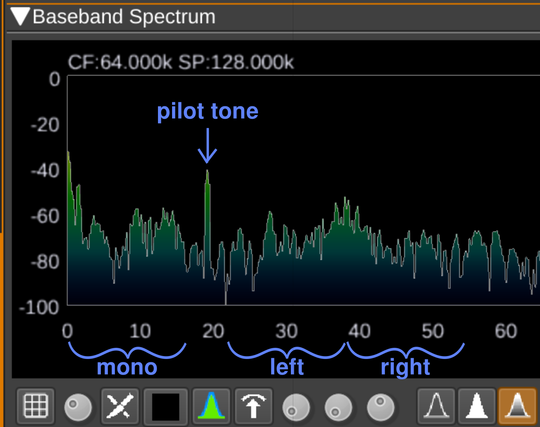
How stereo audio is transmitted is really interesting, because it's backwards-compatible to receivers that don't support it:

Here, you see the demodulated audio frequency spectrum. Below 19k Hz, it's just mono audio. Then, to mark a stereo station, there's a constant "pilot tone" at 19k Hz! (Outside of what most humans can hear.)

Then, if you double the frequency of the pilot tone, you can derive the sections where the left & right channel is transmitted!
7: Receive road traffic information

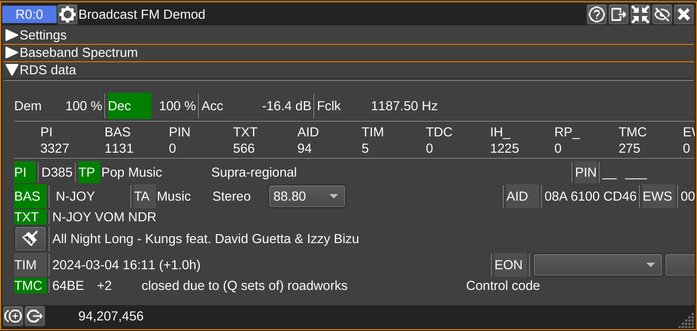
If you triple the frequency of the pilot tone, you get to a range where FM stations transmit small amounts of digital metadata, like the name and genre of the station, and the current song! That's a protocol called Radio Data System.

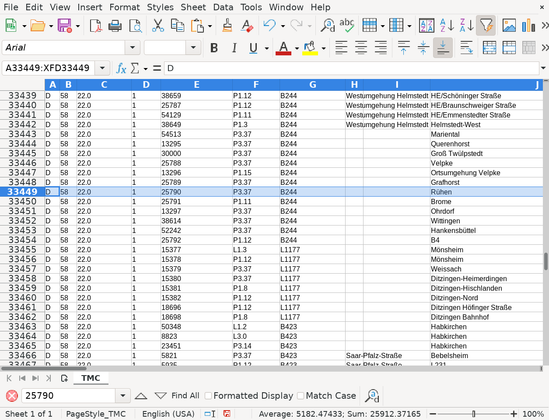
This system can also transmit road traffic information! There seems to be a road closure at "0x64BE". The Federal Highway Research Institute publishes an Excel table, where I could look up that this is a town in Lower Saxony!

8: Listen to conversations on the 2-meter amateur radio band

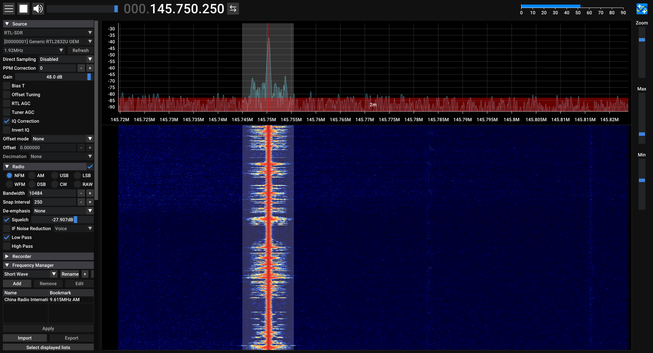
This is a frequency range reserved for amateur radio operators โ€“ for non-commercial use only. You may send on this band after getting a license.

What I found here is seemingly a conversation circle facilitated by a relay around 15 km away from here โ€“ it takes input on a certain frequency, and outputs an amplified copy of it on another frequency! Klaus, Bernd, Jรผrgen and Horst are talking about antennas, relays, and Windows XP! ๐Ÿ˜

9: Listen to digital radio

The SDRangel software also has a demodulator for Digital Audio Broadcast! :O I continue to be amazed by it!

I think this is the first time I've received digital radio via air! Whoa, I see so many stations, and I've only checked a couple of channels.

The advantage of this digital channel is that there's no noise. And I even saw a "cover image" in one of the programs!

10: Listen to PMR446

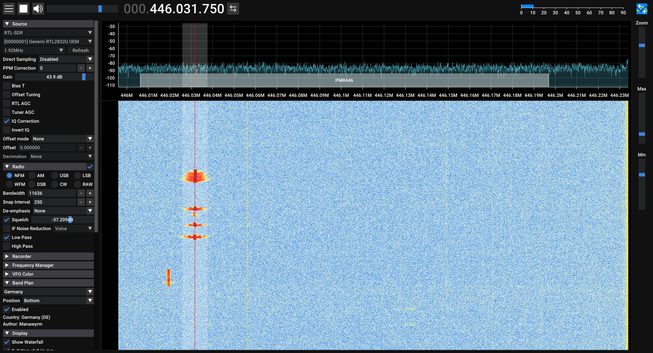
This is a frequency range for "Private Mobile Radio". It's another of these bands where anyone can transmit using a licensed device!

Not a lot of activity here. I heard "Hello, hellooo!", "Can you hear me?" and some short transmissions that sounded like a child! :D

There also seem to be digital transmissions, but I don't know how to decode them yet.

The range of PMR446 devices is pretty low (a couple of hundred metres in cities), so again, the people must be close!

With that, I end the first day of SDR experiments! :) It's amazing to me how much invisible communication is going on around us in the electromagnetic spectrum at the same time!

To be continued tomorrow. Feel free to suggest things I could receive!

11: Read your neighbors' sensors

At 433 MHz, there's a frequency band for "industrial, scientific and medical" applications. And wow, there's quite a lot of activity nearby!

Using the decoder rtl_433, I see two sensors that output the current temperature, humidity, and air pressure!

There's also some "IBIS beacons" flying by, which are used in public transportation, so maybe it's buses driving by?

And just now, an "Interlogix Security" device appeared, reporting "closed switch states" :O

12: Track ships!

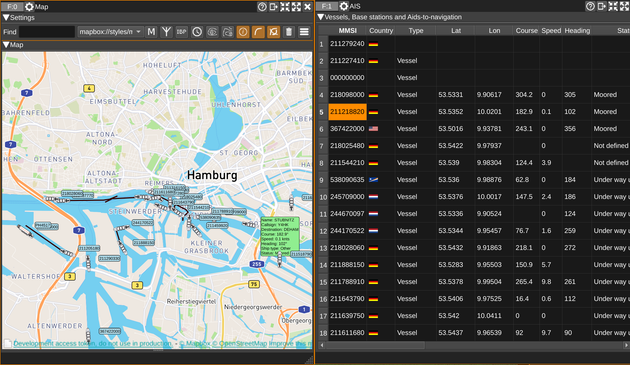
They send out their status using AIS (Automatic Identification System). And again, I receive *a lot* of them here in Hamburg! :O

I was especially excited to receive data from @msstubnitz (a fisher boat that was turned into a culture center/techno club)! It reports its status as "moored", and its speed as 0.1 knots! :D

This is again the software SDRangel. Apparently, it can also display a 3D map, but I haven't figured out how to add 3D modelsโ€ฆ

13: Detect GSM activity

I was curious whether you could tell if someone used their phone!

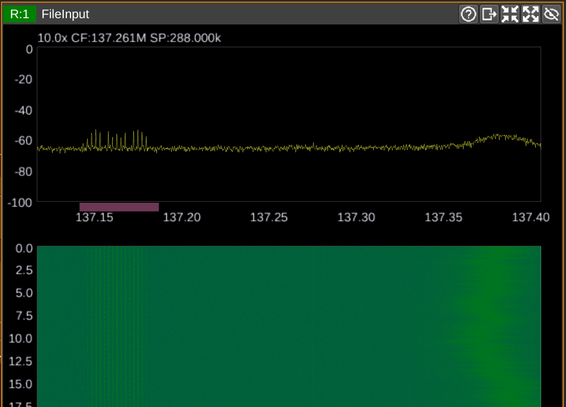
So I borrowed a GSM phone, tuned to the correct frequencies, and made some test calls.

What surprised me most: You can kind of "see" the volume at which I was talking!?

In the recording, the three dense bands at the end were when I was humming into the phone at the other end. This only worked in the "receiving" direction.

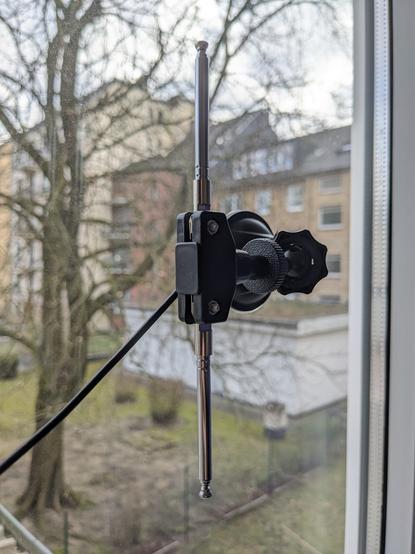
By the way, I try to adjust my antenna to the desired frequency as best as I can.

For GSM, I used the tiny screw-on antennas from the kit! :)

14: Receive signals from a satellite!

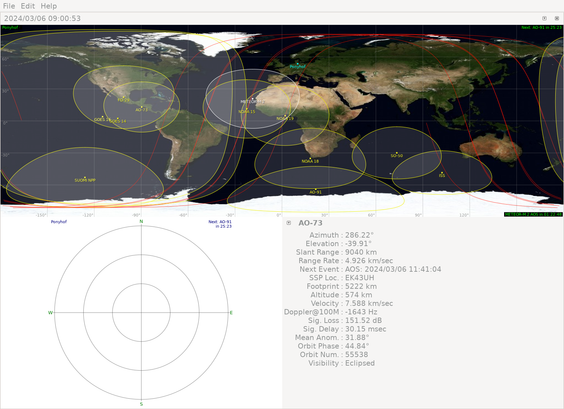
The program gpredict is really nice to find out when satellites will pass overhead! Learned lot yesterday, including that one satellite I was trying to receive burned up last week! :D

I was super excited when I first received a signal from a NOAA satellite! ๐Ÿ›ฐ๏ธ

But I didn't manage to decode it properly yet. Maybe my reception is too noisy? I wanna keep trying, but I gotta move on.

15: Admire TETRA signals

In Germany, the police has switched to an encrypted digital protocol called TETRA.

Even though I've seen some interesting talks at CCC events about weaknesses in the decryption, all I wanna do for now is look at the pretty signals in sdrpp. :3

16: Listen to taxi dispatchers

Again, this is communication not meant for the general public.

I didn't just listen to someone dispatching taxis to specific addresses, and you also shouldn't do that either. ๐Ÿš•

Stay away from a site called "frequenzdatenbank"!

17: Ponder mysterious signals

Some of the most fun I'm having is just browsing frequencies and seeing what I can find!

Sometimes, I encounter signals I can't identify.

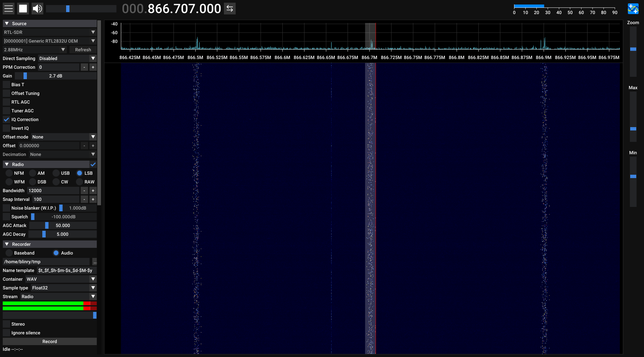
For example, at 865-868 MHz, there's a family of slow, continuous, digital signals that make a nice melody when listened to in single-sideband demodulation!

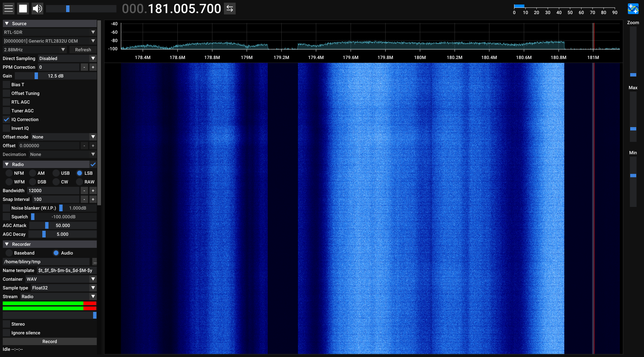
And at 177-180 MHz, there's two very broadband transmissions. Might be TV? But I can't find out what type.

If you have ideas, let me know! :) Time for lunch!

18: Track weather balloons

A radiosonde was just launched in Hamburg! SDRangel can decode its transmission! It has climbed to a height of 5 km, and it's -17 ยฐC there!

Um, I could try to get it after it bursts and lands. Should I go get it?!

Let's go on a field trip!
Ohhh, the balloon popped earlier than predicted! *frantically changes travel plans*
It landed in a forest. Hope I can get to it.

Didn't find the sonde. But something that might be even better โ€“ a friend!

On my way back, will report more soon. Data volume is used up, smartphone battery is empty.

So, the full story: I made my way up to the landing site by subway, train and bike.

As I circled the site, I encountered a person in their 60s, with a stubbly beard and a blue wool hat. He was looking in the direction of the crash site, and was holding a smartphone, so I asked him whether he also was looking for the radiosonde.

He was! We looked for it together for half an hour, jumping over small rivers and crawling through the woods, while he gave me a lot of tips related to hunting sondes.

He told me that he had found around 40 of them so far!

Usually, the sondes keep broadcasting after landing, but this one wasn't. So he quickly guessed that someone else could've taken it. Or maybe it landed in the water and died?

Eventually, we gave up, and walked back to our vehicles. He also is an amateur radio operator, and could answer a couple of questions related to building antennas!

And he was right: Someone had been faster than us! The status was changed: https://radiosondy.info/sonde_archive.php?sondenumber=V2930794

Radiosonde V2930794 / RS41-SGP / Sasel (DE)

Start Date: 2024-03-06 | Status: ZNALEZIONA | Finder: B77W | Comment: Landung im Moor, Sonde 2 Meter รผber Grund, alles geborgen. | Nearest City: Henstedt-Ulzburg (DE)

SQ6KXY Radiosonde Tracker

Some pictures from the landing site!

And I think I have earned this:

19: *Hunt* weather balloons!

20: Receive amateur packet radio

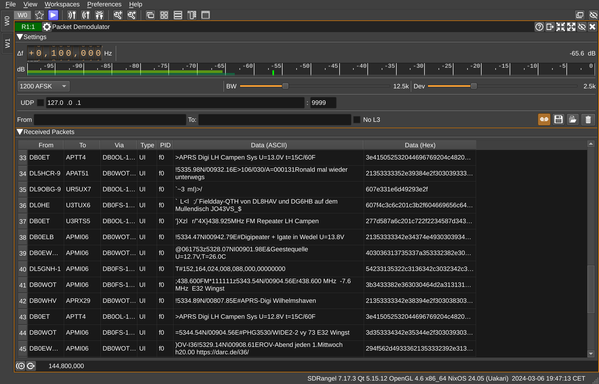
In the 2-meter amateur band, there are certain frequencies for the "Automatic Packet Reporting System". It's a bit like IP โ€“ packets have a "from" and a "to". They can also broadcast their position, or weather data.

Some stations seem to announce themselves as repeaters, which probably help forward the packets to increase the range.

And two people seem to be on a "fieldday", and broadcast their location. :D

SDRangel can create a map automatically:

Good morning! Let's build an antenna!

This is going to be a simple "random wire" antenna, to allow me to get better reception in the lower wavelenghts, which I've omitted so far.

I've measured out 21.6 m of wire (which for โœจmagicโœจ reasons seem to be a good universal antenna length)...

...directly attached it to the center of another SMA connector...

...and draped it all around my room!

People on the Internet say that there are many problems with this โ€“ that it would be better to have it outside, and that there's an impedance mismatch between the receiver and the wire.

I could address those problems, but I wanna try how well this works first :)

21: Receive Morse code from other countries

On the 30-meter amateur band, I found people sending Morse code! :O

I've been learning it a little bit, so if I record it and slow it down, I can understand it: They're sending their callsigns.

These are from Belgium, France, and Italy! \o/

I compared to my 2-meter dipole antenna, and the reception is definitely better โ€“ I can pick up more transmissions, and with much less noise!

22: Receive maritime weather reports

The German Weather Service broadcasts maritime information throughout the day on various shortwave frequencies.

They use a protocol called RTTY (radioteletype), and it took me a while how to decode it. But I found a neat little program called "fldigi": You can pipe audio to it, and then if you pick the correct settings, it happily transcribes the messages!

Here's the station weather reports for the Baltic Sea and Northern Sea!

23: Receive digimodes from other countries

I found some other strange signals on the 30-meter band. The Signal Identification Wiki was really helpful for figuring out what they were: https://www.sigidwiki.com/wiki/FT8

FT8 is a new protocol, invented in 2017, and it seems to be super popular right now! It allows you to transmit short messages, and again, people are looking for people to talk to (CQ), saying how well they receive each other, or saying goodbye (73).

This is the WSJT-X software.

24: Detect whether your notebook is charging

As I'm browsing the very low-frequency bands, I had a strange problem: Sometimes, that would work okayish, sometimes I could even make out voices!

Other times, it wouldn't work at all, and everything would be loud noise. Even in regions where I had better reception before!

Just now, I found out how to solve that issue โ€“ by unplugging my notebook charger. D'oh! :D

25 & 26: See ionosondes and radar signals

In the low frequencies, occasionally, you can hear a short *chirp*! :D These are caused by ionosondes, scientific instruments which measure the properties of the ionosphere by sweeping a wide frequency spectrum.

Another signal (which I accidentally got in the same screenshot) is a radar system โ€“ in this case, according to the Signal Identification Wiki, it's a "CODAR" system, used to measure the motion of water waves and currents along coasts! :O

27: Listen to "single side band" conversations

How do you transmit speech over long distances? You can use "amplitude modulation", where you change the volume of the carrier frequency to model your audio.

As a side effect, the bands to the sides of the carrier will contain a signal, as well.

One trick is to transmit *just* those sidebands, which saves power! But you have to "guess" the base frequency when listening.

SDR++ makes it very easy to play with this! :) Here's someone from Serbia!

28: Listen to AM radio from the other side of the world

At night, low-frequency radio waves can travel further around the world, because they're reflected by the layers of the ionosphere! There's something magical about this.

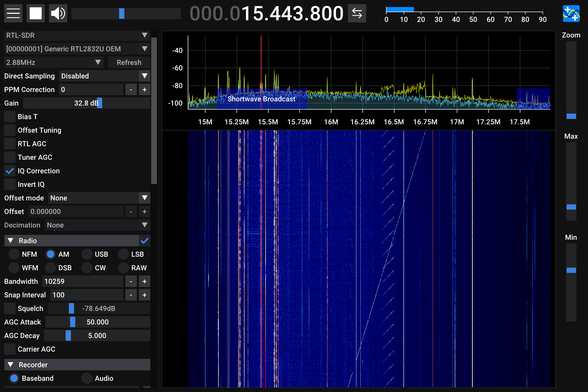
I put my antenna outside, and I can hear *a lot* of broadcasting stations! On https://www.short-wave.info, you can look up where they are located.

Some stations in China are broadcasting with very high power! Some are over 7500 km away.

Wow. It's full of stars! ๐ŸŒŒ

Search for Short Wave Radio Broadcasting Schedules

Short-Wave.Info is a simple, handy, graphical way to search for and display Short Wave radio broadcasting frequency schedules. You can search by frequency, language, broadcaster, time and short-wave band.

29: Listen to CB radio

After I looked into the low frequencies yesterday, let's go to a higher band again: The Citizens Band!

This is the third frequency band I'm aware of where anyone is allowed to transmit โ€“ provided that you use a licensed device!

This is a band where my random wire antenna really comes in handy. Without it, I would have a hard time understanding anything. And even with it, transmissions are extremely noisy.

CB radio is used internationally, especially by truck drivers?

30: Assess the propagation of radio waves using beacons

The International Beacon Project runs a network of 18 stations, which take turns transmitting their callsigns at certain frequencies.

Using this system, you can quickly get a sense of how well radio waves are currently propagating to your location. Clever!

I picked up the beacon from southern Finland! You can see its callsign scrolling away in the video. It's followed by four dashes send with decreasing power. I only heard the first oneโ€ฆ

31: Receive a time signal

I would've loved to receive DCF77, which powers the radio clocks in Germany! But no matter how hard I listened to 77.5 kHz, there was nothing there. I don't think my dongle can do that.

So let's use higher frequencies! Russia transmits its "RWM" time signal at 9996 kHz, which beeps every second, with a long beep for the full hour.

Not enough to tell the time, but enough to adjust your wrist watch, I guess!

32: Receive a weather fax

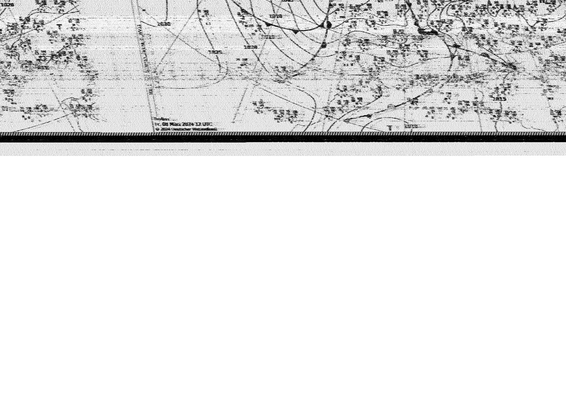
The German Weather Service broadcasts weather maps throughout the day! You can decode them using fldigi's "WEFAX-576" setting.

I caught this one only halfway through. According to the schedule, it's the "Surface weather chart North Atlantic, Europe"!

If you squint *really* hard, you can make out the coast of Spain and the Mediterranean Sea on the right side!

33: Decode images from a weather satellite!

I couldn't stop trying to capture a weather satellite, it's just too cool to receive an image from space!

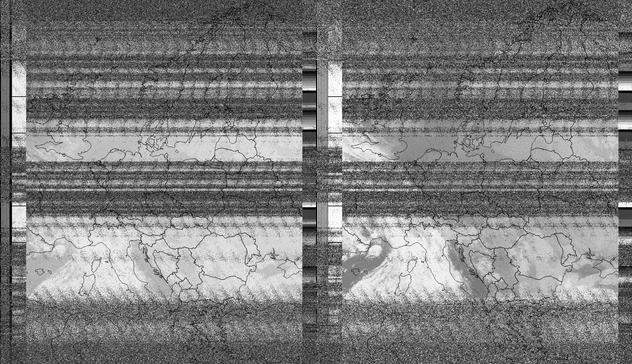
This evening, an American satellite called NOAA-15 passed right over us, so I thought I'd try again. And this time, I got parts of an image! \o/

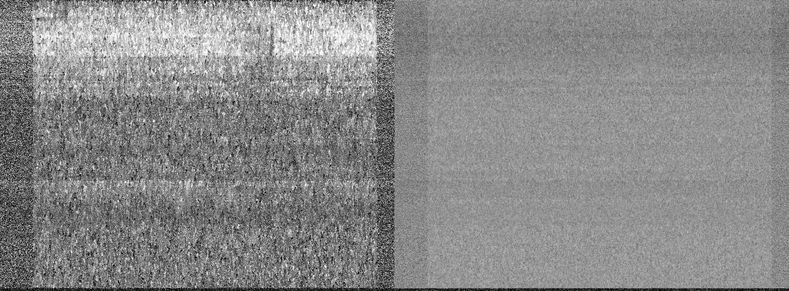
This is real-time data! At night, both transmitted images are infrared recordings.

I recorded the FM signal using SDR++, and then decoded the image using noaa-apt, which also added country outlines.

34: Estimate the speed of satellites

Here's what the NOAA-15 weather satellite sounds like, by the way! *tick-tock*

While recording, I noticed something strange: The transmission didn't happen at the frequency I had expected it to! And the frequency changed.

Then it hit me: Doppler effect! At the time of the recording, the frequency was around 4250 Hz higher than expected.

After looking up the formula, I calculated a relative speed of 9 km/s! (Which got close to its real speed, 7.5 km/s.)

35: Listen to number stations

These stations send encrypted messages using number sequences, possibly for espionage purposes!

So why not listen to one? There's a surprisingly well-maintained database of them here: https://priyom.org/number-stations/station-schedule

So I tuned into the next frequency that was listed, and: Bingo!

Allegedly, this is a station in Moscow. Today, it sent "218, 218, 218" in a loop, followed by three long beeps, which is the format of a "null message".

So no news today for the Russian spies.

Station Schedule โ€บ Priyom.org

36: Receive images from amateur radio operators

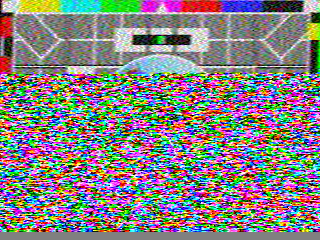
Using a protocol called "SSTV" (slow-scan television), amateur radio operators send each other postcards! :D

I've been browsing the usual frequencies, and tried to decode images using the software QSSTV on Linux.

And I accidentally caught a piece of what seems to be a test image!

Also, SSTV has the prettiest noise! :3

37: Listen to The Buzzer

There's a mysterious Russian station broadcasting at 4625 kHz. Sometimes, it sends encrypted voice messages.

But usually, all it does is send a honking sound every two seconds, to deter other stations from using the same frequency.

The purpose of the station is unclear, but most theories think it's military communication.

38: Catch a LoRaWAN chirp

This was a bit like trying to catch a rare insect! ๐Ÿ›

LoRaWAN is a low-power, wide-area networking protocol, intended for "Internet of Things" applications.

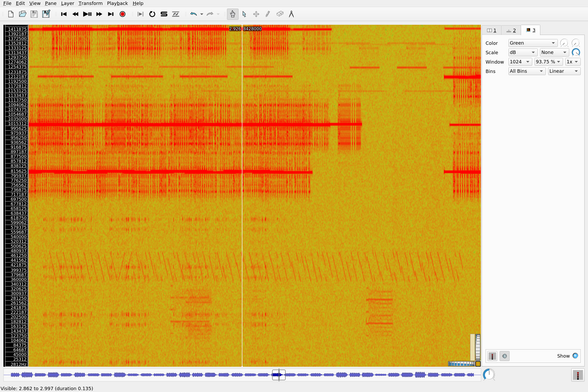
You can see transmission in the lower half of the screenshot! It has a very cute structure: You can see eight "down-chirps", followed by two "up-chirps". That's the header, followed by the payload.

To look for the signal, I made a "baseband capture" in SDR++, and opened the recording in sonic-visualizer.

39: Read data from utility meters

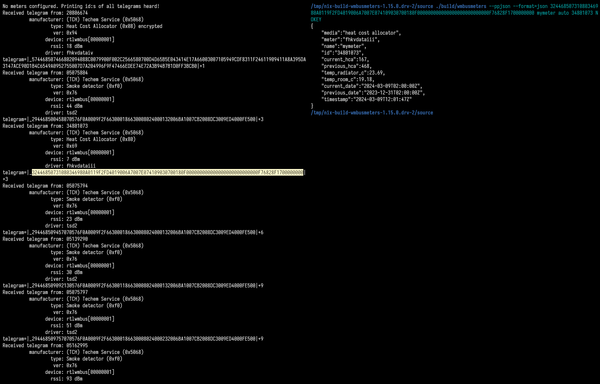
Devices like smoke detectors or meters for water or heat are sending their readings via a protocol called Wireless M-Bus.

Again, I'm surprised by how many devices seem to be around! Thanks for the tip, @envy :)

https://wmbusmeters.org is a really nice tool for decoding the messages.

WMBusmeters

A meta note on the "Make 50 Things" technique!

This week is really intense for me. Initially, I thought I'd do 10 things per day, but it turned out that that's too much. I have to learn so many new things.

Many things I try don't work on my first attempt. Finding LoRaWAN, decoding packet radio, finding something on PMR446, decoding the satellite โ€“ those were all things that required a second (or third) attempt.

This project is exhausting, but also joyful โ€“ having committed to it, I get in a nice flow state, where I can focus on it for hours.

Often, I think: "Okay, this is it. I can't possibly find more things." But this is the power of the 50 Things technique: I have to keep looking, leave my comfort zone, be creative, try things I otherwise wouldn't have tried!
So, 11 more things, huh? If, after reading this thread, you have suggestions for more things to receive/decode/try, let me know! ๐Ÿ˜ฌ

40: "Watch" TV

The chips in my SDR stick are also being used in DVB-T dongles!

So, can we watch TV? Unfortunately, no.

From what I pieced together, there's a difference between using the stick in SDR mode (where it sends the full spectrum), and in TV mode (where it sends the decoded video).

In Germany, there's now DVB-T2, which my hardware don't support in TV mode.

And in SDR mode, the bandwidth is too narrow for DVB-T2.

But we can scroll over a channel and look at it! :3

41: Track cars and buses

Did a little walk to a big intersection, to see what "device signals" I'd find there at 433 MHz.

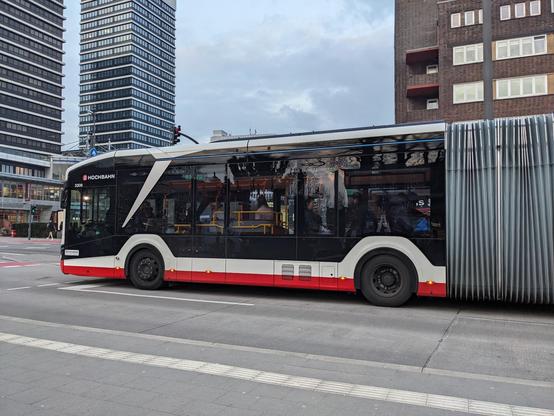
I could confirm that the IBIS beacons are in fact being sent by buses! The included "vehicle ID" even matches the white number that's printed on it.

I also saw some messages from tire pressure monitoring systems in cars! They also include an ID, and usually, the brand of the car! The owners probably aren't aware how easy it would be to track themโ€ฆ (Thanks, @scy!)

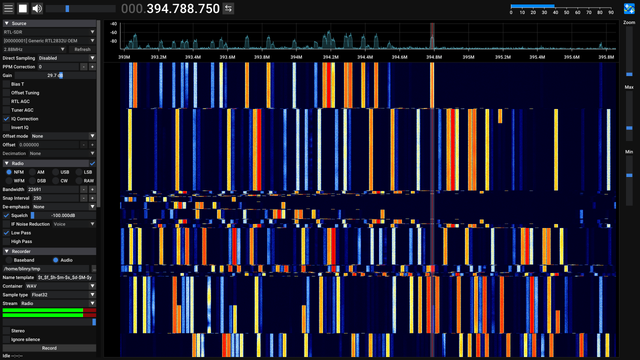
Side note: I wonder why some signals in that band are warped like the one at 433.96 MHz here!

At first, I thought "Ah, Doppler effect again, it's coming from a moving car!" But if that'd be the case, that car would be moving at over 700 m/sโ€ฆ

42: Receive Morse code from a satellite!

So I caught a satellite again! :D This time, it's a school project, the Italian satellite "Max Valier". It continuously sends Morse code on a beacon frequency.

Pretty weak signal, but here's what I could hear:

"3MV MAX VALIER SAT ... MANFRED ES CHRISTA FUKSE 73 ... II3MV ..."

Super happy about this! I got both the name of the satellite, as well as its callsign at the end, and what seems to be some kind of greeting?

(Thanks for the tip, @manawyrm!)

43: Receive emergency service pagers

This is another thing that's not allowed in Germany, so you shouldn't do it.

Pagers use a format called "POCSAG" (Post Office Code Standardisation Advisory Groupโ€ฆ), which you should not decode using multimon-ng.

Because you would find that the content is short and cryptic anyway. It would probably be repeated by several stations all around you, to make sure the whole region is covered.

Do not read the English Wikipedia page! It contains frequencies!

44: Detect when a smartphone is turned on

I was curious whether I could see the NFC transceiver in my smartphone!

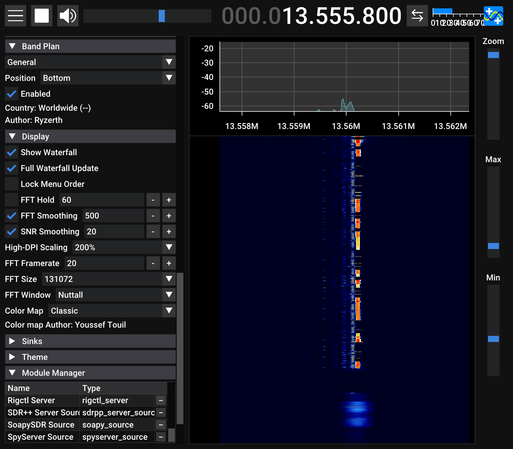
And yeah, especially using my random wire antenna, this works really well!

My smartphone seems to emit at the NFC frequency a couple of times per second.

And when unlocking the screen, it emits five very strong beeps on that frequency! I can see those from the other side of our apartment.

Surely, these signals are the same for every device, right? ๐Ÿ˜ถ

Observe the five beeps here:

45: Communicate wirelessly using a book

@piko and I played around with NFC a bit more, and we found out that when getting close to a tag, a smartphone emits at 13.56 MHz continuously!

So, we sent Morse code to each other between rooms, using a smartphone and a library book! :'D

Take that, Bundesnetzagentur!

Seems that the shortest signal you can create is 70 ms long, resulting in a meager communication speed of ~10 words per minuteโ€ฆ

46: Receive navigational aids for airplanes

There are ground stations that emit a signal that allow calculating your angle relative to it! If you receive two, you can determine your position.

I hear the one close to Hamburg! SDRangel has a decoder, of course! It outputs angles between 210ยฐ and 230ยฐ, which is pretty good! Don't think they are meant to be used from the ground.
The neat navigational map is from https://skyvector.com!

(Thanks, @fly_it!)

SkyVector: Flight Planning / Aeronautical Charts

Make your Flight Plan at SkyVector.com. SkyVector is a free online flight planner. Flight planning is easy on our large collection of Aeronautical Charts, including Sectional Charts, Approach Plates, IFR Enroute Charts, and Helicopter route charts. Weather data is always current, as are Jet Fuel Prices and Avgas 100LL prices.

I spent ages trying to build my own decoder in GNU Radio. But I wasn't familiar with it at all, and I eventually gave up. Still, that seems to be the software you wanna learn for tasks like these!

By the way, how the ground stations work is fascinating: In my case, it's a "Doppler VOR": It transmits a static frequency via amplitude modulation, and adds another signal that moves around in circles, so you get a Doppler frequency shift.

If you compare the two, you can calculate the angle!

@blinry @piko AFAIK such tags are inductively powered by the devive reading them, which would explain why you're seeing a continuous signal at 13.56 MHz. I have no idea how the signal is carried in that, but you might be able to read that as well and eavesdrop on the actual NFC communication.
@blinry @piko Ooh, interesting, didn't know that it can reach so far! Now I need to dig up my own SDR again and have a closer look at the whole NFC stuff...

@blinry are you planning on doing a writeup of these in "long-form"? Like, a blog or something?

Reading through this makes me want to try a lot of it with my SDR, which I use almost exclusively for testing amateur radio equipment, but which is begging to be put to better use.

@b4ux1t3 Will eventually be a blog post, I think, yeah! :)
@blinry oder der Klassiker zu dem Thema, man tauscht einen Teil seiner Freizeit gegen ein neues Hobby ein und bekommt dann sogar einen Decoder dafรผr. Inkl Erklรคrung was es bedeutet ;)
@blinry Have you tried the french VHF over-the-horizon radar GRAVES already? Its transmitting on 143,05 MHz, listen in with USB/CW mode and hear the doppler-shifted reflections of planes, meteors and satellites!
@blinry Doesn't your car regularly reach 2500km/h?
@blinry - have you looked at the weird signal shape of LoRa signals (in the, is it?, 868MHz band)?
@axel_hartmann Yeah, see number 38 :) I love them!
@blinry ...so that wasn't it, then ยฏ\_(ใƒ„)_/ยฏ
@blinry as far as I know the ISM band goes from 433.05 MHz until 434.79 MHz, so this is in the rangeโ€ฆ? I guess there are also some kinds of "channels" defined on it when you want to have different applications using it at the same time
@daniel_bohrer Mh yeah, I meant that that li'l signal in the screenshot seems to change frequencies while its sending! Maybe some emitter is heating up or something?
@blinry oh now I see what you mean! hmmm, yes, something like that?
@blinry looking down the waterfall diagram, there's also a lot of noise in that region. maybe interference?
@blinry Weak battery affecting the crystal?
@sophie @blinry That's my guess too! Voltage droop, temperature changes, something of that nature...
@blinry @scy
Interesting. I'm assuming the batteries (that i recently paid to replace! ) on these tires' ISB transmitters can't be large and last years so the transmitted power must be quite low, and thus range fairly short.
@n1vux That fits my observations. The furthest distance I've spotted these signals from is ~50 meters. @scy
@blinry @scy
50m is further than i expected!
@blinry
If the receiver is sensitive enough, and if you have a directional antenna of some sorts, you could try to see if you can detect the difference in the noise floor coming from the sun vs the clear sky!
But maybe that is hard to do in as a noisy RF environment as most urban places are...
@blinry the RTL2832 chip was initially designed as a cheap DVBT receiver until someone found out that this is done purely via SDR. My RTL stick i am using for feeding ADS-B data to several planespotting websites is actually a DVB T stick since they did not sell these dedicated SDR sticks back then
@blinry Beautiful white noise.

@blinry Work out what's turned on in your house. And your neighbour's houses.

Work out when a car goes past, and see if you can identify it.

Where's the nearest airport radar, and can you hear it ?

Are there any crimes you can detect ?

What is your 3D printer up to ?

What is your phone up to ?

How much wifi is there ?

@blinry

you could look at HAMNET, a amateur radio pager network, with POCSAG1200, not sure if there's a transmitter near you, though.

there's also this digital short wave radio thing called "DRM", "Digital Radio Mondiale". IIRC there's a Windows tool to decode it. Has some fancy graphics for signal constellation, etc.

@blinry i think the ISS is currently down for maintenance, which is sad, because it's very powerful (and thus easy to receive), but you might look through https://network.satnogs.org/observations/ for some satellites with interesting downstream signals.

MAX VALIER SAT is pretty nice for example, it morses it's name and a message all the time. easy to find/receive and it's coming from orbit!

@blinry The only thing I can think of that I didn't see you explicitly cover yet (although you had one in your rtl_433 screenshot) are TPMS signals: tire pressure monitors from cars. They usually carry unique IDs and can be used to identify individual cars from around the neighborhood.
@blinry
Modern cars have radar sensors, cosmic microwave background
@blinry
You already decoded images, sometimes, the ISS sends images in SSTV too. And much more.
Look at https://www.ariss.org/ :)
ARISS

ARISS lets students worldwide experience the excitement of talking directly with crew members of the International Space Station, inspiring them to pursue interests in careers in science, technology,...

ARISS

Have you tried to catch and identify a pulsar? They tend to emit around high MHz bands.

@blinry

I'm not sure if they're strong enough, though. Probably not, but maybe it's a fun thing to look up.

@blinry

@RefurioAnachro Seems that I'd need a big satellite dish :D

I think you're right. Silly me %-D What about van Allen belt frequencies? Measuring some solar weather quantities should be possible. As they are a major source of noise, receiving should not be the problem. Still, I have no idea what I'm talking about...

@blinry

@blinry i see a ball pit there
@blinry is your list already pre-defined?
otherwise: Download WSJT-X and try to decode some WSPR or FT8. I wonder how "far" (in terms of distance) you can hear :)

@manawyrm Did FT8 in thing number 23 :)

But it's totally not pre-defined, always happy about more hints!

@blinry Oops, how did I miss that ๐Ÿ™ˆ
@blinry always check the buzzer ;)
@ajuvo Can't hear it :/
@ajuvo Oh wait, I can now! :O
@blinry If it stops, it's doomsday.
@blinry That's just what they want you to think :P