 blinry
I want to try the "make 50 of something" technique again!
So this week, I'll try to find 50 things to do with a Software Defined Radio! 📻
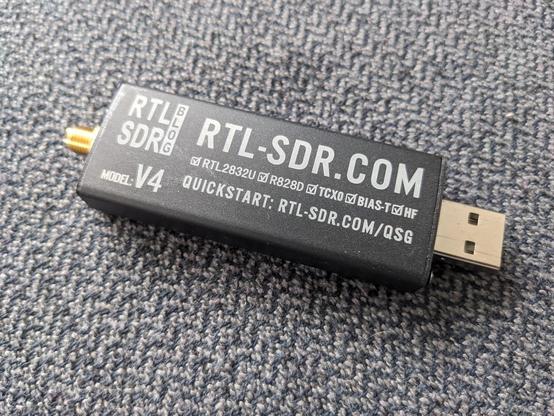
I'll use this simple USB dongle, which you can get for around $30.
I want to try the "make 50 of something" technique again!
So this week, I'll try to find 50 things to do with a Software Defined Radio! 📻
I'll use this simple USB dongle, which you can get for around $30.
1: Listen to FM radio
This is an obvious first thing to do, as the signals are very strong!
I'm using the SDR++ software, and it feels very nice browsing around and discovering the stations around you!
I found a local station that gives 1-hour slots to civic groups, for example!
I'm using a dipole antenna that came with the kit I purchased.
You generally wanna make it half as long as the wave length you want to receive, which is around 3 meters for FM radio.

2: Listen to Freenet
This is a special frequency range in Germany: Anyone is allowed to send there, using licensed devices. There are 6 channels.
I think someone's testing their device there right now. :D I heard a "Hellooo?", then a "Test, test", and then a "General call to all stations". Oh, and just now a short transmission on channel 3 in a Slavic-sounding language!
Freenet devices have a range of only a couple of kilometers, so these people must be pretty close! :O
3: Receive weather conditions from airports
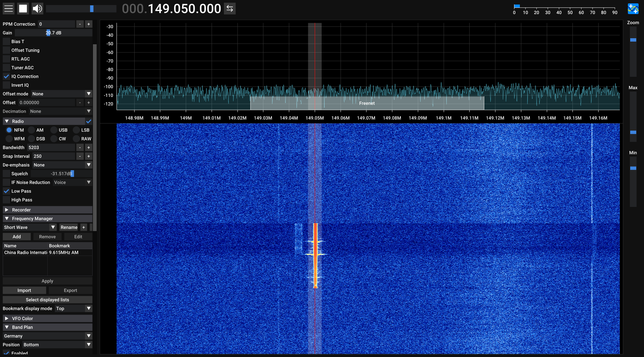
While browsing the aviation frequencies, I found this station that reports weather conditions in an endless loop. It seems to be the "Automatic Terminal Information Service" of Hamburg airport!
Thanks to that, I now know that the current air pressure is 1011 hPa! :D
4: Listen to airplane communication
Listening to "messages not meant for the general public" is not allowed in Germany, so of course I didn't do that. And if I had accidentally done that, I wouldn't be allowed to tell you about it. 🙅
5: Track aircraft via ADS-B
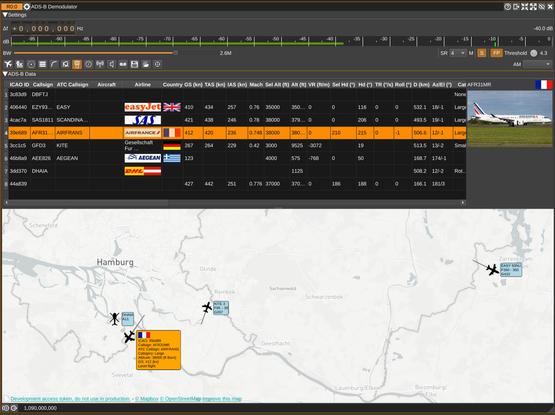
That's short for "Automatic Dependent Surveillance – Broadcast". Aircraft send it automatically to be tracked.
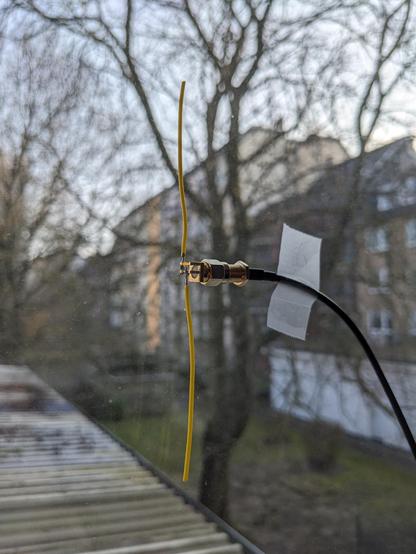
For this, I built my first antenna! From wire and and an antenna connector called "SMA". And it works! \o/
I'm decoding the signal using the software SDRangel. Fascinating! I see some big & small airplanes, and even a helicopter!
6: Listen to *stereo* FM radio
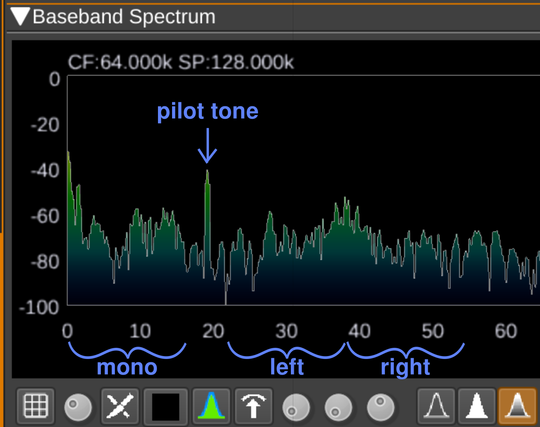
How stereo audio is transmitted is really interesting, because it's backwards-compatible to receivers that don't support it:
Here, you see the demodulated audio frequency spectrum. Below 19k Hz, it's just mono audio. Then, to mark a stereo station, there's a constant "pilot tone" at 19k Hz! (Outside of what most humans can hear.)
Then, if you double the frequency of the pilot tone, you can derive the sections where the left & right channel is transmitted!
7: Receive road traffic information
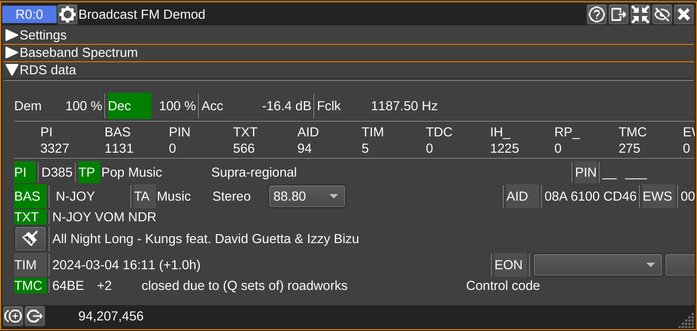
If you triple the frequency of the pilot tone, you get to a range where FM stations transmit small amounts of digital metadata, like the name and genre of the station, and the current song! That's a protocol called Radio Data System.
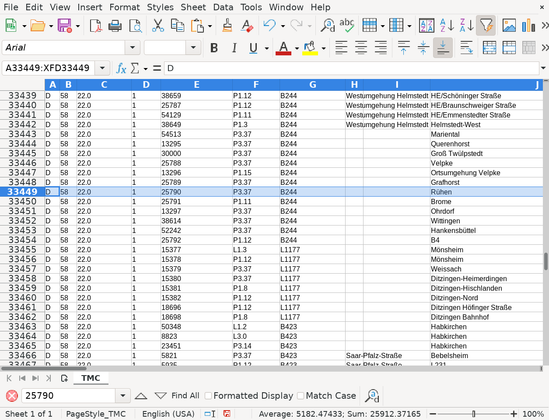
This system can also transmit road traffic information! There seems to be a road closure at "0x64BE". The Federal Highway Research Institute publishes an Excel table, where I could look up that this is a town in Lower Saxony!
8: Listen to conversations on the 2-meter amateur radio band
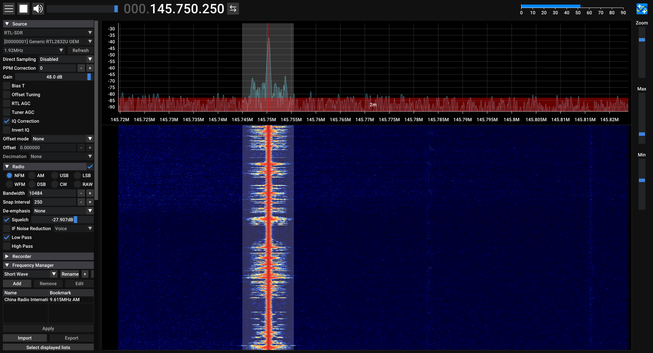
This is a frequency range reserved for amateur radio operators – for non-commercial use only. You may send on this band after getting a license.
What I found here is seemingly a conversation circle facilitated by a relay around 15 km away from here – it takes input on a certain frequency, and outputs an amplified copy of it on another frequency! Klaus, Bernd, Jürgen and Horst are talking about antennas, relays, and Windows XP! 😁
9: Listen to digital radio
The SDRangel software also has a demodulator for Digital Audio Broadcast! :O I continue to be amazed by it!
I think this is the first time I've received digital radio via air! Whoa, I see so many stations, and I've only checked a couple of channels.
The advantage of this digital channel is that there's no noise. And I even saw a "cover image" in one of the programs!
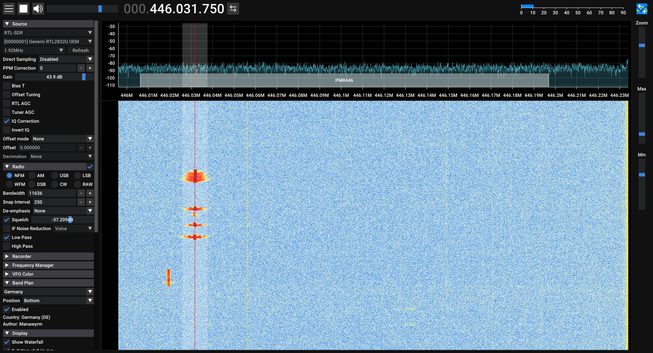
10: Listen to PMR446
This is a frequency range for "Private Mobile Radio". It's another of these bands where anyone can transmit using a licensed device!
Not a lot of activity here. I heard "Hello, hellooo!", "Can you hear me?" and some short transmissions that sounded like a child! :D
There also seem to be digital transmissions, but I don't know how to decode them yet.
The range of PMR446 devices is pretty low (a couple of hundred metres in cities), so again, the people must be close!
With that, I end the first day of SDR experiments! :) It's amazing to me how much invisible communication is going on around us in the electromagnetic spectrum at the same time!
To be continued tomorrow. Feel free to suggest things I could receive!
11: Read your neighbors' sensors
At 433 MHz, there's a frequency band for "industrial, scientific and medical" applications. And wow, there's quite a lot of activity nearby!
Using the decoder rtl_433, I see two sensors that output the current temperature, humidity, and air pressure!
There's also some "IBIS beacons" flying by, which are used in public transportation, so maybe it's buses driving by?
And just now, an "Interlogix Security" device appeared, reporting "closed switch states" :O


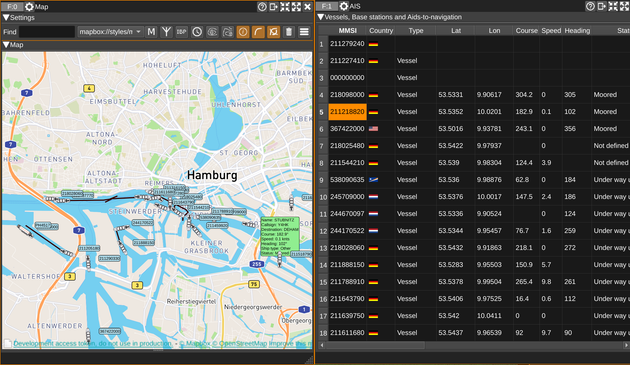
12: Track ships!
They send out their status using AIS (Automatic Identification System). And again, I receive *a lot* of them here in Hamburg! :O
I was especially excited to receive data from @msstubnitz (a fisher boat that was turned into a culture center/techno club)! It reports its status as "moored", and its speed as 0.1 knots! :D
This is again the software SDRangel. Apparently, it can also display a 3D map, but I haven't figured out how to add 3D models…
13: Detect GSM activity
I was curious whether you could tell if someone used their phone!
So I borrowed a GSM phone, tuned to the correct frequencies, and made some test calls.
What surprised me most: You can kind of "see" the volume at which I was talking!?
In the recording, the three dense bands at the end were when I was humming into the phone at the other end. This only worked in the "receiving" direction.
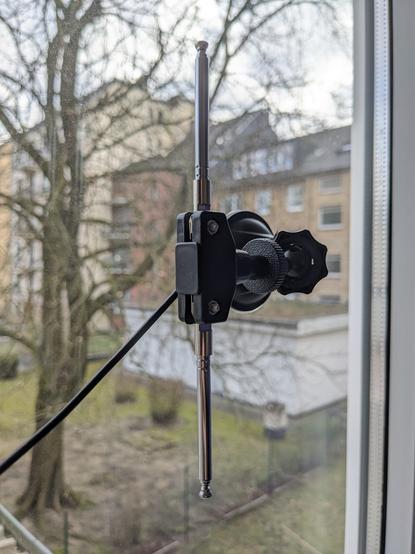
By the way, I try to adjust my antenna to the desired frequency as best as I can.
For GSM, I used the tiny screw-on antennas from the kit! :)
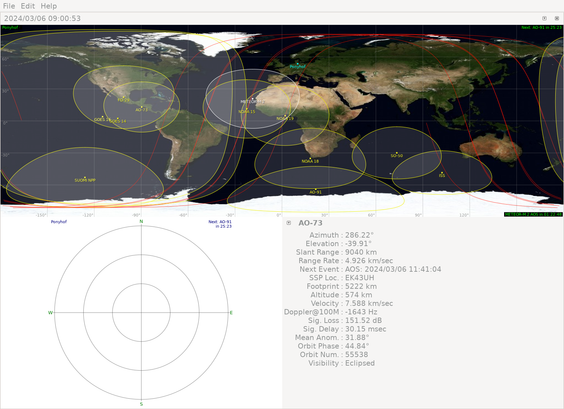
14: Receive signals from a satellite!
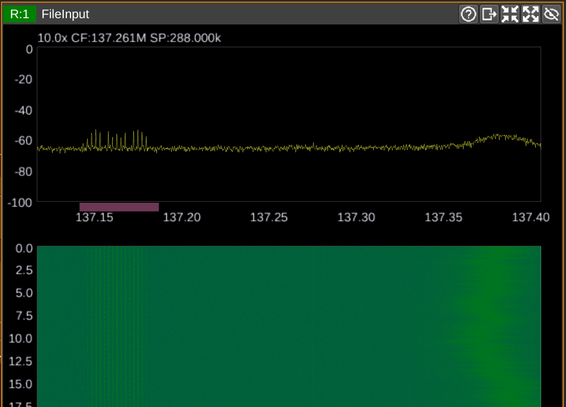
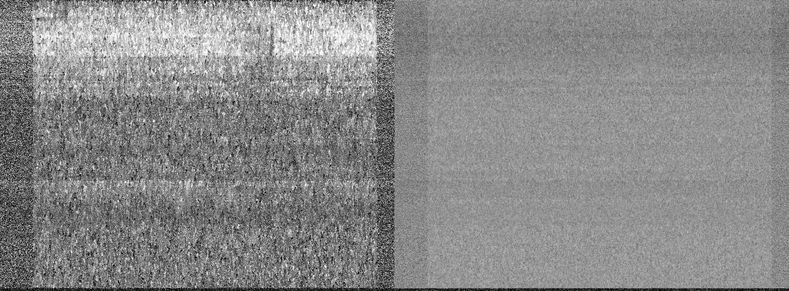
The program gpredict is really nice to find out when satellites will pass overhead! Learned lot yesterday, including that one satellite I was trying to receive burned up last week! :D
I was super excited when I first received a signal from a NOAA satellite! 🛰️
But I didn't manage to decode it properly yet. Maybe my reception is too noisy? I wanna keep trying, but I gotta move on.
15: Admire TETRA signals
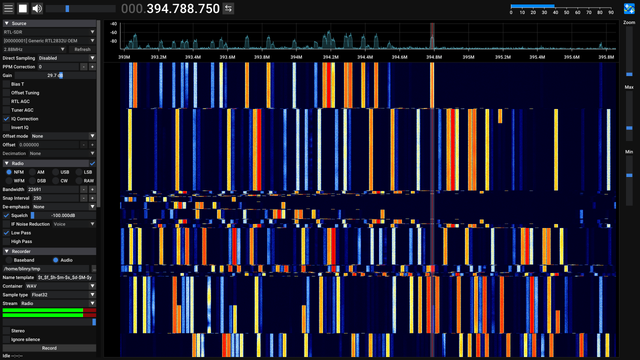
In Germany, the police has switched to an encrypted digital protocol called TETRA.
Even though I've seen some interesting talks at CCC events about weaknesses in the decryption, all I wanna do for now is look at the pretty signals in sdrpp. :3
16: Listen to taxi dispatchers
Again, this is communication not meant for the general public.
I didn't just listen to someone dispatching taxis to specific addresses, and you also shouldn't do that either. 🚕
Stay away from a site called "frequenzdatenbank"!
17: Ponder mysterious signals
Some of the most fun I'm having is just browsing frequencies and seeing what I can find!
Sometimes, I encounter signals I can't identify.
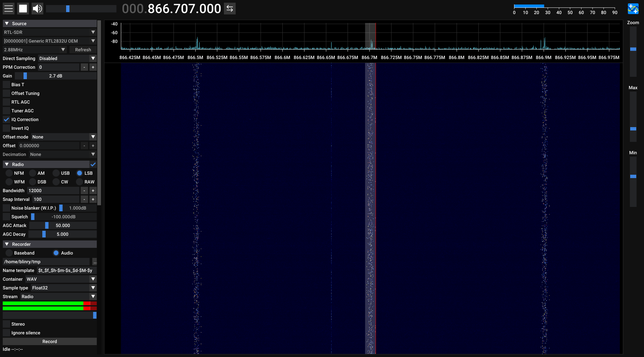
For example, at 865-868 MHz, there's a family of slow, continuous, digital signals that make a nice melody when listened to in single-sideband demodulation!
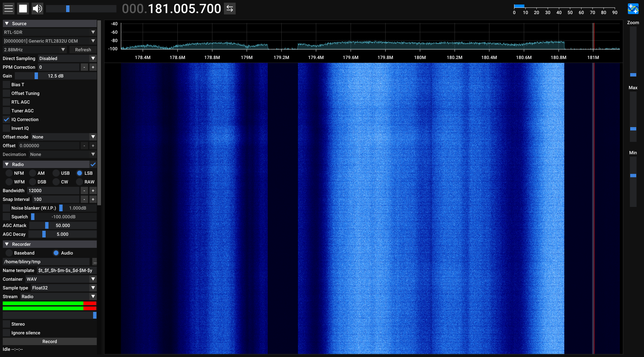
And at 177-180 MHz, there's two very broadband transmissions. Might be TV? But I can't find out what type.
If you have ideas, let me know! :) Time for lunch!

@blinry also useful to read out these pesky TPMS IDs your garage forgot to tell you about so you can write back that information twice a year to the CAN bus of your car when tires are switched for the wintertime and vice versa saving yourself ~90 bucks __each time__.
Looking at you Renault!
@blinry Maybe you already know this, but this is how MarineTraffic.com tracks ships all around the world :) A lot of volunteers operate stations in every corner of the world that pick up AIS messages and send them to MarineTraffic. Our company also maintains a station, the performance stats for last month: 19 NM range, 1026.77 km2 coverage :D
I think there was also a talk on the topic at a Chaos event some time ago 🤔 About some other service than MarineTraffic I think. Cheers! :)
@blinry Well, it's basically wifi: https://en.wikipedia.org/wiki/IEEE_802.11p
I don't know if you can tune to that frequency and decode it.
We used a unifi uap-ac pro for this flashed with a custom openWRT build that tuned the wifi chip to the right frequency. I still have that here and it should still work :D
@blinry With a LNB and a Bias-T you can maybe receive the QO-100 Narrowband (NB) transponder:
https://twitter.com/Manawyrm/status/1167890771346767873 (inspired by a workshop done by c0c0 in Hanover back then)
I'm not quite sure if your SDR can handle these kind of low frequencies. The rtl-sdr.com ones have the "direct-sampling" hack for HF, but I'm very unsure how well it'll perform for such low frequency stuff.
 ~n
~n 2342
2342 Marcus Müller
 lynxis
 ttk (DO1TTK)
 Daniel Bohrer
 Beko Pharm (deprecated)
 sebastian ⚡
 Mr. Hmpf
 Bill Ricker
 Olm-e
Olm-e Kuddel
 Sarah Peper 🏳️⚧️🇺🇦
 Manawyrm | Sarah
 MikeTangoortcloud
 Nico
Nico
 Christian Vogel
 Kater_S
 Zon Orti
 schneider
 uk
uk c0c0bird
 Chris Marquardt
 stefan
 yetzt
yetzt