12: Track ships!

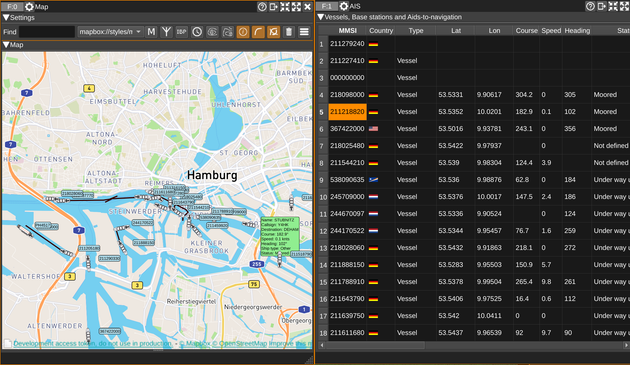
They send out their status using AIS (Automatic Identification System). And again, I receive *a lot* of them here in Hamburg! :O

I was especially excited to receive data from @msstubnitz (a fisher boat that was turned into a culture center/techno club)! It reports its status as "moored", and its speed as 0.1 knots! :D

This is again the software SDRangel. Apparently, it can also display a 3D map, but I haven't figured out how to add 3D models…
13: Detect GSM activity

I was curious whether you could tell if someone used their phone!

So I borrowed a GSM phone, tuned to the correct frequencies, and made some test calls.

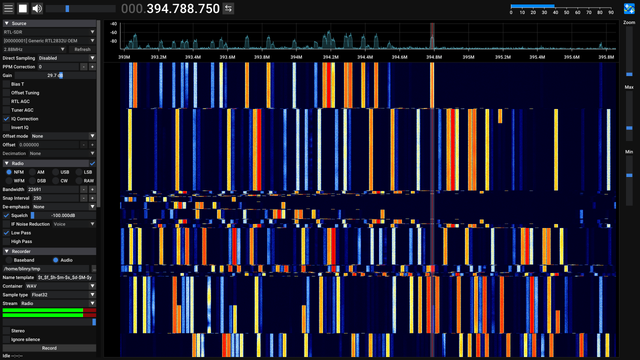
What surprised me most: You can kind of "see" the volume at which I was talking!?

In the recording, the three dense bands at the end were when I was humming into the phone at the other end. This only worked in the "receiving" direction.

By the way, I try to adjust my antenna to the desired frequency as best as I can.

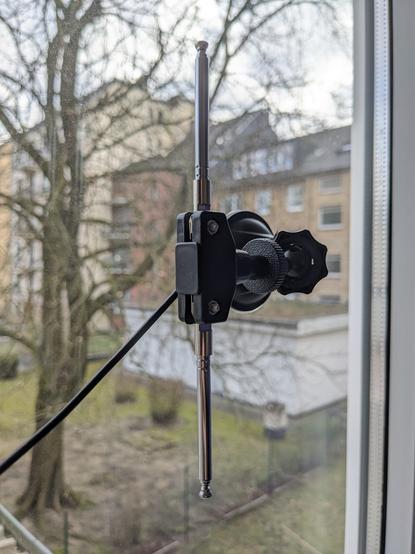
For GSM, I used the tiny screw-on antennas from the kit! :)

14: Receive signals from a satellite!

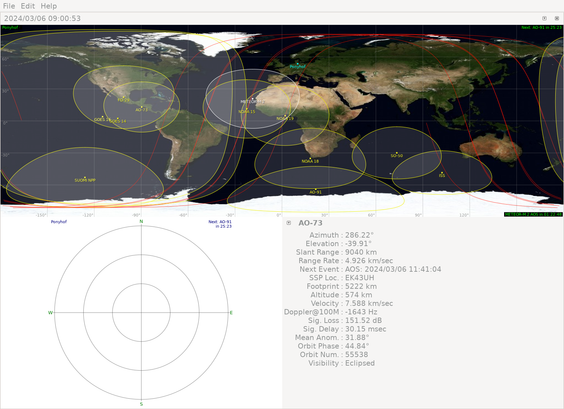
The program gpredict is really nice to find out when satellites will pass overhead! Learned lot yesterday, including that one satellite I was trying to receive burned up last week! :D

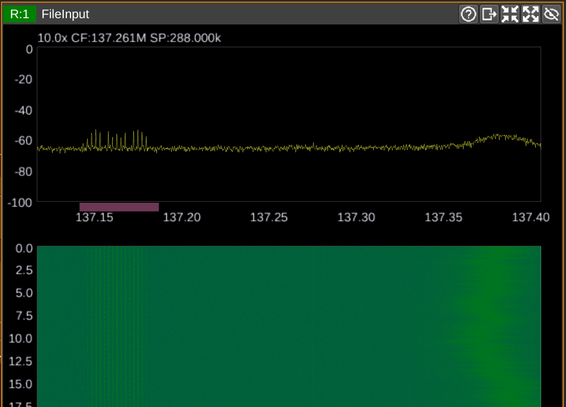
I was super excited when I first received a signal from a NOAA satellite! 🛰️

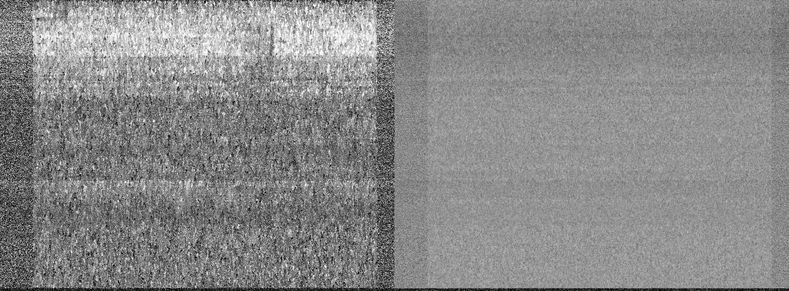
But I didn't manage to decode it properly yet. Maybe my reception is too noisy? I wanna keep trying, but I gotta move on.

15: Admire TETRA signals

In Germany, the police has switched to an encrypted digital protocol called TETRA.

Even though I've seen some interesting talks at CCC events about weaknesses in the decryption, all I wanna do for now is look at the pretty signals in sdrpp. :3

16: Listen to taxi dispatchers

Again, this is communication not meant for the general public.

I didn't just listen to someone dispatching taxis to specific addresses, and you also shouldn't do that either. 🚕

Stay away from a site called "frequenzdatenbank"!

17: Ponder mysterious signals

Some of the most fun I'm having is just browsing frequencies and seeing what I can find!

Sometimes, I encounter signals I can't identify.

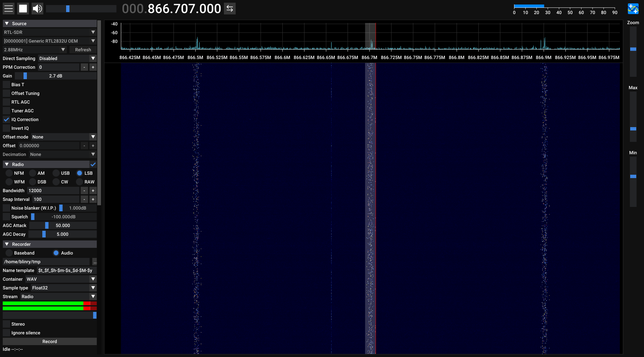
For example, at 865-868 MHz, there's a family of slow, continuous, digital signals that make a nice melody when listened to in single-sideband demodulation!

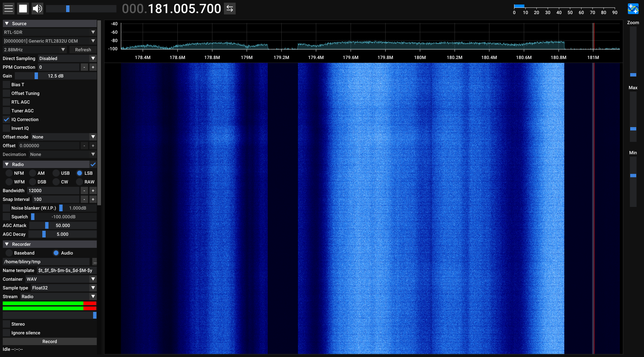
And at 177-180 MHz, there's two very broadband transmissions. Might be TV? But I can't find out what type.

If you have ideas, let me know! :) Time for lunch!

18: Track weather balloons

A radiosonde was just launched in Hamburg! SDRangel can decode its transmission! It has climbed to a height of 5 km, and it's -17 °C there!

Um, I could try to get it after it bursts and lands. Should I go get it?!

Let's go on a field trip!
Ohhh, the balloon popped earlier than predicted! *frantically changes travel plans*
It landed in a forest. Hope I can get to it.

Didn't find the sonde. But something that might be even better – a friend!

On my way back, will report more soon. Data volume is used up, smartphone battery is empty.

So, the full story: I made my way up to the landing site by subway, train and bike.

As I circled the site, I encountered a person in their 60s, with a stubbly beard and a blue wool hat. He was looking in the direction of the crash site, and was holding a smartphone, so I asked him whether he also was looking for the radiosonde.

He was! We looked for it together for half an hour, jumping over small rivers and crawling through the woods, while he gave me a lot of tips related to hunting sondes.

He told me that he had found around 40 of them so far!

Usually, the sondes keep broadcasting after landing, but this one wasn't. So he quickly guessed that someone else could've taken it. Or maybe it landed in the water and died?

Eventually, we gave up, and walked back to our vehicles. He also is an amateur radio operator, and could answer a couple of questions related to building antennas!

And he was right: Someone had been faster than us! The status was changed: https://radiosondy.info/sonde_archive.php?sondenumber=V2930794

Radiosonde V2930794 / RS41-SGP / Sasel (DE)

Start Date: 2024-03-06 | Status: ZNALEZIONA | Finder: B77W | Comment: Landung im Moor, Sonde 2 Meter über Grund, alles geborgen. | Nearest City: Henstedt-Ulzburg (DE)

SQ6KXY Radiosonde Tracker

Some pictures from the landing site!

And I think I have earned this:

19: *Hunt* weather balloons!

20: Receive amateur packet radio

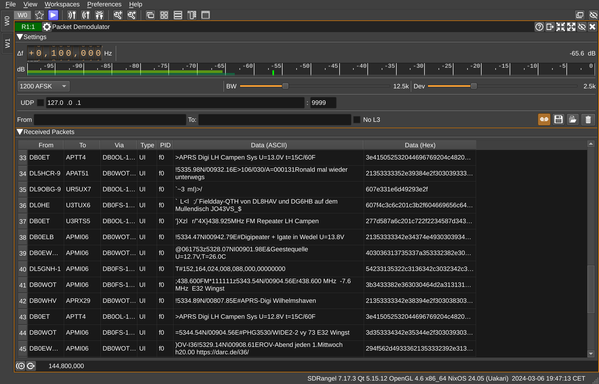
In the 2-meter amateur band, there are certain frequencies for the "Automatic Packet Reporting System". It's a bit like IP – packets have a "from" and a "to". They can also broadcast their position, or weather data.

Some stations seem to announce themselves as repeaters, which probably help forward the packets to increase the range.

And two people seem to be on a "fieldday", and broadcast their location. :D

SDRangel can create a map automatically:

Good morning! Let's build an antenna!

This is going to be a simple "random wire" antenna, to allow me to get better reception in the lower wavelenghts, which I've omitted so far.

I've measured out 21.6 m of wire (which for ✨magic✨ reasons seem to be a good universal antenna length)...

...directly attached it to the center of another SMA connector...

...and draped it all around my room!

People on the Internet say that there are many problems with this – that it would be better to have it outside, and that there's an impedance mismatch between the receiver and the wire.

I could address those problems, but I wanna try how well this works first :)

21: Receive Morse code from other countries

On the 30-meter amateur band, I found people sending Morse code! :O

I've been learning it a little bit, so if I record it and slow it down, I can understand it: They're sending their callsigns.

These are from Belgium, France, and Italy! \o/

I compared to my 2-meter dipole antenna, and the reception is definitely better – I can pick up more transmissions, and with much less noise!

22: Receive maritime weather reports

The German Weather Service broadcasts maritime information throughout the day on various shortwave frequencies.

They use a protocol called RTTY (radioteletype), and it took me a while how to decode it. But I found a neat little program called "fldigi": You can pipe audio to it, and then if you pick the correct settings, it happily transcribes the messages!

Here's the station weather reports for the Baltic Sea and Northern Sea!

23: Receive digimodes from other countries

I found some other strange signals on the 30-meter band. The Signal Identification Wiki was really helpful for figuring out what they were: https://www.sigidwiki.com/wiki/FT8

FT8 is a new protocol, invented in 2017, and it seems to be super popular right now! It allows you to transmit short messages, and again, people are looking for people to talk to (CQ), saying how well they receive each other, or saying goodbye (73).

This is the WSJT-X software.

24: Detect whether your notebook is charging

As I'm browsing the very low-frequency bands, I had a strange problem: Sometimes, that would work okayish, sometimes I could even make out voices!

Other times, it wouldn't work at all, and everything would be loud noise. Even in regions where I had better reception before!

Just now, I found out how to solve that issue – by unplugging my notebook charger. D'oh! :D

25 & 26: See ionosondes and radar signals

In the low frequencies, occasionally, you can hear a short *chirp*! :D These are caused by ionosondes, scientific instruments which measure the properties of the ionosphere by sweeping a wide frequency spectrum.

Another signal (which I accidentally got in the same screenshot) is a radar system – in this case, according to the Signal Identification Wiki, it's a "CODAR" system, used to measure the motion of water waves and currents along coasts! :O

27: Listen to "single side band" conversations

How do you transmit speech over long distances? You can use "amplitude modulation", where you change the volume of the carrier frequency to model your audio.

As a side effect, the bands to the sides of the carrier will contain a signal, as well.

One trick is to transmit *just* those sidebands, which saves power! But you have to "guess" the base frequency when listening.

SDR++ makes it very easy to play with this! :) Here's someone from Serbia!

28: Listen to AM radio from the other side of the world

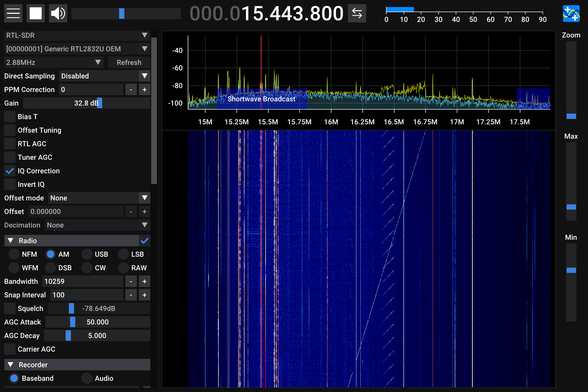
At night, low-frequency radio waves can travel further around the world, because they're reflected by the layers of the ionosphere! There's something magical about this.

I put my antenna outside, and I can hear *a lot* of broadcasting stations! On https://www.short-wave.info, you can look up where they are located.

Some stations in China are broadcasting with very high power! Some are over 7500 km away.

Wow. It's full of stars! 🌌

Search for Short Wave Radio Broadcasting Schedules

Short-Wave.Info is a simple, handy, graphical way to search for and display Short Wave radio broadcasting frequency schedules. You can search by frequency, language, broadcaster, time and short-wave band.

29: Listen to CB radio

After I looked into the low frequencies yesterday, let's go to a higher band again: The Citizens Band!

This is the third frequency band I'm aware of where anyone is allowed to transmit – provided that you use a licensed device!

This is a band where my random wire antenna really comes in handy. Without it, I would have a hard time understanding anything. And even with it, transmissions are extremely noisy.

CB radio is used internationally, especially by truck drivers?

30: Assess the propagation of radio waves using beacons

The International Beacon Project runs a network of 18 stations, which take turns transmitting their callsigns at certain frequencies.

Using this system, you can quickly get a sense of how well radio waves are currently propagating to your location. Clever!

I picked up the beacon from southern Finland! You can see its callsign scrolling away in the video. It's followed by four dashes send with decreasing power. I only heard the first one…

31: Receive a time signal

I would've loved to receive DCF77, which powers the radio clocks in Germany! But no matter how hard I listened to 77.5 kHz, there was nothing there. I don't think my dongle can do that.

So let's use higher frequencies! Russia transmits its "RWM" time signal at 9996 kHz, which beeps every second, with a long beep for the full hour.

Not enough to tell the time, but enough to adjust your wrist watch, I guess!

32: Receive a weather fax

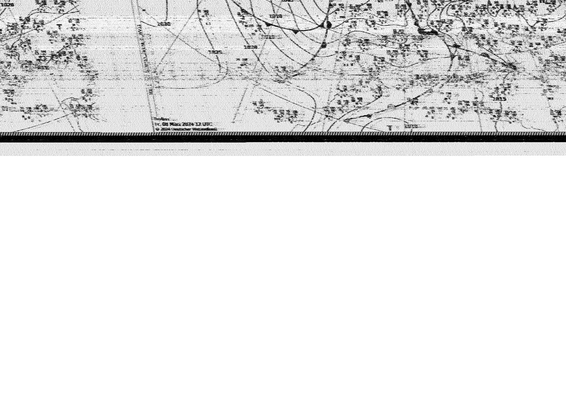
The German Weather Service broadcasts weather maps throughout the day! You can decode them using fldigi's "WEFAX-576" setting.

I caught this one only halfway through. According to the schedule, it's the "Surface weather chart North Atlantic, Europe"!

If you squint *really* hard, you can make out the coast of Spain and the Mediterranean Sea on the right side!

33: Decode images from a weather satellite!

I couldn't stop trying to capture a weather satellite, it's just too cool to receive an image from space!

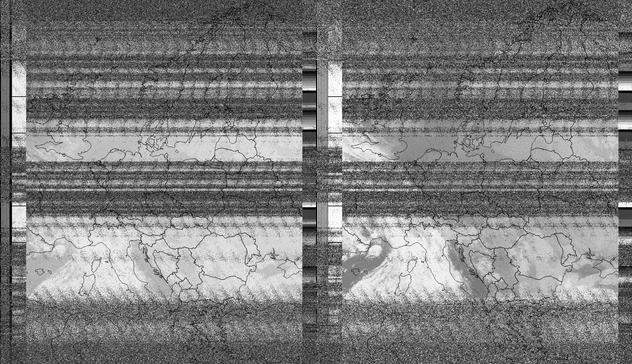
This evening, an American satellite called NOAA-15 passed right over us, so I thought I'd try again. And this time, I got parts of an image! \o/

This is real-time data! At night, both transmitted images are infrared recordings.

I recorded the FM signal using SDR++, and then decoded the image using noaa-apt, which also added country outlines.

34: Estimate the speed of satellites

Here's what the NOAA-15 weather satellite sounds like, by the way! *tick-tock*

While recording, I noticed something strange: The transmission didn't happen at the frequency I had expected it to! And the frequency changed.

Then it hit me: Doppler effect! At the time of the recording, the frequency was around 4250 Hz higher than expected.

After looking up the formula, I calculated a relative speed of 9 km/s! (Which got close to its real speed, 7.5 km/s.)

35: Listen to number stations

These stations send encrypted messages using number sequences, possibly for espionage purposes!

So why not listen to one? There's a surprisingly well-maintained database of them here: https://priyom.org/number-stations/station-schedule

So I tuned into the next frequency that was listed, and: Bingo!

Allegedly, this is a station in Moscow. Today, it sent "218, 218, 218" in a loop, followed by three long beeps, which is the format of a "null message".

So no news today for the Russian spies.

Station Schedule › Priyom.org

36: Receive images from amateur radio operators

Using a protocol called "SSTV" (slow-scan television), amateur radio operators send each other postcards! :D

I've been browsing the usual frequencies, and tried to decode images using the software QSSTV on Linux.

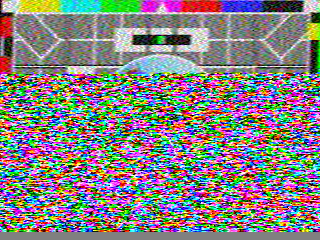
And I accidentally caught a piece of what seems to be a test image!

Also, SSTV has the prettiest noise! :3

37: Listen to The Buzzer

There's a mysterious Russian station broadcasting at 4625 kHz. Sometimes, it sends encrypted voice messages.

But usually, all it does is send a honking sound every two seconds, to deter other stations from using the same frequency.

The purpose of the station is unclear, but most theories think it's military communication.

38: Catch a LoRaWAN chirp

This was a bit like trying to catch a rare insect! 🐛

LoRaWAN is a low-power, wide-area networking protocol, intended for "Internet of Things" applications.

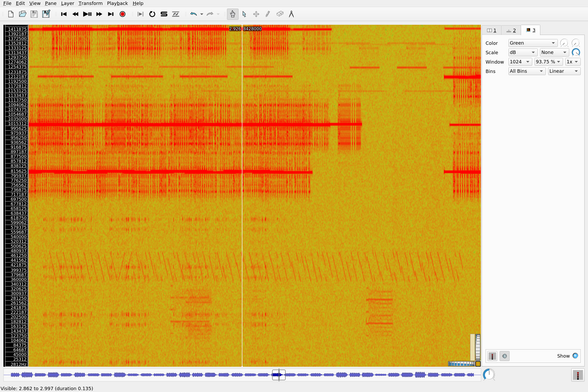
You can see transmission in the lower half of the screenshot! It has a very cute structure: You can see eight "down-chirps", followed by two "up-chirps". That's the header, followed by the payload.

To look for the signal, I made a "baseband capture" in SDR++, and opened the recording in sonic-visualizer.

Have you tried to catch and identify a pulsar? They tend to emit around high MHz bands.

@blinry

I'm not sure if they're strong enough, though. Probably not, but maybe it's a fun thing to look up.

@blinry

@RefurioAnachro Seems that I'd need a big satellite dish :D

I think you're right. Silly me %-D What about van Allen belt frequencies? Measuring some solar weather quantities should be possible. As they are a major source of noise, receiving should not be the problem. Still, I have no idea what I'm talking about...

@blinry