 blinry
I want to try the "make 50 of something" technique again!
So this week, I'll try to find 50 things to do with a Software Defined Radio! 📻
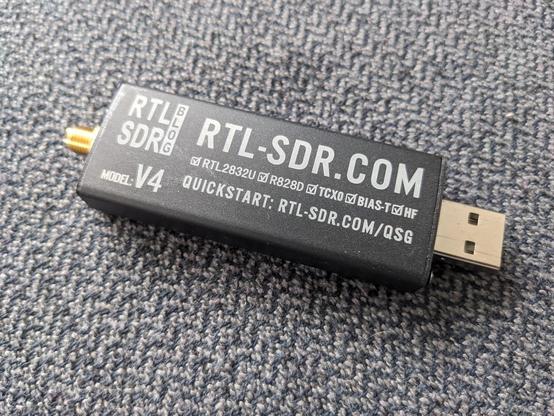
I'll use this simple USB dongle, which you can get for around $30.
I want to try the "make 50 of something" technique again!
So this week, I'll try to find 50 things to do with a Software Defined Radio! 📻
I'll use this simple USB dongle, which you can get for around $30.
1: Listen to FM radio
This is an obvious first thing to do, as the signals are very strong!
I'm using the SDR++ software, and it feels very nice browsing around and discovering the stations around you!
I found a local station that gives 1-hour slots to civic groups, for example!
I'm using a dipole antenna that came with the kit I purchased.
You generally wanna make it half as long as the wave length you want to receive, which is around 3 meters for FM radio.

2: Listen to Freenet
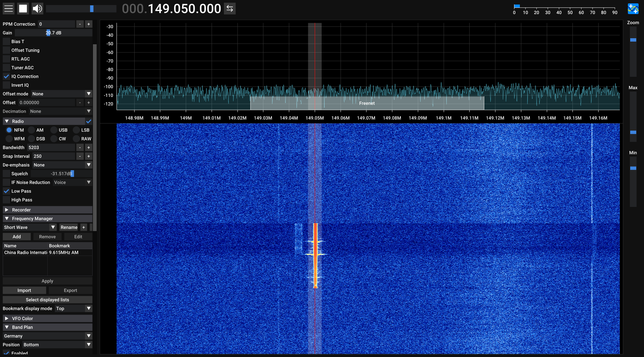
This is a special frequency range in Germany: Anyone is allowed to send there, using licensed devices. There are 6 channels.
I think someone's testing their device there right now. :D I heard a "Hellooo?", then a "Test, test", and then a "General call to all stations". Oh, and just now a short transmission on channel 3 in a Slavic-sounding language!
Freenet devices have a range of only a couple of kilometers, so these people must be pretty close! :O
3: Receive weather conditions from airports
While browsing the aviation frequencies, I found this station that reports weather conditions in an endless loop. It seems to be the "Automatic Terminal Information Service" of Hamburg airport!
Thanks to that, I now know that the current air pressure is 1011 hPa! :D
4: Listen to airplane communication
Listening to "messages not meant for the general public" is not allowed in Germany, so of course I didn't do that. And if I had accidentally done that, I wouldn't be allowed to tell you about it. 🙅
5: Track aircraft via ADS-B
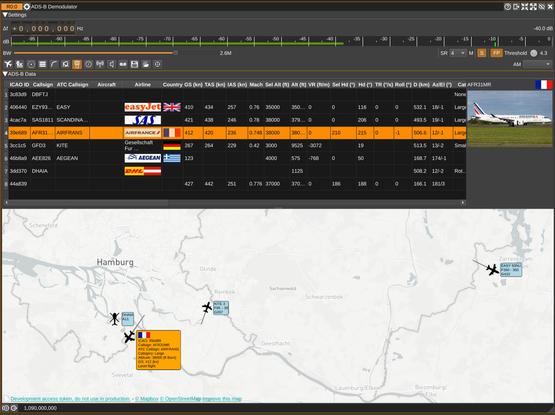
That's short for "Automatic Dependent Surveillance – Broadcast". Aircraft send it automatically to be tracked.
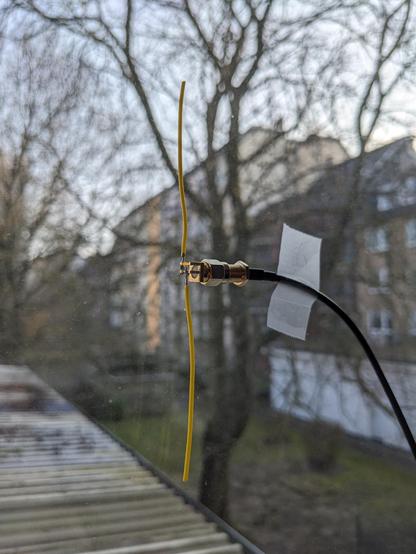
For this, I built my first antenna! From wire and and an antenna connector called "SMA". And it works! \o/
I'm decoding the signal using the software SDRangel. Fascinating! I see some big & small airplanes, and even a helicopter!
6: Listen to *stereo* FM radio
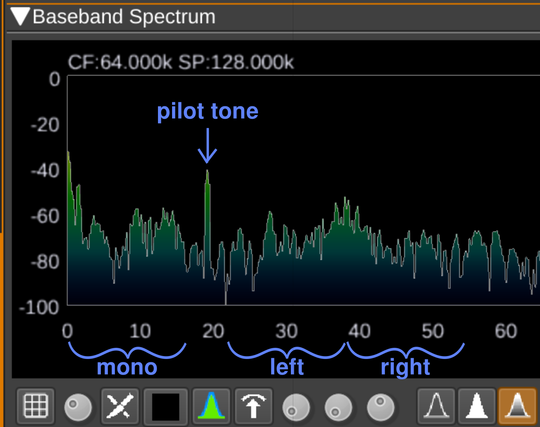
How stereo audio is transmitted is really interesting, because it's backwards-compatible to receivers that don't support it:
Here, you see the demodulated audio frequency spectrum. Below 19k Hz, it's just mono audio. Then, to mark a stereo station, there's a constant "pilot tone" at 19k Hz! (Outside of what most humans can hear.)
Then, if you double the frequency of the pilot tone, you can derive the sections where the left & right channel is transmitted!
7: Receive road traffic information
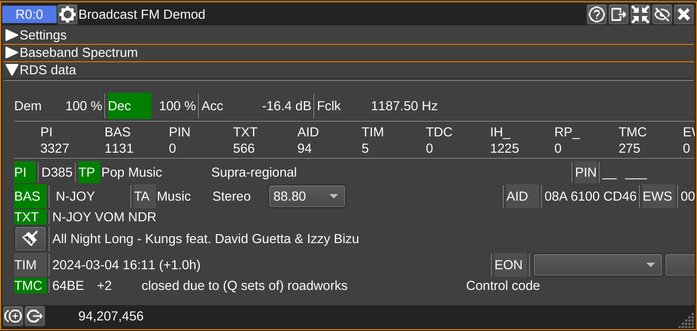
If you triple the frequency of the pilot tone, you get to a range where FM stations transmit small amounts of digital metadata, like the name and genre of the station, and the current song! That's a protocol called Radio Data System.
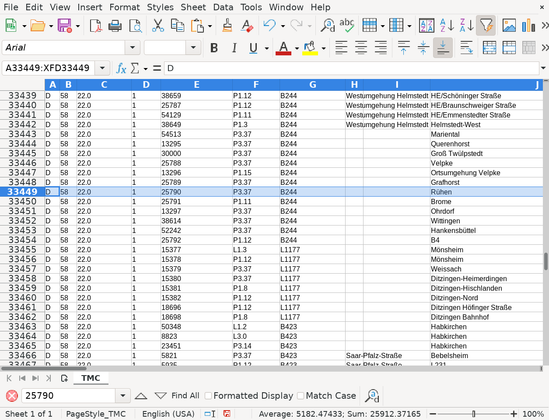
This system can also transmit road traffic information! There seems to be a road closure at "0x64BE". The Federal Highway Research Institute publishes an Excel table, where I could look up that this is a town in Lower Saxony!
8: Listen to conversations on the 2-meter amateur radio band
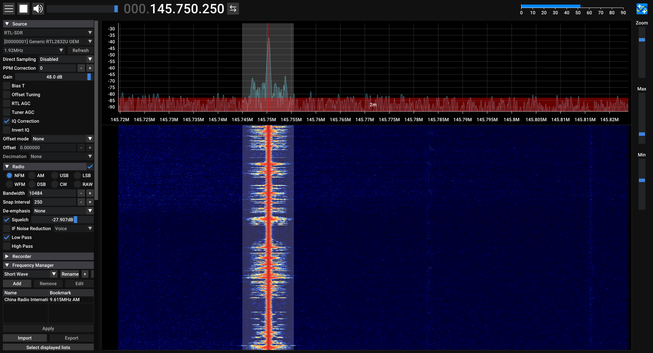
This is a frequency range reserved for amateur radio operators – for non-commercial use only. You may send on this band after getting a license.
What I found here is seemingly a conversation circle facilitated by a relay around 15 km away from here – it takes input on a certain frequency, and outputs an amplified copy of it on another frequency! Klaus, Bernd, Jürgen and Horst are talking about antennas, relays, and Windows XP! 😁
9: Listen to digital radio
The SDRangel software also has a demodulator for Digital Audio Broadcast! :O I continue to be amazed by it!
I think this is the first time I've received digital radio via air! Whoa, I see so many stations, and I've only checked a couple of channels.
The advantage of this digital channel is that there's no noise. And I even saw a "cover image" in one of the programs!
10: Listen to PMR446
This is a frequency range for "Private Mobile Radio". It's another of these bands where anyone can transmit using a licensed device!
Not a lot of activity here. I heard "Hello, hellooo!", "Can you hear me?" and some short transmissions that sounded like a child! :D
There also seem to be digital transmissions, but I don't know how to decode them yet.
The range of PMR446 devices is pretty low (a couple of hundred metres in cities), so again, the people must be close!
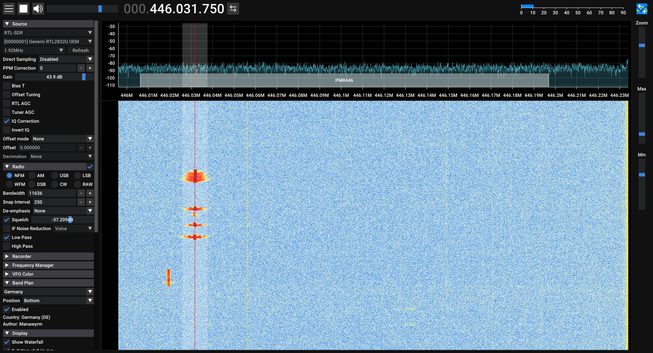
With that, I end the first day of SDR experiments! :) It's amazing to me how much invisible communication is going on around us in the electromagnetic spectrum at the same time!
To be continued tomorrow. Feel free to suggest things I could receive!
11: Read your neighbors' sensors
At 433 MHz, there's a frequency band for "industrial, scientific and medical" applications. And wow, there's quite a lot of activity nearby!
Using the decoder rtl_433, I see two sensors that output the current temperature, humidity, and air pressure!
There's also some "IBIS beacons" flying by, which are used in public transportation, so maybe it's buses driving by?
And just now, an "Interlogix Security" device appeared, reporting "closed switch states" :O


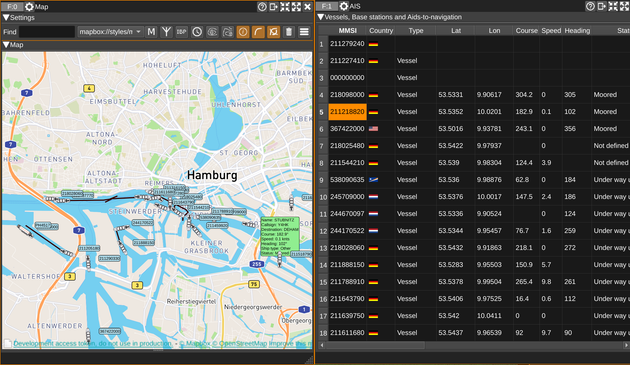
12: Track ships!
They send out their status using AIS (Automatic Identification System). And again, I receive *a lot* of them here in Hamburg! :O
I was especially excited to receive data from @msstubnitz (a fisher boat that was turned into a culture center/techno club)! It reports its status as "moored", and its speed as 0.1 knots! :D
This is again the software SDRangel. Apparently, it can also display a 3D map, but I haven't figured out how to add 3D models…
13: Detect GSM activity
I was curious whether you could tell if someone used their phone!
So I borrowed a GSM phone, tuned to the correct frequencies, and made some test calls.
What surprised me most: You can kind of "see" the volume at which I was talking!?
In the recording, the three dense bands at the end were when I was humming into the phone at the other end. This only worked in the "receiving" direction.
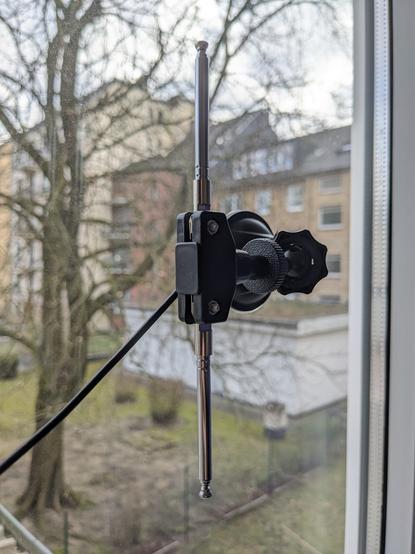
By the way, I try to adjust my antenna to the desired frequency as best as I can.
For GSM, I used the tiny screw-on antennas from the kit! :)
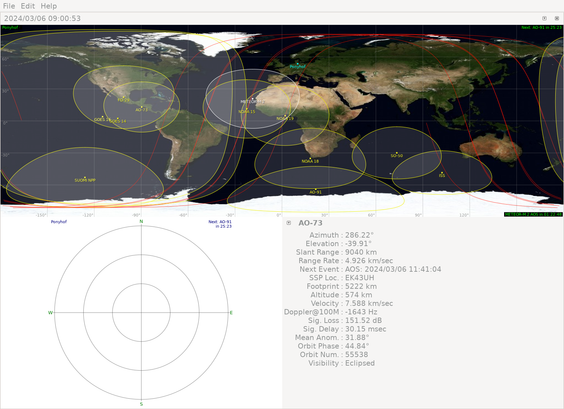
14: Receive signals from a satellite!
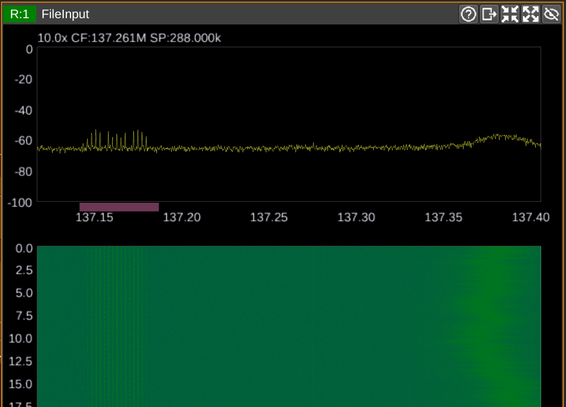
The program gpredict is really nice to find out when satellites will pass overhead! Learned lot yesterday, including that one satellite I was trying to receive burned up last week! :D
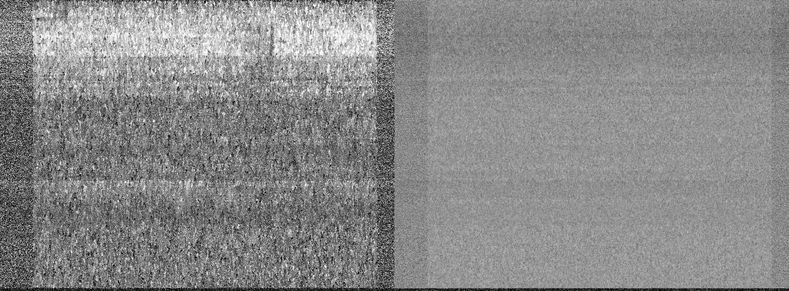
I was super excited when I first received a signal from a NOAA satellite! 🛰️
But I didn't manage to decode it properly yet. Maybe my reception is too noisy? I wanna keep trying, but I gotta move on.
15: Admire TETRA signals
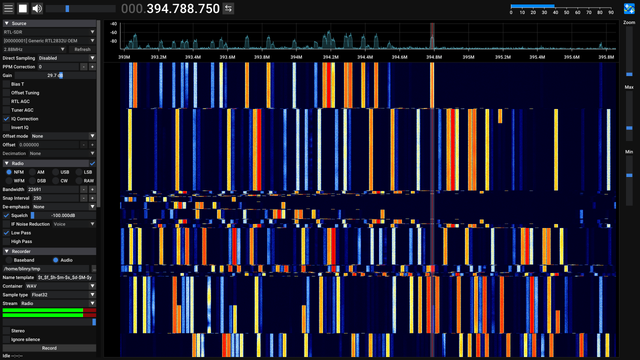
In Germany, the police has switched to an encrypted digital protocol called TETRA.
Even though I've seen some interesting talks at CCC events about weaknesses in the decryption, all I wanna do for now is look at the pretty signals in sdrpp. :3
16: Listen to taxi dispatchers
Again, this is communication not meant for the general public.
I didn't just listen to someone dispatching taxis to specific addresses, and you also shouldn't do that either. 🚕
Stay away from a site called "frequenzdatenbank"!
17: Ponder mysterious signals
Some of the most fun I'm having is just browsing frequencies and seeing what I can find!
Sometimes, I encounter signals I can't identify.
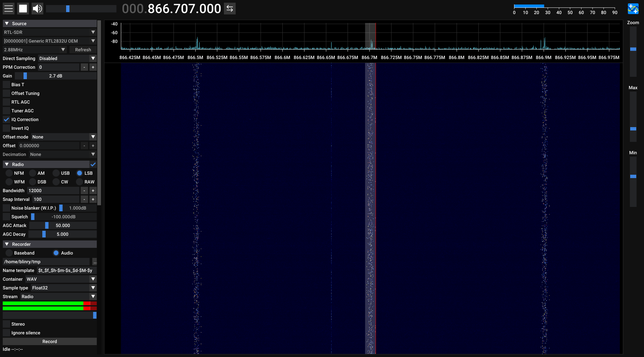
For example, at 865-868 MHz, there's a family of slow, continuous, digital signals that make a nice melody when listened to in single-sideband demodulation!
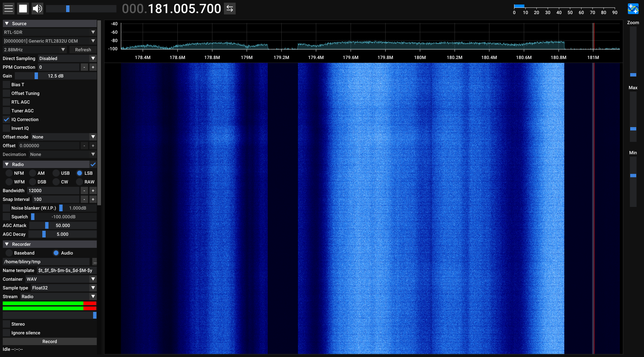
And at 177-180 MHz, there's two very broadband transmissions. Might be TV? But I can't find out what type.
If you have ideas, let me know! :) Time for lunch!
18: Track weather balloons
A radiosonde was just launched in Hamburg! SDRangel can decode its transmission! It has climbed to a height of 5 km, and it's -17 °C there!
Um, I could try to get it after it bursts and lands. Should I go get it?!


Didn't find the sonde. But something that might be even better – a friend!
On my way back, will report more soon. Data volume is used up, smartphone battery is empty.
So, the full story: I made my way up to the landing site by subway, train and bike.
As I circled the site, I encountered a person in their 60s, with a stubbly beard and a blue wool hat. He was looking in the direction of the crash site, and was holding a smartphone, so I asked him whether he also was looking for the radiosonde.
He was! We looked for it together for half an hour, jumping over small rivers and crawling through the woods, while he gave me a lot of tips related to hunting sondes.
He told me that he had found around 40 of them so far!
Usually, the sondes keep broadcasting after landing, but this one wasn't. So he quickly guessed that someone else could've taken it. Or maybe it landed in the water and died?
Eventually, we gave up, and walked back to our vehicles. He also is an amateur radio operator, and could answer a couple of questions related to building antennas!
And he was right: Someone had been faster than us! The status was changed: https://radiosondy.info/sonde_archive.php?sondenumber=V2930794
Some pictures from the landing site!
And I think I have earned this:
19: *Hunt* weather balloons!


20: Receive amateur packet radio
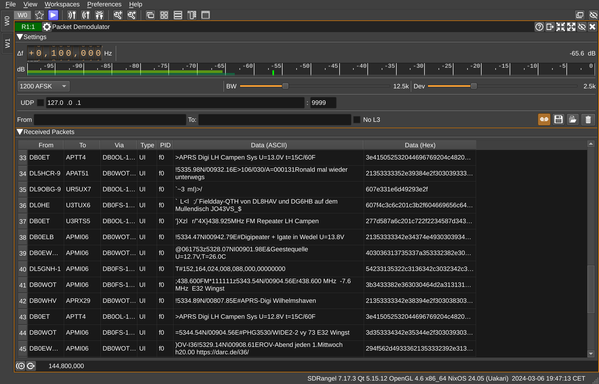
In the 2-meter amateur band, there are certain frequencies for the "Automatic Packet Reporting System". It's a bit like IP – packets have a "from" and a "to". They can also broadcast their position, or weather data.
Some stations seem to announce themselves as repeaters, which probably help forward the packets to increase the range.
And two people seem to be on a "fieldday", and broadcast their location. :D
SDRangel can create a map automatically:

This is going to be a simple "random wire" antenna, to allow me to get better reception in the lower wavelenghts, which I've omitted so far.
I've measured out 21.6 m of wire (which for ✨magic✨ reasons seem to be a good universal antenna length)...

...and draped it all around my room!
People on the Internet say that there are many problems with this – that it would be better to have it outside, and that there's an impedance mismatch between the receiver and the wire.
I could address those problems, but I wanna try how well this works first :)

21: Receive Morse code from other countries
On the 30-meter amateur band, I found people sending Morse code! :O
I've been learning it a little bit, so if I record it and slow it down, I can understand it: They're sending their callsigns.
These are from Belgium, France, and Italy! \o/
I compared to my 2-meter dipole antenna, and the reception is definitely better – I can pick up more transmissions, and with much less noise!
22: Receive maritime weather reports
The German Weather Service broadcasts maritime information throughout the day on various shortwave frequencies.
They use a protocol called RTTY (radioteletype), and it took me a while how to decode it. But I found a neat little program called "fldigi": You can pipe audio to it, and then if you pick the correct settings, it happily transcribes the messages!
Here's the station weather reports for the Baltic Sea and Northern Sea!

23: Receive digimodes from other countries
I found some other strange signals on the 30-meter band. The Signal Identification Wiki was really helpful for figuring out what they were: https://www.sigidwiki.com/wiki/FT8
FT8 is a new protocol, invented in 2017, and it seems to be super popular right now! It allows you to transmit short messages, and again, people are looking for people to talk to (CQ), saying how well they receive each other, or saying goodbye (73).
This is the WSJT-X software.

24: Detect whether your notebook is charging
As I'm browsing the very low-frequency bands, I had a strange problem: Sometimes, that would work okayish, sometimes I could even make out voices!
Other times, it wouldn't work at all, and everything would be loud noise. Even in regions where I had better reception before!
Just now, I found out how to solve that issue – by unplugging my notebook charger. D'oh! :D
25 & 26: See ionosondes and radar signals
In the low frequencies, occasionally, you can hear a short *chirp*! :D These are caused by ionosondes, scientific instruments which measure the properties of the ionosphere by sweeping a wide frequency spectrum.
Another signal (which I accidentally got in the same screenshot) is a radar system – in this case, according to the Signal Identification Wiki, it's a "CODAR" system, used to measure the motion of water waves and currents along coasts! :O
27: Listen to "single side band" conversations
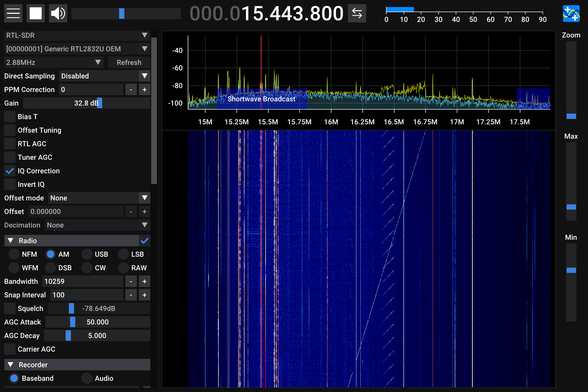
How do you transmit speech over long distances? You can use "amplitude modulation", where you change the volume of the carrier frequency to model your audio.
As a side effect, the bands to the sides of the carrier will contain a signal, as well.
One trick is to transmit *just* those sidebands, which saves power! But you have to "guess" the base frequency when listening.
SDR++ makes it very easy to play with this! :) Here's someone from Serbia!
28: Listen to AM radio from the other side of the world
At night, low-frequency radio waves can travel further around the world, because they're reflected by the layers of the ionosphere! There's something magical about this.
I put my antenna outside, and I can hear *a lot* of broadcasting stations! On https://www.short-wave.info, you can look up where they are located.
Some stations in China are broadcasting with very high power! Some are over 7500 km away.
Wow. It's full of stars! 🌌
29: Listen to CB radio
After I looked into the low frequencies yesterday, let's go to a higher band again: The Citizens Band!
This is the third frequency band I'm aware of where anyone is allowed to transmit – provided that you use a licensed device!
This is a band where my random wire antenna really comes in handy. Without it, I would have a hard time understanding anything. And even with it, transmissions are extremely noisy.
CB radio is used internationally, especially by truck drivers?
30: Assess the propagation of radio waves using beacons
The International Beacon Project runs a network of 18 stations, which take turns transmitting their callsigns at certain frequencies.
Using this system, you can quickly get a sense of how well radio waves are currently propagating to your location. Clever!
I picked up the beacon from southern Finland! You can see its callsign scrolling away in the video. It's followed by four dashes send with decreasing power. I only heard the first one…
31: Receive a time signal
I would've loved to receive DCF77, which powers the radio clocks in Germany! But no matter how hard I listened to 77.5 kHz, there was nothing there. I don't think my dongle can do that.
So let's use higher frequencies! Russia transmits its "RWM" time signal at 9996 kHz, which beeps every second, with a long beep for the full hour.
Not enough to tell the time, but enough to adjust your wrist watch, I guess!
32: Receive a weather fax
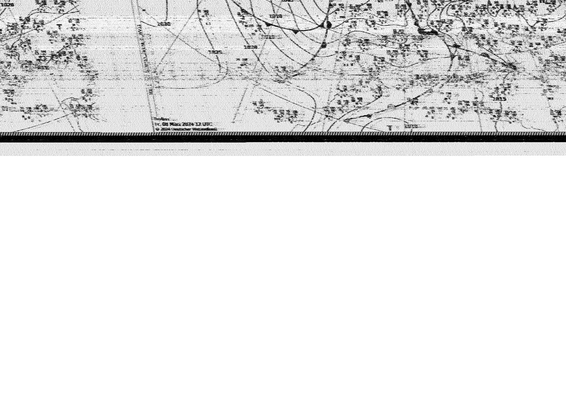
The German Weather Service broadcasts weather maps throughout the day! You can decode them using fldigi's "WEFAX-576" setting.
I caught this one only halfway through. According to the schedule, it's the "Surface weather chart North Atlantic, Europe"!
If you squint *really* hard, you can make out the coast of Spain and the Mediterranean Sea on the right side!

@ugackMiner Yeah, I think this provably was one! The ones I heard moved pretty fast.
Cool that you tried it! :)
@blinry
I _think_ the magic reason is because it's a common multiple of all others sizes, making it perfect for all of them.
But, keep in mind that it's just intuition, not fact based.
@Cqoicebordel From what I gathered, you want a non-resonant behavior, to keep the impedance down, so this length is as far away from being a multiple of the common wavelengths as possible! :)
But I also don't know what I'm doing! :D
@blinry
Given your answer, I googled to know more, and stumbled upon this :
https://udel.edu/~mm/ham/randomWire/
"if you have a capable enough tuner the colored bands below are the *best* lengths [… But] For typical tuners built into a rig, these are the *worst* lengths"
Sooooo… yeah, I'm lost too :D
@blinry
But the wire is green.
Won't the flying pixies note that green is ground, and not seek out your wire?
;^)
@blinry APRS is IP over 1200 baud modem
https://aprs.fi/ is the big map
@blinry Before you're done with 50 using demodulators that others wrote for you,:
quite a nice (and fast-to-read) intro to the theory: https://pysdr.org
"build your first receiver for your wireless doorbell¹" may be quite doable following https://tutorials.gnuradio.org
You'll also like @destevez 's blog on decoding recent moon etc missions https://destevez.net/ &his sat telemetry rx https://github.com/daniestevez/gr-satellites/
—
¹assuming it does smth simple and not zigbee, but then again,gr-ieee-802-15-4 exists
@blinry for all questions regarding GNU Radio and how to use it with an RTL dongle (hint: our all-in one installers, and most Linux distro packaging bring all the driver interfaces and often even the rtl driver itself with it, one-stop shop installation!), the wiki, the [email protected] mailing list and the matrix://chat.gnuradio.org chat server are quite helpful.
No matter what you do: Have fun!


 pandora
 SebasGarcia
 Gina Häußge
 0mega ☣ [hz]
 Ud😷 Sauer
 Manu
Manu mad
mad
 Jessie Nabein
 ugackMiner
 DLS
DLS Daniel Bohrer
 chiasm
 rndmnmbr
 Stewart Russell
 rag. Gustavino Bevilacqua
 Cqoicebordel ❎
 Kelvin n0mql EN35ld
 stfn
stfn 

 Extreme Electronics
 utzer
utzer 

 Fripi (DECT 3034)
 trusty falxter 🧠
 stodarahodan
 Leah
Leah Marcus Müller
 shoc Inc, Rolf Haenggi