close to hearing it
the gentle pitter patter
roof leak lullaby

🌧️ Commentary, wip photo, and ink palette used: https://www.pillowfort.social/posts/3299390

#haiku #ink #FountainPenInk #poetry #MastoArt #CreativeToots

maiji: roof leak

[image set: 1) Photo of open notebook next to two glass dip pens, one pointed and one slightly sanded down with a blunt tip. The page shows a haiku written in ink, illustrated with abstract lines of pale shimmery blue, purple, green, grey reminiscent of drops and ripples of water: "close to hearing it / the gentle pitter patter / roof leak lullaby". Poetry and art by Maiji/Mary Huang, humangray.com. 3) Eight swatches laid out in neat rows next to a mini flashcard set being used as an ink colour swatchbook. 3) 2) In-progress photo showing shiny wet puddles of ink on the page, next to a ceramic cup of water, a waterbrush, a tiny crumpled piece of tissue with the same colours as the inks used, and the two glass dip pens.] Tricycle runs a monthly haiku prompt/challenge, and March 2023’s theme was “roof leak”. (They pick three winners to highlight each month - you can see them here, and read the commentary!)I had a few directions I considered taking this, and the version above was helped along by a mini epiphany. Sleep has always been a tricky thing for me. I do sleep deeply, and remember many of my dreams, and also lucid dream more frequently than most people, it seems - but I don’t sleep a lot at all. I’m also very sensitive to noise, which often makes it harder to fall, and stay, asleep. Four consecutive hours of sleep seems to be my general limit (it’s usually much less than that) that I consider a pretty good bout. One morning near the end of March (and the deadline for haiku submissions), I woke up to a very annoying disruptive knocking. I grabbed my phone to try to record it, thinking the recording could help for reporting the noise. I soon discovered I had difficulty recording it because… the sound of the rain outside my bedroom window was actually louder. And I had a bit of that deeper oh moment. The pitter patter of the rain didn’t bother me because of my perspective of it. After I got up, I finalized the wording of this haiku. The oft-repeated 5-7-5 syllable (or Japanese on, which isn’t the same thing) structure is actually not always followed by poets in any language (a lot of my poems from 31 days would count as haiku, for example). And most of the haiku I read in English are translations of Japanese haiku, so the syllable count isn’t usually retained anyways. So I found it a little tricky consciously follow the formal structure in English, but also interesting and fun to work within the specific format constraints.The month-long time frame was also helpful in being able to support a bit of mindfulness practice, and work with intentionality. Write a bunch over time, come back and tweak a little and edit, try it several times with the seasonal word in different places (e.., challenging myself to try some starting or ending with the seasonal word, other times in the middle). I tend to want to post something online as soon as I’ve finished it, so this was a nice exercise in being patient and not being so tied to doing something for the sake of anything other than just doing it.The illustration was fun to do as a meditative practice as well, picking some vibey colours from my collection, then blobbing and circling and dripping and wiping abstract patterns to illustrate the theme. The booklet uses Tomoe River paper.I’m currently working on my April haiku. You’ll see it next month! :)

Pillowfort

shh don't disturb them
heads bowed in quiet study
water narcissus

🌼 Commentary, wip photo, and ink palette used: https://www.pillowfort.social/posts/3353610
💧 Haiku Ink series: https://humangray.com/haiku-ink-series

#haiku #ink #FountainPenInk #poetry #MastoArt #CreativeToots

maiji: narcissus

[image set: 1) Photo of open notebook next to two glass dip pens, one pointed and one slightly sanded down with a blunt tip. The page shows a haiku written in ink, illustrated with strokes and blobs of ink that look like yellow flowers with long green stems and leaves nodding over ripples of water. 2) Eight swatches laid out in neat rows next to a mini flashcard set being used as an ink colour swatchbook. 3) In-progress photo showing shiny wet puddles of ink on the page surrounded by the glass dip pen, crumbled tissue stained with golden brown ink, small vials of ink and a ceramic cup with water.] shh don't disturb themheads bowed in quiet studywater narcissus - Poetry and art by Maiji/Mary Huang, humangray.com April 2023's haiku in the haiku ink series. If it weren't for the specific prompt, I don't think I otherwise would have ever used "narcissus" in a haiku. "Narcissus" has a melodic, sophisticated sense to it. I feel like "daffodil" is more my "haiku style", because it feels charming and approachable. I think, anyways, haha.Here I have the vision of a cluster of little scholarly flowers in quiet contemplation. As you may know from my hua series, in Chinese, narcissus is “water xian” - xian being a kind of immortal. At a recent sangha session, we reflected on how encounters with nature can support mindfulness. As everyone shared their personal experiences and thoughts, the greater sense of being, of inner peace/calm that it can bring however temporary, I had a teeny tiny insight. I thought, mmm it's funny how all of us have these stories about things like going out for a walk in the trees, sitting by the water... And it's funny that when I think about nature, I have this sense of nature as this thing out there that I go and visit, some kind of vacation or departure from the usual. But as I reflected, I realized... actually, I am nature! I'm not some separate thing from nature. I and every other human being on this planet, is an expression of what we call nature, this interesting/funny/miraculous coming together of all these elements in this shape, wandering the universe and blobbing around and doing our thing. It's really amazing.Of course, it's easy to not be consciously aware of that, to forget that in the day to day. Placing ourselves in a very visible, tangible environment that engages our senses is a powerful reminder of... our true nature, I suppose. It also reminded me of that famous Zen koan of the original face. It goes something like: "what was your face before your parents were born?" or "what was your original face before you were born?" or some variation of that. That feeling of going out in nature as some kind of remembering who/what you really are, your true face - I had that very brief moment of "oh!" beyond just intellectual musing, and then it passed.Narcissus in quiet study. I wonder that sometimes it's not so much "anthropomorphizing" or "humanizing" something so much as... nature-izing ourselves? Just words.I actually finished May's prompt early this month. Look forward to seeing it at the end of next month, while I look forward to learning what June's prompt is soon...!

Pillowfort

high rise hazy moon
your almost forgotten face
floats past the buildings

🌕 Commentary, wip photo, and ink palette used: https://www.pillowfort.social/posts/3420508
💧 Haiku Ink series: https://humangray.com/haiku-ink-series

#haiku #ink #FountainPenInk #poetry #MastoArt #CreativeToots #moon

maiji: hazy moon

[image set: 1) Photo of open notebook next to two glass dip pens, one pointed and one slightly sanded down with a blunt tip. The page shows a haiku written in reddish-brown ink, illustrated with strokes and washes forming a scene of high-rise buildings at night in shades of grey tinged with blue and purple, clustered together beneath a smoky full moon tinted with pink and lavender. 2) Eight swatches laid out in neat rows next to a mini flashcard set being used as an ink colour swatchbook. 3) In-progress photo showing the page with handwritten text and outlines of the buildings with light splotches for the windows. In the background is a sketchbook propped up displaying thumbnail roughs of the composition. Around the page are glass dip pens, a waterbrush, small vials and a bottle of ink, and ink bottle packaging.] high rise hazy moonyour almost forgotten facefloats past the buildings - Poetry and art by Maiji/Mary Huang, humangray.com Living in a city full of condos and light pollution, in conjunction with pandemic and late night safety concerns, sometimes days can go by without seeing the moon. Or other things, and people…I found this prompt way harder than the previous ones for March and April. The “original” Japanese kigo (seasonal word in haiku) would be oborozuki 㜧㜈, and it’s a Supremely Classic Kigo in my mind, basically exactly the kind of thing I think of when I hear kigo. It has a long history in literature and art and appearing in so many places. â€œOboro” is a word that refers to a shrouding kind of mist slightly obscuring or dimming the moon; the kanji is formed by a “moon” radical combined with the character for dragon (the full traditional Chinese character, as modern Japanese uses a simpler kanji for dragon). It’s the same oborozuki given as a reader sobriquet to the character Oborozukiyo (“Misty Moon Night”)  in the Tale of Genji, and the reference in Houzouin Inshun’s Noble Phantasm/special move OboroUraZuki (“Hazy Inverted Moon”) in Fate/Grand Order, to name just two examples that you may have seen if you’ve followed my posts long enough! So I think the difficulties come from having so many pre-existing conceptions and associations with it and struggling to do something that doesn’t feel like I’ve encountered it a bajillion times before. And to make it more personal instead of mystical. I didn’t want to get too lofty with this - conceptually speaking, anyways (it seems kind of funny to say “I didn’t want to get lofty” for a poem about a floating moon). I wanted to still capture a kind of grounded, ordinary feeling. Tricycle gave two options for the prompt, the alternative being “blurry moon”, which felt really unusual to me. “Blurry” has an appealingly simple, almost childlike quality to it, and I wrote a number of haiku with that in mind.… But in the end, with this direction, the alliteration of “high-rise hazy” was too much to resist. Maybe next time.

Pillowfort

Thumbs drawing circles
on grandpa's bare feet - he smiles
like he's in heaven.

A memory of special days with Yeye, my grandpa. ❤️

👣 Commentary, wip photo, and ink palette used: https://www.pillowfort.social/posts/3521261
💧 Haiku Ink series: https://humangray.com/haiku-ink-series

#haiku #ink #FountainPenInk #poetry #MastoArt #CreativeToots #family #grandfather #grandpa

maiji: barefoot

[image set: 1) Photo of open notebook next to two glass dip pens, one slightly sanded down with a blunt tip. The page shows a haiku written in sepia ink, illustrated with swirls and circles forming the shapes of flowers and two footprints. 2) Eight swatches laid out in neat rows next to a mini flashcard set being used as an ink colour swatchbook. 3) In-progress photo showing an open notebook with handwritten text and outlines of the two footprints at an early stage of the illustration. Around the notebook are bottles and vials of ink, the glass dip pen on a ceramic watercup, and a fountain pen and small pen/pencil bag lying on another notebook.] Thumbs drawing circleson grandpa's bare feet - he smileslike he's in heaven. - Poetry and art by Maiji/Mary Huang, humangray.com Yeye, my grandfather, is the one who brought us to Canada, who helped raise me as I grew up here. He was, and is, a cornerstone of and inspiration for my life in so many ways. He died at 94 after an eventful year full of health ups and downs and frequent trips to emergency. Nearly every free moment - all the weekends, all the holidays, all the time off work - we spent at his side. One of my strongest impressions throughout that period was the feeling of gratitude for all the time we were able to spend with him. That year I made a discovery: Yeye really loved foot massages! I don’t remember how it started exactly, but I think he might have made some comment about feeling cold, and we’d already given him thick socks and a heated blanket. I used to accompany him on walks, but as time passed he spent more and more of it sitting or lying in bed. I suppose it crossed my mind this was something else I could do for him during our visits. Looking back it seems obvious, but it’s amazing to think that none of us, to my knowledge, had ever thought of giving him a foot massage until then.So I gave him foot massages every time I saw him. We found and tried different lotions and my mom dug up various little manual wood massage tools to use as well. He never failed to exclaim how this was the best thing ever, which was funny because all his life he had a reputation as quite a serious and reserved person. Near the end, when he was too weak to speak anymore, he would still make little wiggling hand gestures to indicate that he would like a foot massage. It’s the least I could give him. Thank you, Yeye, for everything. Appropriate to the theme of feet, my mind ran all over the place with this kigo. I started off thinking about my own feet, about the sensations of the soles of my feet against the floor, and about how our feet really ground us in so many ways, and how easy it is to take them for granted despite the load they bear for us every single day. When’s the last time we really looked at our feet? Really felt the curves and shapes of our toes, arches, heels? And felt the things we can feel with our feet? That was my general train of thought. Then one morning I thought of somebody else’s feet - my grandfather’s, and all the memories of that treasured time with him before he died, and I started writing haiku in that direction. I struggled a lot with it, trying to figure out how to capture something that was so simple but somehow kept coming out super complicated in such few lines. After a while of growing very frustrated with my attempts, I took a break from haiku. When I came back to it, I worked in several other directions instead. But I kept returning to this idea. It just felt really special if I could... just... create and share something about those memories, no matter how small. I even went about sketching a composition and picking inks (faded, nostalgic colours) even though I still wasn’t happy with any of the actual haiku attempts. I guess I was trying to set my brain up with the assumption that I would make it work somehow! Finally late one evening, about a week before the end of June submission deadline, I did another ~7 or so iterations on another concept before coming back to this one - and it seemed to flow a little more easily this time around. Another ~4 drafts later, I had this version.Punctuation and capitalization with English haiku is always an interesting creative decision. In the previous haiku in this series, I didn’t use any capitalization or periods. That's generally my preference, giving the poems a bit more of a floating ephemeralness. With this piece it felt right to make it more grounded - that it was a real thing I shared with my grandpa, of a particular time and space.Something interesting happened while I was making the art. The Ferris Wheel Press Ink, Cream of Earl [Grey], doesn’t really look like its swatches. This was a small sample I had lying around for a while, and some kind of aging/ fading or chemical reaction must have taken place in the vial. As you can see the ink actually looks rather green compared to the rosy swatch! It startled me a little when it came down on the paper, but I just kept going. It seemed fitting, actually - another reminder of the constant transformation that my grandpa, and all of us, go through in our brief, transformative existences.Thank you for reading and walking this cherished memory lane with me!

Pillowfort

somewhere deep beneath
the white lotus flowers lie
the roots of our soup

🥣 Commentary, wip photo, and ink palette used: https://www.pillowfort.social/posts/3625094
💧 Haiku Ink series: https://humangray.com/haiku-ink-series

#haiku #ink #FountainPenInk #poetry #MastoArt #CreativeToots #lotus #LotusRoot #soup

maiji: lotus

[image set: 1) Photo of open notebook next to two glass dip pens, one slightly sanded down with a blunt tip. The page shows a haiku written in ink of swirling blues, greens and yellow-brows, creating an underwater-seaweed-and-bubbles impression, with circles at the bottom of the image evoking the shapes of lotus roots. 2) Eight swatches laid out in neat rows next to a mini flashcard set being used as an ink colour swatchbook. 3) In-progress photo showing an open notebook at an early stage of the illustration, where it is just the lines of poetry bordered by green lines and drops of ink with shapes resembling leafy pads. A hand holding a waterbrush hovers over the page, and a glass pen, vials of ink, ink bottle, sketchbook and pen can be seen lying around. 4) An angled closeup of the illustration with fresh wet blobs of ink.] somewhere deep beneaththe white lotus flowers liethe roots of our soup - Poetry and art by Maiji/Mary Huang, humangray.com There are a lot of aspects to haiku, and of course people have different tastes. A good haiku can look deceptively simple, evoking really powerful stories by painting all the things around the story and letting the reader’s own mind fill the gap with emotive colour. This is something I aim (try, hope) to do in a lot of my creative work, text or image-based. With varying degrees of success.One of the main things I love is when a haiku can break down into three clear moments or segments but also work as one seamless sentence. I don’t often manage to do that, so I was happy with where I was able to net out.When finalizing "lotus", I spent an inordinate amount of time debating between the use of “of” versus ”for” in the last line, “the roots of / for our soup. “For” is interesting because it gives it a sense of direction and purpose - the roots exist in service of the soup, we are hunting for roots for our soup, the roots will be transformed into the soup.“Of” has a more neutral, floating taste to it - even a sense of interdependence. The roots exist; they are the basis and foundation of our soup. But soup is not the only purpose of their existence - or perhaps, it is not only the soup that owes its existence to the existence of the lotus flower roots. Or perhaps they are not separate things at all.In the end, I realized if I were writing it Chinese or Japanese, the meaning in my head would simply be “of”. So “of” it was.I usually only share one WIP photo, but here I loved the underwater bubbling-up look of the glistening ink drops at the angle!

Pillowfort

summer afternoon
my father's harmonica
hasn't sung one note

🔅 Commentary, wip photo, and ink palette used: https://www.pillowfort.social/posts/3770415
💧 Haiku Ink series: https://humangray.com/haiku-ink-series

#haiku #ink #FountainPenInk #poetry #MastoArt #CreativeToots #summer #SummerAfternoon #harmonica

maiji: summer afternoon

[image set: 1) Photo of open notebook next to two glass dip pens, one slightly sanded down with a blunt tip. The page shows a haiku written in bold coral ink with scribbles of cloud and grass-like shapes in blue, pink, brown blending into each other and forming purples, mauves and taupes where they meet. 2) Eight swatches laid out in neat rows next to a mini flashcard set being used as an ink colour swatchbook. 3) In-progress photo showing an open notebook at an early stage of the illustration, where it is just the lines of poetry in bold coral with drops of ink splattered around it. Around the open book are paper towels, an open sketchbook with scribbled drafts, a dip pen resting against a ceramic water pot, a bottle of ink and the edges of the swatchbook. 4) An angled closeup of the illustration showing the gold shimmer coming through parts of the ink.] summer afternoonmy father's harmonicahasn't sung a note - Poetry and art by Maiji/Mary Huang, humangray.com What do you think of when you hear (or see) the words “summer afternoon”? What kind of mood does that stir in you? This haiku went through quite a number of different ideas, all of them playing with sights, activities, sensations, and so on that, to my imagination, evoke a feeling of things that could go on and on. A lazy summer afternoon kind of feeling, when there’s nothing you have to do, and anything you do do feels like it could stretch into forever. You know what I mean?Lazy afternoons do make my mind wander, and funnily enough I found that happening in what I was writing too. The poems started to stretch out in that wondering direction, juxtaposing the sense of things feeling like they could go on forever with a sense of looking back - or looking forward - from a vantage point where we know that the things won’t - or didn’t.One afternoon I went out for a walk, poetry on the brain and sorting things out in my head. All along the trail I listened to the sound of cicadas chirping noisily in the fields. They’re such an ubiquitous sound at this time of the year, and I wrote a few “summer afternoon” haiku with them as well, but it didn’t feel quite “there”. While meditating on sound, however, I suddenly recalled: when I was very little, my father was usually away due to work. As a child I rarely saw him except in the summer. I do remember late summer afternoons, the shadows of evening seeping in as we sat in the backyard, and hearing tunes flow from his harmonica. He’s retired now, and I haven’t heard him play in years.For this illustration, I didn’t really have a strong sense of the visual direction, and in a lot of ways I think it came out more scattered and haphazard and messier than most of the other pieces to date. This makes perfect sense because my mind was feeling scattered and haphazard and messy. You can actually see in the WIP that I changed one of the words at the last second, scribbling over it and wiping it out and rewriting anew underneath. Also, I wanted to use warm colours for a summer afternoon, especially the colour orange. But I don’t have any orange inks, and I didn’t want to use some of the more yellow inks I have already used in the series this soon, and since one of the original objectives of this series was to use up my existing inks, it didn’t make sense to buy an orange ink… I picked some colours I thought could give me that warm vibe, and it created an energy that probably wouldn't have happened without that constraint. Overall, it’s interesting seeing how this turned out, especially when I step back and look at it as part of the whole haiku ink series.

Pillowfort

dreaming of being
as undiscriminating
as a drop of dew

☔ Commentary, wip photos, and ink palette used: https://www.pillowfort.social/posts/3910958
💧 Haiku Ink series: https://humangray.com/haiku-ink-series

#haiku #ink #FountainPenInk #poetry #MastoArt #CreativeToots #dew #Buddhism

maiji: dew

[image set: 1) Photo of open notebook next to two glass dip pens, one slightly sanded down with a blunt tip. The page shows a haiku written in dark black-purple ink, with abstract, layered patches of dripping purple and teal inks. At the bottom of the page is a drawing of a blade of grass with a large dewdrop hanging from its underside. 2) Eight swatches laid out in neat rows next to a mini flashcard set being used as an ink colour swatchbook, spread out like a fan. 3) In-progress photo showing an open notebook at an early stage of the illustration, where it is just the lines of poetry in black-purple and the outline of the blade of grass with a few dark green patches. On the back of the previous page, the bold pink inks of the previous month's haiku ink illustration are visible. Around the open book are paper towels blotted with rainbow ink colours, part of an open sketchbook, a dip pen resting against a ceramic water pot, various bottles of ink and a small sample vial. 4) An angled closeup of the illustration showing the words "drop of dew" and the dew dangling from the blade of grass. Silver shimmer can be seen through the ink.] dreaming of beingas undiscriminatingas a drop of dew - Poetry and art by Maiji/Mary Huang, humangray.com My first thought on seeing the kigo (haiku seasonal word/prompt) for September was “Oh, man”. â€œDew”, like “blurry/hazy moon”, carries so much history and meaning, especially if you’re into Buddhist poetry. It is very easy to fall into wondering how can you do justice to it in any kind of barely original way. And the masterful examples provided didn’t help alleviate that feeling - certainly not the fact that one of them was Issa’s famous haiku, which I’ve illustrated and talked about before. But it was also a really great reminder to approach things with a beginner’s mind. How do I forget what I know, and look at this with fresh eyes? And then, how do I step outside of that too, without expectations, without discriminating between “fresh” and “not fresh”? Practice in action. Suddenly it seemed obvious.This was actually the first attempt at the prompt. I wrote a handful of other approaches after, but nothing else seemed to capture my thoughts as clearly as the moment I wrote this one. I don’t think it’s that remarkable or original, but I think it captured exactly what I was feeling.The closing gatha of the Diamond Sutra asks us to see all things as being no different from various ephemeral phenomena - like a dream, a bubble, and a drop of dew. But beyond helping us to understand impermanence and the jewel-like preciousness of every moment, a drop of dew also does something else. It falls anywhere, on anything, and it doesn’t discern “good” or “bad” wherever it may end up. Sometimes I wish I had that presence of mind to not fall into the trap of prejudging everything that comes my way. To be brave enough to let something be what it is. Actually, I don’t know that “brave” is necessarily the right word. It is, simply, what it is.

Pillowfort

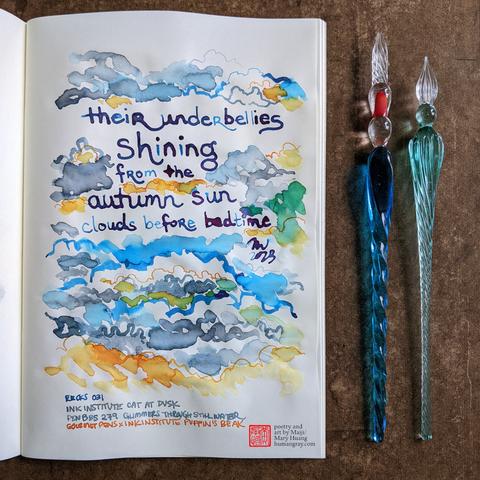
their underbellies
shining from the autumn sun
clouds before bedtime

(October's kigo inspired a double feature!)

☁️ Commentary, wip photos, and ink palette used: https://www.pillowfort.social/posts/4028390
💧 Haiku Ink series: https://humangray.com/haiku-ink-series

#haiku #ink #FountainPenInk #poetry #MastoArt #CreativeToots #autumn #nature #clouds

maiji: autumn sun

[image set: A series of photos showing two haiku illustrated with ink, followed by closeup detail shots, swatches of the inks used, and work-in-progress photos. 1) Photo of open notebook next to two glass dip pens. The page shows a haiku written in vivid blue ink with layers of multicoloured clouds rendered in greys, blues, yellows, oranges and greens where the inks blend. 2) Similar photo of open notebook, with a page showing a haiku written in dark gold ink in the centre of a glowing tree rendered with trunk/branches and foliage of sepia, brown, yellow, orange, gold and fine splatters of ink. 3 and 4) Detailed closeups showing the shifting colours and glittering effects in the various inks used. 5 and 6) Two photos showing ink swatches laid out in neat rows next to a mini flashcard set being used as an swatchbook. 7 and 8) In-progress photos of early stages of the illustrations, where it is just the lines of poetry with a glass dip pen starting to rough out surrounding outlines of clouds or tree trunk/branches. Past the in-progress art is an open sketchbook with rough sketches, ink bottles, waterbrushes and other art supplies.] their underbelliesshining from the autumn sunclouds before bedtimeearlier this monththe tree outside my windowwas the autumn sun - Poetry and art by Maiji/Mary Huang, humangray.com It's a double feature for October's haiku!Initially I was cool to the kigo “autumn sun”. The immediate vibes when I read the phrase were "how nice... not evoking anything in particular" for me. But then something funny started happening. As I started writing, more and more haiku kept coming out. Every time I went out or looked around, there was another idea, another angle. In the end this ended up being probably the most prolific and diverse month of haiku ink to date! There were so many options and directions to choose from. So I ended up finalizing two, in recognition and celebration of the eventfulness of October.Both of these are actually different views from the same window. “Clouds before bedtime” was a moment I recall as being later in the day. It was still light outside - the sky was quite bright blue. I’d taken a break to do some eye stretches (looking at objects in the distance then gradually closer, looking left/right and up/down etc.), and turned my head to look out the window. That’s when I noticed: in between the high-rises, past the buildings, the clouds in the sky were flat and white - save for their undersides, which were shining gold. I’d never seen that before - or at least, I’d never noticed that I’d seen it before. For the cloud bellies, I picked an ink with a lovely gold glitter, making them sparkle when you tilt the page.“The tree outside my window” was the last poem written while reviewing everything near the end of the month. I noticed several poems talking about the brilliantly yellow leaves of the tree outside - which was by then almost completely bare. Hard to believe those poems had just been written a few weeks prior… While working on this piece, I discovered a new technique! I’ve always loved the flicking-a-brush textural effects you can get with paint. I discovered you can do the same thing with the ink on the grooves of a glass dip pen, using a waterbrush to flick them off!I like that in both of these haiku the autumn sun is not the star (metaphorically anyways, haha). Instead, it highlights (spotlights?) something else. What I also like is that these poems are by and large descriptions and observations of nature, but the presence of the observer as also participating in the scene through the act of observation being related to their (my) perspective - my window, my bedtime (though I suppose it could also be the clouds’ bedtime!) is quite palpable.Inks usedautumn sun (clouds before bedtime) Gourmet Pen x Ink Institute Puffin's Beak Eecks 031 Ink Institute Cat at Dusk PenBBS 279 Glimmers Through Still Water autumn sun (the tree outside my window) BookPensCom 25 Zhenjing Dominant Industry Autumn Forest Gourmet Pens x Ink Institute Puffin's Beak Ink Institute Cat at Noon

Pillowfort

(and here's the second!)

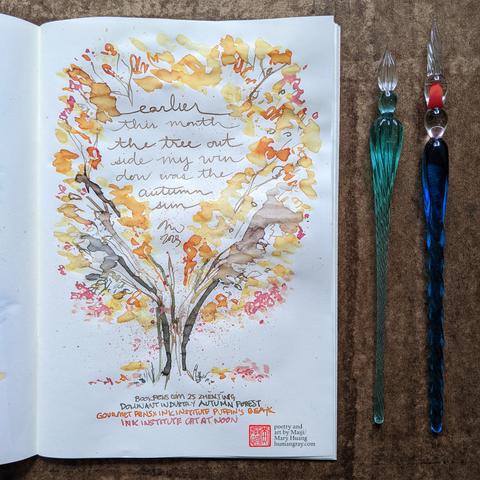
earlier this month
the tree outside my window
was the autumn sun

🍂 Commentary, wip photos, and ink palette used: https://www.pillowfort.social/posts/4028390
💧 Haiku Ink series: https://humangray.com/haiku-ink-series

#haiku #ink #FountainPenInk #poetry #MastoArt #CreativeToots #autumn #nature

maiji: autumn sun

[image set: A series of photos showing two haiku illustrated with ink, followed by closeup detail shots, swatches of the inks used, and work-in-progress photos. 1) Photo of open notebook next to two glass dip pens. The page shows a haiku written in vivid blue ink with layers of multicoloured clouds rendered in greys, blues, yellows, oranges and greens where the inks blend. 2) Similar photo of open notebook, with a page showing a haiku written in dark gold ink in the centre of a glowing tree rendered with trunk/branches and foliage of sepia, brown, yellow, orange, gold and fine splatters of ink. 3 and 4) Detailed closeups showing the shifting colours and glittering effects in the various inks used. 5 and 6) Two photos showing ink swatches laid out in neat rows next to a mini flashcard set being used as an swatchbook. 7 and 8) In-progress photos of early stages of the illustrations, where it is just the lines of poetry with a glass dip pen starting to rough out surrounding outlines of clouds or tree trunk/branches. Past the in-progress art is an open sketchbook with rough sketches, ink bottles, waterbrushes and other art supplies.] their underbelliesshining from the autumn sunclouds before bedtimeearlier this monththe tree outside my windowwas the autumn sun - Poetry and art by Maiji/Mary Huang, humangray.com It's a double feature for October's haiku!Initially I was cool to the kigo “autumn sun”. The immediate vibes when I read the phrase were "how nice... not evoking anything in particular" for me. But then something funny started happening. As I started writing, more and more haiku kept coming out. Every time I went out or looked around, there was another idea, another angle. In the end this ended up being probably the most prolific and diverse month of haiku ink to date! There were so many options and directions to choose from. So I ended up finalizing two, in recognition and celebration of the eventfulness of October.Both of these are actually different views from the same window. “Clouds before bedtime” was a moment I recall as being later in the day. It was still light outside - the sky was quite bright blue. I’d taken a break to do some eye stretches (looking at objects in the distance then gradually closer, looking left/right and up/down etc.), and turned my head to look out the window. That’s when I noticed: in between the high-rises, past the buildings, the clouds in the sky were flat and white - save for their undersides, which were shining gold. I’d never seen that before - or at least, I’d never noticed that I’d seen it before. For the cloud bellies, I picked an ink with a lovely gold glitter, making them sparkle when you tilt the page.“The tree outside my window” was the last poem written while reviewing everything near the end of the month. I noticed several poems talking about the brilliantly yellow leaves of the tree outside - which was by then almost completely bare. Hard to believe those poems had just been written a few weeks prior… While working on this piece, I discovered a new technique! I’ve always loved the flicking-a-brush textural effects you can get with paint. I discovered you can do the same thing with the ink on the grooves of a glass dip pen, using a waterbrush to flick them off!I like that in both of these haiku the autumn sun is not the star (metaphorically anyways, haha). Instead, it highlights (spotlights?) something else. What I also like is that these poems are by and large descriptions and observations of nature, but the presence of the observer as also participating in the scene through the act of observation being related to their (my) perspective - my window, my bedtime (though I suppose it could also be the clouds’ bedtime!) is quite palpable.Inks usedautumn sun (clouds before bedtime) Gourmet Pen x Ink Institute Puffin's Beak Eecks 031 Ink Institute Cat at Dusk PenBBS 279 Glimmers Through Still Water autumn sun (the tree outside my window) BookPensCom 25 Zhenjing Dominant Industry Autumn Forest Gourmet Pens x Ink Institute Puffin's Beak Ink Institute Cat at Noon

Pillowfort
@maiji Just wanted to say that I love this one too! The haiku and visuals make it easy to have the fiery colors of an autumn tree stay within the mind's eye. Beautiful work!
@chrystynenovack Thank you so much! It was definitely a bold sight and a great contrast to see/experience what was just outside my window in such a short period ☀️