 Craig
Craig Miguel de Icaza ᯅ🍉
The issue is that these developers wanted one thing (lower fees), but lobbied for “freedom of stores” and “external payment systems”
They got what they asked for, which is not what they wanted.
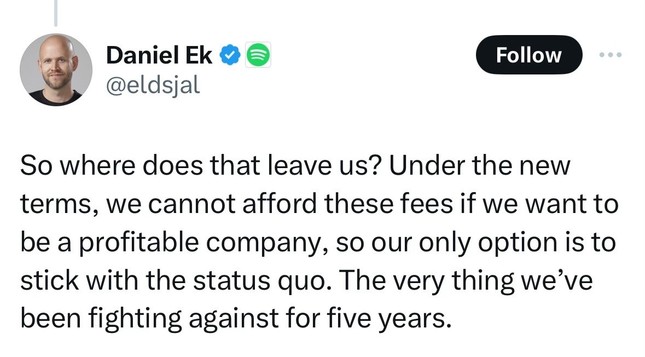
The issue is that these developers wanted one thing (lower fees), but lobbied for “freedom of stores” and “external payment systems”
They got what they asked for, which is not what they wanted.
@Migueldeicaza This isn't how it works. The problem with install-based fees isn't that it's too high. It's that it makes it generally impossible to make software at all. This is why it was rejected so completely with Unity.
An install fee means "with these terms, you're not going to release the software at all". It was how Unity used it (they didn't want you to pay the fee; they wanted you to use their ad network) and it's how Apple is using it (they don't want you to use an alt app store).
@BartWronski @mcc Unity were two issues: (a) pricing change; (b) effectively pricing was retroactive. People had to go back to the drawing boards and reevaluate their business model.
In this case, you don’t have to change the model. You put your projections on a spreadsheet and you figure out whether to keep your existing deal or opt into the new deal.
@mcc @Migueldeicaza
Also is very naive stating that "your specification was not precise, therefore you got what you wanted". In this case there's an imbalance of power between the large company that controls the app store and the devs.
No matter what people ask, a powerful player will be able to satisfy the requirements while making things even worse.
@mcc Apple is not doing an install fee per install they are doing a fee per user.
This is very common in the SDK space, you typicly pay up front for 10k users or 100k users when you license most SDKs.
@vicho no. I mean every vendor that is up in arms about closed platforms could have taken a stand years ago and said “we will nurture a fully open platform and desktop” and support AOSP, Linux desktop.
But they chased the money and the convenience.
And now they are crying.
@Migueldeicaza I'm hesitant to say they got anything. There's certainly not "freedom of stores" by any meaning of the word.
Would anyone accept it if Walmart had to approve everything on the tables in your local farmer's market? Or even the Whole Foods? Because we've got the software equivalent happening here.
@savaran that’s not what is going on. You can publish whatever you want in the EU now via other AppStore’s.
You do have to pay a fee to sell your goods in Walmarts parking lot though.
@overstrike @Migueldeicaza I’ve been miss understanding this. Would swear on my initial reading of the new rules at https://developer.apple.com/support/dma-and-apps-in-the-eu/#distribution-eu it said the CTF was only applicable for the new business terms on the App Store. But no, upon checking again this evening the CTF is ‘… and/or alternative app marketplace’.
Which, really is downright Unity like. wtf.
@Migueldeicaza I find it weird that the EU wasn't more specific about taxes or accepting apps.
They do regulate debit/credit cards interchange fees, and the DSA regulates content moderation on social media.
@Migueldeicaza Yep, I agree. I'm not saying it is (also because cards interchange is regulated at 0,30% maximum!)
But the EU already regulate other markets more specifically. They could've regulated a max 15% fee for gatekeepers and required app approvals to be transparent and appealable
They didn't regulated those, but just opened up the market (in hope EU companies can compete on them, I think)
@Sweepi by freedom of stores they wanted “we want to publish whatever without Apple approving”.
Apple has always been crystal clear they want a fee for using their work
@Sweepi excellent! Good job! Now read the rest and discuss with your lawyer!
Ciao!
@Migueldeicaza Spotify who gave a gazillion to Rogan and wasted money on attempting to rule podcasting?
Oh, yeah, Mr. Ek, it’s Apple that’s in the way of your profitability, which is a neat trick considering how well Android does in mobile and Windows on the desktop.
 mcc
mcc Louis Ingenthron
 phi1997
 Bart Wronski 🇺🇦🇵🇸
 Victor Bogado
 Matthaus Woolard
 Alvaro
 Mieszko Ślusarczyk
 Cory
Cory 
 piofthings
 Vicente Reyes
 savaran
 overstrike
 Dominic Hopton
 Bynkii
 Felipe Cepriano
 Sweepi
 Garrett Wollman
 Pomegranate County Irregulars
 Max Leibman has moved!
 Juan Tatay Galvany - silta 🔥
 Kristopher Browne
 donkey