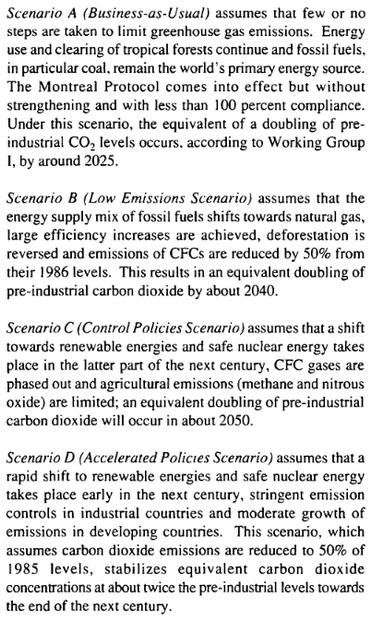
I opened the first IPCC report, released in 1990, and copied their scenario graph for CO2 emissions.

I marked the latest data with a red dot. Carbon dioxide emissions in 2023 were 40.7 GtCO2 (= 11.09 GtC).

Whatever you think about the IPCC you must admit their business-as-usual calculations were pretty robust.

Edit: previous version of this post also talked about methane, but here story is not as clear, see down below: https://mas.to/@jackofalltrades/111731258956894444

#ClimateChange #ClimateCrisis #Climate #IPCC

Jack of all trades (@[email protected])

@[email protected] As to methane, it's more complicated, and it seems I've made a mistake. IPCC 1992 Supplement (pages 10 and 30) says that annual emissions of CH4 amount to about 500 Mt, of which 60% is anthropogenic. That would give 300 Mt though, but their graph clearly has a value of about 370 Mt. Maybe they overestimated them in the 1990 report?
mas.to
@jackofalltrades there's nothing sadder than a long-term forecast that's right on the nose. It leaves the impression that folks were working to it as a target, instead of against it as a warning.
@jackofalltrades I think few things frustrate me more than how spot on we are on the "Business as usual". It's like we did nothing in the last 30 years! :D
@deepbluev7 @jackofalltrades Well, we dit nothing with any meaningful impact: all talk and symbols.
@jackofalltrades instead of working on eliminating methane emissions, especially fugitive methane emissions, we got a fracking boom instead. Thanks, O&G companies!

@jackofalltrades the alternative scenarios used in the early IPCC reporting were quite bad. Business-as-usual is just the null model. I would hope that the IPCC got that right.

What this shows is that we need better alternatives for the null model. And clearer pathways to implement them. Otherwise you'll open this figure again in 10 years and draw another red dot on the business-as-usual line. And we'll get more comments like "we're doomed. lolz".

@kta @jackofalltrades i find it really weird that the other scenarios in that report were more optimistic.

then again, we didn't have the idea of "tipping points", and maybe scientists were more optimistic about capitalism finding more creative ways to exploit and pollute, while putting governments into an arm-lock about restricting such tendencies.

@meena @kta

For the base scenario they assumed that economic growth would continue and will be fueled by fossil fuels. Something that is true to this day, see this whole thread: https://mas.to/@jackofalltrades/110793069634402306

For the other scenarios they assumed the economy would still grow, but with some parts of it running without generating emissions. How? It wasn't for them to say.

The alternatives are well understood, but nobody wants to give anything up: neither the common folk, nor the big governments.

Jack of all trades (@[email protected])

Attached: 1 image "For the time being, oil *is* the economy." - Nate Hagens https://youtu.be/-585aVUNz68 #ClimateChange #JustStopOil #economics #oil

mas.to

@jackofalltrades @meena -- We've given the old RCPs up. The new RCPs (which are more actionable) are so different, that we struggle with comparisons with predictions made against the older (AR4) RCPs (attached).

Regarding the alternative scenarios, I do think it's for us to say. All of us -- but climate scientists in particular -- need to play an active role in understanding and guiding the RCPs, so we can facilitate the transition away from fossil fuels.

https://www.nature.com/articles/nclimate1385

Global warming under old and new scenarios using IPCC climate sensitivity range estimates - Nature Climate Change

Models and scenarios on which climate projection are based vary between IPCC reports. To facilitate meaningful comparison, this study provides probabilistic climate projections for different scenarios in a single consistent framework, incorporating the overall consensus understanding of the uncertainty in climate sensitivity, and constrained by the observed historical warming.

Nature

@kta @meena

The way I understand it, the problem is not that we can't figure out what to do or that we're not clear about it, but that we don't want to do it. Methods of reducing emissions are known to anyone interested in the topic. Yet it took 28 climate summits for the world leaders to acknowledge the need to transition away from fossil fuels. Citizens are equally ambivalent.

@jackofalltrades @kta i am convinced that (the majority of) citizens would be less ambivalent about it, if the political leadership was clear on the what and the how.

But all the transition timelines communicated seem to be plans made for a dream world.

@meena @kta

Most people really don't know much about climate change mitigation: https://www.washingtonpost.com/climate-solutions/2023/08/28/climate-action-poll/

And even when they do know they don't care: https://mas.to/@jackofalltrades/110297602628375757

It's simply not high on their priority list: https://mas.to/@jackofalltrades/111704915705935413

What the leaders are doing comes out of that.

You’re doing it wrong: Recycling and other myths about tackling climate change

Most Americans think their actions can help fight climate change, but they’re not always right on which are the most effective, according to a Post/UMD poll.

The Washington Post

@jackofalltrades @kta of course saving the climate isn't high on my priority list, if I have to work hard (and harder still after covid) to pay rent, so I'm not directly exposed to climate change as it is happening outside this house.

and I'm sure that's the case for a lot of people.

it's a huge privilege to have the kind of time and energy to care about climate change, *before* it hits your house.

*that* is what I'm saying needs to change.

@meena @kta

The less money you have the less freedom you have to care about #ClimateChange, that's for sure.

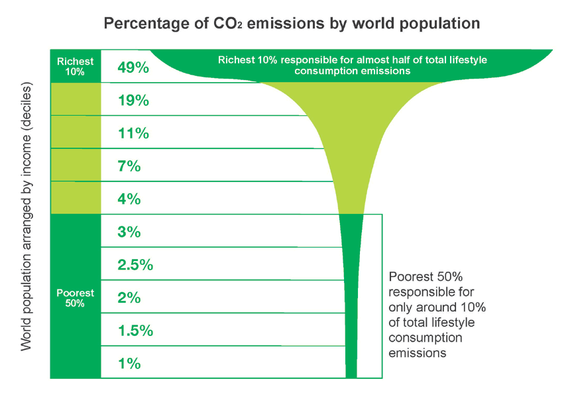
The good news is that the less money you have the less you are responsible for climate change, as well. See https://oxfamilibrary.openrepository.com/bitstream/handle/10546/582545/mb-extreme-carbon-inequality-021215-en.pdf#page=4

So when I'm saying that people don't care I don't mean the people that don't have the time and energy to care. I mean the people that do, and yet they choose to continue their high-energy consumerist lifestyles.

@jackofalltrades @meena this doesn't sound right. Climate policy analysts regularly poll the public to unpack sentiment on climate:

... Americans think global warming will harm future generations of people (71%), plant and animal species (70%), the world’s poor (69%), people in developing countries (68%), people in the United States (64%), people in their community (55%), or their family (52%). Many Americans also think they themselves (47%) will be harmed...

https://climatecommunication.yale.edu/publications/climate-change-in-the-american-mind-beliefs-attitudes-spring-2023/toc/2/

Climate Change in the American Mind: Beliefs and Attitudes, Spring 2023

Public understanding of global warming has increased since last fall.

Yale Program on Climate Change Communication

@jackofalltrades @meena ... About three in ten Americans (28%) say they look for information about solutions to global warming several times a year or more often...

... About two-thirds of Americans (66%) disagree with the statement “it’s already too late to do anything about global warming,” while only 13% agree...

I see people that believe we can do something about climate change and that want us to make progress on addressing it.

@jackofalltrades @meena -- my great fear is that the 28% of Americans that clearly care about climate change and want to do something about it will encounter some of the doom-scrolling messaging about climate change that gets posted on Mastodon, and disengage. Write the process off as hopeless. When it absolutely is not.

@kta @meena

I've seen these polls before and I long wondered how it is possible that the action on climate is so timid. Is it all due to capitalism, fossil propaganda and corrupt politicians? These things play a role, but I think there is a deeper reason.

Only once you combine results of your polls with the ones I listed that a fuller picture emerges.

To the majority climate change is happening, but is in the category of things that someone else should do something about, like the government.

@kta @meena

So sure, ask them if the government should do more about climate change and most will say yes.

But ask them what the government should prioritize and climate change will rarely be on the list of their top priorities, and definitely much lower than "the economy".

Worse still, ask them if they are willing to give up flying, fast food, fast fashion, big cars and other examples of wasteful consumption and you'll get an overwhelming disagreement.

@kta @meena

My greatest fear is that people won't wake the fuck up and the society will sleepwalk into a disaster, believing they can just recycle and slap a solar panel on their roofs and all will be dandy. And when the shit hits the fan they will beg for a strong leader, barbed wire on the borders and all that jazz.

Who am I kidding, all of this is already happening as we speak...

@jackofalltrades @meena "Climate change will rarely be on the list of top priorities, and definely lower than the economy."

* research citations needed, here. This is a cognitive bias unrelated to climate change research that we need to unpack. I don't see a people ignorant of climate change or it's impacts that needs "waking up". I see a population that doesn't know what to do. It's our job to help figure it out. And quickly.

@jackofalltrades @meena And to me, anthropogenic climate change and economics are the same thing. It's energy production used to power our global economy. If we can solve this, we will have solved the emissions problems causing climate change. That's what needs to be fixed. And we can do it, but we need to keep our eyes on the prize.

@kta @meena

I gave you links a few posts above, but for your convenience here's one poll from the US: https://mas.to/@jackofalltrades/111704915705935413 and here's another from the UK: https://yougov.co.uk/topics/society/trackers/the-most-important-issues-facing-the-country

This also matches my daily experiences. Almost everyone I know believes #ClimateChange is happening, but they'll still go on that international vacation. They know what to do, but they don't want to.

Jack of all trades (@[email protected])

Percent of U.S. adults who want the government to focus on #ClimateChange in 2024 dropped to 21% from 26% the year prior. https://apnews.com/article/2024-top-issues-poll-foreign-policy-israel-d89db59deb07f53382cc9292b49f4d1c I think an open-ended question like this is a better representation of the popular opinion, especially compared with a poll that asks if the government should do more about climate change. Only climate deniers would answer "no" to that. You can get closer to learning people's true values if you ask them to prioritize. https://www.pewresearch.org/science/2020/06/23/two-thirds-of-americans-think-government-should-do-more-on-climate/

mas.to

@kta @meena

To me climate change is just a symptom of a bigger problem of #overshoot. Without addressing overconsumption all the energy technologies we invent won't be enough to save our civilization from #collapse.

@jackofalltrades @kta @meena

This is because too many people are basically just struggling to survive until the next paycheck.

@freeformz @kta @meena

There are too many indeed, although they are not the majority that I'm talking about. I addressed this point here: https://mas.to/@jackofalltrades/111742638270429916

Jack of all trades (@[email protected])

Attached: 1 image @[email protected] @[email protected] The less money you have the less freedom you have to care about #ClimateChange, that's for sure. The good news is that the less money you have the less you are responsible for climate change, as well. See https://oxfamilibrary.openrepository.com/bitstream/handle/10546/582545/mb-extreme-carbon-inequality-021215-en.pdf#page=4 So when I'm saying that people don't care I don't mean the people that don't have the time and energy to care. I mean the people that do, and yet they choose to continue their high-energy consumerist lifestyles.

mas.to

Side note: I don't know if this is yet another way that the US is exceptional, but living paycheck to paycheck is a *very* broad category.

"""
Even households earning six figures may still be living paycheck to paycheck: 34% of respondents earning $100,001–150,000, 35% of those earning $150,001–200,000 and 39% of those earning $200,000 or more described themselves as not having money leftover after covering expenses.
"""

https://www.forbes.com/advisor/credit-cards/survey-living-paycheck-to-paycheck/

@freeformz @kta @meena

Survey: How Many Americans Are Living Paycheck To Paycheck?

Amid rocketing housing costs, rising inflation and other economic pressures, Americans are feeling the pinch. Wages don’t always increase in tandem with higher living costs, leading to a widespread trend of living paycheck to paycheck. A Forbes Advisor survey has taken a dive into Americans’ financial situations. An alarming two in five (40.7%) respondents reported […]

Forbes
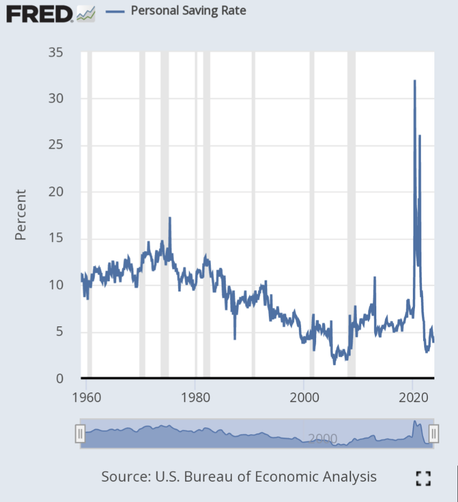
Personal Saving Rate

Graph and download economic data for Personal Saving Rate (PSAVERT) from Jan 1959 to Nov 2023 about savings, personal, rate, and USA.

@kta @jackofalltrades @meena

All true no doubt in my mind.

With that said, your posts talk about “giving up”, which of course folks won’t give up those things without there (a) there being some alternative to them; (b) actual govnement willing to tackle these issues.
(Speaking from my USA PoV anyway)

@freeformz @kta @meena

When someone earns more than $100k I'm sure there is plenty they could give up to lower their carbon footprint. The alternative is always there: consuming less. Waiting for the government to do something is a cop out in this case.

@jackofalltrades @kta @meena
I’m not saying we should wait for the government to do anything. I’m saying that for some things there aren’t workable alternatives atm and that we need systemic change NOW.

Reduce consumption- yes everyone should do that, especially the top 10 or 20 % (it me I guess).

But a lot of that is blaming individuals. We need systemic change, which is super slow w/o government intervention and I don’t think we have the time anymore for slow systemic changes.

@freeformz @kta @meena

Agreed, systemic change is what we need, not even on a national, but on a planetary level.

Which explains why we haven't gotten it yet. Big systemic changes are scary and most people prefer slow incremental changes. It's no surprise politicians and governments do the same (in addition to protecting the interests of capital).

So here we are. Our lives are comfortable enough, and if not it's because of "the economy". Climate change is far away in most people's minds.

@jackofalltrades @meena I promise that the global elite know that climate change is a thing. And most of them care. Sometimes deeply. But they don't know how to reduce emissions. There is no shutting things down. Their supply chains are not under their control. Their buildings are powered by natural gas. Factories by coal. Fleet vehicles by petro. Revenue by a broader global economy driven by fossil fuels. The only way to get these companies to change is by swapping out their engines, mid-flight
@kta @jackofalltrades and we might have to start with the economic engine driving it all.
@meena @jackofalltrades let me guess? Capitalism.
@meena @jackofalltrades We can get there, fellow worker. But that's a big rock to lift. And a big hill to push it up.

@jackofalltrades the scientific community didn't get any real engagement from policy folks. Even economists were on the fence about climate change back then. So the alternative scenarios were just kinda made up. They did the best they could with what they had.

The scenarios in the more recent iterations of the IPCC's work are better. But it still hasn't fixed the implementation gap.
https://www.nature.com/articles/s41558-023-01755-9

Taking stock of the implementation gap in climate policy - Nature Climate Change

A gap persists between the emissions reductions pledged by countries under the Paris Agreement and those resulting from their domestic policies. We argue that this gap in fact contains two parts: one in the policies that countries adopt, and the other in the outcomes that those policies achieve.

Nature
@jackofalltrades This is on us, by-the-way. We need to come up with technology and policy actions that drastically lower emissions. And militantly hold our politicians and business leaders collective feet to the fire.

@jackofalltrades Impressive!

If I'm reading the graphs right, we seem to be seeing somewhat less _warming_ than the 1990 report predicted.

The graph on page xxiii shows temperature rise above 1765. Drawing lines on the graph suggests about 0.45degC in 1950 and about 1.8degC in 2022. https://data.giss.nasa.gov/gistemp/graphs/graph_data/Global_Mean_Estimates_based_on_Land_and_Ocean_Data/graph.txt has a different baseline but their smoothed figures are -0.07 for 1950 and 0.90 for 2022, an increase of about 1degC versus the IPCC's prediction of 1.35degC.

(That puts present temperatures around the low end of where the Scenario B,C,D curves are in that graph, but I don't think it gives any reason to think e.g. that future trajectories are likely to show the downward curvature of Scenario D.)

For the avoidance of doubt, 1degC is plenty to be concerned about; I'm not trying to say "... so concern about climate change is all a scam" or any such nonsense. Nor am I suggesting that the IPCC were incompetent; on the page before that graph is another one showing just the business-as-usual scenario with "high", "best", "low" curves, and what we're seeing appears to be about half-way between "best" and "low". So it looks as if the IPCC made a decent estimate and a decent estimate of its uncertainty, and we got slightly lucky.

@gjm

Thank you for pointing that out, really interesting.

Between 1990 and 2020 temperatures have risen by 0.56°C, so 0.186°C per decade.

IPCC in 1990 estimated temperature increase of 0.3°C per decade (with an uncertainty range of 0.2°C to 0.5°C). The reason for this is because their models did not account for masking effect of aerosols.

I'm not sure if it's fair to call that "lucky". The warming potential is there, but hidden, for now at least.

@jackofalltrades interesting, what comes to my mind without reading the IPCC report: are we really on business as usual, as to the predictions of the report, or are effects even worse than predicted and little measures taken since then are just enough to fulfill the business as usual predictions?
@jackofalltrades As a physicist I usually get great satisfaction when pointing out correct predictions. In this case, not so much.
@jackofalltrades 33 years of climate "progress" as shown by the red dots. Good grief.

@jackofalltrades it is even worse, because we had in fact some activities to get carbon emissions to a lower level, or stopped the growth at least.

So the projection was conservative and reality could be even more bad now

@jackofalltrades apologies if I'm being dense, but can you help me understand the dots? I found the graphs on p61 of the overview.

I think I'm seeing reports of circa 37 billion tonnes of CO2/year right now, and even if that graph is just carbon, that's still almost 14 billion tonnes, no?

Also trying to square the methane emissions numbers: IEA says about 135m tonnes from energy sector, at 40% of all sources, so ca 337.5?

(This is where, hopefully, someone schools me and I am enlightened...)

@danlyke

Great questions, and of course, my pleasure.

Via Wikipedia: "Each part per million of CO2 in the atmosphere represents approximately 2.13 gigatonnes of carbon, or 7.82 gigatonnes of CO2." -- https://en.wikipedia.org/wiki/Carbon_dioxide_in_Earth%27s_atmosphere#Current_situation

The ratio is 1 gram of carbon equals 3.664 grams of CO2.

According to preliminary estimates, CO2 emissions in 2023 reached 40.7 gigatonnes of CO2: https://sustainability.stanford.edu/news/global-carbon-emissions-fossil-fuels-reached-record-high-2023

This equals to about 11 gigatonnes of carbon.

Carbon dioxide in Earth's atmosphere - Wikipedia

@danlyke

As to methane, it's more complicated, and it seems I've made a mistake.

IPCC 1992 Supplement (pages 10 and 30) says that annual emissions of CH4 amount to about 500 Mt, of which 60% is anthropogenic. That would give 300 Mt though, but their graph clearly has a value of about 370 Mt. Maybe they overestimated them in the 1990 report?

@danlyke

I took the 580 Mt value from IEA: https://www.iea.org/reports/global-methane-tracker-2023/understanding-methane-emissions but those are total emissions, of which man-made are only 60%, which would give the value of 348 Mt. That's my error.

If I placed the red dot on the graph as 348 Mt though it would look like they were flat, but that's not the case.

Since 1990 annual methane emissions have risen by roughly 20%, see https://www.nature.com/articles/s43247-023-00969-1/figures/2

The uncertainty ranges are quite big though, as CH4 emissions are harder to estimate than CO2.

Understanding methane emissions – Global Methane Tracker 2023 – Analysis - IEA

Global Methane Tracker 2023 - Analysis and key findings. A report by the International Energy Agency.

IEA
@jackofalltrades thanks. Don't know how I got my math wrong, I thought I was using (16*2+12)/12 as my Carbon to CO2 factor (close enough to your 3.664), but apparently not.
@jackofalltrades
Re your edit: thanks for explaining the edit :)
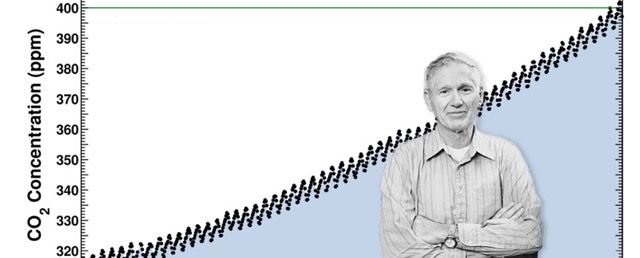
@jackofalltrades 40.7 GtCO2 = 5.215 ppm (conversion factor = 1/7.80432). The latest daily atmospheric CO2 reading, from the Keeling Curve (https://keelingcurve.ucsd.edu/), is 423.14 ppm. Add 5.215 ppm to that, & we shall have a CO2 level of 428.355 ppm by the end of this year. I hope that's wrong!
The Keeling Curve

The Keeling Curve is a daily record of global atmospheric carbon dioxide concentration maintained by Scripps Institution of Oceanography at UC San Diego.

The Keeling Curve

@rmblaber1956 Thankfully it is wrong, because Earth still has functioning carbon sinks.

In the last ten years the rate of growth of CO2 concentration in the atmosphere has been about 2.3 ppm per year. That is about 18 Gt of extra CO2 each year. The rest that humanity emits is absorbed by natural sinks: land and ocean.

However, functioning of these sinks cannot be taken for granted, see: https://mas.to/@jackofalltrades/111685740870238500

Jack of all trades (@[email protected])

@[email protected] "While carbon dioxide (CO2) emissions fell by 5.4% in 2020, the amount of CO2 in the atmosphere continued to grow at about the same rate as in preceding years. (...) The ocean didn’t absorb as much CO2 from the atmosphere as it has in recent years – probably in an unexpectedly rapid response to the reduced pressure of CO2 in the air at the ocean’s surface." ...wait, what? We reduced emissions, but the CO2 concentration kept rising at the same rate? Is this the end of the line?

mas.to
@jackofalltrades If it's 48% of it added to the atmosphere (see https://wmo.int/topics/greenhouse-gases), that would be 2.5032 ppm, which added to 423.14 ppm, gives 425.6432 ppm. That sounds rather more realistic, but not much more comforting, given what de la Vega, et al, (2020) have to say, see: https://www.nature.com/articles/s41598-%20020-67154-8.
Greenhouse gases

World Meteorological Organization
@jackofalltrades would be cool to see the whole historical trajectory, not just the most recent year
@jackofalltrades Very depressing:
Not only does it mean that, if we did nothing during the last 30 years, neither will we in the next 30.
But on top, as climate systems have an inertia of about 20 years, anything big we would do today will only have a stabilizing impact in 20 years.
+5°C here we go, with *cataclysmic* (I weigh my words) consequences for a very large share of mankind. What was presented as the worst case scenario is now the likely one.