The strain on scientific publishing šŸ“„:

The publishing sector has a problem. Scientists are overwhelmed, editors are overworked, special issue invitations are constant, research paper mills, article retractions, journal delistings… JUST WHAT IS GOING ON!?

Myself, pablo, @paolocrosetto and Dan have spent the last few months investigating just that.
https://arxiv.org/abs/2309.15884

A thread🧵1/n

#AcademicChatter #PublishOrPerish #Elsevier #Springer #MDPI #Wiley #Frontiers #PhDAdvice #PhDChat #SciComm

The strain on scientific publishing

Scientists are increasingly overwhelmed by the volume of articles being published. Total articles indexed in Scopus and Web of Science have grown exponentially in recent years; in 2022 the article total was approximately ~47% higher than in 2016, which has outpaced the limited growth - if any - in the number of practising scientists. Thus, publication workload per scientist (writing, reviewing, editing) has increased dramatically. We define this problem as the strain on scientific publishing. To analyse this strain, we present five data-driven metrics showing publisher growth, processing times, and citation behaviours. We draw these data from web scrapes, requests for data from publishers, and material that is freely available through publisher websites. Our findings are based on millions of papers produced by leading academic publishers. We find specific groups have disproportionately grown in their articles published per year, contributing to this strain. Some publishers enabled this growth by adopting a strategy of hosting special issues, which publish articles with reduced turnaround times. Given pressures on researchers to publish or perish to be competitive for funding applications, this strain was likely amplified by these offers to publish more articles. We also observed widespread year-over-year inflation of journal impact factors coinciding with this strain, which risks confusing quality signals. Such exponential growth cannot be sustained. The metrics we define here should enable this evolving conversation to reach actionable solutions to address the strain on scientific publishing.
arXiv.org

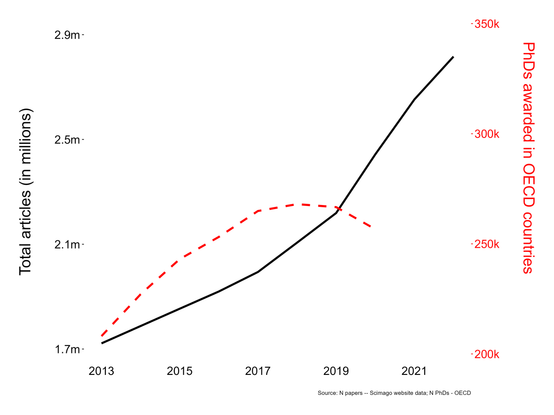
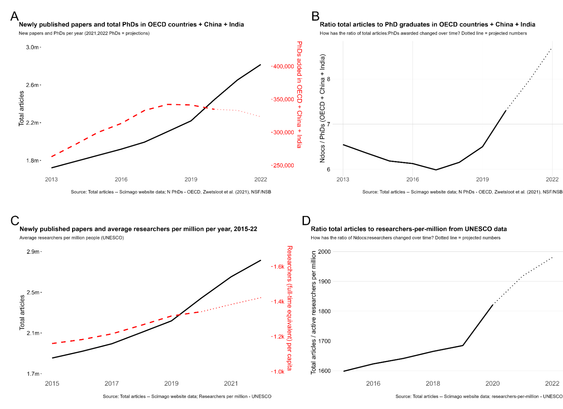
First, things first: growth in articles published each year has outpaced the scientists doing the publishing. With #PublishOrPerish, we all face an ever-increasing workload (writing, reviewing, editing…). It’s been rough.

Strain itself is neutral: this could be a welcome change! Are we becoming more efficient? Are we combatting biases (academic racism, positive result bias)?

If that’s all it were, the solution to strain would be to build a better infrastructure.

But… well… it’s not. 2/n

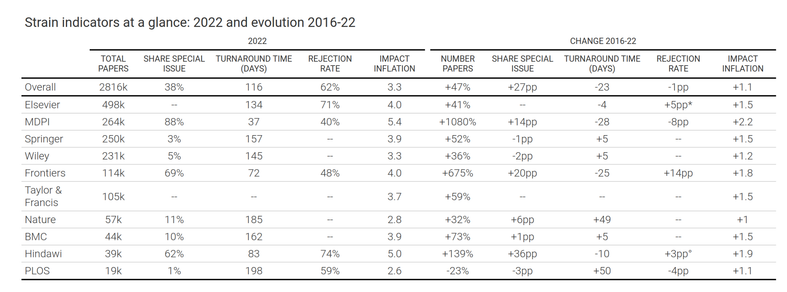
We see that certain groups are major drivers of this article growth, in some cases seemingly out of nothingness. This includes your classic publishers like #Elsevier and #Springer, but also the upstarts #Frontiers and… most significantly #MDPI.

In numbers, there were nearly 1 million more articles per year published in 2022 (2.8m) compared to 2016 (1.9m). MDPI takes the lion’s share at 27% of that growth, with Elsevier (16%) a distant 2nd.

How did we get to this point? 3/n

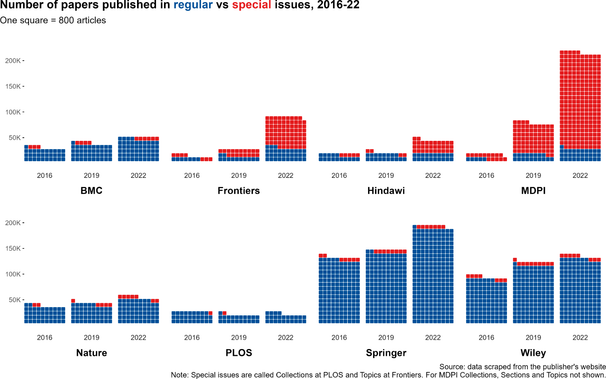
I could be nuanced (it's in the preprint!). But let’s be frank: it’s special issues.

ā€œDear Dr ___, your preeminent work in [FIELDYOUDONTWORKIN] drew our attention to your [COPYPASTEPAPERTITLE] and we were thoroughly aroused. We invite you to submit to special issue with us, who love your preeminence. Yours faithfully, [AROUSED].ā€

The figure speaks for itself. With my leftover characters, instead I wanna ask y’all to send me screenshots of your favourite SI invitations! Hit me! šŸ˜€ 4/n

So still… is it worth it? Strain itself is neutral. Maybe these special issues are just giving a voice to authors with less privilege?

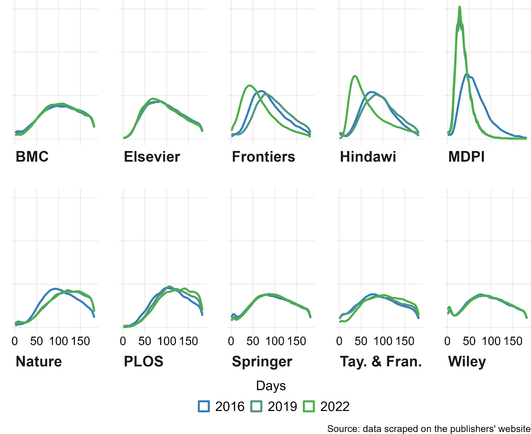
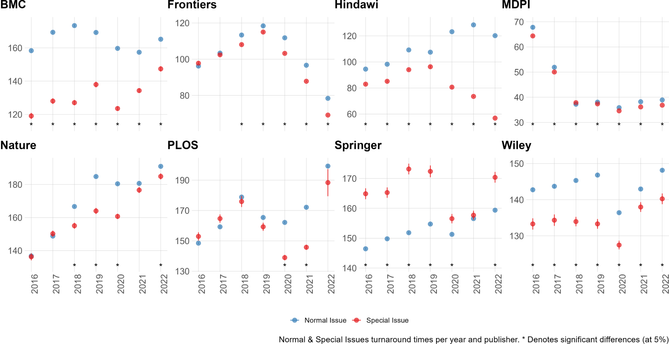
Or maybe not. The publishers hosting special issues drastically reduced their turnaround times (TATs: submission to acceptance) - and let’s be clear, that’s INCLUDING revisions. 5/n

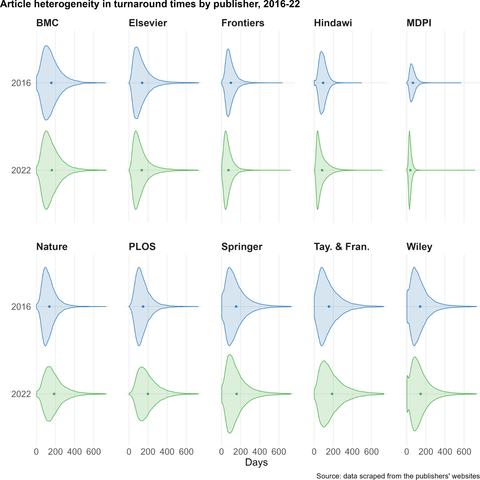
Now, it’s not our place to judge what an average TAT is supposed to be, but we’re very confident it’s not 37 days across all research fields. Experiment requests in fruit flies take weeks, whereas mice will take months.

TATs are also supposed to vary from article to article: some articles are great on 1st draft, some need a little TLC, and some need… a lot… Yet #MDPI journals in particular, across the board, accept everything in a blistering 37 days with almost no variation. 6/n

But it’s not just #MDPI: #Frontiers and #Hindawi also grew their share of special issues. One might argue: ā€œThese are just labels publishers use. The peer review process is the same.ā€

Au contraire mon ami : no it’s not. Special issues have lower TATs. They’re intended to be lax. They’re for authors to voice ideas that could turn out to be wrong, but advance the conversation in the field. That’s what they used to be at least… and what made them ā€œspecial.ā€ But I digress… 7/n

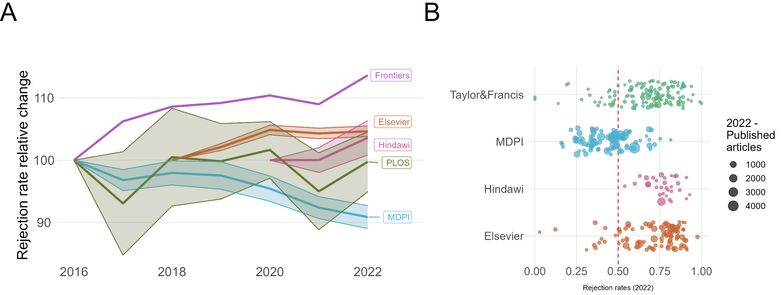
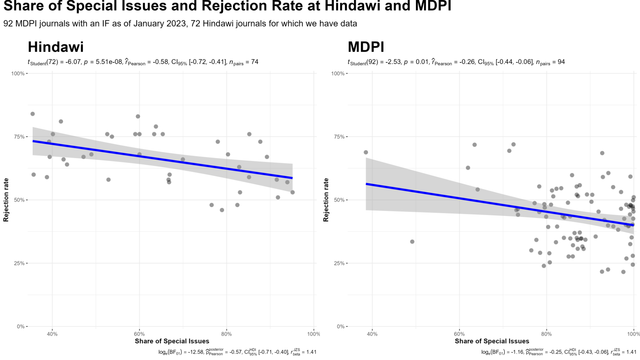
We also looked at rejection rates (RRs), with some caveats: we took a publisher’s word at what their RRs were, and don’t know underlying methods. But we figured RRs will at least be calc’d consistently within groups. We compared relative RRs over time and RRs compared to proportions of special issues.

Again, #MDPI was the maverick, with a unique decline in RRs over time. Not only that, but in both #Hindawi & MDPI, more special issues means lower RRs. The review process *is not* the same. 8/n

@MarkHanson

Indeed, there's a flagrant conflict of interest: each paper accepted pays APCs, each paper rejected costs time and money to handle and pays nothing.

For journals to be honest, they should charge for submission to acknowledge the processing cost – presumably a smaller sum than current APCs – or not charge at all: decouple income from accepting papers.

#ScientificPublishing

@albertcardona @MarkHanson that would be even worse! It would just reverse the incentive not get rid of it, and lead to even more wasted time from scientists (an externality as far as publishers economics are concerned).

@neuralreckoning @MarkHanson

Was talking about community journals. For-profit journals shouldn't exist to begin with.

@albertcardona @MarkHanson society journals have the same problem. They often fund the operations of the society including the annual meeting, etc.

@neuralreckoning @MarkHanson

That is indeed true. Hiding costs of other events and activities in the article processing charge.

@albertcardona @neuralreckoning @MarkHanson I’m old enough to remember when JNeurosi had a submission fee. It wasn’t particularly well-received šŸ˜‚

@schoppik @neuralreckoning @MarkHanson

If they said, here is a submission fee, but if accepted there's no acceptance fee, would it have been received the same way?

The one issue with submission fees is that it would reduce the number of submissions, which at the limit would match that of acceptances. I doubt this would happen though, particularly for glamour journals were submissions can feel like buying a lottery ticket.

#ScientificPublishing

@albertcardona @neuralreckoning @MarkHanson I don’t follow — do you mean an acceptance fee in addition to publication charges?

@schoppik @albertcardona @neuralreckoning @MarkHanson

What exactly was the logic for that? I never really understood it.

@tdverstynen @albertcardona @neuralreckoning @MarkHanson "Before the implementation of the submission fee, peer review costs had been borne only by authors whose manuscripts were accepted, and the fee was a way to allocate them across the entirety of manuscripts that used the review process." https://www.jneurosci.org/content/37/9/2267
No Submission Fee for SfN Members

The Journal of Neuroscience is committed to the peer review process and for many years the Journal has had a submission fee that helps defray the cost of that review. The fee partially covers the costs of staff time, editorial effort and technological infrastructure. Before the implementation of the

Journal of Neuroscience

@tdverstynen @albertcardona @neuralreckoning @MarkHanson

The point stated in the editorial stands, independent of the assets of the society: the cost of processing rejected papers is borne entirely by authors whose papers are accepted.

I also don't really understand the implied bit of "SfN is rich and so should implement my priorities." $70M is a lot, but <10% of that is liquid, and it's not really enough to buffer 3-5 bad years. Data here, your projections may differ https://www.sfn.org/-/media/SfN/Documents/NEW-SfN/About/Annual-Report/Consolidated-Financial-Statements/SFN-Consolidated-2022-FS.pdf

@schoppik @albertcardona @neuralreckoning @MarkHanson
but SfN is rich enough to have investments in the Cayman Islands
Has the Society for Neuroscience lost its way?

The tl;dr version: The Society for Neuroscience (SfN) makes humongous amounts of money from its journal and meetings, but spends very little...

@deevybee

Thank you, that was a very interesting read. What an accurate picture of the Society for Neuroscience.

Having paid the membership from my pocket for 2-3 years after having attended SfN once, I realized it was a racket. Serving its own interests and not at all mine or those of any practicing neuroscientists, at least not the junior ones and much less if outside the US.

@schoppik @neuralreckoning @MarkHanson

@albertcardona @deevybee @schoppik @neuralreckoning fwoo. I wonder just how many societies are really small for-profit companies in sheep's clothing. I know of societies people are critical of, but usually for reasons like "they hold extravagant meetings fora clique of members." Not "they like building mountains of money."

@MarkHanson @albertcardona @deevybee @schoppik @neuralreckoning

Table 1 in this paper contains a few randomly selected examples (including SfN):

https://royalsocietypublishing.org/doi/10.1098/rsos.230207

It can get much, much worse than SfN! Cough - ACS - cough

@brembs @albertcardona @deevybee @schoppik @neuralreckoning
I'll admit, I have looked at ACS data in our dataset plenty, and I knew their acronym stood for "American Chemical Society," but I hadn't thought of them as an Academic Society until now. My brain just imputed society as a 'buzzword' in their case, because they were so vastly different from other societies in our dataset. šŸ˜…

@MarkHanson @albertcardona @deevybee @schoppik @neuralreckoning

A SINO? 🤣

But generally: are societies that derive the overwhelming part of their revenue from publishing, side with publishers against scholarship and put financials over mission still societies?

@brembs @albertcardona @deevybee @schoppik @neuralreckoning the default setting in my brain apparently never even considered the case for it!
@brembs @albertcardona @schoppik @neuralreckoning Many thanks Bjorn - this had passed me by - fascinating analysis

@deevybee @albertcardona @schoppik @neuralreckoning

I have something along these lines coming up on the LSE blog in the coming days...

@neuralreckoning @MarkHanson yes, the Society has made some indefensible mistakes @deevybee . But @albertcardona consider this proposition please: without the Society, there’s no Decade of the Brain, no doubling of the NIH budget, and JFRC isn’t focused on neuro that first decade. I acknowledge it is unknowable but perhaps it’s worth considering. Edited to add this link for some historical perspective https://www.sfn.org/-/media/SfN/Documents/NEW-SfN/About/HofSfN/SfN_50YearBook.pdf

@schoppik @neuralreckoning @deevybee @albertcardona
it's also a weird case when there's basically wealth hoarding. At any time, that could be reversed, and suddenly it would be great! For a time at least. And that's the curious rub... any sort of wealth accumulation is all about the timeframe it takes place in, and extends for.

None of this is advocating for/against SfN, just a curiousity of forces in the world and how to view them.

@schoppik

Thanks, and interesting thought. Haven't yet heard about the link between the society and JFRC. As far as I know the pivot from malaria research to neuroscience before opening its doors had to do with the Gates Foundation announcing their focus on neglected tropical diseases at the time of JFRC's preparatory meetings to choose the focus of the whole institute, and the influence of early advisors to the directorship such as Brenner and Borst.

@neuralreckoning @MarkHanson @deevybee

@albertcardona @neuralreckoning @MarkHanson @deevybee oh absolutely -- it's not the proximal cause by any means. I submit that the reason neuroscience was on the table as a candidate -- and that there were so many compelling group leaders -- was the foundation laid a decade or two earlier. Again, impossible to know for sure, but worth considering.
@schoppik @MarkHanson @deevybee @albertcardona I find it hard to have many positive feelings about the society for neuroscience. As a theorist, I'm treated as a second class citizen (common with most neuroscience orgs though). As a European, I feel like I'm paying for an org that mostly lobbies for US-based neuroscientists, which feels unfair. In general, it seems to be an org that supports the model of gating access to participation in science behind the ability to pay, which feels like exactly the opposite of what we should be doing as a scientific community.

@neuralreckoning @schoppik @MarkHanson @deevybee @albertcardona

Those are all very hard-hitting arguments that are difficult to disagree with.

My own little "civil disobedience" has been (for almost ten years before the pandemic) to crash their lavish all-you-can eat/drink presidential reception.

And now to write the "Mastodon over Mammon" article.

And yet, the meeting itself is still my favorite one.

@brembs @neuralreckoning @schoppik @MarkHanson @deevybee @albertcardona

"My own little "civil disobedience" has been (for almost ten years before the pandemic) to crash their lavish all-you-can eat/drink presidential reception."

Dare I said this sounds very Drosophilist šŸŖ°šŸŖ°šŸŖ°šŸŖ°šŸ‰šŸ‘šŸŠšŸ„­šŸšŸŒ

The fediverse is an opportunity learned societies can’t ignore

Just as social media has become ubiquitous in academia, its established formats and dynamics have been brought into doubt. Bjƶrn Brembs argues that learned societies concerned with their core missi…

Impact of Social Sciences

@neuralreckoning
I went to the thing for my first time this year. It was cool for lots of people to be there, but that was basically it - I wandered around trying to see stuff but gave up and just spent most of my time trying to see friends I hadn't seen in awhile/had only ever met online. Folks came around to my poster but mostly those that I already knew or were already on board. Hard to justify the like $2000 it cost to go all told. Doubt ill go again until I have something I like want to put in ppls hands and can get in a booth or smth.

Too big. Felt weird. Dont like the politics of "one big corporate nonprofit." Did manage to see a vendor zapping their own brain with a TMS machine which was a highlight.

@jonny I don't know if it's a consolation or not but your $400 registration fee probably more than covered an hour's salary for the CEO. Probably not two hours though.