Don't miss this one ⤵️​. A wide-ranging and provocative conversation covering disparate issues like: How do we balance accuracy versus breadth as scientists? Why should we read a book written in 1897? When is a paw a hand? And should scientists cede the term "dopamine" to the pop-psychologists?

Exactly the type of thing I love about the furry elephant.

https://neuromatch.social/@NicoleCRust/111012453557938392

Nicole Rust (@[email protected])

On jargon - is it useful? Is it necessary and useful for scientists to say "mnemonic" to refer to "memory" and "affect" to talk about "emotion"? In other words, given that everyone understand emotion and mood and no one really understands what "affect" is until you are really deep into things, why is the term affect useful and important at all? And should we reserve it for deep dives (as opposed to public facing websites and such)? And does anyone call themselves an "emotion researcher?" or a "mood researcher?" @PessoaBrain @[email protected]
Neuromatch Social
@NicoleCRust
What an incredible discussion!

@NicoleCRust @brembs @DrYohanJohn @WorldImagining

Sorry if I'm not including everyone here.

I think we need more jargon in neuroscience (mind/brain).

Couple of examples. Examine the mess that is the debate about "consciousness" because (in part) so many senses are mixed, including "sentience", "awareness", etc.

Or the fact that we use basically folk psychological terms all the time. So even if qualify what I mean by attention* in one of my papers, using a term that is used in a dozen ways will surely lead to confusion.

Our mind/brain field is highly technical, but the language surprisingly accessible to most people. That's a problem not because we want to be "distinguished professors" but because of the complete terminological confusion we inhabit!

I couldn't read all the discussion, so apologies if this was already discussed and debunked... 🙂

#neuroscience

@PessoaBrain @NicoleCRust @brembs @DrYohanJohn @WorldImagining do people working in the field agree on all the required terms with the required specificity? Or is this an ongoing matter of debate that would need to be settled first?

@mrcompletely @PessoaBrain @NicoleCRust @brembs @WorldImagining

Terminological debates never get settled in biology! ;)

And neuroscience is very very far from something like an IUPAC system.

I'm speculating, but it seems like successful review/theory papers often end up popularizing new terms. Popular textbooks have done this too, but perhaps in the internet era things are different. A sociologist of science might have data on such dynamics.

@PessoaBrain @NicoleCRust @brembs @DrYohanJohn @WorldImagining

oh man, this is so related to the blog I read this morning! What's the name for that effect where you see something one place then suddenly everywhere?

I think more jargon leads to more silos in the literature, we certainly need a discipline wide set of standards... but first we probably need a massive ontology of all existing terms and their approximate synonyms (and the joyous task of noting the overlapping ones of course)!

@PessoaBrain @NicoleCRust @brembs @DrYohanJohn @WorldImagining

Opinion…

Rare:
A term sucks from the get-go.
Theorists pluck ill-suited term out of thin air and it suffers “survival of the fittest.”

Typical:
A term doesn’t age gracefully.
As findings roll in and theory advances, it becomes clear that a term can no longer provide its intended service. A maturing theory might need to shed a term, or competing terms have emerged, or theorists perceive a need for new differentiating terminology.

@PessoaBrain @NicoleCRust @brembs @DrYohanJohn @WorldImagining

Also:

A theorist with a wider view (across disciplines, perhaps) might envision eventual benefits of using an underdog term.

Example:
School-based educators like the term “engagement” because it readily lends itself to observation *and* facilitates professional communication, but the more psychological term “motivation” could open the door for educators to more fully embrace/apply a high-potential idea such as “self-regulation.”

@PessoaBrain @NicoleCRust @brembs @DrYohanJohn
Some counter-examples from fields where terms do have strict definitions yet use words which also have a wide range of everyday meanings (i.e. are not "jargon" per se): mass, power, gravity, element, compound, volume...

I think it's useful to reflect on how *unproblematic* the technical use of these terms is as opposed to, say, "consciousness" or "attention." The problem then reduces to an absence of strict definitions more than to polysemy.

@PessoaBrain @NicoleCRust @brembs @DrYohanJohn In other words, we shouldn't avoid using certain terms in science on the basis that they already have common everyday meanings. We should consider avoiding certain terms in science on the basis that they don't yet have a strict scientific definition conducive to rigorous delimitation of inquiry/investigation. I believe the nuance between these two reasons is worth bearing in mind.

@WorldImagining @PessoaBrain @NicoleCRust @brembs

I think physical concepts like mass etc aren't fraught with all the cultural baggage of psychological terms. Few people have strong opinions on what "volume" means, but many have some notion of what "emotion", "thinking", or "attention" mean.

The case of "representation" is exemplary and doesn't bode well: people who explicitly disavow a symbolic Fodorian notion of representation have to endlessly reassert this when Gibsonians are around. 😅

@DrYohanJohn @WorldImagining @PessoaBrain @NicoleCRust @brembs

related diffs btwn fields I learned:

» I have a chemistry brain and a physics brain, and they will never meet each other, they will never happen at the same time...
...
and what I'm thinking of pH with my chemistry brain I think about H plus as a hydrogen ion...

if if I'm thinking about it with my physics brain I'm like that's a proton «

by watching a cool #scicomm debunking video by @acollierastro

~1:36
https://youtu.be/rBQhdO2UxaQ?t=96

alkaline water ...with lemon

YouTube

@DrYohanJohn @PessoaBrain @NicoleCRust @brembs Cultural and *affective* baggage to be precise 😅 It's a very good angle to raise, although any, perhaps all scientific concepts are (putatively) equally fraught with affective baggage until an empirical demonstration-based consensus is reached. Mass incl., back in its own days of ontological dispute a century or so ago. And no need to recall disputes around heliocentrism.

So are psychological terms really a special case? Or just still in dispute?

@WorldImagining @PessoaBrain @NicoleCRust @brembs

My immediate reaction is that "equally" can never be accurate. :P

@DrYohanJohn @PessoaBrain @NicoleCRust @brembs Doubly glad I went back and stuck that (putatively) in now! 😅

@WorldImagining @DrYohanJohn @PessoaBrain @NicoleCRust @brembs

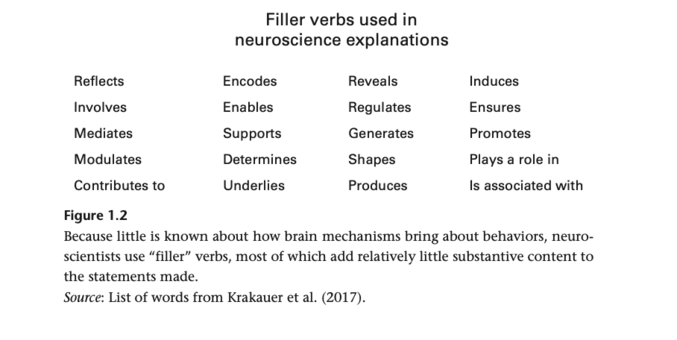
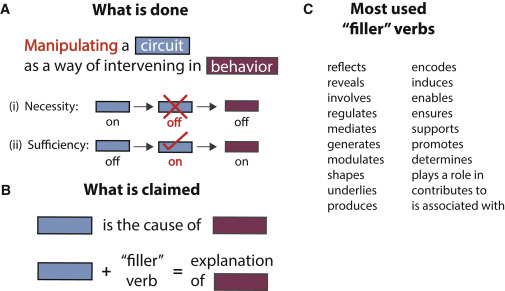
how related #EntangledBrain starting ch.1 citing:
List of words from Krakauer et al. (2017)

» Because little is known about how brain mechanisms bring about behaviors, neuroscientists use "filler" verbs, most of which add relatively little substantive content to the statements made. «

ps: having ESL I just wrote unconsciously ‚conscience’ non-stoping.. until.. Luiz politely made me notice: never again ;)
https://www.thoughtco.com/conscience-conscious-and-consciousness-1692727.

Conscience, Conscious, and Consciousness: What's the Difference?

Master the difference between these commonly confused words, which look similar but have dramatically distinct definitions

ThoughtCo

@knutson_brain @WorldImagining @DrYohanJohn @PessoaBrain @NicoleCRust @brembs
hehe TY now I had to lookup: open & didn't expect these fine quotes:

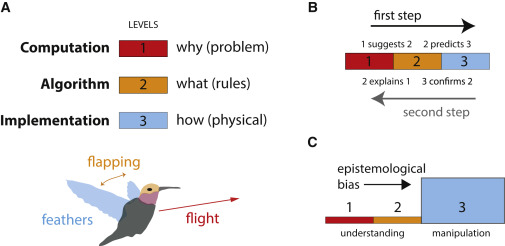
“…trying to understand perception by understanding neurons is like trying to understand a bird’s flight by studying only feathers. It just cannot be done”
(Marr, 1982/2010)

“Behavioral experiments often are a necessary first step before a subsequent mutually beneficial knowledge loop is set up between implementation and behavioral level work.”

1/3

@knutson_brain @WorldImagining @DrYohanJohn @PessoaBrain @NicoleCRust @brembs

” Modeling and studying the responses of the neural substrate on any scale—large or small—will not

*by itself*

lead to insights about how behavior is generated.

One reason for this is that the properties of neural tissue may be more diverse than the subset actually exploited for natural behaviors “

2/3

@knutson_brain @WorldImagining @DrYohanJohn @PessoaBrain @NicoleCRust @brembs
(Jonas and Kording, 2017)
”we referred to earlier provides an empirical demonstration of the fundamental difference between intervening and recording versus understanding how information flows through processing steps”

(Woese, 2004)
”science is driven by both technological advances and a guiding vision.”

”behavioral work provides understanding, whereas neural interventions test causality”
https://doi.org/10.1016/j.neuron.2016.12.041
/3

@knutson_brain @WorldImagining @DrYohanJohn @PessoaBrain @NicoleCRust @brembs

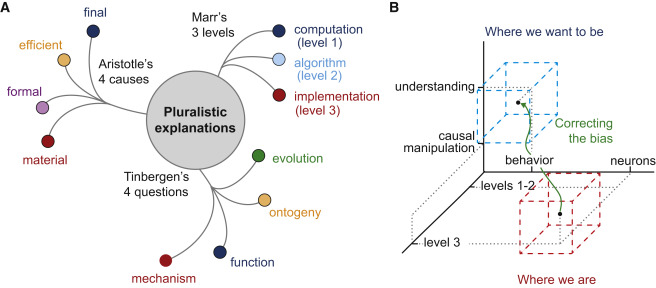
IMHO also cool standing critique & conceptualizations to think about in these two figs:

open paper:
https://doi.org/10.1016/j.neuron.2016.12.041

4/3

@teixi @knutson_brain @DrYohanJohn @PessoaBrain @NicoleCRust @brembs I know most of these papers, all very interesting. Though I'm not clear on which particular point (as there are many!) in the above discussion you're aiming your posts at..?

@WorldImagining @knutson_brain @DrYohanJohn @PessoaBrain @NicoleCRust @brembs

Fig 3 a b
unexpected discovery to me because not only applies to the neuroscience interventionist!

IMHO also applies for some critique for nowadays ai training datasets as modeling real inference hype!

from the refs: more Andersons that I didn't know ;)

#1 More Is Different:
Broken symmetry and the nature of the hierarchical structure of science.

#2 anderson perhaps listened in podcast?

do you recom other refs?

@teixi @WorldImagining @DrYohanJohn @PessoaBrain @NicoleCRust @brembs so neurobehavioral work provides understanding of causality? (strong, but I like it)

@knutson_brain @WorldImagining @DrYohanJohn @PessoaBrain @NicoleCRust @brembs

conclusion in abstract, not in finale:

“we argue that study of the neural implementation of behavior is best investigated after such behavioral work.
Thus, we advocate a more pluralistic notion of neuroscience when it comes to the brain-behavior relationship: behavioral work provides understanding, whereas neural interventions test causality“

difficult to get from their behavior interventionists critique

¯\_(ツ)_/¯

@NicoleCRust We don't need more jargon if it would cause us to spend more time stuck in semantic arguments.

I get that it can be fun to argue whether the brain computes, or what a representation is, or whether a hot dog is a sandwich, but most of these arguments boil down to folks having different intuitions for the meanings of these words. If we were more in the habit of enumerating definitions explicitly before assessing/applying them, a lot of this would go away.

@NicoleCRust It would be pity to add more jargon if all we did was argue about its definitional boundaries.