The #ClimateCrisis will make the 2008 mortgage crisis look like a walk in the park. With ice cream.

" Rising seas, bigger #floods, and other increasing #climate hazards have created a dangerous instability in the U.S. financial system. "

That, on top of developers building in flood plains and wildfire-prone places, and the US government providing the #insurance.

#ClimateChangeIsTheLastStraw
https://yaleclimateconnections.org/2023/04/bubble-trouble-climate-change-is-creating-a-huge-and-growing-u-s-real-estate-bubble/

Bubble trouble: Climate change is creating a huge and growing U.S. real estate bubble

Rising seas, increased flood risks, and other increasing climate hazards have created a dangerous instability in the U.S. financial system.

Yale Climate Connections

#HomeInsurance premiums are in the five figures: this is #insurance companies telling you, in their language of premiums, that you're living in a vulnerable place.

"I've heard of #premiums for residences in Lismore being $15,000. It's just not reasonable," Katschke says.

But is IS reasonable, if you consider how high the risk is of losing the entire home. Calling it unreasonable is a form of #ClimateDenial.

https://www.abc.net.au/news/2023-04-12/government-involvement-disaster-insurance-protect-australians/102167338

The government needs to get involved in disaster insurance to protect more Australians, says this expert

Disaster insurance is likely to become less accessible in the future. One economist says the solution could be government intervention.

ABC News
Citing climate change risks, Farmers is latest insurer to exit Florida

The move comes as insurance companies drop coverage in California, Louisiana and other states hit by disasters and high reconstruction costs.

The Washington Post

"Since most #US #insurance companies are backed by international #reinsurance companies that cover other parts of the world, #homeowners everywhere will pay the price for #ClimateChange’s global effects."

https://www.vox.com/climate/2023/7/13/23792409/floods-vermont-new-york-natural-disaster-insurance-global-climate-risk-change

Vermont’s floods, China’s heat wave: How global climate disasters are raising insurance rates

Without local knowledge and infrastructure for unusual floods, fires, and storms, climate risks are becoming increasingly expensive.

Vox

DeSantis:
"Knock on wood."
Followed by:
"Thoughts and prayers" ??

"#Florida’s #insurance crisis: #DeSantis says ‘knock on wood’ during #hurricane season.
Insurers will return to Florida after hurricane season, DeSantis says"

"The governor said last year that #CitizensInsurance was unfortunately undercapitalized and that the company could go belly up if they actually had to weather a storm."

https://www.news4jax.com/news/local/2023/07/13/floridas-insurance-crisis-desantis-tells-floridians-to-knock-on-wood-during-hurricane-season/

Florida’s insurance crisis: DeSantis says ‘knock on wood’ during hurricane season

Gov. DeSantis is also making news after addressing the topic, on a conservative talk show, where DeSantis is urging patience and hoping for no hurricanes this season.

WJXT News4JAX

"If people can't get #Insurance, they can't get #mortgages."

States cap #InsurancePremiums, so insurers pull out - but the truth is that homeowners could not afford the premiums it would take for the insurers to stay. (This is why no insurer covers #flooding).

States should also not be the "insurer of last resort" because that burden - the burden that no insurance company will bear - would just fall on the taxpayer.

It's going to be a huge mess.

https://www.npr.org/2023/07/22/1186540332/how-climate-change-could-cause-a-home-insurance-meltdown

Some places had homes built there before they *became* vulnerable. But also:

"In the future, stopping development in the riskiest areas is ultimately part of the solution to rising insurance losses, experts say.

But for now, restricting development isn't popular with most politicians."

Because every new property brings in new property taxes.

https://www.npr.org/2023/07/22/1186540332/how-climate-change-could-cause-a-home-insurance-meltdown

Here is an interview with the CEO of a #Louisiana #insurance company. Of their $ 445 M loss since Katrina, 90% is covered by re-insurance (but the re-insurance premiums have skyrocketed). And Louisiana has a cap on homeowners' #premiums.

As in Florida, there is the Louisiana Citizens Insurance (where the taxpayer bears the risk).

Basically they're all just praying for a quiet #hurricane season. Meanwhile the Gulf is like a hot tub.

Sounds precarious.

https://www.audacy.com/wwl/news/local/whats-behind-skyrocketing-home-insurance-in-louisiana

The knock-on effects are far-reaching in time and space:

"UPC has not given a reason for pulling out of #Hawaii, but according to property #insurance legal blogs the company took a financial hit after #HurricaneIke hit #Texas and has struggled to bounce back."
That was in 2008.

https://www.hawaiinewsnow.com/2023/07/28/major-insurance-carrier-announces-withdrawal-state-leaving-policy-holders-dust/

Major insurance carrier to withdraw from state, leaving policy holders in limbo

Universal Property and Casualty (UPC) says it will no longer offer homeowners, condominium and renters insurance in Hawaii.

Hawaii News Now

And yet
"Almost 400,000 more people moved into than out of the most #flood-prone counties in 2021 and 2022. Same for counties vulnerable to #wildfires and heat.

Consumer-rights group Public Citizen says buyers deserve access to average #HomeInsurance prices by ZIP code over time, which would show where insurers believe risks are spiking and whether they’re paying inflated rates. But insurance companies have blocked such efforts, saying the information is proprietary."

https://www.bloomberg.com/news/articles/2023-07-27/homebuyers-ignore-risk-of-climate-change-insurance-meltdown

Homebuyers Ignore Risk of Climate Change Insurance Meltdown

As major underwriters abandon vulnerable states, people keep moving into danger zones.

Bloomberg

#Arkansas:

"According to QuoteWizard, there has been $59 billion worth of natural disasters statewide in the last 20 years, and now people are just cutting [#HomeInsurance coverage] where they can.

“It has gone up so high now people are just having to knock it to the bare minimum,” Kelly said.

Kelly stressed this is a dangerous game because if something does happen to these people, they’re basically out of luck."

https://www.kait8.com/2023/07/26/homeowner-insurance-rates-continue-rise-arkansas/

Homeowner insurance rates continue to rise in Arkansas

With the average rate for homeowners’ insurance premiums reaching $3,000 a year in Arkansas, some people are struggling to afford their payments.

KAIT

"Yellen said it’s necessary for FSOC to examine how these shifts may affect the wider financial system.

#FSOC, established after the global financial crisis to identify and address systemic vulnerabilities in the #US financial system, includes the heads of the Treasury Department, Federal Reserve, Federal Deposit Insurance Corp. and Securities and Exchange Commission, among other regulators."

https://fortune.com/2023/07/30/janet-yellen-protection-gap-insurance-climate-change-disasters-treasury-secretary/

Janet Yellen sees a ‘protection gap’ between insurance and climate change—just 60% of 2020’s $165 billion in losses got covered

Just 60% out of the $165 billion in climate-related losses were covered in 2020.

Fortune

"Besides the impact of #ClimateChange, land use planning in more exposed coastal and riverine areas, and urban sprawl into the wilderness, generate a hard-to-revert combination of high value exposure in higher risk environments. Protective measures need to be taken for insurance products to remain economical for such properties at high risk. It is high time to invest in more climate adaption."

https://www.swissre.com/press-release/Severe-thunderstorms-account-for-up-to-70-of-all-insured-natural-catastrophe-losses-in-first-half-of-2023-Swiss-Re-Institute-estimates/cea79f3c-6486-41a8-9c6e-09df260efe30

Severe thunderstorms account for up to 70% of all insured natural catastrophe losses in first half of 2023, Swiss Re Institute estimates | Swiss Re

Severe thunderstorms account for up to 70% of all insured natural catastrophe losses in first half of 2023, Swiss Re Institute estimates

"Dave Burt, one of the “Big Short” investors who correctly anticipated chaos in the US #SubprimeMortgage market in the 2000s, said #InsurancPremiums for wildfire protection were just $1.5bn in 2021; damages were six times bigger. A move by insurers to close that gap could result in a drop of up to $495bn in property values, he said."

This entire article is, as it says, a "discomfort blanket", sketching out the ways various sectors can be devastated by #ClimateChange.

https://www.ft.com/content/899472a8-e5e2-4fde-bc91-7e548ba35294

Lex in depth: how investors are underpricing climate risks

The costs of inaction on global warming are potentially vast and often not sufficiently factored in to asset values

"Prices for #reinsurance rose as much as 40 percent on Jan. 1 from a year earlier, according to a report by Gallagher Re, a brokerage firm that puts together reinsurance coverage deals. The price increases jolted insurers, who then made changes to where and for what they offered coverage."

This makes home insurance more expensive for all of us, even if we don't live in vulnerable places.

https://www.nytimes.com/2023/08/16/business/reinsurance-global-crises.html

How a Small Group of Firms Changed the Math for Insuring Against Natural Disasters

Climate change, inflation and global instability have thrust companies that sell insurance to insurers into the spotlight.

The New York Times

" If the continuing risk of fires, hurricanes, and other weather-related disasters isn’t enough to make Americans think carefully about how and where to build a #home, perhaps the rising cost of #insurance might concentrate their mind. Yet policies at all levels of government suppress the signal that insurers are sending. "

https://www.theatlantic.com/ideas/archive/2023/08/home-insurance-costs-wildfires-floods-weather/675141/

What Your Insurer Is Trying to Tell You About Climate Change

Insurers are trying to send a message. The government is trying to suppress it.

The Atlantic

"#HurricaneIdalia could become the costliest #CimateDisaster to hit the #US this year, analysts say, with massive implications for #insurance and risk management industries."

“The business of insuring for catastrophes used to mean exceptional, very rare events and that’s not what we’re seeing. These are much more common, so something’s got to change.”

https://www.theguardian.com/us-news/2023/aug/31/hurricane-idalia-cost-update-category-3-florida-georgia

Hurricane Idalia could become 2023’s costliest climate disaster for the US

Analysts estimate the category 3 storm has already racked up a preliminary cost of $9.36bn, straining the insurance industry

The Guardian

"In the #US, the increases [in insurance premiums] are so savage that some homeowners are giving up on #insurance altogether, the Wall Street Journal reported this week. Less than one in five Floridians have #FloodProtection.

#Climate, macroeconomics and politics are besieging this corner of the financial sector."

https://www.bloomberg.com/opinion/articles/2023-08-31/climate-hurricanes-inflation-create-a-perfect-storm-for-insurers?

Climate: Hurricanes, Inflation Create a Perfect Storm for Insurers

Climate, macroeconomics and politics are besieging this corner of the financial sector.

Bloomberg

"At least five large #US property insurers — including #Allstate, #AmericanFamily, #Nationwide, #ErieInsurance Group and #BerkshireHathaway — have told regulators that #ExtremeWeather patterns caused by #ClimateChange have led them to stop writing coverages in some regions, exclude protections from various weather events and raise monthly #premiums and #deductibles."

https://www.washingtonpost.com/business/2023/09/03/natural-disaster-climate-insurance/

Home insurers cut natural disasters from policies as climate risks grow

Major insurers say they will cut out damage caused by hurricanes, wind and hail from policies underwriting property along coastlines and in wildfire country.

The Washington Post

"For the billionaires and mere multimillionaires who have flocked to places like South #Florida, a five- and six-figure [#HomeInsurance] policy, while costly, won’t break the bank.

The result: an acceleration of #ClimateGentrification. Increasingly, only the affluent will be able to afford to insure themselves against the #ExtremeWeather, #floods and #wildfires on our warming planet. People of more modest means will simply be priced out, industry experts say."

https://www.bloomberg.com/news/articles/2023-09-07/ultra-wealthy-miami-homeowners-see-insurance-costs-top-600-000-a-year

Ultra Wealthy Miami Homeowners See Insurance Costs Top $600,000 A Year

Insurance premiums are soaring as climate risk grows, pricing everyone but the wealthy out of some coastal areas.

Bloomberg

"Reeling from four hurricanes in 2020 & 2021 that caused $23 billion in damage, #Louisiana is undergoing an #insurance calamity that is harming the state’s economy and even reducing its population."

“If you look at where the costs end up, some monstrous proportion of the city would be unable to reasonably afford #FloodInsurance,” said Feldbaum. “And not by a small margin, but where it's just completely beyond the average households’ ability to pay the average #premium.”

https://www.bloomberg.com/news/articles/2023-09-11/louisiana-insurance-market-in-crisis-from-climate-fueled-storms

Louisiana Insurance Market In Crisis From Climate-Fueled Storms

Damages from hurricanes have pushed insurers to close their doors or hike rates, forcing some residents to move out of state.

Bloomberg

This is now hitting the mainstream news.

"Morse said she put her house on the market for a year, but it didn't sell — a failure she ascribes to the recent rise in mortgage rates as well as her insurer withdrawing from her region. "

#HomeInsurance #ClimateChange
https://www.cbsnews.com/news/insurance-policy-california-florida-uninsurable-climate-change-first-street/

Homes in parts of the U.S. are "essentially uninsurable" due to rising climate change risks

Extreme weather is spurring some insurers to exit states like California and Florida, while homeowners grapple with surging premiums.

CBS News

"First Street estimates that 39 million #US #homes are insured at artificially suppressed prices compared with the risk they actually face. Of those, nearly 6.8 million homes are covered by state-backed “insurer of last resort” policies.

But as the number of disasters and the related damages keep rising, they predict, the #insurance market will undergo a major adjustment and rates will surge, popping what the nonprofit calls a #ClimateInsuranceBubble."

https://www.bloomberg.com/news/articles/2023-09-20/us-home-insurance-bubble-closer-to-popping-as-climate-risks-mount

US Home Insurance ‘Bubble’ Closer to Popping as Climate Risks Mount

Premiums kept artificially low don’t factor in rising danger from wildfires, floods and storms, making the market overdue for a correction.

Bloomberg

"His agency also wants to more accurately price at-risk homes and encourage residents to better harden and protect them from #wildfires, and squelch the rapid growth of #California’s FAIR plan, which, as Lara said Thursday, has become the “first resort, not last resort” for many residents."

#HomeInsurance rates will go way up in California, and especially so for vulnerable homes. I hope they keep the equity issue in mind while crafting this policy.

https://www.washingtonpost.com/climate-environment/2023/09/21/california-insurance-risks-fire-climate/

California plans big insurance shifts as climate change hits home

The actions of the nation’s biggest state could have implications for U.S. consumers, as more carriers leave disaster-prone states.

The Washington Post

"The cost of #hurricanes has grown as more people move to coastal areas that are more at #risk from hurricanes."

The risk to growing #populations and #development in storm-prone areas “really matters,” Junge told Bloomberg. "I am not sure people are really aware of how much this is a problem."

https://themessenger.com/business/climate-change-population-growth-worsen-the-cost-of-hurricanes

Climate Change, Population Growth Worsen the Cost of Hurricanes

As oceans heat up, hurricanes are becoming more frequent

The Messenger

Insurance does not cover all the damage:

"While #hurricanes and the recent Tropical Storm #Ophelia grab headlines due to the number of those impacted, smaller, more localized #storms are on the rise and are also causing significant damage where they land.

Tucker said the cost to clean up the trees in her yard alone was about $35,000, which her #HomeownersInsurance did not cover because the trees didn’t damage her house."

https://whyy.org/articles/climate-change-causing-more-damaging-storms-rising-insurance-rates-delaware-valley/

Climate change is causing more damaging ‘mid-size’ storms. Insurers are taking notice

Storm damage is on the rise. Here’s what that means for homeowners in the Delaware Valley.

WHYY

#ClimateChange has barely started being reflected in insurance claims and the price of #HomeInsurance.

"The prediction suggests that a sharp rise in home and property #insurance prices, which has already created an #affordability crisis for households and businesses in at-risk areas, has yet further to go."

This will contribute to
#ClimateInflation

https://www.ft.com/content/44cc0731-e863-468a-a6b7-f55e4d28e90d

Lloyd’s of London warns insurers climate-related pain is still to come

Executive at the insurance market has called for ‘urgent’ investment in risk modelling

Financial Times

" #Texas #HomeInsurance rates have increased 22% on average so far in 2023, twice the national rate. More billion-dollar disasters have occurred in Texas this year than any other year on record. "

https://www.texastribune.org/2023/11/30/texas-homeowner-insurance-climate-change-costs/

Climate change, costly disasters sent Texas homeowner insurance rates skyrocketing this year

Texas rates have increased 22% on average so far in 2023, twice the national rate. More billion-dollar disasters have occurred in Texas this year than any other year on record.

The Texas Tribune

"About 3.2 million Americans have moved due to the mounting risk of flooding, the First Street Foundation said in a report that focuses on so-called "#ClimateAbandonment areas," or locations where the local population fell between 2000 and 2020 because of risks linked to #ClimateChange.

Across the U.S., nearly 36 million properties — one-quarter of all U.S. real estate — face rising #insurance prices and reduced coverage due to high climate risks."

https://www.cbsnews.com/news/climate-change-america-3-million-migrants-first-street-nature/

About 3 million Americans are already "climate migrants," analysis finds. Here's where they left.

Communities across the U.S. are facing greater risks from extreme weather. Some are already seeing their population shrink.

The couple in this story got a non-renewal on their #HomeInsurance. That crimps their property value by 17%. They got an offer for an insurance rate six times that of the old one. But also they can't sell their house as a mortgage requires home insurance.

https://www.cnbc.com/2024/02/05/what-homeowners-need-to-know-as-insurers-leave-high-risk-climate-areas.html

If their mortgage is paid off they might stay put, quietly living there without insurance. Until one day disaster hits and they find themselves without a home or a nest egg.

The uninsurable world: what climate change is costing homeowners

"Rising premiums are a de facto ‘carbon price’ on consumers as extreme weather events become more frequent."

On the growth of taxpayer-backed insurance, the risks to bank credit, and growing friction between #insurance companies wanting to make a profit and governments wanting to protect homeowners from spiraling insurance costs.

https://www.ft.com/content/ed3a1bb9-e329-4e18-89de-9db90eaadc0b

The uninsurable world: what climate change is costing homeowners

Rising premiums are a de facto ‘carbon price’ on consumers as extreme weather events become more frequent

Let's connect the dots:

There is a housing crisis.
NYMBYs fight in-fill and taller housing.
Developers build in unsafe places like flood plains, wildland-urban interface places.
Housing is cheaper there.
Climate change brings floods / wildfires
That cheaper housing is more vulnerable.
It's a climate real estate bubble.

"The crash could be especially detrimental for lower-income homeowners, many of whom hold the vast majority of their net worth in their home value."

https://www.natlawreview.com/article/climate-bubble-real-estate-and-extreme-weather

The Climate Bubble: Real Estate and Extreme Weather

Last year, the U.S. experienced 28 confirmed billion-dollar weather events, the most on record since the National Centers for Environmental Information began re

National Law Review

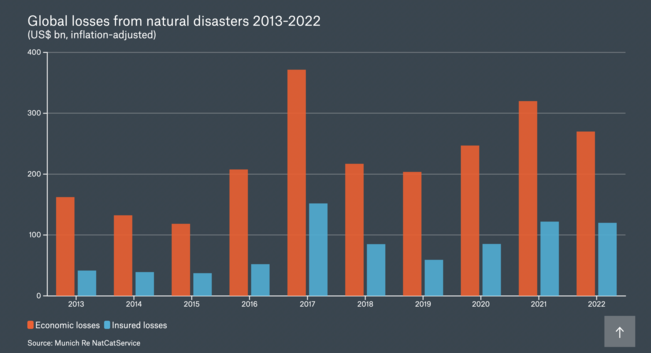
In every year of the past ten years, only a third to a half of losses of extreme weather disasters was insured.

Of the majority of the losses, the uninsured part, would that hit the poor more, or the rich? </sarc>
😥

https://www.munichre.com/en/risks/natural-disasters.html

Natural disaster risks - Rising trend in losses | Munich Re

Each year, natural disasters destroy assets worth billions of dollars. Research indicates: weather disasters are already being influenced by climate change

Here it starts:
Many #Florida home sellers are "#motivated"—meaning they would accept lower offers from buyers to sell quickly.

"One reason homeowners might be willing to sell despite the less than ideal market conditions is the high insurance rates in the state, which have risen dramatically in the past few years.

Home insurance in 2023 was about $6,000, according to Triple-I—the highest premium in the country."

(But not a word about climate change)

https://www.newsweek.com/florida-homeowners-desperately-trying-move-out-1874173

Florida Homeowners Are Desperately Trying to Move Out

One reason Florida homeowners might be willing to sell despite the less than ideal market conditions might be the high insurance rates in the state.

Newsweek
@CelloMomOnCars This year, my HOA has been rejected by 38 insurance companies. We simply don't know whether or not we will have insurance for the coming year for the townhome exteriors. Utilities should crank that into their analysis of whether to go 100 per cent zero carbon,

@tmstreet

Wow!!
That's ... pretty concerning.

Is there something the HOA can do to mitigate the risk the insurers deem uninsurable?

@CelloMomOnCars So far, it appears mitigation is not an option as they just lump us in with the general danger of the Estes Valley.

@tmstreet

That sounds really terrible.
Does this mean that the entire town is having a hard time getting insurance?

@CelloMomOnCars No. I don't think this generally applies to single family homes or complexes with a lot less structures. We are the largest townhouse complex in Estes so I think it is a function of taking on that level of risk. This was also an issue for another condo complex in Estes and they ended up insuring each home on an individual basis. We might have to end up doing something along those lines.

@tmstreet

I am so sorry you have to go through this, and worry about the trend, and how even more people will simply be unable to afford owning a home.

@CelloMomOnCars Thank you. Hopefully, something can be worked out.
@CelloMomOnCars What an epic thread this is. You are cataloguing a metastasizing crisis of unimaginable consequence in real time. Amazing vigilance and work on your part.

@Staggaly

Thanks. It's good to see this covered in the mainstream news, finally. I suspect that even those of us who have their eyes on this, will still be blindsided by the magnitude of the issue. 😥

@CelloMomOnCars My 2024 premium just came in at 22% above 2023.

I'm thinking of shopping for an insurer that can do a more 'personalized' assessment of the property. My part of the neighborhood is on high ground, there's no realistic scenario where we face flooding from climate, and I don't feel like subsidizing my neighbors down the hill if it's gonna add this much to the cost.

@DarcMoughty

Part of the increase on your premium is because your insurer - any insurer - need re-insurance. In the face of increasing climate disasters, re-insurers have upped the premiums they charge insurers, and part of that gets passed on to you, whether or not your home is vulnerable.

Don't like the rising insurance premiums? Vote for people who are serious about climate action, and make them do it.

@CelloMomOnCars Where will the service workers live? We certainly know the ultra-wealthy cannot mow their own lawns…

This is tongue in cheek but it does point to a larger issue with the gentrification. Yes, you can house your own groundskeepers but these folks rely on service workers for much more than just the lawn. Isolation will bring a new set of problems.

@CelloMomOnCars I have been saying for years that if you want proof of #ClimateChange, look to #insurance companies, who don’t have the luxury of denial.