 Collin York
 Glenn Fleishman
"The Tragedy of the Commons" was written by a eugenicist and was effectively debunked as ahistorical fantasy decades ago. More propaganda in the service of privatizing public space and resources. Pass it on. https://blogs.scientificamerican.com/voices/the-tragedy-of-the-tragedy-of-the-commons/

 Chris White finds this vexing
@glennf sigh, didn’t know that. Thanks for this!
@stoneymonster Lotta people make money citing debunked theories!
 Brian Dear
@glennf Thanks. Really interesting.
The essay also, rightly I think, mentions how responding to the planetwide emergency requires a response rivalling that not seen since WWII, something I’ve been thinking about lately too. A level of mobilization, focus, and sacrifice at all levels of society as well as industry. Drop what you’re building/doing and build/do this instead. Author Kim Stanley Robinson addresses much of this in the must-read MINISTRY FOR THE FUTURE.
 yeet_da_rich
@brianstorms @glennf none of this will be solved with the existing systems. Go out and disrupt them.
 Deb has moved! (see profile) 🇨🇦
@brianstorms @glennf LOL. Just put a hold on the book you mention. I'm 156th in line :-)
I loved (and re-read) his Mars trilogy. It was also thought-provoking re: shaping the environment.
I loved (and re-read) his Mars trilogy. It was also thought-provoking re: shaping the environment.
 Mike McGraw
@glennf
A professor of environmental science explains that we need to “make room in the lifeboat” for everyone in order to begin to effectively counter climate change.
A professor of environmental science explains that we need to “make room in the lifeboat” for everyone in order to begin to effectively counter climate change.
 AccordionBruce
@glennf
I had always assumed “The Tragedy of The Commons” was classic economic theory back to Adam Smith or something
Shocked to see it dated to the year I was born, hiding it’s racist footnotes all my life!
#environmentalism #eugenics #immigration #economics #ScientificAmerican
 Kathy E. Gill 🇺🇦
Unless you have read Adam Smith, if you are American you probably have a skewed vision of his work.
He opposed monopolies, for example.
Here’s HBR on the tragedy of the commons:
https://online.hbs.edu/blog/post/tragedy-of-the-commons-impact-on-sustainability-issues

@kegill
I have a vague impression as a non-economist who has read a bit that “Capitalists have warped Adam Smith”
So as a naturalized dual Canadian–American I’m with you ✍️
I mostly meant, “as old as Adam Smith”
I’m no expert, but however old his theories are, I expect they are older than me (1968, same as this Tragedy of the Commons rubbish apparently 🚮 )
Lol!
Yes. Modern political rhetoric has bastardized Adam Smith!
The article, Tragedy of the Commons, may have issues regarding arguments about populations. (I do not study population growth.)
However, the economic basis of an argument about the challenges of commons is sound. And far older than Hardin.
Plus (repeating myself) the ad hominem nature of the article Glenn shared is quite objectionable, especially given the publication.
 Phil Rees
@AccordionBruce @glennf The idea does go back to William Forster Lloyd in 1833. Harding just came up with a label that stuck.
The real tragedies are that many of our politicians have aligned themselves with Harding's "Lifeboat Ethics" and that we've let them.
 Psittacus cafeina
It was part of Lockean theory, but there served less obviously a racist program and more a bourgeois one, justifying the enclosure of the commons to private use and the transformation of peasants into proles
 Voline
 ninavizz
 Pauline von Hellermann
Yes - the real tragedy is the #TragedyOfTheNONCommons !
I wrote this piece about this a while back. Must read the one posted here now, too
https://medium.com/@p.vonhellermann/the-tragedy-of-the-non-commons-4bfad884cdbe

"The law locks up the man or woman
Who steals the goose from off the common,
But lets the greater felon loose
Who steals the common from the goose."
(Part of 18th century poem by Anonymous)

 Stan Schymanski
@glennf I was there was something like a "super-boost" button! Thanks for sharing this incredible article!
 Dallman Ross
@glennf I read this. I have to say I'm disappointed Mildenberger fails to distinguish between a scurrilous author and his thesis. What kind of a person — or creep — Hardin was is not much related to whether his thesis has teeth. What his motives were or what the motives are today of Nazis or eugenicists or whomever who use the thesis to selfish advantage does not speak to whether the thesis has teeth. It's like saying trains shouldn't run on time, because Mussolini wanted them to run on time.
 Jeremy D. Goodwin // JDG
@spamless @glennf Your response sounds like the response of someone who has not read the article he is criticizing.
@JeremyDGoodwin @glennf I said I read it, and I read it. Yes, of course not everything people do with a commons is destructive. I don't think the thesis claims that is so.
Yes, of course plenty of people have good intentions and motivations. I don't think the thesis claims no one does.
@JeremyDGoodwin @glennf I don't have a full-length article on the Scientific American Blog Network to respond in, or the time to do that anyway. I had 500 characters. I used 496, I think. I cut some stuff out that didn't fit. I was left with the hope that the underpinning thought would come through.
 DB Schwein
@spamless @JeremyDGoodwin @glennf
Your first ~225 words focus on separating the author from his work, and sadness that this article didn't do that. Which, of course, it did...pretty early on.
It seems like someone who only has 500 words wouldn't waste 50% on something easily debunked.
@deirdrebeth @JeremyDGoodwin @glennf I don't have 500 words. I have 500 *characters*. Mastodon, or my instance of it at least, is still microblogging. I disagree with your claim. The whole weight and tenor of his piece was to instruct us on what a scumbag the author and his sympathizers were and are.
 wb x64
@spamless @glennf commons were almost always managed in some way though, they were stolen from the commoners via Enclosure a few hundred years ago, one of the precursors of capitalists carving up every bit of land for their profit. The idea that private ownership prevents land use tragedies is kinda false on its face.
@wilbr @glennf Already in feudal England at the time Middle English was emerging following a linguistic nadir for English under the long shadow of the Norman Conquest, various English kings took vast areas of the King's Forests for their private, privileged hunting grounds and forbade the "depletion" of game by (hungry) peasants. Thus, well before "a few hundred years ago" or any whiff of capitalism.
In no way am I arguing for private ownership as the fix or as a viable alternative to commons.
 Solar Pierre
@glennf thinking of commons we should havein mindn Nobel Prize laureate Elinor Ostrom: https://www.cambridge.org/core/books/governing-the-commons/A8BB63BC4A1433A50A3FB92EDBBB97D5

@glennf Informationen in deutsch zu Elinor Ostrom und Allmenden: https://www.bpb.de/shop/zeitschriften/apuz/33204/elinor-ostrom-und-die-wiederentdeckung-der-allmende/
 moondog548
@glennf outstanding, ACTIONABLE, information. Thank you!
 rubes
rubes@glennf Honestly the good news is that the current generation can learn who Hardin really was. I was taught that Hardin was a xenophobic white nationalist who believed that if you help poor people it takes away from natural selection.
 Admin
Admin@glennf it's a bit more complex than this, as it's a real thing inside capitalism, and we do all live inside capitalism so it's a real thing. For it not to be a real thing, you will need t change the human world to live in a different economic syteam to capitalism - this is a challenge.
So functualy it is a real thing that we encounter in most alternatives. best to keep this in mind when building alts #KISS
#OMN#indymediaback #OGB #visionontv etc :)
 Mendie


 AT-AT Assault 🏳️⚧️
Honestly, I still think the general idea is right on the money. What you have to take into consideration is, an asshole wrote this. He correctly predicts/Projects how assholes would ruin things. And guess what the capitalists that control the world are?
 Daniel Hakimi
@glennf Well, more like, it is relevant economic theory, but only when viewed on a grid of the theoretical extremes of rivalrousness and excludability, which also expounds on the cases where many goods should or can be public goods. And then you have to realize that rivalry is a more complex concept in reality, and that excludability is better thought of in terms of exclusion *costs* rather than *possibility*, and then think of externalities and social cost, to really make sense of the concept.
Rivalry and excludability are not theoretical extremes. Modern example in the US: most Interstate highways. The challenge of not managing that commons is obvious during rush hour.
I don’t see how externalities play into a public good unless you mean that no one personally bears the cost of degradation.
@kegill @glennf I'm confused. A highway is a great example of something that's somewhat rival (two people van use it just as easily as one, but as traffic increases beyond a certain point, each new car starts to reduce others' enjoyment of the highway) and excludable given an excludability cost (setting up toll booths and slowing traffic) and social cost (externality) (as more cars drive longer distances faster, they damage the environment). Are you *trying* to make my point for me?
Your post framed the commons as a “extreme” theoretical concept.
Public goods (aka “a commons”) are rival and NON-excludable.
Interstates without tolls are public goods. So are public parks; national forests. The oceans. The air.
I5 in Seattle from about 3:30-6:30, M-F, of a commons w/a tiny bit of theoretical management. The risk of a ticket when violating the car pool lane is only a mild deterrent More people want to use the commons than its capacity.
@kegill @glennf Interstates are excludable. Didn't we just talk about how interstates are excludable? Didn't *you* just acknowledge how interstates are excludable, by taking the time to specify that we weren't excluding people from this one.
I also pointed out that framing interstates as non-rivalrous is a dramatic oversimplification. They have limited capacity, and as more people drive on them, not only does a safe speed decrease, but accident rates increase and wear and tear increases.
No.
Interstates that have no tolls are NOT excludable.
They are, however, rival.
As is any public good for which there are no barriers to use.
@kegill @glennf I think you're confusing "excludable" with "exclusive." Excludable doesn't mean that there are barriers, it means that we are cabable of building barriers. Hence the -able. The classic example is national defense. I can't stop a bomb from landing on my house but let the bomb land on my neighbor's house because he didn't pay. We can't stop an invasion for me but not for him. The military can serve us all or serve none of us. We have no clear mechanism for exclusion.
@kegill @glennf The theoretical extremes on the grid are absolute rivalry or free and absolute excludability or absolute non-rivalry or absolute non-excludability. The grid shows simple divisions between public, private, common, and club goods. The complications come when we realize things like the private and social costs of excludability, and have to choose whether or not we exclude; see Free vs Proprietary software, and software patents versus non-patented inventions.
The air and the oceans are commons, owned by no “one.
Clean air and water do not happen without management.
I don’t see them as “extremes”.
And yes I know the grid.
Good lord.
Water quality.
Air quality.
Over fishing.
Externalities are a hallmark of these public goods and the reason we have fishing (and hunting) licenses. The Clean Water Act. The Clean Air Act.
I managed comms for the 1st greenfield dairy plant built in PA post CWA. My master’s degree is in econ. I have intimate familiarity with CWA in multiple states.
But I don’t mouth off about law as though I were a lawyer.
@kegill @glennf you have, during this conversation, confidently confused public goods and common goods. I've studied enough economics to know the difference. I don't know or care where you got your Master's from. Listing a bunch of common and public goods doesn't change the definition of excludability.
@DanHakimi @kegill Hello! please include me out of future replies
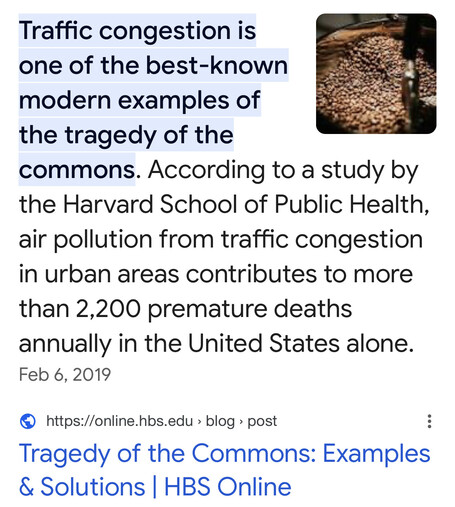
Traffic is example of tragedy of the commons.
1. Public roads are public goods
2. It’s not possible to prevent a licensed driver and vehicle from driving on a public road. Note there are two management tools in that sentence.
3. Air pollution is a result (negative externality = tragedy)
4. Gridlock can result (modern corollary to overgrazing, repeated day after day)
Not my (learned) opinion
Source: Harvard Business School
2019
Shared earlier
https://online.hbs.edu/blog/post/tragedy-of-the-commons-impact-on-sustainability-issues
The Tragedy of Urban Roads: Saving Cities from Choking, Calling on Citizens to Combat Climate Change
2010
Fordham Urban LAW Journal
Again, not MY opinion
https://ir.lawnet.fordham.edu/cgi/viewcontent.cgi?article=2347&context=ulj
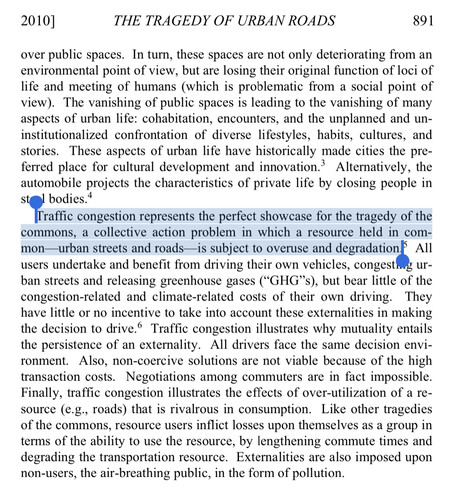
@kegill Alright, so let's break down a few issues. For one, both of your sources talk about the externality of pollution, which I also did in my first post in this thread, whereas your first comment acts confused about how externalities can factor in at all: https://mastodon.social/@kegill/110807924916883662
@kegill Then... The first source does not mention excludability at all, and the second makes my point quite well. At the top of page 893, they talk about the *costs* of exclusion. They cite a paper suggesting that we should treat roads as non-excludable because it's too costly to exclude people from them. It does *not* argue that excludability is a simple binary and that it's impossible to exclude people from roads. It explicitly contemplates cost-efficiency. Excludability in terms of *cost*.
@kegill Then... remember when you confused "public goods" with "commons?" https://mastodon.social/@kegill/110810059881492850. Yeah, no, this article simply starts off by framing roads as a commons before both questioning excludability and talking about flow rates and congestion, which do, in fact, complicate the question of rivalry. Let's dig into that...
@kegill Mankiw still treats rivalry as a binary, and congestion too, oversimplifying traffic as follows:
If a road is not congested, then one person’s use does not effect anyone else. In this case, use is not rival in consumption, and the road is a public good. Yet if a road is congested, then use of that road yields a negative externality. When one person drives on the road, it becomes more crowded, and other people must drive more slowly. In this case, the road is a common resource.
@kegill this article, quite hilariously, argues against that framing, arguing that roads are both excludable and rival, suggesting that they're generally private goods or sometimes club goods: https://fee.org/articles/are-roads-really-public-goods/.
@kegill Side note: treating roads as oversupplied at some times of day and undersupplied at other times of day is really hilarious. As though you could just have more roads during rush hour, and take them away when they weren't congested. Do you see the humor in that?