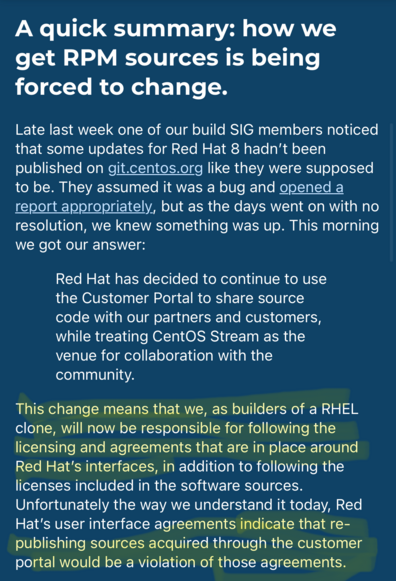
Red Hat is happy to take your code and distribute it, first with minimal changes, and perhaps with more changes over time.

But if you do it, you are a leech.

Love that the Brodie here goes into gatekeeping what is considered a contribution:

https://www.redhat.com/en/blog/red-hats-commitment-open-source-response-gitcentosorg-changes
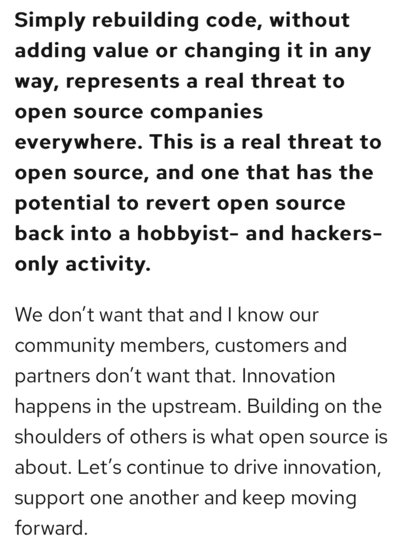
Red Hat’s commitment to open source: A response to the git.centos.org changes

More about Red Hat's decision to make CentOS Stream the primary repository for RHEL sources.

This is Red Hat’s Reddit moment: how dare people other than us benefit from the free labor that we have packaged.

If you had the misfortune of reading the replies to my post, enjoy an explanation without corporate speak.

While the authors of this post need to walk a fine line to attempt to salvage their efforts, I have no stakes on this, and can tell you in black and white the answer to the last question is: yes, IBM and Red Hat are doing this to eliminate their competitors and extract more money from the market.

Time to pay rent:

https://almalinux.org/blog/impact-of-rhel-changes/

AlmaLinux OS
@Migueldeicaza Bit lost in the lingo here, but does this mean Red Hat is trying to benefit from all commits made to RHEL-based distro’s while gating all its own contributions behind a subscription paywall?
@maxsteenbergen essentially- yes

AlmaLinux OS

@Migueldeicaza

That article is not a lie. It says Red Hat is no longer publishes the sources the way Alma consumed them.

The phrase "gating all its own contributions behind a subscription paywall" is a very different statement.

All RH contributions are public.

Even those RHEL patches, which go to minor-stream branches first and not land in the CentOS Stream directly, _must_ be brought into CentOS Stream before the next minor release of RHEL by the development policy.

@maxsteenbergen

@bookwar @maxsteenbergen glad we agree the article is factual, let us go to the article:

@Migueldeicaza

The screenshot is not contradicting.

I am not talking about republishing sources acquired through the customer portal.

I say: Red Hat publishes all RHEL content via CentOS Stream Gitlab repositories. It doesn't just publish them, it also _develops_ that RHEL content via open MRs on GitLab.com

https://gitlab.com/redhat/centos-stream/rpms/glibc

Small subset of patches goes to the internal git and minor release of RHEL before landing in that GitLab repo, but it does land there later.

@maxsteenbergen

Red Hat / centos-stream / rpms / glibc · GitLab

The glibc rpms

GitLab
@bookwar @mattdm @Migueldeicaza /unsubscribe. I was just trying to make sense of what I was reading. I have 0 investment in anything RHEL. What I can say though, is that the tone I'm reading is not exactly community-friendly, but more on the hostile side. Take that as you will, I will not debate it, but it does not instil confidence in RH's proclaimed good citizenship in Open Source.

@maxsteenbergen

Sorry for pulling you into this.

But I think that I have the right to be plain and straightforward if someone repeatedly dismisses the attempts to discuss or explain things and then continues to make incorrect claims spreading the misinformation.

@maxsteenbergen @Migueldeicaza

Absolutely not. All Red Hat contributions are upstreamed where possible, and made available openly and without restriction at https://gitlab.com/redhat/centos-stream/rpms

That might not match precisely the form of the patch in an specific RHEL release, but those _are_ available alongside the binaries. Most differences are due — ironically contrary to the narrative Miguel is pushing — to getting those changes upstream, benefiting everyone and making patches obsolete.

rpms · GitLab

CentOS Stream RPMs

GitLab

@mattdm @maxsteenbergen people don’t want that, people want the exact replica, the one that is certified by assorted third parties for functionality and device drivers.

The bullshit you spew can work on some naive people, but sadly for you, i am not one of those.

@Migueldeicaza @maxsteenbergen

I agree that many people want those things. That work has value, separate from the code.

So, I get why people are so upset even though the licenses are followed (and beyond — again, it's not all GPL) and even though the actual fixes and improvements are shared freely to all.

But I wish you wouldn't keep claiming that Red Hat isn't doing the latter.

@mattdm @Migueldeicaza @maxsteenbergen I'm glad you're finally acknowledging the true purpose behind the changes. You're also confirming that Red Hat aims to benefit from the work of others (through upstream and third-party repositories) without extending the same courtesy in its entirety.

@overcode @Migueldeicaza @maxsteenbergen

I'm not saying anything new here. And, I don't think your conclusion is fair at all to all of the work Red Hatters do. You can of course say whatever you want, but please don't ascribe that to me.

@Migueldeicaza @mattdm @maxsteenbergen

"people want ... the one that is certified"

I want to remark on that point specifically. There is not one line of "certification" in RHEL. As a developer, I cannot write certification.

Certification is part of the support contract that Red Hat provides, not a part of the software. The thing that people want is Red Hat's support.

@gordonmessmer @Migueldeicaza @mattdm @maxsteenbergen Some people want Red Hat's support.

Other people are quite happy to support Linux themselves, but want to run commercial Linux software that is only supported on distributions identical to RHEL.

@mathew @Migueldeicaza @mattdm @maxsteenbergen

Sure, I've supported such software in the past. Generally, it falls into two classes: The first class is software that targets the major version's interface, and that software will run on Stream if you can't or don't want to use RHEL.

The second class is much less common and is only supported on one minor release of RHEL. Rebuilds aren't much good here, because they're be supported for less than six months.

@mathew @Migueldeicaza @mattdm @maxsteenbergen

RHEL works for the second class of apps, providing two or four years of support for a minor release, depending on your contract.

Without extended support, there are just very few reasons to rebuild RHEL.

@maxsteenbergen @Migueldeicaza No. All the software is still publicly available in CentOS Stream, where updates are prepared and pushed to first. They then flow into RHEL, and this exact special version is not longer published verbatim.
@Migueldeicaza must say, i didn't have "Red Hat goes SCO" on my bingo card
@Migueldeicaza it seems a bit like claiming rights over a database of public information, yes?

@Migueldeicaza in what way is it akin to Reddit? #Centos Stream is the upstream where #RHEL comes from. Most packages in RHEL are verbatim Centos content and a RHEL release can be traced to a tag or a commit in Centos.

Also #RedHat continues paying developers that contribute directly to upstream projects like #Gnome, #GTK, the #Linux #kernel... In what way is any of that akin to Reddit?

@Migueldeicaza I work at SUSE and many people angered at RH are looking for enterprise alternatives and focusing on SLES/OpenSUSE Leap, so I will probably profit from FUD directed to #RedHat.

But I think it's completely disingenuous when not openly hypocritical to pretend that closing RHEL while opening #Centos and maintaining #Fedora and all the upstream contribution makes RH a bad #OpenSource actor.

@itorres did you bother to read the screenshot?

@Migueldeicaza @itorres

Did you read _more_ than the screenshot? You're taking it out of context and misrepresentating both what Mike said and what Red Hat does.

@mattdm @itorres he said it - and it is posted on their corporate site. There is no ambiguity or misunderstanding- this had lawyers and PR review it.

@Migueldeicaza @itorres

Yet, you are taking it out of the context of the rest of the post, and adding words like "leech" — which isn't even there as a reasonable paraphrase of the words you did choose to focus on.

@mattdm @itorres I just translated from PR corporate speak.

@Migueldeicaza @mattdm @itorres It's pretty clear that the freedoms and collective advantages FLOSS grants are at some odds to profit generation: this *is*, indeed, a threat to RH's business model.

Once it becomes "good enough" that support is no longer deemed universally necessary, the funding model flounders since everyone else also wants to maximize their (short-term) profits.

We need different funding models.

@larsmb @mattdm @itorres agreee, this has always been a problem, I think it remains an unsolved problem. An asymmetry between those that build the code and those enabled to monetize it

@larsmb @Migueldeicaza @itorres

I agree about different funding models. But, I want to stress — Red Hat has not made (and I do not expect it to make) any changes relevant to that. All changes are made available to everyone, and upstreamed directly if possible.

@mattdm @Migueldeicaza @itorres A big part of the GPL is the right to redistribute (and use, for any purpose, the modified or unmodified source code).
So you're saying RH is not adding any restrictions or negative consequences to that?

(I get the part about "you're not allowed to redistribute the signed binaries". I think that part is fair enough.)

@larsmb @Migueldeicaza @itorres

I think this is well-covered elsewhere. I can find you some links if you like.

@larsmb @Migueldeicaza @mattdm @itorres

I found the distinction in economics between Public Goods and other types of goods helpful in understanding all this. It seems like FOSS is fundamentally at odds with normal market approaches, and RedHat is trying to get around that. (https://youtu.be/hA2z-X31IvI?list=PL-uRhZ_p-BM4XnKSe3BJa23-XKJs_k4KY)

@mattdm @Migueldeicaza @itorres lol, are you seriously claiming it improves in the slightest with "context". it absolutely does not.
@davidgerard @mattdm @Migueldeicaza @itorres supposedly the word leech was used at least once on RHs internal communication to describe distros like Rocky and Alma.

In either case, this'll probably kill RHELs market share. A big part of its sales premise is indirectly that you could dev on (formerly) CentOS (and up to recently, Rocky/Alma) while prod (that needs the certifications) has the RHEL license.

Supposedly Rocky has been able to score a NASA contract already so who knows, it might become the new standard setter.

Downstream RHEL clones are key to RHs success. That said, it's no suprise when you realize it's owned by fucking IBM.
@glitch @davidgerard @mattdm @itorres I have no insider information. I was purely translating corporate/PR speak into English
@mattdm @Migueldeicaza @itorres still waiting on the "context" that allegedly improves this
@Migueldeicaza Spoken like a real Ximian 😬
@helge did I ever tell you our ximian story with red hat?
@Migueldeicaza I don’t remember that, go ahead!
@Migueldeicaza the cognitive dissonance in that post is absolutely staggering
@anizocani and the contempt - just yuck.
@Migueldeicaza we're gonna keep seeing this for the next few years - companies that aren't doing well always start to just throw wild punches in the air like this as they're spiraling the drain

@Migueldeicaza red hat are contributing a ton of effort to OSS. I genuinely don't see the problem. If you don't like their approach any more, you can vote with your wallet and choose a different enterprise distro ...

The only interesting thing im seeing out of this 'debate' is that the Fediverse has now managed to match Twitter in terms needlessly nasty arguments 😆

@Migueldeicaza I literally just pulled that quote from the article into a private chat this morning. If companies have difficulty perpetuating their business models when freedom is preserved, why would I value preserving those companies over preserving software freedom?
@Migueldeicaza (for people who don't like the Free Software nomenclature, my argument remains the same if you substitute "the open source definition" for "software freedom").

@Migueldeicaza I suppose this is yet another data point supporting the idea that Open Source Software in a world of capitalism can only exist as a pastime for the already-rich. Only companies extracting profit from *something else* can afford to maintain OSS. Only individuals paid for *something else* can contribute significant time to OSS projects in their spare time.

It’s a precarious thing to profit *directly* from maintaining OSS and selling it as a service, precisely because someone else can copy and repackage your work for less money—which is entirely within the spirit of OSS—and undercut your business model. A business truly in the spirit of GPL would celebrate such a copy; but a business that must profit from their work on OSS would see it as theft of their livelihood.

@drahardja @Migueldeicaza

Some astute observations. I would also add that probably is the reason why don’t see many firms in the form of Redhat existing selling support on OSS. It is too precarious and they don’t have the first mover advantage that Redhat itself had.

@Saad @drahardja exactly. This isn’t a secret, we have known for now some 20 years that the red hat model couldn’t be generally be reproduced. A handful of attempts exists here and there, the exceptions to the rule.

@drahardja this is an incredibly accurate assessment of the problem. And I don’t think we have found a viable solution.

This move by red hat is truly tasteless.

@drahardja @Migueldeicaza Disagree. This isn’t about making money or not, this is about making MORE money. This is a squeeze.

What you guys are forgetting is RH is two main things: a brand, and a support company. IBM is killing the brand here with this and doesn’t care because they see more dollars in squeezing the support biz. And they think the IBM brand is infallible and will ultimately just be that anyway.

@drahardja @Migueldeicaza This is why I wish we could think of FOSS as public infrastructure and give it public funding.
@Migueldeicaza seems like a really weird hill to die on, given that the sorts of people who pay you money in open source are usually the ones who do so more to dot the i’s and cross the t’s on support than specifically what code they have access to. Why piss off the people who don’t do that anyway, but whose primary value is in the goodwill they generate? Especially as the code is still available anyway, just with more effort than before, if I understand correctly

@sinbad I suspect the answer is crass: the bonus of the entire group that passed this decision is tied to revenue growth and they can’t do that with OSS so they are pulling this.

It is a denial of service on the community. Like paying a 1,000 bill with cents.