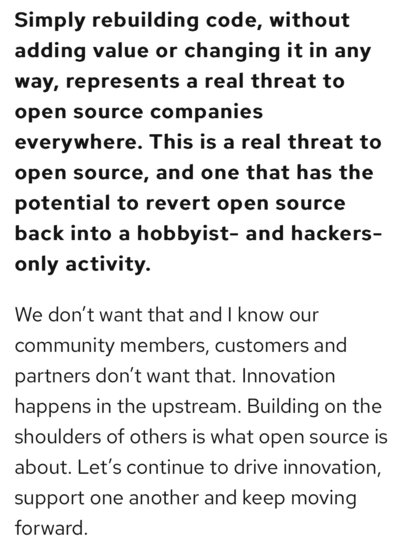
Red Hat is happy to take your code and distribute it, first with minimal changes, and perhaps with more changes over time.

But if you do it, you are a leech.

Love that the Brodie here goes into gatekeeping what is considered a contribution:

https://www.redhat.com/en/blog/red-hats-commitment-open-source-response-gitcentosorg-changes

Red Hat’s commitment to open source: A response to the git.centos.org changes

More about Red Hat's decision to make CentOS Stream the primary repository for RHEL sources.

@Migueldeicaza I suppose this is yet another data point supporting the idea that Open Source Software in a world of capitalism can only exist as a pastime for the already-rich. Only companies extracting profit from *something else* can afford to maintain OSS. Only individuals paid for *something else* can contribute significant time to OSS projects in their spare time.

It’s a precarious thing to profit *directly* from maintaining OSS and selling it as a service, precisely because someone else can copy and repackage your work for less money—which is entirely within the spirit of OSS—and undercut your business model. A business truly in the spirit of GPL would celebrate such a copy; but a business that must profit from their work on OSS would see it as theft of their livelihood.

@drahardja @Migueldeicaza

Some astute observations. I would also add that probably is the reason why don’t see many firms in the form of Redhat existing selling support on OSS. It is too precarious and they don’t have the first mover advantage that Redhat itself had.

@Saad @drahardja exactly. This isn’t a secret, we have known for now some 20 years that the red hat model couldn’t be generally be reproduced. A handful of attempts exists here and there, the exceptions to the rule.