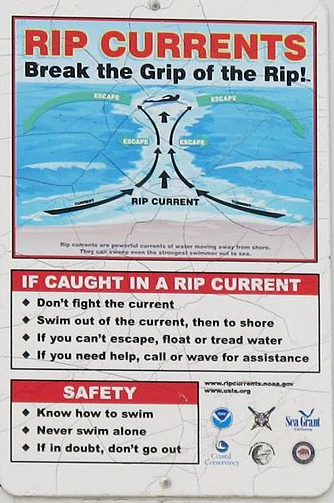
HOW TO SPOT A RIP CURRENT:

IT'S WHERE THE WATER LOOKS EASIEST AND SAFEST, with no waves breaking or rolling in.

NEVER ENTER THE SEA HERE.

If you get caught in a rip, DON'T FIGHT IT. You can't swim back to shore against it; you will become exhausted and drown.

Instead, SWIM ACROSS IT, parallel to shore. You'll soon be out of the current and can then easily swim back.

Boost, please, and make sure your friends and family know this when they hit the beach.

Credit where due, BTW. I found this on a Facebook Friend's page; he had shared the post of a group called "The Other 98%", of which I know nothing, other than that this is good advice. I had to drastically paraphrase their text to fit Mastodon's character limit, but that's the gist of it.
@marcas learned this as a young child in Florida. It works , swim parallel to the shore until you can easily swim in.might be a long walk back to your family but you will get back.

@ArmyGirl Yep. Grew up five minutes from the beach (albeit at a much more northern latitude), learned this early on.

We had a different term for rips, a term not really suitable for a family fediverse.

@marcas Might you honor us by putting in a comment with a content warning?

I'm so interested in knowing what it was. Grew up by a touristy beach and only ever heard it called a rip current.

@dawni @joelmartinez The most common term — the one your parents would use when warning you about them — was “undertow”, which is technically incorrect. (Undertow is a thing, but that thing is not a rip current.)

But we kids always called them “sea pussies”.

@joelmartinez @dawni I’ve seen that bowdlerized as “sea pus”, as in the awful whitish goop oozing from an infection. Hard to see that as an improvement, frankly.

@joelmartinez @dawni The idea being that the sand being sucked out to sea turns the rip a bit whitish and, I guess, pus-like. Which, yeah, sometimes.

But not always by any means. And anyway, nice try, but like it or not — and no longer being a giggling snotnosed prepubescent brat, I don’t particularly like it myself — it’s sea pussy.

@joelmartinez

Now *this* is useful information I can take with me to the beach. Thanks, @marcas

Not to rip on the 14-year-old we all once were, because pus kinda makes sense, but I truly don't get how or why it's a pussy. And here I sit in my old age

@joelmartinez @dawni Can’t help you there. At the time I learned the term, I had only the very vaguest idea what an *ahem* was. In retrospect, I can see how the term came about (the “pus” thing only makes sense on fairly rare occasions — rips mostly *don’t* look whitish, unless there is a simultaneous strong undertow (which is not the thing that will kill you).
@joelmartinez @dawni But a few years ago, visiting NY with my family, we spent a day on the beach in the Hamptons. (The south shore of Long Island is basically one big beach, 100+ miles long.) We didn’t see any of this, but on the Monday we learned that five people drowned off the beach we were visiting that day, fighting against rips. They were all strong, fit young men.

@marcas That's so sad.

Last weekend, tourists in three separate incidents died in Panama City Beach on the same day during a double-red flag, likely from rip currents.

(In Florida, a flag system warns about things like jellyfish and currents. Double-red means it's so dangerous it's closed and you could be arrested if caught swimming).

People just don't understand the danger. Almost every time, had they been better informed about what to do, they would have been fine.

@marcas @greene That is excellent and lifesaving advice. I didn’t know that’s what a rip current looks like. Thank you for sharing.
@marcas This is really helpful, thank you. I knew about the ‘swim parallel to shore’ advice, but had no idea how to actually spot a rip current.

@greene Thanks, but really, I’m just passing it along, as are all the people boosting this post. It *is* good advice, though!

I grew up very close to a beach and learned this as a little kid. Most people don’t grow up near beaches and, too often, don’t learn it. Hence my eagerness to pass it along — it really can save your life, and it’s stupidly easy (though counterintuitive).

@marcas Unfamiliarity and lack of information can be so dangerous. I’m a highly experienced river swimmer and thus excellent at handling river currents, but they behave *so* differently from ocean currents, and I can count on one hand the number of times I’ve been in the ocean. Being informed makes me feel a bit less leery of going to a beach for a swim.
@marcas My father and I were caught in a rip current when I was 14. The waves were high because of a tropical storm out in the gulf. There wasn't just a rip current; the undertow was also ridiculous.
I was fine, but he was a terrible swimmer who panicked. There was no lifeguard (private beach), and I had no idea what to do. All I could do was try to keep him above the surface until two guys swam out to get us. It was terrifying.
I was a stupid kid and quickly learned what the ocean can do.
@dancinyogi @marcas @Catawu I lost a good friend to a rip current in Destin, FL. His son got caught in it and he went to get him. Son is fine, he drowned.
@Karoli @dancinyogi @marcas I ended up working on a case where a 16 yr old swam out to save a group of 4 people who were caught in a rip… he saved them, but he drowned. He got the Carnegie Medal posthumously. Up by Moss Landing. Weird how that works out, eh?
@Karoli @dancinyogi @marcas I was in touch with the family for years… and 4 of his friends are still in our circle.
@Catawu that IS weird.
@Karoli @Catawu How did he save them while drowning himself? Aspiration ---> pneumonia?
@msbellows @Catawu on my friend’s case, he got Ryan out of the rip current and got carried away himself, fought it and drowned. People don’t know what to do in a rip current and they panic and do the wrong thing
@Karoli @msbellows My friends’ friend wasn’t a good swimmer, was just leaving the beach when he heard the cries for help. He grabbed an inner tube, swam out to them, but was exhausted by the time he reached them (they were overloading a small surfboard). “Save yourselves” were his last words. There’s more to the story which I will share with you in an email later. It’s outright eerie.
@dancinyogi @marcas this happened to me when I was around 12-14 (I don't recall the exact year). The undertow was so strong it ripped me off my feet in just over waist deep water and drug me under and out to sea so fast I didn't even have a chance to take a breath before I went under. I was a good swimmer, but I was tossed and turned under water before coming to my feet on a sandbar a couple hundred yards from the shore. 😱 It was pretty scary.
@marcas it can happen in lakes too! i remember my mom teaching me how to get out of these when i was a little kid. she really hammered it into me. we always referred to it as "undertoe" tho.
The differences between rip currents, undertows and rip tides

Rip currents, undertows, and rip tides are natural ocean hazards. These hidden dangers put swimmers and beachgoers at risk. Learn how to identify them.

Surfertoday
@marcas, they are really dangerous
@marcas a very special thank you for the wonderful image description!

@marcas

When I was a child I got caught in one of these in the Atlantic Ocean. I had a boogie board and couldn’t figure out why I kept drifting further and further out. I kept swimming and was getting nowhere, getting scared and frustrated. Thankfully a friend’s dad realized what was going on and swam out to me and got us back. He explained rip currents to my parents and me. Forever grateful!

@marcas
I am pretty sure that some of the things at the water edge are people. Zoom in and you can make out legs.
@marcas Never saw anything like this. 😮 Thx for this.
@marcas almost drowned in a rip about 5 years ago because I did indeed swim against it and became exhausted!
@marcas
It has a blonde mustache and a silly laugh!?
@marcas We have very dangerous currents on the eastern shore of Lake Michigan. They are like junior riptides but are still dangerous because average beachgoers don't expect them in fresh water. Lots of unfortunate deaths.
@marcas Also note the shape of the shoreline. If it undulates like a wave stay out. Look at the picture and it shows that clearly.
@marcas
It is good to stay calm.
https://youtu.be/Ug2TMPKGrvc
How to escape a rip NSW Ed

YouTube
@marcas you won't easily swim across it, you'll be sucked out by it faster than you can swim so at best you'll go diagonally, I think
@marcas Its an old video now but this gives you a good visual on how far out they can go too: https://www.youtube.com/watch?v=AoZVmgiUcGs
Dr Rip - Behind the scenes dye release

YouTube

@marcas I got caught in one of these (when I was 13, I think?) and the swimming parallel-to-shore thing really works.

One warning, though: It's almost never this easy to spot from where you enter the water itself. The higher up you are, the more visible it is.

@jonathanhorowi1 @marcas that is what I thought about the picture. The clues close up are more subtle.
@marcas I wonder how easy/hard it is to spot this from the sand.

@marcas

I remember getting caught in a rip current around 8 years old, when I lived in Florida. I wasn't dragged underwater, thank God. But while playing some aquatic variant of "tag", I suddenly found myself moving *very* quickly out to sea, away from my friends.

My friends went to shore to tell my mother, while I hauled ass about 100 feet parallel to the shore, because I had been given this lesson about a billion times in school and in scouts. Then I went in to shore. I was a little tired, but okay.

Mom met me at the shore, and she seemed freaked out. I didn't quite grasp why; I had just done what I'd been told to do in that situation, *of course* I was safe.

I had no idea rip currents were so dangerous until I was quite a bit older.

@marcas that's some sound advice that I as a certified scuba diver can only second:

DON'T FIGHT CURRENTS, BECAUSE YOU CANNOT AND WONT WIN!

@marcas I know this too well - I'm one of the lucky few that was ignorant to this back in 1989 and tried to swim to shore... after 3 big waves that pushed me deep down (the last one I was about to blackout!), somehow, miraculously, I surfaced back up and found myself ashore being given 1st aid by beach goers...I spent about 20 mins face down on the sand just catching my breath and energies...lucky indeed!
Usually, not in this case it seems, these are also marked with flags on shore.
@marcas The swimming sideways recommendation is pretty good, but recent updates recognize that it isn't foolproof.
https://www.ripcurrentsafety.com/escaping-rips
Escaping Rips — Rip Current Safety

Rip Current Safety
@marcas not that you need my endorsement, but SO TRUE. Listen to this person.
@marcas beaches in my area have signs with these exact warnings. more beaches seriously need it

@marcas this ad about them from 1990 stuck in my head

https://youtu.be/vEbMFF5nhiI

Lotto WaterSafety NZ: It's a Rip. (1990)

YouTube

In the early 1940s, my late mother was a kid from the German heavy industry Ruhr area. Her entire school fled from the allied bombing attacks (bombing of civilian targets was ugly custom in WW II) to the Baltic Sea coast. One beach day, several members of her class were caught in a strong current. Mom made it to shore by herself, but the teachers had to get in and rescue pupils that had drifted very far away. This was one of the terrifying stories mom occasionally told.

@marcas

@marcas Fluid dynamics wants to kill you

@tryst @marcas as also shown by the innocuous phrase "delta P"

https://youtu.be/AEtbFm_CjE0

Delta P

Enjoy the videos and music you love, upload original content, and share it all with friends, family, and the world on YouTube.

YouTube