Since there is a lot of confusion about bees, and the saving thereof, a thread:

1. Honey Bees are a Eurasian/African species not native to the Americas but used here for agriculture. Their well-being is no more a conservation concern in the Americas than that of house cats or chickens.

2. Honey bees are having some problems, though, especially with high winter colony losses. Commercial beekeepers are slower to build colony numbers in the spring, which raises early-spring hive rental prices...
...which raises almond prices for consumers. This is the scale of the honey bee problems: one of agricultural economics.

3. Native bees are hugely diverse- with many thousands of species in the Americas- and their status varies from species to species. How are they doing? Some are great! Some are extinct! Some are disappearing! Most we simply have no idea, since there is very little money out there to hire the necessary people to watch 6,000 bee species across an entire continent.

4. But when we say "save the bees!" we are referring mostly to these many hundreds of native bees that are declining. Not honey bees, which are fine and still outnumber pretty much all the other bees now, in spite of elevated winter losses some years.

#bees #conservation

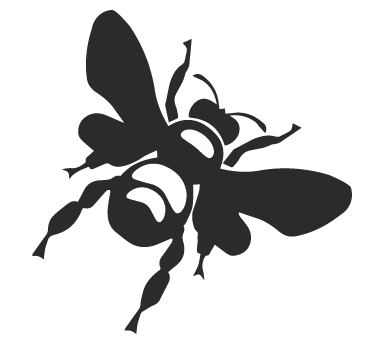
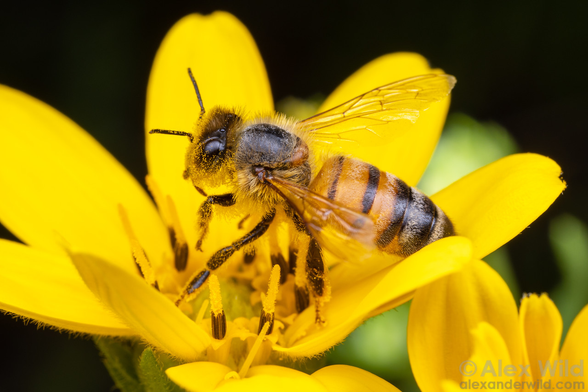
Anyway, here's a Honey Bee (Apis mellifera), it's the common waspy-looking bee with the big pollen-carrying baskets on the hind legs and the gray stripes towards the end of the abdomen:

Native bees look like everything else. Hairy, hairless, yellow, gray, blue, metallic green, black, white, stripes? or not. Huge. Or tiny, like dust.

https://www.alexanderwild.com/Insects/Hymenoptera/Bees/

Bees - Alex Wild

A gallery of bees.

Want to help the bees?

1. Stop using pesticides. This includes "green" pesticides and mosquito misters.

2. Plant a diversity of flowers, if you have space.

3. If you have land, leave some bare patches, as most native bees are soil-nesters.

4. Leave dead trees and plants to stand for the wood and twig-nesting species.

5. Vote against politicians who are insensitive to environmental concerns. You know the ones. Out with them.

6. Vote for politicians who expand protected areas.

@alexwild we’re lucky to have several varieties of bees in our garden - which is planted for them. Bumblebees, miner bees, carpenter bees and wild honeybees.
@alexwild For maximising biodiversity in your garden, having native plants is key.
@alexwild We built a house and it came with landscaped gardens, we removed them and planted bee (and butterfly) friendly native (to Australia) species. Worth every cent. I don’t use pesticides, but am required by law to have termite treatment every year, so I follow the tech around making sure they keep the spray as localised as they possibly can, and if it’s too windy I reschedule.
@alexwild doing my part to make a scruffy hospitable space, gradually digging out grass to replace with wildflowers. And my gumball tree loves to contribute the deadwood heap.

@alexwild Find out plants are actually native to your area! They're much more useful to the local insect population than stuff imported from other continents.

A great way to get comfortable with your bug ecosystems (in north america anyway) is to grow some native varieties of milkweed! Milkweed hosts SO many bugs (including critically threatened monarch caterpillars) and you can just go look at all the aphids, milkweed bugs, beetles, and predators thereof doing their thing in broad daylight. Milkweed is easy to grow, easy to propagate, and extremely tough.

@alexwild Asclepias syriaca (common milkweed) spreads by rhizomes and can be too aggressive for some yards, but is great for seeding meadows.

Asclepias tuberosa (Butterflyweed) is a smaller and bushier, well behaved variety with vibrant orange flowers, great for anchoring flower beds.

I'm in the NE US so I have my pick of several species including A. incarnata, A. purpurescens, and A. verticillata along with syriaca and tuberosa.

Avoid A. curassavica with it's distinctive red-orange blossoms with yellow centers, that's a South American species that doesn't do much for North American insects. I see it for sale all over because of the showy blossoms, sometimes passing it off as A. tuberosa.

@alexwild We never used pesticides. We don't plant any flowers – we just let all the flowers that grow here be. Usually there are some patches of ground not completely covered by vegetation. Plenty of dead trees and branches – we don't burn them, like most people here. We could have honeybees, but we don't. They'd outcompete local wild pollinators Our dogs learned not to eat pollinators. Almost no politicians here care about the environment.
@alexwild
7. Execute the rich people to stop corruption and allow politicians stop the climate change. 🌻🐝
@alexwild Great thread. Let's make sure our farms and towns are good environments for *all* the local bees (and moths and flies and beetles, etc.), not just honeybees.
@alexwild Hi Alex, What's the best pocket field guide for insects for novices to get? Audubon? Princeton? NWF?

@admin maybe Kaufman or NWF? Some states like Texas have good regional guides (like Abbott).

Insect field guides are all kind of a losing proposition though. Even the best can’t fit more than 3% of the species in, and nothing rivals BugGuide.

@alexwild
One of my favorites, tiny and shiny.
These nest in rotting logs I set out in my garden for this purpose.

https://www.inaturalist.org/observations/116977550

#Bees #Anthophila #HabitatGardening #UrbanGardening #Brooklyn

Pure Green Sweat Bee (Augochlora pura)

Pure Green Sweat bee from Beverly Square East, New York, United States on May 11, 2022 at 12:52 PM by Chris Kreussling (Flatbush Gardener). Augochlora pura? on Zizia aurea in my front yard, May 2022

iNaturalist

@alexwild 🎯

Great information!

@alexwild Thanks for this thread, very much appreciated and useful.
@alexwild my friend has eight native #stingless #bee hives in her garden, and they are just the most loveliest tiny creatures ☺️ #bzzz
@alexwild There are thousands of retired people who would be willing to help gather data. Use this resource of volunteers.
@alexwild Not your current topic, but I feel the need to interject that the Xerces Society has a citizen science project to track native bees. Very important work! https://www.bumblebeeatlas.org/
Bumble Bee Atlas

A website to help communicate the goals and findings of the Xerces Society Bumble Bee Atlas Projects.

@alexwild even in Europe I often feel like beekeepers are pushing honeybee ''protection'' as a key aspect of things for their own interest (while they do a lot of damage to bee populations)
I cannot imagine how frustrating it must be for you as bees aren't even native 🙄