
Since there is a lot of confusion about bees, and the saving thereof, a thread:

1. Honey Bees are a Eurasian/African species not native to the Americas but used here for agriculture. Their well-being is no more a conservation concern in the Americas than that of house cats or chickens.

2. Honey bees are having some problems, though, especially with high winter colony losses. Commercial beekeepers are slower to build colony numbers in the spring, which raises early-spring hive rental prices...
...which raises almond prices for consumers. This is the scale of the honey bee problems: one of agricultural economics.

3. Native bees are hugely diverse- with many thousands of species in the Americas- and their status varies from species to species. How are they doing? Some are great! Some are extinct! Some are disappearing! Most we simply have no idea, since there is very little money out there to hire the necessary people to watch 6,000 bee species across an entire continent.

4. But when we say "save the bees!" we are referring mostly to these many hundreds of native bees that are declining. Not honey bees, which are fine and still outnumber pretty much all the other bees now, in spite of elevated winter losses some years.

#bees #conservation

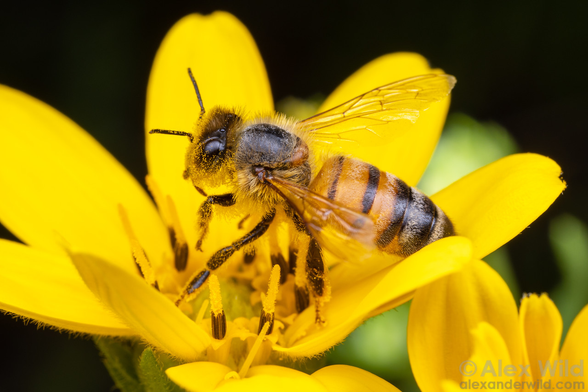
Anyway, here's a Honey Bee (Apis mellifera), it's the common waspy-looking bee with the big pollen-carrying baskets on the hind legs and the gray stripes towards the end of the abdomen:

Native bees look like everything else. Hairy, hairless, yellow, gray, blue, metallic green, black, white, stripes? or not. Huge. Or tiny, like dust.

https://www.alexanderwild.com/Insects/Hymenoptera/Bees/

Bees - Alex Wild

A gallery of bees.

Want to help the bees?

1. Stop using pesticides. This includes "green" pesticides and mosquito misters.

2. Plant a diversity of flowers, if you have space.

3. If you have land, leave some bare patches, as most native bees are soil-nesters.

4. Leave dead trees and plants to stand for the wood and twig-nesting species.

5. Vote against politicians who are insensitive to environmental concerns. You know the ones. Out with them.

6. Vote for politicians who expand protected areas.

@alexwild Find out plants are actually native to your area! They're much more useful to the local insect population than stuff imported from other continents.

A great way to get comfortable with your bug ecosystems (in north america anyway) is to grow some native varieties of milkweed! Milkweed hosts SO many bugs (including critically threatened monarch caterpillars) and you can just go look at all the aphids, milkweed bugs, beetles, and predators thereof doing their thing in broad daylight. Milkweed is easy to grow, easy to propagate, and extremely tough.

@alexwild Asclepias syriaca (common milkweed) spreads by rhizomes and can be too aggressive for some yards, but is great for seeding meadows.

Asclepias tuberosa (Butterflyweed) is a smaller and bushier, well behaved variety with vibrant orange flowers, great for anchoring flower beds.

I'm in the NE US so I have my pick of several species including A. incarnata, A. purpurescens, and A. verticillata along with syriaca and tuberosa.

Avoid A. curassavica with it's distinctive red-orange blossoms with yellow centers, that's a South American species that doesn't do much for North American insects. I see it for sale all over because of the showy blossoms, sometimes passing it off as A. tuberosa.