
The way Twitter users dealt with #DM #spam was to block DMs from non-followers. There are settings with similar effect on Facebook.

You can also do that on #Mastodon.

THIS IS NOT A HACK. It's literally why the feature exists. Use it. Maybe instead of banhammering the largest single instance on the #Fediverse.
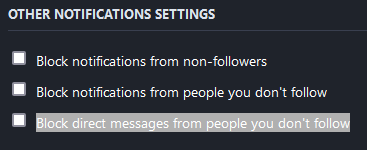

I get that this doesn't help people on platforms like Friendica that don't have an equivalent feature. But most of the people I see complaining about #spam from mastodon.social & mastodon.world seem to be coming from people on mastodon instances.

Also the naive programmer-macho stuff is making me nuts. Seriously guys, it's not as simple as hacking in one line (or ten or 50) of code to integrate SpamAssassin. It really truly isn't. & no Mastodon.social isn't rolling in money, & throwing money at the problem would make no more sense than throwing devs at it (AHEM #MythicalManMonth? /AHEM).

Could it be done fast? Maybe. Sure, why not? Should it? Well I have it so from a half dozen people about whose experience I know nothing so SURE!

& in any case, going after the spam messages themselves is, frankly, the wrong priority.

The problem is the spammers. Stop the spammers, you stop the spam.

So people talking about methods for limiting spam signups are on the right priority. Mastodon.social & Mastodon.world are focusing on limiting or qualifying signups; people are discussing options for adding friction to the signup process. Those could actually work.

SpamAssassin is basically a non-solution for most instances.

Let's take apart this whole "just integrate SpamAssassin!" thing for a minute. Leave aside the worrisome specificity (why that particular product?), let's ask some questions:
1. At what point in the message-creation workflow is the spam filter inserted? Creation? Receipt?
2. If at creation, how does one appeal? Because I assure you the filter's gonna block A METRIC SHITLOAD of legitimate posts. (If your response is 'well then they SHOULD be blocked' then mine is 'well you SHOULD be ignored').
3. In email, we get to review our #spam folders for messages that are wrongly classified. On my work email, I'd say 80% of my junk folder was wrongly-classified, if I use a CAN-SPAM-compliant definition of spam. Where does that system reside in Mastodon? Who builds it? Who tests it? How long does that take?

We should maybe adopt a convention of distinguishing between #spam & #FediSpam: if it's exploiting features of the #Fediverse to make the spam harder to kill, it's FediSpam.

E.g. here, describing how a single site is automating post creation to send single spam messages from many servers. 'Everone on Join Mastodon' as one reply characterizes it.

FediSpam can't be killed by a single approach. You'd need to improve ability to assess humanness, & screen messages.

https://mastodonapp.uk/@JdeBP/109867177655794794

JdeBP (@[email protected])

So, FediVerse, what systems do you have in place to stop #FediSpam not coming from a single instance but from hundreds of them? Consider @[email protected] , which is also @[email protected], @[email protected], @imtaaa, @[email protected], @[email protected], and many others. There are several advertisers going around doing this, creating 1-advert-post accounts across many instances (at the rate of 1 or 2 per day, at 1 instance). So what's stopping this? Or has no-one thought about it yet? #FediHelp @Fyrsta @wild1145 @[email protected] @[email protected]

Mastodon App UK

Every approach I've heard so far to improving the ratio of humans to spambots does so by introducing some kind of friction into the signup process. #Mastodon "corporate" clearly prioritizes reduction of friction on signups as a means to drive adoption. That's advantageous to spammers.

Anything done to fight spambots at the source will at least incrementally reduce adoption. But by how much? #CAPTCHA might be a good compromise, but would it help? If it does, benefit will be short term.

Then there are the various strategies intended to triage the signup approval process. There are a bunch of them, but none of them will *stop* spambots from registering.

Spam is an arms race. Some of it's always going to get through.

In any case the current trend toward demonizing mastodon.social is unhelpful but also unsurprising. Folks need a face to blame. "It's coming from everywhere" is too scary to comprehend.

I'm just paranoid enough to note that #Fedispam could look an awful lot like an attack by mainstream social media on the #Fediverse. I don't think it *is*, but the threat to Facebook, Twitter, Insta, etc from the ActivityPub Fediverse is pretty obvious - & adding friction, making federated social media look more difficult to use, that's all gravy for, say, Meta.
I don't think any of the big centralized-social-media players are actually BEHIND #fedispam because...why would they need to be? Spam is inevitable. They just had to wait for it. & let's get real, fedispam is actually a great illustration of a real weakness in federated social media. If we're going to be honest about the world we'd like to see, it's crucial we be honest about that world's risks.
We can't #techsolutionism our way out of #fedispam. The solution is going to need to involve actual humans taking actual actions at massively distributed scope & scale. That's something the internet's been trying to deliver on since I've been on it, which is over 30 yrs now. (Oh, wait, I'm not supposed to mention how long I've been doing this, apparently that's bad for some reason.)
I actually think federated social media (e.g. the #fediverse) could finally deliver on that promise of massively distributed human action. One of the things that could kill it would be unrealistic #TechSolutionist expectations - like '#spam & #fedispam will be magically fixed by technology.'
#TechSolutionism
@FeralRobots It's not an unavoidable tradeoff between fast adoption with more spam bots and slow adoption with less spam bots. IMO, concerning the signup process, what drives better adoption is straightforwardness and what drives away bots is checks. These checks might slow down the signup process, but they don't have to make it less straightforward (e.g. captcha don't make a signup process more complicated, at least for unimpaired users).
@steakfrite Straightforwardness with a slower process could still work, yes. It's going to hinge on execution; but another advantage of federation is that even if some instances have crap execution, others will have great execution.
@FeralRobots True. The great thing about the fediverse is it drives innovation. That's because profit & competition isn't necessary to drive innovation, diversity is.