@StellaQuasten : precies, dit soort problemen kun je niet oplossen met techniek.

#TechSolutionism #TechSolutionisten

@nekodojo wrote:

"Can people stop breathlessly reporting “deficiencies” where you already compromised a system using something unrelated to #Passkeys like it’s a big problem?"

I'll stop reporting such issues once idiots stop suggesting passkeys are safe *even* if endpoints are compromised because private keys are in an uncrackable vaults and copystealing public key is pointless (even if some worry about QC) _and_ no certificates get issued to malicious fake websites _and_ Apple and Google fix their shit (*).

(*) If only you were interested in reading about passkey shortcomings I would have written about it - again.

The problem at hand: evangelical techsolutionists believing in "flawless" tech who whine "don't dare to negatively write about my darlings!"

@patrickcmiller @tychotithonus

#Passkeys #InfoSec #NotShuttingTFU #TechSolutionism #TechSolutionists

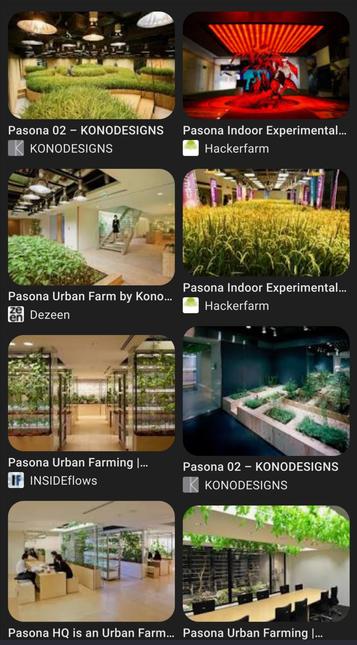
Have you seen or heard about an indoor farm in a Tokyo office building? Only today I found out that this indoor 'farm' actually had closed already in May 2017 when the recruitment corporation moved their HQ!!! ...despite knowing that mind-blowing examples from Japan tend to be generalized for the whole country based on stereotypes and presented over and over again uncritically. The more important part is, this innovation was not primarily about food production, even though most mentions focus on #futurefood with a tone of #techsolutionism, but about marketing, team building, employer retainment, so more the social aspects that food growing and consuming can enhance.
#urbanfarming #tokyo #Japan #futurefood #TechWontSaveUs

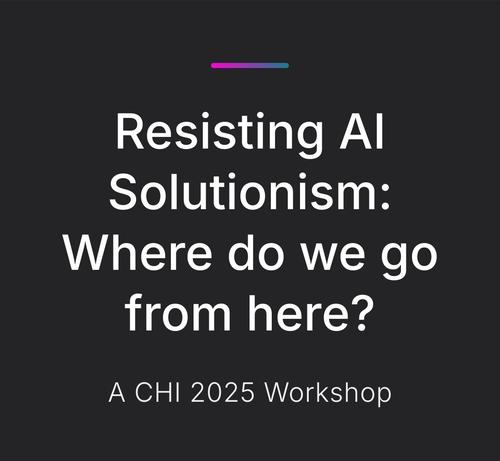
My colleagues and I are hosting a hybrid workshop during CHI 2025 in Yokohama

Call for Participation

In this hybrid workshop we want to explore ways of resisting, not necessarily AI per se, but the solutionist treatment it is receiving, i.e., "the idea that technology provides solutions to complex social problems" (Lindtner et al., 2016).

Participants are invited to produce a 2-3 page position paper using the ACM Primary Article Template (single column) presenting recent, ongoing work, or personal reflections on topics related to resisting AI solutionism.

Please submit your position papers to the lead organiser [email protected], by 27th February 2025, 23:59 (Anywhere on Earth).Participants should aim to respond to the following:

Tell us about some resisting (e.g. from personal experience, a project, the literature, the media, in fiction).

How do you envision resisting AI solutionism?

What could you, or others, not resist when advancing the AI cause?

How do we reimagine AI data practices?

What would it mean to privilege the outlier in AI?

How do we challenge harmful AI practices and consequences?

For more information, visit https://resisting-ai-solutionism.carrd.co/

#CHI2025 #AI #Techsolutionism #AISolutionism

Resisting AI Solutionism

A website for a CHI 2025 workshop about resisting AI solutionism.

Resisting AI Solutionism
This podcast is a must-listen for those interested in the consequences of the dark side of #TechSolutionism
https://toot.cat/@EveHasWords/113844125821819178
Eve 😘📚 (@[email protected])

In [How to See Tech Like a Luddite](https://www.thenation.com/podcast/archive/twsu-011625/), [Jathan Sadowski](https://www.jathansadowski.com/) and @[email protected] have an important conversation about Luddism and how the real history of Luddism can benefit us today. #luddite #technology #capitalism #TechWontSaveUs

Toot.Cat

"Regulating Big Tech will be a crucial part of leveling the playing field and ensuring that the basic duties of a democracy can be fulfilled. But as both Lalka and Schaake suggest, another battle may prove even more difficult and contentious. This one involves undoing the flawed logic and cynical, self-serving philosophies that have led us to the point where we are now.

What if we admitted that constant bacchanals of disruption are in fact not all that good for our planet or our brains? What if, instead of “creative destruction,” we started fetishizing stability, and in lieu of putting “dents in the universe,” we refocused our efforts on fixing what’s already broken? What if—and hear me out—we admitted that technology might not be the solution to every problem we face as a society, and that while innovation and technological change can undoubtedly yield societal benefits, they don’t have to be the only measures of economic success and quality of life?

When ideas like these start to sound less like radical concepts and more like common sense, we’ll know the techlash has finally achieved something truly revolutionary."

https://www.technologyreview.com/2024/12/13/1108459/book-review-silicon-valley-democracy-techlash-rob-lalka-venture-alchemists-marietje-schaake-tech-coup/?utm_source=the_download&utm_medium=email&utm_campaign=the_download.unpaid.engagement&utm_term=Active%20Qualified&utm_content=12-13-2024&mc_cid=c87d81ff06

#TechSolutionism #SiliconValley #BigTech #Democracy #TechRegulation

How Silicon Valley is disrupting democracy

Two books explore the price we’ve paid in handing over unprecedented power to Big Tech—and explain why it’s imperative we start taking it back.

MIT Technology Review
In general it's gonna be a very #techsolutionist era for a long time, not least because #techsolutionism is a great way to hide grifts.
Also though when we do eventually have to face the fact that climate change is real & is fucking us, we'll be so far down its gullet that our only hope will be large-scale #geoengineering solutions. (FTR I despise geoengineering & think most large scale GE soltuiosn are more likely to kill us all than the climate change.)
https://mastodon.social/@FeralRobots/113442598685683017

#Worldcoin #TechSolutionism #Crypto #Blockchain: "Worldcoin, then, is the ultimate attempt at tech solutionism: A human-grade AI world that Altman is building might also be technologically regulated by a tool that Altman has his hands in.

Today, in an airy space in San Francisco’s Mission District, Altman and Blania presented their latest vision for Worldcoin, now rebranded to the World Network, or World for short. The event included keynote presentations, new hardware, promises of expanded services, and hands-on (eyes-on?) time with the new product, like an Apple event if the Apple designers had just returned from an ayahuasca retreat. (The Wi-Fi password for the event: IntelligenceAge.)

A spokesperson for Tools for Humanity said all event attendees can have their iris scanned today, and 500 attendees will receive a new Orb when it ships in 2025.
“We need more orbs, lots more orbs, probably on the order of a thousand more orbs than we have today,” Tools for Humanity chief device officer Rich Heley said during the keynote.

This Orb has a new, pearly look. It’s running on Nvidia’s Jetson chipset and, according to Tools for Humanity, “provides nearly 5X the AI performance” for faster identity verification. None of this makes it less bizarre." https://www.wired.com/story/worldcoin-sam-altman-orb/

Sam Altman’s Eye-Scanning Orb Has a New Look—and Will Come Right to Your Door

The ambitious identity-verification project Worldcoin, now called World, wants a future where humans are “orb-verified.”

WIRED

Nevertheless, it's interesting that Microsoft is pushing employers towards the inclusion of performance and HR decisioning data into its intrusive insider risk profiling system.

I see it as prototypical #techsolutionism

I'm sure telling employees 'please improve your performance but we now see you as a threat' will greatly improve motivation and trust.

Utilizing employee data originally collected for HR purposes for security+risk monitoring may have legal implications, certainly in Europe.

Navneet Alang, a writer and cultural critic based in Toronto, coherently exposes the risk of AI falling prey to hype. The article will take time to read. It may be worth being patient. It covers almost all the current known trends of AI. I am highlighting a few that appeals to me.

What we call AI at the moment is mostly concerned with LLMs (large Language Models), or big language models. The models learn how tokens connect to one another and, over time, learn context, such as where a word might appear, in what order, and so on. Because LLMs are essentially looking into vast quantities of data patterns and determining how they connect to one another, they can frequently provide quite reasonable-sounding claims that are incorrect, incoherent, or simply bizarre.

The author then discusses the socio-political factors that influence technology implementation. This is the most interesting aspect to me. AI and machine learning's ability to evaluate millions of parameters at once may and extract patterns from data far trump humans' ability to parse specific types of altruistic use cases which can be reduced to data. It is not appropriate to believe that every problem can be solved or alleviated through technological interventions, often without considering the underlying social, political, or economic complexities. This is called techno-solutionism. If and when change occurs, it will be largely driven by political will, resources, and a battle of competing ideologies and interests that go beyond emergent technologies like AI and Machine Learning. The majority of the world's issues are not the result of a lack of intelligence or processing capability. Some of the answers to these challenges appear to be straightforward. However, the improvements are difficult to apply due to social and political pressures, rather than a lack of insight, thinking, originality, or technology.

Technology is primarily a tool. If one has a task to complete, technology can assist to do it. However, there are some key technologies, such as shelter, the printing press, the nuclear bomb or rocket and the internet, that almost redefined the world, changing our perception of both ourselves and reality. As mentioned before, the promise of AI resides in dealing with data sets on a scale that humans cannot handle. Pattern recognition machines used in biology or physics are likely to produce exciting and helpful results. Otherwise, as per author, AI applications are mostly quotidian. AI will not create a huge new universe, but rather, depending on our perspective, make what is already there slightly more efficient or deepen and consolidate the structure of the present. Yes, some aspects of our job may be easier, but it appears that those automated duties will eventually become part of more work.

#AI #OpenAI #ChatGPT #ZeroTrustInformation #LargeLanguageModels #LLM #GPTAI #TechSolutionism
AI Is a False God | The Walrus

The real threat with super intelligence is falling prey to the hype

The Walrus