 Froody
 acb
acbRT @luismbat@birbsite
Who would have thought that adding a Sierpinski Triangle Fractal as musical notes would actually sound good!😅
RT @luismbat@birbsite
Who would have thought that adding a Sierpinski Triangle Fractal as musical notes would actually sound good!😅

https://jazzaria.bandcamp.com/album/fractal-blues Sierpiński's triangle, like all fractals, contains multitudes. What happens if those multitudes are rendered sonically? You get blues within blues within blues... Featuring a compact jazz band of piano, upright bass, bass trombone, baritone and tenor saxophones, trumpets, and drum kit. Inspired by Luis Batalha's (lbatalha.com) harp-based fractal song. #musodon #jazz #blues #fractal
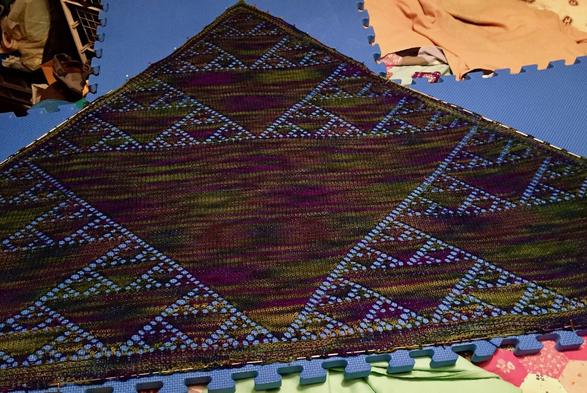
If you double the height each time it's going to go up by an octave (assuming height == frequency.) So you wouldn't have to do anything too weird with the scale. It'll sound pretty good already.
Ah, never mind, just saw the piano keys next to it. Yeah, that probably helps more yet 🙂
Cursor progresses through equilateral triangles filled with dot pattern, all sharing a baseline, but increasing fractally in size and complexity. Each dot corresponds to a note on the piano keyboard across left edge of image. The music reaches a crescendo with each triangle peak, increasing in complexity, length, pitch and loudness. Sounds like Bach, surprisingly catchy.
1st phase: 3 triangles of each size. 2nd phase: triangles are built up gradually over time.

@acb This is very cool. I've seen other places where music and mathematics intersect so I would have guessed, and some mathematics / music theory nerd could probably explain why.
In fact I would imagine that experiments like this are how mathematics/music theory nerds are born.
@acb Amazing & loving the build up! I've also had great success with using 1D #CellularAutomata in the same manner. You could also try adding secondary #Fractals/automata to control note durations, create #PolyRhythms, cause key/chord changes, self-modification of rules etc. Here's a video of an installation for which the realtime composed music is using both of these approaches (and other #GenerativeMusic techniques):

@jet @acb yeah you're probably right, lots of DAWs are dark grey.
Anyway Renoise is a #Tracker which originated in the 90's possibly even earlier, from the #DemoScene movement in Europe so they have a lot of meaning to me as I grew with with trackers like FastTracker 2, Impulse Tracker, Sound Tracker etc.
Renoise is a commercial tracker that even works on Linux, there is a free version that mostly lacks export to WAV.
@acb if you like such things and theories you can have a lock at this:
https://youtu.be/M48319x1Kg4
And the explanation video to it is here:
https://youtu.be/8x374slJGuo

 Directed Alberto Cetoli Graph
 Jazzaria
 nerdy-horse-digital
 Knitronomicon
 Dr Elena Lonergan
 Simon Gredal
 Zabuxx
 LillyLyle/Count Melancholia
 Nicolas Pettiaux
 Dr David Mills
 Dilski
 Roger Ap Gwillian
 ⁂ Fish Id Wardrobe
 I Can't Believe It's Not Zero!
 Noah Gibbs
 Mark Armstrong
 EmJaeCaer
 vetetix
 Yingtai
 resoluxe
 Kagan MacTane (he/him)
 Jazztronaut
 Bel Lion
 Ian McLeod
 swiffy
 Cea Noyes
 Ethan 🌒
 Cosmic Ray
 Gavin Graham
 hypergeometric2f1
 Harold Daniel 🌞 🇺🇦
 Dreaming of dad jazz.
 This is Mur
 Karsten Schmidt
 Rainer Burkhardt ❌
 Vani Srinivasan
 Nafeon the Bear
 Dominic Pajak
 Rob van der Linde
 Michael U
 Marije van den Berg
 The Chaotic Good 🏳️⚧️🏳️🌈🖖
 nash
nash Michael 🏴☠️ Fleet
 Alan Westbrook
 Shujin Academy VGM Club
 Tom Martinek
 ScriptOps
 \m/(-_-)\m/
 ¡Emancipemos a… se cambió!
 DoKo
DoKo