Crowdsourcing your ideas for the #BrainIdeasCountdown:

Before we all turn into Winter Holiday pumpkins: What are some most interesting ideas in brain research that I haven't highlighted yet? I've sketched out my own ideas for these last 2/10 days (promise!). But brain research is working on so much & I'm curious to hear your thoughts about what exactly that is. Here's my (random) list:

Idea10: Our moods depend on what's happening in our gut.

Idea 9: Across individuals, the same brain functions are implemented by biological details that vary a lot.

Idea 8: Consciousness level can be measured by measures of brain activity complexity.

Idea 7: Stimulation of the brain at multiple nodes may dance it from dysfunction back to normal function.

Idea 6: Gene therapy may circumvent the need to understand how mutated proteins lead to brain dysfunction.

Idea 5: Neurons in the brain influence one another through the electric fields that they generate, ephaptic coupling.

Idea 4: Our health and well-being is determined not just by our genes, but also the genes of those around us, "social genetic effects."

Idea 3: We rely on our memories of the past to predict the future.

Idea 2: We can control the excitability of neurons by shining light on them, optogenetics.

Idea 1: Free will is NOT an illusion.

  • Ideas 1 & 2 updated posthoc to complete the list.

For details, click here: #BrainIdeasCountdown

So: What haven't I highlighted yet?

Thinking about brain research this way is a bit of a twist on how we normally think about things. I would say that we tend to think more in terms of findings, eg "That paper found ..." whereas this is something more like, "That stack of papers is working on the idea that ..."

It's interesting to think about one's own work in that light: What ideas am I working on and who else is working on the same idea (perhaps with a different approach)? Similarly, what sorts of ideas is the field working on? And are these ideas new or old?

Here's a slightly more provocative way to pose the question: In The Idea of the Brain, Matthew Cobb argues, "In reality, no major conceptual innovation has been made in our overall understanding of how the brain works for over half a century ... we still think about brains in the way our scientific grandparents did."

Setting aside semantic debates about what constitutes a "major conceptual innovation", brain researchers are clearly working on a large number of ideas that their grandparents had not thought of. But what are those, exactly?

@NicoleCRust It is a complex dynamical system and a prediction organ (although some gran dparants may have thought of that already?)

@MolemanPeter
Yes! These are two important ideas, regardless of when they arrived.

If we did care to know when they joined us, we might trace the complex dynamical system bit to Hopfield nets (so 1982)? John remains our contemporary, so I think we should call that a newish idea.
https://www.pnas.org/doi/10.1073/pnas.79.8.2554

As for the idea that the brain is a prediction organ - that seems a bit older. Bayes (1700s?)

@NicoleCRust Bayes is old, but also applied to the brain? I don't know, do you?
@MolemanPeter Fair enough. I've largely given up on the notion that it's useful to split hairs between brains and minds/behavior - I think it's more useful to put it all in the same pile (but I should be clearer about that when I write). Bayes was motivated to figure out how he could make good predictions. Extending signal detection theory to incorporate Bayes (eg priors) to model behavior began to really take off in the 1990s. But I'm not sure of the history in between. Anyone?
@NicoleCRust Agree -re brain and mind/behaviour- but I think in older times, untill recently, the brain iitself has not been seen as a Baysian organ.
@NicoleCRust Matthew Cobb is here too @matthewcobb – has there been any recent idea on what the brain is or how it operates that wasn't a rehash of an idea from before 1970?
#neuroscience #brain
@albertcardona @matthewcobb
Thanks! And really great question. How about:
The brain is a complex recurrent dynamical system, Hopfield 1982.
https://www.pnas.org/doi/10.1073/pnas.79.8

@albertcardona @matthewcobb

Or this one? Across different individuals, the same brain functions are implemented by biological details that vary a lot. This is true even for simple circuits like the ones that control the stomach of a crab, where the numbers of ion channels can vary 2-6x across different crabs but the circuit always does the same thing.

https://www.sciencedirect.com/science/arti

@albertcardona @matthewcobb
I'd love to see anyone add to this list! But the main point is also really important for everyone to grasp, I think: there are many fewer things in this list than you might imagine.

@NicoleCRust @matthewcobb

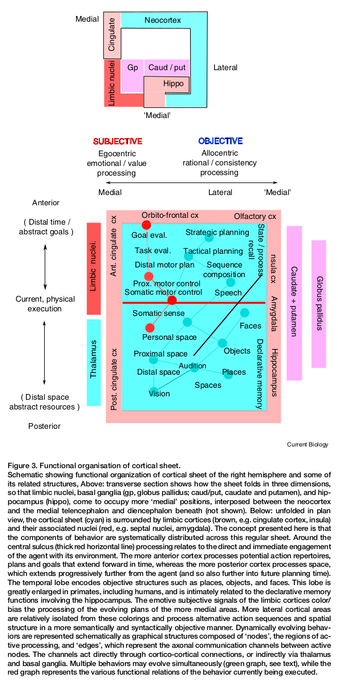
Related, on navigating the brain, I find this perspective from Douglas and Martin 2012 https://scholar.archive.org/work/2hbqczvzrnfrdnwcvfpreodg24 a useful synthesis of what was known or suspected or somewhat understood at the time, 10 years ago.

The first figure relates areas of the cerebral cortex with the basal ganglia.

The second figure maps space and time axes over the cortical sheet, with markings for subcortical nuclei and attributed functions to cortical areas.

#neuroscience #brain

@albertcardona @matthewcobb
Thank you! There are some ideas here that I was not aware of with regard to how their ideas about a canonical microcircuit are organized in 2D on the cortical sheath. TL;DR: It's a bit complicated, but the AP axis captures the spatiotemporal scale of the agent’s interaction with the environment & the ML axis captures subject vs objective processing.
https://linkinghub.elsevier.com/retrieve/pii/S0960-9822(12)01326-7
@albertcardona @matthewcobb
A shocking correlate of this is that the vast majority of brain researchers never come up with a new idea about how the brain works. Which I don't throw out there to belittle (I'm one too) but to inspire the next generation: WE.NEED.NEW.IDEAS.ABOUT.HOW.THE.BRAIN.WORKS!

@NicoleCRust @albertcardona @matthewcobb

I strongly expect that anyone coming up with a new idea that really works, especially if it can be made to run in silico, will be surprisingly often ignored, obstructed, machinated against, and finally have their idea "stolen" by tech oligarchs and used against humanity.

@NicoleCRust @matthewcobb

That's what motivates me to work on small organisms: we have a chance to study, conceptualize, and eventually understand, how the brain works as a whole.

I would like to think that solving the #Drosophila brain is within scope of the next two decades. Understanding the mammalian brain, on the other hand, particularly that of a primate, is within my grandchildren's lifetime.

First lets make a paper airplane, only much later let's design a jumbo jet.
#neuroscience

@NicoleCRust @albertcardona @matthewcobb
One of the things I've been struggling with recently is how the vast majority of papers (including most or arguably all of mine) don't propose an idea that could in principle get us closer to understanding how the brain does what it does. I have the feeling that there was this moment in time when people were coming up with tons of crazy theories. They were all wrong (probably) but it was exciting. Now we're just talking about how many dimensions a 'neural manifold' has and I just can't get excited about that (sorry manifold people). In my case, I think I've had a small handful of ideas that went in the direction I'd like neuroscience to be going in of proposing ideas that could scale to part of a full explanation of the brain, but I haven't pursued them because they were hard to define or get funding for. My resolution for 2023 is to focus more on those interesting questions and less on things that I think are easy to get published or get funding. For what it's worth, the biggest challenge to neuroscience I reckon is how it can operate in a stable way based on what seems to be a surprisingly unstable substrate (e.g. synaptic turnover). If I had a good idea about how to solve that problem, that's what I'd be working on.

Edited to add: I don't mean to criticise anyone's work! It's more a personal realisation that I've not been pursuing research directions that I believe could really lead to understanding the brain. On a metascience level, I think it's important that different people take very different approaches, most of which they will disagree on. If it's not like this, we won't make progress. My realisation is perhaps that I've been trying too hard to fit in and it's not working for me.

@neuralreckoning @NicoleCRust @matthewcobb
Kudos to that. I'd posit, only ideas and data sets that will remain interesting decades from now are worth working on right now. "Anatomy doesn't expire" is an inspiration for me. I don't know what's the equivalent in the theory or modelling fields, but anatomically-grounded models seems for me one clear way to go, and given the centrality of cells–neurons–in brain function, that to me means starting with species that have a synaptic #connectome mapped.
@albertcardona @NicoleCRust @matthewcobb
I actually kinda think the opposite for theory. What we need is more wild ungrounded exploration to find mechanisms that could explain the richness of the brain, because the grounded theory we've been pursuing so far can only explain aspects of brain function that aren't rich enough to explain the really interesting stuff. Most models are based implicitly or explicitly on the idea of stable weights and mostly electrical signalling. What happens to all that theory if both of those assumptions are wrong (and it increasingly seems they might be)?
@neuralreckoning @NicoleCRust @matthewcobb Anatomy and development say there are gap junctions, there are increasing and decreasing numbers of synapses throughout the day, synaptic size isn't constant, the spatial arrangements of axons and dendrites motivate ephaptic coupling, there are changes in neuron number seasonally throughout the year, and neuromodulation reshapes circuit activity dynamically. Agree that theory has fallen short so far of capturing most of these.
@neuralreckoning @albertcardona @NicoleCRust @matthewcobb tbc those two assumptions are definitely wrong on multiple temporal and spatial scales, there is no need to hold back there
@neuralreckoning @albertcardona @matthewcobb
Wow Dan. I’m going to think on this for a bit. This strikes me as a very important conversation and one we should not treat as a simple whim along with all else that flitters by. For now, thank you.

@neuralreckoning @NicoleCRust @matthewcobb

By the way on the turnover and overall dynamic nature of neural circuits, Casey Schneider-Mizell @csdashm has a paper from his PhD times on modelling a neural network that factors in neurogenesis and also cell death:

"From network structure to network reorganization: implications for adult neurogenesis" 2010 https://iopscience.iop.org/article/10.1088/1478-3975/7/4/046008/meta
#neuroscience

@neuralreckoning @NicoleCRust @albertcardona @matthewcobb
Ok I share the feeling but am going to disagree on the manifold part: part of why I started being interested in the brain in the first place was that I was interested in studying dynamical systems of belief and action in politics and economics. when it turned out that wasn't ... how the discipline of economics worked my history prof suggested neuroscience and was right by an unimaginable longshot. I came thru dynamical systems and was always and perpetually baffled why neuroscientists didn't see the brain as intrinsically a nonlinear dynamical system, which has its methodological constraints. but all I saw was people trial averaging individual neural measurements, which makes no sense with the long range dependencies across every timescale from milliseconds to years in a system like the brain.

the manifold is just true, almost tautologically so: if one defines neural activity in a geometrical space, given the connectivity of neurons which influences the possible dynamical vocabulary of each and the population, there is some constrained dynamical regime that the population is allowed to act on. I also get bored of papers that lose the plot of what they're trying to explain and resort to extremely trivial estimates like number of dimensions, etc. I get unimaginably more depressed when I see techniques like representational similarity analysis, completely geometrically unfounded, overtake entire fields because the technique is intrinsically expedient to developing a career: you get to say whatever you want with it.

Have you ever read Solaris? by Stanisław Lem? you should read solaris. it's the best description of this problem of trying to understand something that is so unimaginably complex that maybe, unlike physics, where a vast number of phenomena could be compressed to a very small number of parameters (relatively speaking!!!), the brain is less compressible. maybe the complexity of theory that we need to match the "compressibility" of the brain is less attainable given how we do science. it's a good book.

What if there was no possible theory? that every brain was as complex as every atom of it interacting with its full range of independent possible complexity, regardless of the interactive constraints composed by its partners? The interdependence of parts guarantees some pattern, but how much?

I don't think we even have the vocabulary for it, but I feel like we can recognize promising directions through the hype if we can build systems that make it so we don't need to individually take a global view on what we're even looking at, and instead are able to work cumulatively across time and space. Ideally, we'd also be able to work honestly, without the pressure of hype, as you're describing as your focus rn. I don't believe with the current incentive systems that surround science stretching from the everyday to the career-long that we'll ever get there, one of the reasons I abandoned the craft. I want to one day be able to study the brain though, when we reclaim the planet, so don't kill the manifolds yet.

@jonny @neuralreckoning @NicoleCRust @matthewcobb

You point out what I think is an important first step: to identify the invariances.

For example, as already functional neuronal arbours grow, they can remain a single electrical compartment [1], the synaptic wiring diagram doesn't change qualitatively [2, 3], and the underlying compensatory mechanisms are likely related to the "degeneracy" of, or overcapacity in, ion channel variants [4, 5].

#neuroscience

References follow below.

Activity-dependent compensation of cell size is vulnerable to targeted deletion of ion channels - Scientific Reports

In many species, excitable cells preserve their physiological properties despite significant variation in physical size across time and in a population. For example, neurons in crustacean central pattern generators generate similar firing patterns despite several-fold increases in size between juveniles and adults. This presents a biophysical problem because the electrical properties of cells are highly sensitive to membrane area and channel density. It is not known whether specific mechanisms exist to sense membrane area and adjust channel expression to keep a consistent channel density, or whether regulation mechanisms that sense activity alone are capable of compensating cell size. We show that destabilising effects of growth can be specifically compensated by feedback mechanism that senses average calcium influx and jointly regulate multiple conductances. However, we further show that this class of growth-compensating regulation schemes is necessarily sensitive to perturbations that alter the expression of subsets of ion channel types. Targeted perturbations of specific ion channels can trigger a pathological response of the regulation mechanism and a failure of homeostasis. Our findings suggest that physiological regulation mechanisms that confer robustness to growth may be specifically vulnerable to deletions or mutations that affect subsets of ion channels.

Nature
@jonny @NicoleCRust @albertcardona @matthewcobb
I don't have anything against manifolds per se. I did my PhD in dynamical systems and hyperbolic geometry. It's just that I haven't seen anything done with that theory that makes me feel I better understand what the brain is doing. Read Solaris but honestly forgotten most of it. Much preferred the Tarkovsky film which I think goes in an entirely different direction.

@neuralreckoning
@NicoleCRust @albertcardona @matthewcobb @WiringtheBrain

Dan, I'm not sure I agree with you but need to think. One place for ideas is in review/conceptual papers and I think there's a good amount of ideas going around in those. I have tried to be active on this end, or at least as much as time permits.

@PessoaBrain @neuralreckoning @albertcardona @matthewcobb @WiringtheBrain
Dan's post feels important - something we should all be thinking and talking about. Given that we are all about to turn into pumpkins (or at least I am) I hope we can pick this up in a serious way early 2023.
@PessoaBrain @neuralreckoning @NicoleCRust @albertcardona @matthewcobb @WiringtheBrain
There seems to be a small circle of people indeed doing work like this, notably you, Paul Cisek, Kevin here too, but even this conceptually exciting work is still very far from diffusing throughout the neuroscience community: most, unfortunately, still know nothing of it, which, I think, is the reality Dan's comment reflects.
@WorldImagining @PessoaBrain @NicoleCRust @albertcardona @matthewcobb @WiringtheBrain
I didn't mean to criticise anyone's work! It's more a personal realisation that I've not been pursuing research directions that I believe could really lead to understanding the brain. On a metascience level, I think it's important that different people take very different approaches, most of which they will disagree on. If it's not like this, we won't make progress. My realisation is perhaps that I've been trying too hard to fit in and it's not working for me.
@neuralreckoning
@WorldImagining @NicoleCRust @albertcardona @matthewcobb @WiringtheBrain
Didn't take it as a criticism at all. To the point of making more vigorous impact as @WorldImagining says, well that's part of science. Ideas have complex ways of diffusing and have their own dynamics... (sorry to be so predictable!)

@PessoaBrain @neuralreckoning @WorldImagining @NicoleCRust @albertcardona @matthewcobb @WiringtheBrain A latent question throughout this thread is whether we would recognize a powerful new idea if it did come along (or has come along?...). It seems common to expect "new" ideas to be "exciting", etc, but I don't see those expectations as necessary or even desirable. If some new concept is a stepping stone to a powerful shift in understanding, it seems just as likely it would be difficult to reconcile with our current way of thinking. Otherwise, why didn't the shift already happen?

A really new idea about the brain is likely to be challenging and unreasonable, to be something we instinctively try to reject. More a thief in the night than a triumphal entrance, waiting for its importance to be discovered in retrospect. Like the old joke: every great scientific idea is wrong before it is obvious.

I expect you have counter-examples to offer, and I am dramatizing a bit. But a paltry return on the enormous number of person-hours going into brain science might arise not because we just haven't found that great new idea yet, but because we're fundamentally wrong about something, and error correction is psychologically harder than novelty detection.

@PessoaBrain @neuralreckoning @WorldImagining @NicoleCRust @albertcardona @matthewcobb @WiringtheBrain Clayton Christensen's The Innovator's Dilemma makes arguments about industrial innovation that might be useful analogies here, though not all the economic details will line up. Typical reference is of course Thomas Kuhn. I think this concern, that we are bad at recognizing and adapting to progress as it is happening, is a prime argument for hedging the system, through more support of mad scientists wandering in the wilderness (compatible with what Dan was saying, I think) and fewer opportunities and requirements for prestige. I'm generally skeptical of the norm that the highest scientific goal is the manufacture of great new ideas; it seems like a flawed knowledge model imbued with social status bias. To be clear, I really enjoy your posts, Nicole, and the ideas are exciting. And I think a worthwhile variant you might try is to sometimes flip the script and seek out "obviously wrong" ideas from recent years, and earnestly try to construct arguments in favor of them anyway (if they are wrong but substantive). Like Dennett's "steel-personing", but intended not for debates, but to break out of conceptual local minima.
@jason_ritt @PessoaBrain @neuralreckoning @NicoleCRust @albertcardona @matthewcobb @WiringtheBrain An anecdotal point relative to all these interesting arguments, but Kuhn was fundamentally and vocally opposed to supporting mad scientists wandering in the wilderness. More like Feyerabend, I also think developing a capacity for entertaining (in a deep sense) all kinds of ideas and paradigms, right or wrong, is a fertile path for researchers, especially theoretical ones. Gould thought similar.

@jason_ritt @PessoaBrain @neuralreckoning
@WorldImagining @NicoleCRust @albertcardona @matthewcobb @WiringtheBrain

Here’s one: what if substantial neural computation & memory is carried out by genetic circuitry (eg miRNA & TF networks) that control pulse amplitude, frequency, & LTP? A network inside each node of a network.

@jason_ritt @PessoaBrain @neuralreckoning
@WorldImagining @NicoleCRust @albertcardona @matthewcobb @WiringtheBrain

My lab works in Synthetic Biology where we (as a field) engineer fairly complex I/O, analog, dynamic, & sequential logic genetic circuits. Such genetic circuits could exist inside each neuron, controlling synapse interactions.

@hsalis @jason_ritt @PessoaBrain @neuralreckoning @WorldImagining @NicoleCRust @matthewcobb @WiringtheBrain

It’s undeniable that neurons aren’t simple cells, and that particularities of their cellular metabolism play a role in neural circuit function. An obvious link between neural function and molecular components is Ca2+, which beyond uses in monitoring neural activity has been proposed as a basis for molecular ticker tapes of activity, written directly to the genome.
1/3

@hsalis @jason_ritt @PessoaBrain @neuralreckoning @WorldImagining @NicoleCRust @matthewcobb @WiringtheBrain

Key question is whether we can ignore cell metabolism and still make sense of neural circuit function? Recent work by Hermann Cuntz lab on the degeneracy of ion channels https://arxiv.org/abs/2203.06391 hints that perhaps yes: the molecular level has the means to implement homeostasis so as to brush over details of cellular architecture that would otherwise require careful attention.
2/3

Pareto optimality, economy-effectiveness trade-offs and ion channel degeneracy: Improving population models of neurons

Nerve cells encounter unavoidable evolutionary trade-offs between multiple tasks. They must consume as little energy as possible (be energy-efficient or economical) but at the same time fulfil their functions (be functionally effective). Neurons displaying best performance for such multi-task trade-offs are said to be Pareto optimal. However, it is not understood how ion channel parameters contribute to the Pareto optimal performance of neurons. Ion channel degeneracy implies that multiple combinations of ion channel parameters can lead to functionally similar neuronal behavior. Therefore, to simulate functional behavior, instead of a single model, neuroscientists often use populations of valid models with distinct ion conductance configurations. This approach is called population (also database or ensemble) modeling. It remains unclear, which ion channel parameters in a vast population of functional models are more likely to be found in the brain. Here we propose that Pareto optimality can serve as a guiding principle for addressing this issue. The Pareto optimum concept can help identify the subpopulations of conductance-based models with ion channel configurations that perform best for the trade-off between economy and functional effectiveness. In this way, the high-dimensional parameter space of neuronal models might be reduced to geometrically simple low-dimensional manifolds. Therefore, Pareto optimality is a promising framework for improving population modeling of neurons and their circuits. We also discuss how Pareto inference might help deduce neuronal functions from high-dimensional Patch-seq data. Furthermore, we hypothesize that Pareto optimality might contribute to our understanding of observed ion channel correlations in neurons.

arXiv.org

@hsalis @jason_ritt @PessoaBrain @neuralreckoning @WorldImagining @NicoleCRust @matthewcobb @WiringtheBrain

On the other hand, the double genome duplication from mere chordates to vertebrates, and the expansion of neural gene families in cephalopods & other invertebrate families with species that score high for cognition, suggest that molecules matter a lot. Even between the reptile cerebral cortex and the mammalian, a key difference between pyramidal cells has been suggested as molecular.
3/3

@hsalis @jason_ritt @PessoaBrain @neuralreckoning @WorldImagining @NicoleCRust @matthewcobb @WiringtheBrain

On reptile pyramidal cells I’m thinking of:

“Cellular physiology of the turtle visual cortex: distinctive properties of pyramidal and stellate neurons”
Connors & Kriegstein 1986 https://www.jneurosci.org/content/6/1/164.short

and

“Dendritic properties of turtle pyramidal neurons”
Larkum & al. 2008 https://journals.physiology.org/doi/abs/10.1152/jn.01076.2007

#neuroscience #reptile #cortex

Cellular physiology of the turtle visual cortex: distinctive properties of pyramidal and stellate neurons

The electrophysiological properties of neurons in the three-layered dorsal cortex of the turtle, Pseudemys scripta elegans, have been studied in vitro. Intracellular recordings suggested two distinct classes of neuronal behavior. Cell labeling with either Lucifer Yellow or horseradish peroxidase revealed that these behaviors correlated with the two morphological classes of cortical neurons: pyramidal cells and stellate cells. Examination of Golgi-stained neurons of dorsal cortex did not uncover any other obvious classes. Pyramidal cells had their somata in the cell layer, and extended several densely spined apical dendrites through the molecular layer to the pia. They also had spiny basilar dendrites directed through the subcellular layer toward the ependymal border. Physiologically, pyramidal cells had relatively prolonged action potentials that showed marked frequency adaptation during a sustained suprathreshold current pulse. Their most striking characteristic was a tendency to fire two discrete sizes of action potential, one small (mean = 34 mV) and of relatively low threshold, the other large (mean = 76 mV) and of higher threshold. We hypothesize that at least some small spikes arise from distal dendritic sites, whereas large spikes are somatically generated. Both spikes were tetrodotoxin-sensitive, although calcium-dependent electrogenesis occurred when potassium channels were blocked. In contrast to pyramidal cells, the somata of stellate cells were found in the molecular and subcellular zones. Their dendrites tended to be horizontally oriented and spine-free. Stellate cells had relatively brief action potentials, each of which was followed by a large but short-lasting undershoot of membrane potential. Stellate cells showed little or no spike frequency adaptation. Spike amplitudes were always relatively uniform and large (mean = 73 mV). Thus, in the dorsal cortex of turtles, the pyramidal cells, which are projection neurons, and stellate cells, which are local GABAergic inhibitory neurons, have distinctly different membrane characteristics. The physiological properties of the two types of turtle cortical neurons are very similar to their counterparts in cortical structures of the mammalian telencephalon.

Journal of Neuroscience

@albertcardona @hsalis @jason_ritt @neuralreckoning @WorldImagining @NicoleCRust @matthewcobb @WiringtheBrain

Interesting. But some turtles are pretty unique reptiles no? I mean, some have a layered sector of pallium/cortex. Three layers right? It's been a while since I read it last.

@PessoaBrain @hsalis @jason_ritt @neuralreckoning @WorldImagining @NicoleCRust @matthewcobb @WiringtheBrain

Classical cytoarchitectonic work of reptile cerebral cortex is wrong. Tosches and Laurent (2018) https://www.science.org/doi/full/10.1126/science.aar4237 demonstrated that not only all inhibitory neuron types are there except for Chandelier cells, but also the layering is far more elaborate and much closer to mammals than ever known before.

@jason_ritt @PessoaBrain @neuralreckoning @WorldImagining @NicoleCRust @albertcardona @matthewcobb @WiringtheBrain
"Shallow ideas can be assimilated; ideas that require people to reorganize their picture of the world provoke hostility."
according to Gleick, James. Chaos: Making a New Science (Kindle Locations 558-559). Open Road Media. Kindle Edition.
This may equaly apply to seing the brain as a self-organizing complex dynamical system as to chaos.
Andrew Glennerster (@[email protected])

In summary, don’t imagine that the brain carries out complex 3D coordinate transformations (retinal -> egocentric -> world-centred). Instead, imagine a point moving across a high dimensional manifold of potential brain states and what that movement could achieve. 21/21.

Mastodon @ SDF
@jason_ritt @PessoaBrain @neuralreckoning @WorldImagining @NicoleCRust @albertcardona @matthewcobb @WiringtheBrain @elduvelle @clarepress
I am adding Clare Press as she has advocated spending more time thinking about frameworks. https://doi.org/10.1016/j.cub.2021.11.027. Jason is correct that our paltry progress is because we have a fundamentally wrong conception. Here is a 6min version of what I think is missing: https://www.youtube.com/watch?v=oDLtPY1e9bk (summary: the brain produces just a daub of paint, not a picture in one go).

@ag3dvr @jason_ritt @PessoaBrain @neuralreckoning @NicoleCRust @albertcardona @matthewcobb @WiringtheBrain @elduvelle @clarepress

Thanks for sharing the video, very interesting. Is what you're calling for, the canvas, a metaphor for something similar to what the global neural/cognitive workspace is intended to refer to?

@WorldImagining @jason_ritt @PessoaBrain @neuralreckoning @NicoleCRust @albertcardona @matthewcobb @WiringtheBrain @elduvelle @clarepress

Thanks for looking at it. No, I am thinking of something simpler (from a neural perspective), i.e. neural state -> action -> neural state -> action etc. This is easy for the brain to do and it is easy to see how it evolves from simpler organisms. But this sounds like neural control of action. The tricky bit is to apply it to perception. 1/3

@WorldImagining @jason_ritt @PessoaBrain @neuralreckoning @NicoleCRust @albertcardona @matthewcobb @WiringtheBrain @elduvelle @clarepress

In reinforcement learning, this is called a 'policy network'. In the paper and the thread I refer to above, I have tried to illustrate this claim (ie that perception can be understood as a policy network) using 3D vision as an example, i.e.:
https://doi.org/10.1098/rstb.2021.0448
explained in a 21-part toot here:
https://mastodon.sdf.org/@ag3dvr/109541827847990553
2/3

Understanding 3D vision as a policy network | Philosophical Transactions of the Royal Society B: Biological Sciences

It is often assumed that the brain builds 3D coordinate frames, in retinal coordinates (with binocular disparity giving the third dimension), head-centred, body-centred and world-centred coordinates. This paper questions that assumption and begins to ...

Philosophical Transactions of the Royal Society B: Biological Sciences

@WorldImagining @jason_ritt @PessoaBrain @neuralreckoning @NicoleCRust @albertcardona @matthewcobb @WiringtheBrain @elduvelle @clarepress

You ask what the canvas is. One simple example is what is often described as a 'spatial canvas' that unites foveal processing across eye movements. In this paper, the authors are interested in the non-retinotopic representation of the face:
https://doi.org/10.1016/j.cub.2019.01.077. 3/4

@WorldImagining @jason_ritt @PessoaBrain @neuralreckoning @NicoleCRust @albertcardona @matthewcobb @WiringtheBrain @elduvelle @clarepress

More generally, the canvas is the manifold of potential neural states across which we move. That is where the interesting complexity of the brain lies, not in the apparatus that generates an instantaneous neural state. The instantaneous neural state is the daub of paint, the interesting complexity is all about linking these together. 4/4

@ag3dvr @WorldImagining @jason_ritt @neuralreckoning @NicoleCRust @albertcardona @matthewcobb @WiringtheBrain @elduvelle @clarepress

Andrew, very cool ideas, and I think shared by some of us at least. Will take a look at some of the pointers you shared, thanks.

@ag3dvr @jason_ritt @PessoaBrain @neuralreckoning @NicoleCRust @albertcardona @matthewcobb @WiringtheBrain @elduvelle @clarepress
Okay, I think I see what you mean about the canvas, though still have doubts about your opposing "instantaneous neural states." Such a thing, in my perspective, could exist only in the abstract, not experientially or physiologically. I don't know of any apparatus that generate "instantaneous states," since every neural or cognitive "module" develops under feedback..?

@neuralreckoning

hi Dan,

i wonder... on this, something for you perhaps:

http://anexerciseinmental.com/on-the-exercise
http://anexerciseinmental.com/about
http://anexerciseinmental.com/framing-questions

full disclosure, i have only just begun hastily pushing these notes online, from a fairly weighty, densely-linked, pkm. so, a sketch, for the time being. though i can prioritise topics, aspects, or revisions, as necessary

best,

on the exercise

active draft. a technical sketch. general, before special —alignment, before distraction project overview This project will be referred to as the exercise a brief history of the exercise The exercise began as an attempt to find a better way to describe meditation practice – but as the exercise progressed, the project

an exercise in mental
@neuralreckoning @NicoleCRust @albertcardona @matthewcobb its a bummer that reviewers (myself included) often ask authors to "step back" their conclusions, instead of letting them flex their creativity

@NicoleCRust @albertcardona @matthewcobb

Do we *really*, though!

I'm very partial to Sydney Brenner's quote about progress in science: "Progress in science is made through new technologies, new discoveries, and new ideas, probably in that order."

To me, the biggest deficit--not that theory is unimportant--is in being able to experimentally address the problem at the scale that we know is important. It's kind of like we're trying to understand weather dynamics by giving everyone in London a thermometer (and not bothering to tell them to keep it outside), putting a wind-speed meter in Glasgow and in Miami, and observing the clouds from a lunar observatory.

We know for certain that there is lots of feedback, that connectivity is elaborate and important, and that gain control can be large--in short, we have every reason to believe that details ought to matter, and mostly we can't see them, which makes it very hard to discern how well we actually understand "how the brain works". If current (detailed) theories were fully adequate, I'm not sure we'd know!

So to me, we need ideas not about how the brain works but how to couple what we can actually observe with somewhat reducing the space of possible models. (Plus I second Albert's recommendation to invest effort in simpler systems.)

@NicoleCRust @albertcardona @matthewcobb

For example, if we're interested in cortex, we have to grapple with the fact that cortical connections are broadly specified during development, extensively modulated by activity, and may contain some intermediate representation and state of some computation that isn't easily connected either to outside stimuli or to goal-directed behavior. So we have a mixed problem of development, synaptic plasticity over multiple timescales, highly parallel input and output...and have a hard enough time even measuring the broad outlines of the basic rules like synaptic pruning, let alone how the system was built.

So, what is the operation of cortex, or a cortical column? Well, maybe the cortical architecture supports, as is, with known mechanisms of synaptic plasticity etc., a variety of general-purpose computations and the only thing we're really missing is the correct parameter ranges and initial network connectivity to support this function (but we'll never know without better data than we can get right now).

Alternatively, maybe the largely reductionistic approach taken by neuroscience has led us to missing systemic effects (LFPs, neuromodulators, etc.) that play a critical role in how the circuit functions, and if we had better measurements of such things (both what they are and the magnitude of their effects), we'd figure out the computation.

Or maybe we're not even conceptualizing the "computation" the right way at all. Maybe the analogy we draw to input-output devices like transistors or functions are poor ways to model how the brain works, and there's an emergent property of the system that will give us better explanatory power. But if we came up with a much better model, unless we magically manage to nail all the free parameters perfectly, would we actually agree with the experimental data we can collect any better than in the first case where we guess that each neuron is integrating dendritic inputs and producing spikes and that's basically all we need to know?