 SetKu
SetKu Adam Conover
Everyone is asking "What's the next Twitter going to be" and bemoaning the fact that the userbase is splintering. But splintering is a GOOD thing. The internet would be a lot healthier, more diverse, in instead of 3 or 4 dominant platforms, we had dozens or even hundreds of upstarts. Yes, centralization is convenient, but as we're seeing, it's also dangerous. If the result of the Twitter turmoil is to drive people to a more diverse, less convenient, less centralized web, I say AWESOME.
Seriously, the most fun I ever had online was in the years prior to 2008 - when instead of visiting just one or two huge sites over and over, I spent my days wandering from message board to personal site to proto-social network in search of cool people and cool stuff. If we move just 1% back in that direction - with people visiting Mastodon, AND Cohost, AND whatever the fuck other sites they like - I'll be very happy.
 jveezy
@adamconover Bring back webrings!
 Carson Wood
@adamconover I remember trying to make my own message board with like phpBB and connecting to all the ones like those back then!
 Advisory Briefs 🛠️
@adamconover and the lack of centralization within Mastodon itself is incredible...so when Gab made a Mas fork, most the other Mast instances just blocked them, I've never been called a commie pinko leftist here (as an insult anyway) and that's a feat I never thought a social media network could have
 Lê Fê is back
 Mega “Byte” Matt
@adamconover there are a couple of other social networks that are abusing this chaos by doing malicious stuff with people's data, though. Hive/Post aren't too kosher, for example.
 MelloProto
@adamconover Brighter days are on the horizon. The whole Twitter debacle might just cause a new wave of online exploration. We need that.
 Darryl Mott
@adamconover Which is fine if your goal is "fun".
For people who use social media for self-promotion of their work that pays their bills or activists and organizers who use it to keep people informed of critical political issues and direct action events, this is a critical blow.
 eyajpng
@Abstruse @adamconover agreed, though if fediverse/activitypub catch on, it would go a long way toward healing that blow
 Cory Oldweiler
@Abstruse @adamconover Well said. One of the things I’m having a hard time with is how so many posts/people are assuming that everyone’s desires/needs/communities are the same. They’re not.
 Chris Freitag
@adamconover 100% agree with how this feels. Like we were in a 14-year internet relationship with services we perceived as easier but were actually smothering us.
 Brett Haddoak
@adamconover bring back IRC servers and BBS's
 John Harris
@adamconover I think a big part of the change is that many many more people lot more people started coming online, which both caused a lot of big companies to chase the casual user (to the detriment of the old guard, who were always the enthusiasts), and news orgs also started seeing social media as the "real" internet because of the huge population.
I think the old web has never really gone away, but it's been ignored a lot lately, that's caused it to seem like it's diminished, and that perception has caused a lot of actual diminishment. Plus, old sites succumb to entropy _very_ easily, and the energy behind creating replacements has been less, and somewhat co-opted by Fandom. Instead of creating a fun and idiosyncratic fansite, people just make something on Fandom.
 nohhue
@rodneylives @adamconover I disagree with the notion that "web 1.0"old sites haven't gone away. Take GeoCities: It got bought by Yahoo and then nuked from the internet with no archives.
Mastodon is trying to being the "decentralized" nature of the Internet (which was the entire goal of it, BTW) back. But unfortunately, a lot of "Eternal September" users and younger generation internet users come from the "web 2.0" era which... centralized servers (like GeoCities) but unlike GC doesn't"seperate"
@nohhue @adamconover That's a big place though, that was always looking to profit off of its members somehow. People still make tiny websites in places, it's sill pretty cheap to get a domain name. "Haven't gone away" can be interpreted along a range, from "still exist somewhere" out to "are everywhere." Geocities dying was terrible yes, but there's Neocities out there. There's still free tools like Wordpress and Blogger (for now), and Tripod still offers a personal tier.
@rodneylives @adamconover Sure, but ultimately Blogger (Blogspot anyway) has "died" in the sense of relevancy. Wordpress is a mixed bag in that if you host, it can be great (despite a security/patching nightmare) but if not you're at the whim of the host (like... Mastodon instances/Geocities).
My point is/was more that web 1.0, while great, runs into the issue that Mastodon has (and I've stated on other post): Most web 2.0/newer users aren't going to throw money at hosts and--
@rodneylives @adamconover -- "support" the service. GeoCities was just an example of the "splinter" effect of many websites... however, they were hosted on a "main service" (GeoCities hosted) like web 2.0.
Ultimately, the only way to get the Web 1.0 effect back is if everyone hosted their own servers, but that requires 1) money 2) bandwith and 3) technical know-how.
Which comes back to Mastodon: Masto. wants to be the 3 above... and most folks are used to Twitter/GeoCities-alikes where the--
@rodneylives @adamconover --hosting it done "itself" and they (generally!) don't have to pay.
(I should probably tag Adam out of this and whew, Masto doesn't solve the thread/long form issue Twitter has/had. :p)
 bisk
bisk@adamconover If you thought that was fun, I would recommend checking out https://neocities.org/ It is a modern clone of Geocities, like how it sounds. Lots of cute personal little sites. You all should try it!
 Philip Mallegol-Hansen
@adamconover I too hope we once again get to see the “Web” deserve its name. The plethora of interconnected sites was such a great experience.
Everyone creating a corner on the internet for themselves, in an infinite fractal of interests is more work, but definitely rewarding.
Everyone creating a corner on the internet for themselves, in an infinite fractal of interests is more work, but definitely rewarding.
 charlesesmith
@adamconover Please bring back blogs and weird forums and even IRC. I just hope he buys Facebook next.
 Jason, Human, Average
@adamconover Welcome! Glad to see you've made it to the party.
 mekka okereke
@adamconover
I hear that but... have you noticed that I'm the first Black person replying to this post?
I was online prior to 2008 too, and I have to tell you that those message boards weren't as fun for everyone.
If we're not very careful, decentralization reduces the effectiveness of social networks for driving social change. If the status quo works for you, that's a good thing! If it doesn't, then it's not.
Social networks as entertainment vs social networks as survival.
 Stephen Tatton
@adamconover the most fun i had online was before going online became an existential crisis, so, agreed
@adamconover I feel the same and I don't remember it being less convenient in any way. If anything it was thrilling to follow links from site to site discovering new stuff, diving down the entire ocean of the web. Today people mostly dive into a few controlled timelines. To me the experience was far more enriching and personal back then.
 Erik Moeller
Also: 2007 was the year you helped create one of the funniest videos I've ever seen on the Internet
https://www.oldeenglish.org/videos/Dishes_Like_to_Be_Dirty.mov
 Jaluna Rolik
@adamconover Those were the good ol' days, weren't they? I still remember it like it was yesterday...
Partially because i was still part of the message board community well after that. :D
 It's Just Jenn 🏳️⚧️
@adamconover decentralization is the way to go, both within the #fediverse and even outside of it.
 JimboFett
@adamconover To this day, I have the best discussions on the older PHP style message boards.
Why? Because you can get into a deeper discussion instead of how witty you can be in 200 characters or less.
That's why #Mastodon is so special.
 Danica Niki Radisic
@adamconover was just thinking today how Mastodon servers remind me of mIRC channels. Plus ça change, I suppose.
 tinkan
@adamconover I think it's better to have the *ability* to shard and decentralize when a big network begins to abuse its users and/or do 'the wrong thing'. (Whatever the wrong thing may be)
Centralization is going to happen, but not being locked in when things get *bad* is a great feeling.
The fact that half a dozen networks exist, or can be created for people to flee to is phenomenal.
 Jen
Jen@adamconover yes!! This.
 Marcia Darling
@adamconover Innovation happens in the fringes, so I'm all for this.
 Ryan
Ryan@adamconover Honestly, those were the days. I know I sound like the old man now, but really, it was fun. I’m not asking for Geocities all over again (although… 🤣), but you are right.
 Matt Stoller
@adamconover What about those of us who hate fun and healthy voyages of self-discovery?
 Dr. Casey Fiesler
@adamconover I actually totally agree with this, especially in the sense that sprawling, flat platforms can become toxic in part because they're not a community, but instead many communities with different bumping up against each other.
Though some of my research on platform migration (https://theconversation.com/mass-migration-from-twitter-is-likely-to-be-an-uphill-battle-just-ask-ex-tumblr-users-193677) has also shown that splintering leads to lost connections and friendships. So it would be nice if we had better ways to maintain those across platforms.

 David Dixon
@adamconover
[this is good]
[this is good]
 Seppo Helava
@adamconover I definitely don’t want to go back to ‘98 era web, when you had to remember what links to follow to get to a specific site, and tell everyone the entire path of breadcrumbs if they wanted to check it out.
 timpaintsdolls
@adamconover this is what RSS was for, right? Make it easier to keep up with your favorite sites/blogs/etc but via _their_ sites. It’d be great if things swung back that way, even if it’s not specifically RSS
 Greg Stolze
@adamconover well give www.gregstolze.com a look, particularly the FICTION tab.
 iteration523
@adamconover Yeah, it's toxic centrism at work - "discourse" replacing discussion, and the notion prevailing that to be "fair and balanced", even the most inane shit takes deserve to be treated on an equal footing.
Used to be better & more productive when most conflict was *within* bubbles which did not constantly tug-of-war between the loudest screamers, but shared a common BASIC UNDERSTANDING, and differing in details, implications and implementation, not interpretation of fundamental facts.
 Al Creed 🇨🇦
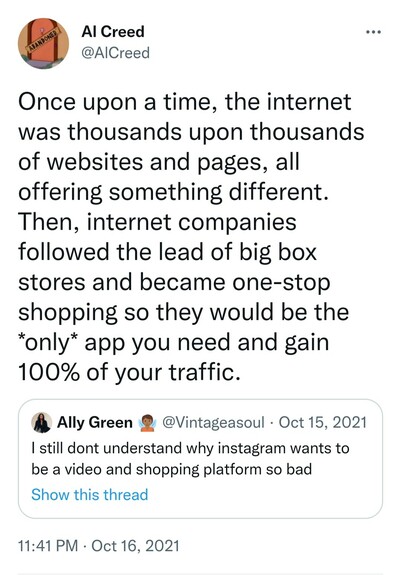
@adamconover About a year ago, when Facebook crashed, I had this same pining for the Internet of Yore.
 Max Woolf
@adamconover bring back internet forums
 Roupine
@adamconover but adaaaaaam now I have to have more taaabs opeennnnnn
 muttzarella
Agreed. I also have faith that the community will, in time, find ways to sand off many of the rough edges of the experience (see: browser extensions simplifying interaction with external instances)
 Óli Gneisti (English)
The thing you don't notice on Mastodon is that many users are not on Mastodon. The Fediverse is the important bit. Mastodon is just a tool.
 Derek Powazek 🐐
@adamconover Yes! May a million bars bloom. https://powazek.com/posts/3571

 John Mastodon
@fraying @adamconover Sounds like IRC
 endeavorance 🕊️
@adamconover The web as designed is decentralized and *in theory* is at its best when decentralized!
And the best part is we already have the technology we need to make that happen. The primary focus should be helping people learn those new ergonomics after an era of large tech companies defining the shape of the web.
I am excited.
Also, loved the G word! Glad to see you here.
 Vin
Vin@adamconover I think two things can be true, and in fact them both being true is what makes federation so important:
1. The public square being owned by one person is incredibly dangerous
2. A singular public square is important to have and beneficial to all
1. The public square being owned by one person is incredibly dangerous
2. A singular public square is important to have and beneficial to all
 Mike Pearson
@Grapevine @adamconover I agree in principle, but the world, and even regions may be too big for a single town square. It will be interesting to watch it evolve even though the ride may be rough.
 Alaric
@adamconover yes I’m finding all sorts of sites these days
 Benj Edwards
@adamconover I agree with this completely
 Galaxy Sailor
@adamconover For indy filmmakers looking to crowdfund it well be a nightmare. It's difficult to see it as a good thing in that respect.
 Will Myers
@adamconover yeah, okay, but for those fighting for freedom in Ukraine? China? Tigray? Centralization helped them, a lot.
 Nate Smith
@adamconover please don’t ruin Mastodon
 Jake in the desert
@adamconover absolutely THIS. Same with political parties. The more the better. Which is the MAIN problem here the USA since there's only two, really. Quite a case study so far 🙄
 Bill G (dadonymous)
@adamconover Quit trying to get me to see the bright side. I'm a pessimist, dangit!
 Sean
Sean@adamconover I'm conflicted on this. On the one hand, splintering means more competition and a chance for new ideas and features to flourish. On the other, it destroys discoverability. Lower discoverability can limit harassment, but it also means the market of independent artists, artisans, writers, devs, etc that have grown around Twitter will lose a crucial means of getting word out there. More niche communities will also have a harder time spreading news and info outside of existing circles.