The FTX hearing by the Senate Committee on Banking, Housing, and Urban Affairs starts shortly. I'll be livetooting it here, and will be publishing a recap of it in my newsletter later.

Hearing stream: https://banking.senate.gov/hearings/crypto-crash-why-the-ftx-bubble-burst-and-the-harm-to-consumers
Newsletter:https://newsletter.mollywhite.net/

I'll use the #FTXhearing hashtag throughout, so feel free to filter it out if I'm clogging your feed or you'd rather catch up later.

Crypto Crash: Why the FTX Bubble Burst and the Harm to Consumers | United States Committee on Banking, Housing, and Urban Affairs

The Official website of The United States Committee on Banking, Housing, and Urban Affairs

Statements by witnesses—Prof. Hilary Allen, Kevin O'Leary, Jennifer J. Schulp, and Ben McKenzie—have already been published at the link above.

#FTXhearing

Sen. Brown (D-OH) opens with a very critical statement, where he talks about Facebook's Libra project (shut down by gov't.) which he describes as a "shiny tool" to try to extract money from consumers.

#FTXhearing

"Crypto doesn't get a free pass because it's shiny and bright, or because venture capitalists think it might change the world." – Sen. Brown

Brown urges that this hearing is not just about FTX, but will focus on the crypto industry and consumer protection.

#FTXhearing

Sen. Toomey (R-PA) says largely the opposite to Brown, and echoes the crypto industry's line that we must separate FTX's wrongdoing from all this promise that supposedly exists in the industry.

#FTXhearing

"There's nothing intrinsically good or evil about software, it's about what people do with it... Code committed no crime..." – Sen. Toomey

😮‍💨

#FTXhearing

Toomey says some Senators have suggested "pausing cryptocurrency" while hearings go on.

#FTXhearing

The crypto industry clearly has a strong spokesperson and salesman in Senator Toomey.

#FTXhearing

Sen. Brown introduces the witnesses. Prof. Hilary Allen and Ben McKenzie Schenkkan (better known as Ben McKenzie) will be critical of crypto; Kevin O'Leary and Jennifer Schulp are both pro-crypto.

#FTXhearing

First up is Prof. Hilary Allen. Her statement is challenging crypto's claims they are decentralized. She has suggested that "a ban on crypto would be the most straightforward".

She says that if legislators are not willing to proceed with a ban, then they must be very careful not to enact laws that would make crypto "too big to fail".

#FTXhearing

Now Kevin O'Leary is up. He was a paid spokesman of FTX. He's listing his crypto entanglements, and talking them up 🙄

O'Leary echoes Toomey in his statements that Bitcoin "isn't a coin, it's software".

This is a recently popular argument, which seems to seek to lean on "code as speech" precedence.

#FTXhearing

O'Leary explains how HE will be the one to do the detective work on what happened at FTX.

#FTXhearing

He characterizes skeptics as "entrenched businesses" who "abhor competition".

#FTXhearing

Now Jennifer J. Schulp, who's in camp "this is an FTX problem, not a crypto problem". She's talking up defi.

#FTXhearing

She characterizes various regulatory suggestions from the crypto-critical as "taking technological choices out of people's hands."

#FTXhearing

"Risk is a natural component of markets, and failure is often necessary for development."

#FTXhearing

Now Ben McKenzie, who says the crypto industry depends on "misinformation, hype, and, yes, fraud".

#FTXhearing

McKenzie is outlining how he does not believe that cryptocurrencies are currencies, and how he believes that every cryptocurrency is a security.

#FTXhearing

"In my opinion, the cryptocurrency industry represents the largest Ponzi scheme in history." - McKenzie

Sen. Brown asks if this kind of fraud exists at other crypto firms.
Allen: Yes
O'Leary: Yes, at unregulated exchanges
Schulp: Most likely
McKenzie: It's endemic.

#FTXhearing

McKenzie outlining the cross-pollination between execs at online gambling and fraud enterprise Ultimate Bets and the crypto industry: Stuart Hoegner at Tether and Dan Friedberg at FTX

#FTXhearing

O'Leary not great at yes or no questions. He claims the comparison to gambling are outdated and like early comparisons of the stock market to gambling.

#FTXhearing

Sen. Toomey pushing back on McKenzie's claim that all cryptocurrencies—including Bitcoin—would be securities.

Not surprised there.

He's having Schulp make that argument for him.

#FTXhearing

The argument, a common one, is that Bitcoin is too decentralized to be classed as a security.

#FTXhearing

O'Leary outlines the potential for blockchains, saying that 1/3 of the MIT class wants to work in the crypto industry.

Maybe not the best argument given that SBF was an MIT grad...

#FTXhearing

O'Leary is blaming FTX's collapse on Changpeng Zhao (CZ) of Binance.

#FTXhearing

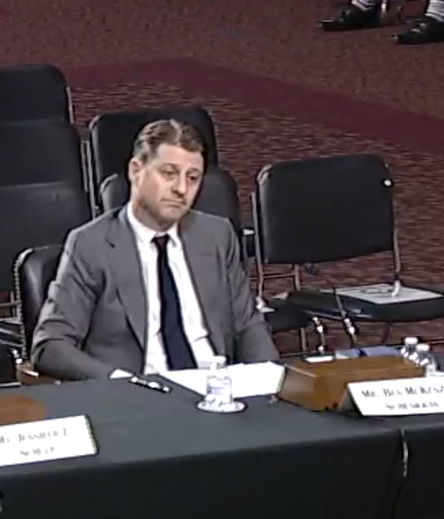
Ben McKenzie's soul leaving his body while O'Leary talks

#FTXhearing

Hilary Allen explains how "proof of reserves" and other crypto industry attestations don't replace proper auditing.

#FTXhearing

Allen also says that arguments that crypto needs to be regulated completely differently from existing systems because "it's decentralized" doesn't hold water, and explains how the Bitcoin software and mining pools are highly centralized.

#FTXhearing

Sen. Menendez (D-NJ) asks O'Leary if he might not have lost money if FTX had complied with existing regulations.

He says absolutely, but FTX wasn't regulated.

Compelling.

#FTXhearing

Sen. Menendez (D-NJ) is worried about the extent to which crypto might be integrated with traditional finance, adding contagion risk.

#FTXhearing

Mendendez asks McKenzie how we could combat the advertising.

McKenzie says we should use the right terminology, classify cryptos as securities, possibly treat crypto as gambling and restrict advertising, and require disclosures.

#FTXhearing

Sen. Tester (D-MT) opens with skepticism, asks Allen how her concerns expressed in front of the Senate last year have developed.

She expresses her gratefulness that banking regulators have largely siloed crypto, and limited FTX's explosion from affecting traditional finance.

#FTXhearing

But she expresses concerns over how crypto and traditional banking are increasingly intermingling, and she says we need to "firm up" the separation between the two.

#FTXhearing

"We have to think about how much of this we're willing to tolerate in the name of innovation." - Hilary Allen

Allen explains how the subprime mortgage crisis exposure was around $1.3T, and the reduction in the crypto industry "market cap" (which she also expresses skepticism about) was on that order, so if crypto and tradfi had not been segregated, its failure could've been catastrophic.

#FTXhearing

Sen. Tester asks if, had the two been closely coupled, the government might have had to bail out crypto like it had to bail out banks in 2008. Allen says yes.

#FTXhearing

O'Leary points to LedgerX as the "only entity that didn't go to zero" in the FTX collapse as proof that proper regulation could have protected FTX investors.

He conveniently ignores the other US-based entities involved the bankruptcy.

#FTXhearing

Sen. Hagerty (R-TN) is concerned about a "similar implosion by Binance", which he says would be catastrophic for the crypto industry and for consumers. Asks how US regulators could work with global regulators to bring transparency to Binance.

#FTXhearing

O'Learly: "In one phone call we could solve this problem"

my god, he's done it

#FTXhearing

Sen. Hagerty outlines ties he believes exist between Binance and the CCP, seems very concerned about that. Schulp decides to sidestep discussing those ties.

#FTXhearing

Sen. Warner (D-VA) is up. He's also concerned Binance and possible ties to the CCP.

Talks about the "clunkiness" of Bitcoin, lack of scalability, environmental cost.

#FTXhearing

Warner worries that "FTX is just the tip of the iceberg".

You and me both, my man.

#FTXhearing

@molly0xfff Thanks for live-tooting this.
@molly0xfff I feel like the quotes around innovation are missing.
@molly0xfff LOL. Crypto is not too big to fail, which is why it must be allowed to fail. It has always been 100% risk. We been tellin' y'all.
@molly0xfff Why don’t they treat it like the Ponzi Scheme it actually is?
@molly0xfff lol sounds like his account books were pretty decentralized, too.
@molly0xfff who cares about the knowing the reserves independent of their associated liabilities
@molly0xfff you chose this life brother

@molly0xfff

He’s staring at his future: endless sessions, hearings and trials.

Hell. Blockchain style.

He is not a happy man.

@molly0xfff I feel this man's feelings with every fiber of my being.
@molly0xfff I swear every episode of this Netflix series is more bananas than the last one
@molly0xfff then you can blame Binance collapse on FTX 😂
@molly0xfff haha, I’ll blame the 2008 financial crisis on the likes of Steve Eisman and Micheal Burry who made the unforgivable decision of noticing a financial bubble 🫧 Don’t look up
@molly0xfff there is a 0% chance this is true unless they had a really expansive push-poll wording on the question.
@molly0xfff It would be interesting to know why they want to work in that industry. If you removed the "possibility of getting lots of money from magic beans", how many would remain?
@loke @molly0xfff I think this is largely the reason. Smart college students want money. Film at 11.
@molly0xfff extremely curious how old that data is
@molly0xfff people with huge student loans surrounded by corporate doors want to get rich, news at 11
@molly0xfff 1/3 of MIT wants to work on scams. Neat
@molly0xfff But, and stick with me here... Is it fraud if all the cool kids want to do it?
@molly0xfff As an MIT grad, I am pressing X to doubt. I don't recall a whole graduating class *ever* being surveyed in a statistically trustworthy way. A push poll of an opportunity sample with heavy response bias? That, I could believe. One-third of an entire graduating class wanting to work in *any* single industry is sus.