Brilliant new paper by Naomi #Oreskes, concluding that "our overall situation suggests that it does not suffice for scientists simply to supply #factual #information, and leave it at that. Scientists need as well to engage actively with the recipients of that information." https://link.springer.com/article/10.1007/s43538-022-00121-1
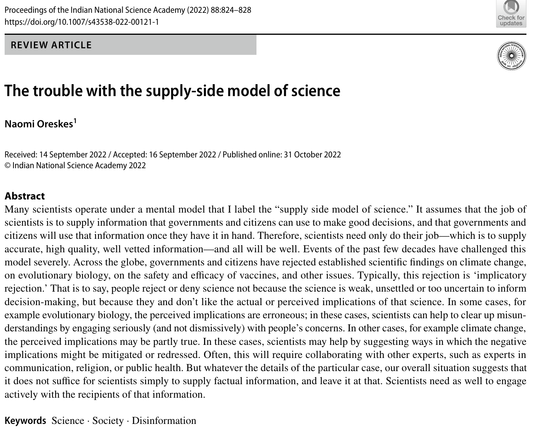
The trouble with the supply-side model of science - Proceedings of the Indian National Science Academy

Many scientists operate under a mental model that I label the “supply side model of science.” It assumes that the job of scientists is to supply information that governments and citizens can use to make good decisions, and that governments and citizens will use that information once they have it in hand. Therefore, scientists need only do their job—which is to supply accurate, high quality, well vetted information—and all will be well. Events of the past few decades have challenged this model severely. Across the globe, governments and citizens have rejected established scientific findings on climate change, on evolutionary biology, on the safety and efficacy of vaccines, and other issues. Typically, this rejection is ‘implicatory rejection.’ That is to say, people reject or deny science not because the science is weak, unsettled or too uncertain to inform decision-making, but because they and don’t like the actual or perceived implications of that science. In some cases, for example evolutionary biology, the perceived implications are erroneous; in these cases, scientists can help to clear up misunderstandings by engaging seriously (and not dismissively) with people’s concerns. In other cases, for example climate change, the perceived implications may be partly true. In these cases, scientists may help by suggesting ways in which the negative implications might be mitigated or redressed. Often, this will require collaborating with other experts, such as experts in communication, religion, or public health. But whatever the details of the particular case, our overall situation suggests that it does not suffice for scientists simply to supply factual information, and leave it at that. Scientists need as well to engage actively with the recipients of that information.
SpringerLink
@wolfgangcramer This is exactly why I favour STEAM rather than STEM. Science, Technology, Engineering, and Mathematics can mean so much more if their practitioners have studied some Arts. Without being able to communicate and empathize (English Lit/Languages), to think about ethics (Philosophy), to be able to contextualize (history), etc., a practitioner only reaches a limited audience.
@OSuxanna @wolfgangcramer
It was pointed out to me yesterday that STEAM and/or STREAM (Reading) is essentially, and simply, a liberal arts education.
@bradweed @wolfgangcramer
Perhaps, although I think of a liberal arts education as heavy on the arts with a science minor. I certainly know that I had to take a 'science' (mathematics) elective. STEAM would be a STEM degree with a good minor in a language, a philosophy perhaps, and a creative element.
@OSuxanna @wolfgangcramer I can see that happening. Probably depends on the major, the school, and the student. For example, my wife went to Bates (a prototypical liberal arts school) majoring in Mathematics with a minor in Computer Science. Her electives were mostly in Studio Art. She blended them with a career in computer graphics.
@bradweed @wolfgangcramer It occurs to me that I don't really understand what a liberal arts school is. All three of my universities had a wide spectrum of degrees/courses on offer.
@bradweed @wolfgangcramer And it would be possible to 'kill two birds with one stone' by taking music theory, e.g., as a more 'scientific/creative' elective. Theory is logic.
@wolfgangcramer strange to think that is adequate! scientists don't just generate facts, many pursue those facts with various PASSIONS. both obviously need to be passed on to public!
@wolfgangcramer
I am surprised that many consider this new considerations, following from recent events. This was already the result of the building of nuclear weapons by nuclear phycisists - ever since, at the latest, scientists have carried an undeniable responsibility for the knowledge they have, which is much more than making it available.
@W_Lucht I think I know quite some colleagues who would rather not agree with Oreskes' statements...
@wolfgangcramer @W_Lucht I'm one of them. Although I greatly value and appreciate the time and efforts many scientists invest in educating the public and campaigning for the right decision, I see the latter as a citizen's duty, not a scientist's. I am trained to assess scientific questions and compute uncertainties, but when it comes to weighing up societal pros and cons of policies, I cannot claim more authority than the average citizen. #science #politics (1/2)
@wolfgangcramer @W_Lucht When we engage in political campaigns with our scientist hat on, we run into the danger of losing impartiality, i.e., like in many political debates, cherry pick facts to convince others of our position. This is the high art of debating, but has no place in science and can bring science in discredit. Therefore, I would strongly advocate for leaving our scientist hats at home when we engage in political debates. (2/2)
@schymans @wolfgangcramer
The problem is: saying nothing is just as political, as consequential as taking responsibility for the knowledge we carry.
@wolfgangcramer
That's true, of course. It's as if the 20th century and all its discussions about the responsibility of scientists never happened. Of course the 20th century in Germany also shows the abyss opened when politicising science. But on an individual, personal level, the lesson remains: your knowledge comes with a responsibility to not avoid taking on the consequences.
@wolfgangcramer they need to engage actively with the recipients of the information, but also go into that conversation those recipients may not be acting in good faith. So many scientific projects now include stakeholder engagement, but few rigorously engage with the actual politics that define the stakeholders.
@wolfgangcramer @ProfJanRadford Absolutely correct! However scientists (individuals) are diverse like all fields and the key here is the statement around collaboration. To be a very talented scientist is rare, and to be a very good translator is rare. Both combined is extremely rare. We should not make people feel like they must be all things. Celebrate diversity with teamwork and collaboration and most DEFINITELY ensure that supply side engages demand!

@tasvo @wolfgangcramer @ProfJanRadford

Tas van Ommen, thank you so much for this comment!
Climate scientists are currently under a lot of pressure. We are expected to have to do it all: from providing novel scientific evidence to the whole spectrum of public engagement via communication and activism. This often goes beyond the talents of an individual.

@wolfgangcramer sounds like the information deficit model and really nothing new. An effect that is very common in hands on experience. Only because in academic circles a rather small groups is prepared to research and has honed skills to focus endless hours, does not mean that this is easily supplied or available in general population. It is a skill that is not transferable but needs to be learned volitionally. The bubble of academia is a bubble, too.
Sorry, is in GER
https://klimakommunikation.klimafakten.de/
Inhaltsverzeichnis - Klimafakten Handbuch

Wir haben genug Klimafakten, um endlich zu handeln. Offenbar aber brauchen Politik und Gesellschaft etwas anderes. Woran also fehlt es in der Debatte um Klimaschutz? Das erfahren Sie in diesem Handbuch. In jedem Kapitel finden Sie neben Tipps und Übungen auch eine Langversion als PDF zum Herunterladen und Schmökern. Das vollständige Handbuch (als gedrucktes Buch […]

Klimafakten Handbuch

@wolfgangcramer

I'm glad to see this discussion happening. This is something I always talk with fellow scientists about. That said, I don't know what the actual, real life, answer is.

If you're actually attempting to counter disinformation you're talking about setting up industry wide comms, and at that point who decides what points are pushed out aggressively? Which ones aren't? There's too much science done on a daily basis to pump it all out there beyond journals.

Does academia, government or commercial R&D decide what is worthy? Good and bad research comes out of each. It's a great discussion, but I have yet to see a great answer.

@wolfgangcramer I'm so tired of arguing this so it's great to see this! We must engage (and promote the people who are good at that). So much wrong with academia is due to the fact that we give positions based on very little and not at all on demonstrated ability to do the next job up.

@wolfgangcramer Cash et al wrote a piece on this back in 2006, too. Different angle on the same challenges. In hindsight though parts read as a bit naive now.

"Countering the Loading-Dock Approach to Linking Science and Decision Making"

https://doi.org/10.1177/016224390628754

@ConserveChange @wolfgangcramer I was thinking the same thing - the inadequacy of the loading dock, i.e., "supply side," model of science communication/provision has been raised for many years; see the extensive lit around co-production, transdisciplinarity, actionable science, boundary organizations, etc. Much has also been written on the role of advocacy in science. I appreciated Oreskes' point but was disappointed by the lack of acknowledgement of previous work and thought in this area.
@wolfgangcramer Is it only me or there is missing word(s) after "they" in "... but because they and don't like the actual or perceived implications of that science."?
@wolfgangcramer @Thomashegna I was just reading a piece about how the experts were completely surprised by the anti-vax movement, and I am completely surprised at how out of touch they are with influencer culture.
Pandemics and Public Engagement: Democracies vs Autocracies | Keynote World One Health Congress

YouTube
@wolfgangcramer YES! The need for knowledge co-production models of research and adequate resource and effort allocation to knowledge mobilization is obvious. But I struggle increasingly with how to effectively change policy or behaviour in response to my science.