 Wolfgang Cramer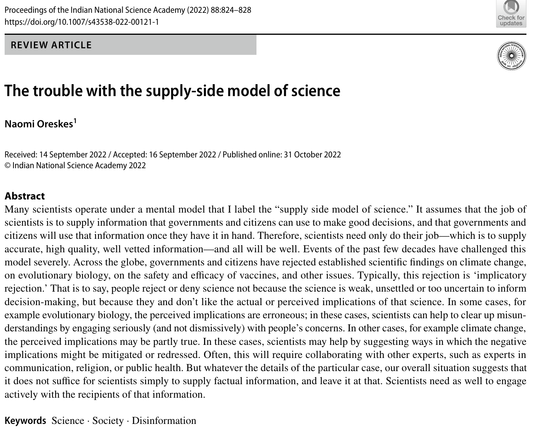

The trouble with the supply-side model of science - Proceedings of the Indian National Science Academy
Many scientists operate under a mental model that I label the “supply side model of science.” It assumes that the job of scientists is to supply information that governments and citizens can use to make good decisions, and that governments and citizens will use that information once they have it in hand. Therefore, scientists need only do their job—which is to supply accurate, high quality, well vetted information—and all will be well. Events of the past few decades have challenged this model severely. Across the globe, governments and citizens have rejected established scientific findings on climate change, on evolutionary biology, on the safety and efficacy of vaccines, and other issues. Typically, this rejection is ‘implicatory rejection.’ That is to say, people reject or deny science not because the science is weak, unsettled or too uncertain to inform decision-making, but because they and don’t like the actual or perceived implications of that science. In some cases, for example evolutionary biology, the perceived implications are erroneous; in these cases, scientists can help to clear up misunderstandings by engaging seriously (and not dismissively) with people’s concerns. In other cases, for example climate change, the perceived implications may be partly true. In these cases, scientists may help by suggesting ways in which the negative implications might be mitigated or redressed. Often, this will require collaborating with other experts, such as experts in communication, religion, or public health. But whatever the details of the particular case, our overall situation suggests that it does not suffice for scientists simply to supply factual information, and leave it at that. Scientists need as well to engage actively with the recipients of that information.
 Dr. OSuxanna Steele
 Brad Weed