Steven Manson

@Smmanson
126 Followers
371 Following
11 Posts
FOSS4G North America just got a mastodon account! I'm managing it and most of the social media for the upcoming conference. Please help me out by following https://fosstodon.org/@foss4gna if you're a fan of open source geospatial softare & in North America. #foss4gna
FOSS4GNA (@[email protected])

1 Post, 9 Following, 1 Follower · Connecting People, Places, and Geospatial Technology Join the community of data engineers, developers, managers, analysts, and all who love the location in Baltimore, MD, USA to learn, share, and break bread. This in-person event brings back the human relationships and opportunities of geospatial technology. https://foss4gna.org/
Fosstodon
WE'RE HIRING! We have 4 vacancies to work on our
@NERCscience
#NERCdsh. Do you have skills in #geospatial software engineering, user needs, business analysis or #environmentalanalytics? Visit our careers for links to apply. Deadline 14 April 2023. http://digital-solutions.uk/index.php/careers/
Careers - NERC Digital Solutions Programme

Digital Solutions Programme - current vacancies.

NERC Digital Solutions Programme

There's no Greenhouse #envhum book talk today - we're on holiday break. Here are book talks you can join in January 2023. Check links for start times.

16 Jan, Matt Henry, Hydronarratives: Water, Environmental Justice, & a Just Transition
shorturl.at/admuP

23 Jan, Christiaan De Beukelaer, Trade Winds: A Voyage to a Sustainable Future for Shipping shorturl.at/mvBMQ

30 Jan, Faizah Zakaria, The Camphor Tree & the Elephant: Religion & Ecological Change in Maritime SE Asia
shorturl.at/JVX01

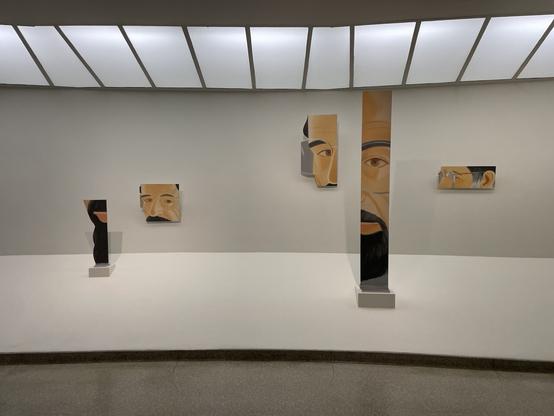
If I ever have my portrait painted (I can’t ever see that happening), I’d want it to look like Alex Katz’s fragmented portrait of Allen Ginsberg.
Integrating Stripe with BigQuery

One of the projects that I mentioned in my post a couple of weeks ago was the migration of our billing system to Stripe. Stripe is widely used for billing on the internet, in both SaaS and non-SaaS…

geoMusings
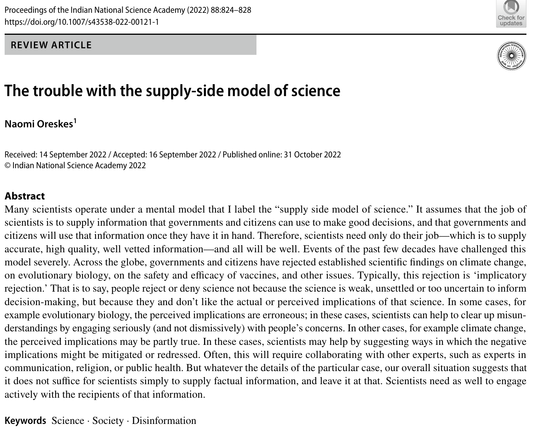
Brilliant new paper by Naomi #Oreskes, concluding that "our overall situation suggests that it does not suffice for scientists simply to supply #factual #information, and leave it at that. Scientists need as well to engage actively with the recipients of that information." https://link.springer.com/article/10.1007/s43538-022-00121-1
The trouble with the supply-side model of science - Proceedings of the Indian National Science Academy

Many scientists operate under a mental model that I label the “supply side model of science.” It assumes that the job of scientists is to supply information that governments and citizens can use to make good decisions, and that governments and citizens will use that information once they have it in hand. Therefore, scientists need only do their job—which is to supply accurate, high quality, well vetted information—and all will be well. Events of the past few decades have challenged this model severely. Across the globe, governments and citizens have rejected established scientific findings on climate change, on evolutionary biology, on the safety and efficacy of vaccines, and other issues. Typically, this rejection is ‘implicatory rejection.’ That is to say, people reject or deny science not because the science is weak, unsettled or too uncertain to inform decision-making, but because they and don’t like the actual or perceived implications of that science. In some cases, for example evolutionary biology, the perceived implications are erroneous; in these cases, scientists can help to clear up misunderstandings by engaging seriously (and not dismissively) with people’s concerns. In other cases, for example climate change, the perceived implications may be partly true. In these cases, scientists may help by suggesting ways in which the negative implications might be mitigated or redressed. Often, this will require collaborating with other experts, such as experts in communication, religion, or public health. But whatever the details of the particular case, our overall situation suggests that it does not suffice for scientists simply to supply factual information, and leave it at that. Scientists need as well to engage actively with the recipients of that information.

SpringerLink
@USpatial Yay!!!!